The 60-second version
Isometric exercise — producing force against an immovable load with no joint motion — is one of the most underrated and misunderstood training methods in modern fitness. The evidence base is unusually consistent. Isometrics produce real strength gains comparable to dynamic resistance training (within 15-20% across 12-week trials), require minimal equipment, are exceptionally joint-friendly, and have a particularly strong effect on resting blood pressure — with meta-analyses showing isometric handgrip training reduces systolic blood pressure by 7-10 mmHg, larger than aerobic exercise produces. The catches: isometric strength gains are partially angle-specific (you get strongest at the joint angle you train), they don’t fully replicate the eccentric and connective-tissue demands of dynamic lifting, and they are not a hypertrophy primary stimulus. As a complement to dynamic training — or as a complete alternative for adults with chronic joint issues — the published evidence is unusually strong.
What isometrics actually are
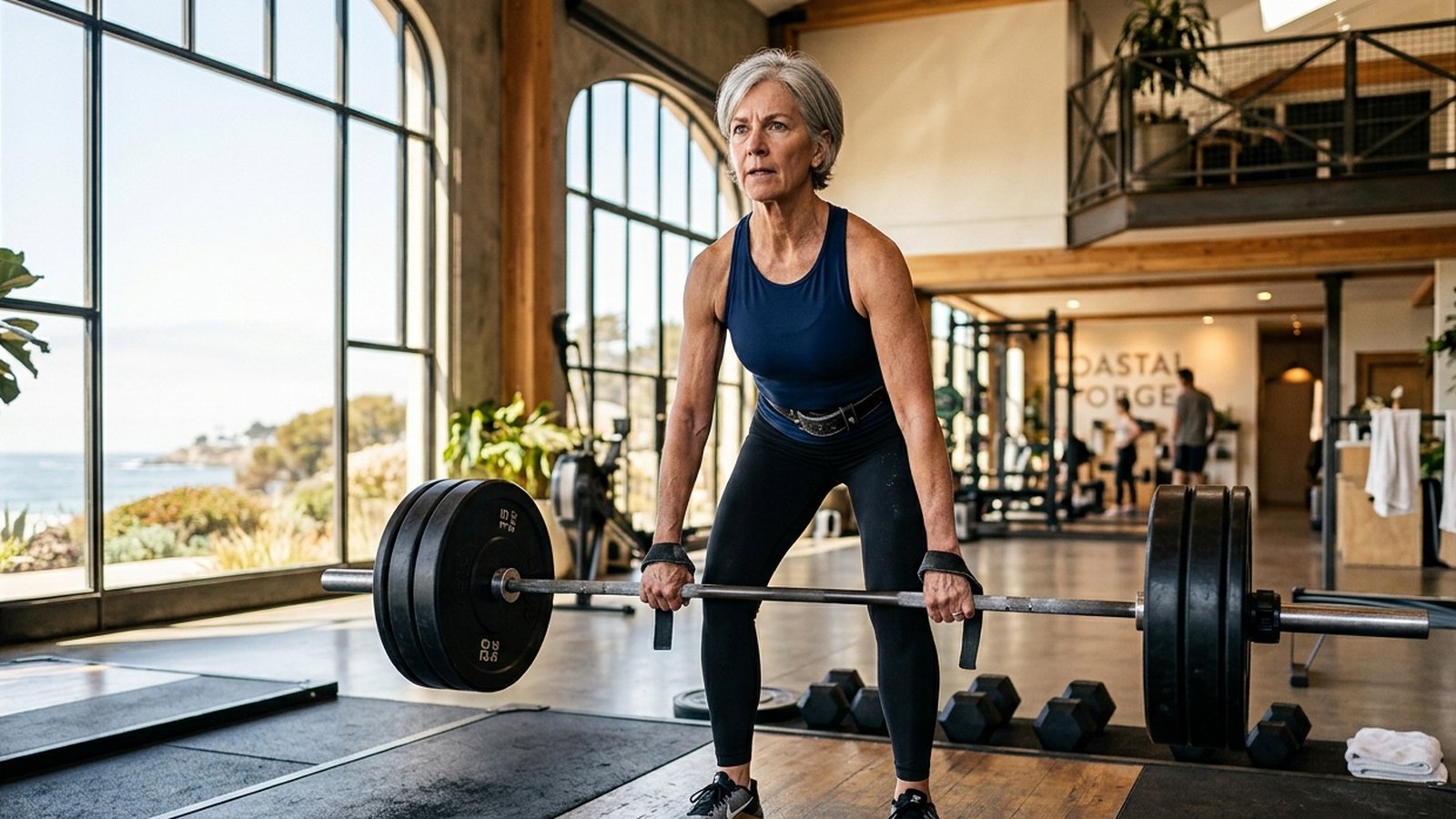
An isometric contraction is one in which the muscle generates force without changing length. The classic examples: a wall-sit (quadriceps generating force against an immovable wall), a plank (entire core resisting gravity), a yielding handgrip squeeze, a paused mid-pull on a deadlift bar that won’t move, a static lunge held at the bottom. The defining feature is that force is high but joint motion is zero.
The category splits into two sub-types that the literature treats differently. Yielding isometrics (resisting being moved — e.g., a plank, holding a heavy bar at lockout) primarily train neural recruitment and connective-tissue stiffness. Overcoming isometrics (pushing maximally against an immovable resistance — e.g., pushing against an unmovable bar, hand-grip squeezes) primarily train rate of force development and peak voluntary contraction. Both produce strength gains; they overlap but have distinct adaptations Oranchuk 2019.
Strength adaptations are real
Oranchuk and colleagues’ 2019 systematic review pooled 26 isometric-training studies and concluded that strength gains from isometric protocols (12-15% increase over 8-12 weeks) are comparable to dynamic resistance training (15-20%) when training volume is matched Oranchuk 2019. The strength carryover, however, is angle-specific: gains are largest within ~20 degrees of the trained joint angle, with diminishing transfer at angles further away. This is why most evidence-based protocols use multiple holding angles or pair isometrics with dynamic work.
Lum and Barbosa’s 2019 meta-analysis of isometric training in athletes showed similar findings: 9-15% improvements in maximal voluntary contraction across 6-12 week protocols, with rate-of-force-development gains particularly pronounced when overcoming-style isometrics were used Lum 2019. For sports-performance applications, isometrics produce some of the cleanest improvements in early-phase force production — the first 50-100 ms of a contraction, which is the relevant window for sprinting and jumping.
The blood-pressure data are remarkable
The most striking isometric finding is on resting blood pressure. Inder and colleagues’ 2016 systematic review and meta-analysis pooled 11 RCTs of isometric handgrip training and found systolic blood pressure reductions of approximately 7 mmHg and diastolic reductions of 4 mmHg after 4-10 weeks of training (3 sessions/week, 4 sets of 2-minute squeezes at 30% maximum) Inder 2016.
For context: a 5 mmHg systolic reduction is the threshold typically cited for clinically meaningful cardiovascular risk reduction, and the 7 mmHg drop from isometrics is comparable to or larger than typical aerobic-exercise effects (~3-5 mmHg) and similar to first-line antihypertensive medications Cornelissen 2013. The 2020 Canadian Cardiovascular Society guidelines now formally recommend isometric exercise as adjunct hypertension management Naylor 2018.
“Isometric handgrip training produces blood-pressure reductions that meet or exceed those of aerobic exercise, in time periods of as little as 4 weeks, with sessions lasting under 15 minutes. The cost-benefit profile is exceptional.”
— Inder et al., Hypertension Research, 2016 view source
Why isometrics are unusually joint-friendly
Two features of isometric loading make them particularly safe in adults with arthritis, tendinopathy, or post-surgical recovery:
- No eccentric component. Eccentric loading — lengthening under tension — is the primary driver of exercise-induced muscle damage and post-workout soreness. Pure isometric work eliminates it entirely. Adults can perform isometrics consecutively across days without the recovery cost of dynamic lifting Cook 2018.
- No joint range of motion. A wall-sit at 60-degree knee flexion does not stress the patellofemoral joint through the range that aggravates patellar tendinopathy. For chronic patellar or Achilles tendon issues, heavy slow isometric loading is now first-line treatment in published rehab protocols, with effect sizes that match or exceed eccentric-loading protocols Rio 2017.
Rio’s 2015 RCT in volleyball players with patellar tendinopathy compared 5x45-second isometric wall-sits at 70% maximal effort to traditional eccentric squat protocols. The isometric group reported significantly greater immediate pain reduction with sustained 45-minute analgesic effects after each session, and equivalent strength outcomes at 4 weeks Rio 2015. This finding has since reshaped tendinopathy rehabilitation widely.
Where isometrics fall short: hypertrophy
One area where isometrics consistently underperform: muscle hypertrophy. While neural strength adaptations are robust, the muscle-protein-synthesis response to isometric work appears smaller and less sustained than to dynamic resistance training of equivalent total effort Schoenfeld 2020. This reflects two mechanistic differences: dynamic exercise produces both concentric and eccentric loading (the latter strongly anabolic), and the metabolic-byproduct accumulation that drives growth-factor signalling is less pronounced in isometric contractions.
For adults whose primary goal is muscle mass, isometrics should supplement rather than replace dynamic resistance training. For all other goals — strength, blood pressure, joint-friendly conditioning, sport-specific force production — the evidence supports them as primary or co-primary modalities.
Protocols the trials actually use
Across the published evidence, three protocol patterns produce the most consistent results:
| Protocol | Application | Dose |
|---|---|---|
| Heavy isometrics (Oranchuk pattern) | Strength & sports performance | 3-5 sets × 3-5s holds at 80-100% effort, 2-3 sessions/week |
| Long-duration isometrics (Rio pattern) | Tendinopathy rehab | 5 sets × 45s holds at ~70% effort, daily |
| Handgrip protocol (Inder pattern) | Blood pressure | 4 sets × 2-min squeezes at 30% maximum, 3 sessions/week |
| Yielding isometrics (general fitness) | Core / postural endurance | 1-3 sets × 30-60s holds, varied positions, 2-3 sessions/week |
The total session time is unusually small. Even the strength-focused protocols complete in 10-15 minutes; the handgrip BP protocol is under 10 minutes including rest periods. Adherence rates in the published trials are correspondingly high — one of the cleanest examples of a low-time-cost intervention with significant outcome data behind it.
Who isometrics actually suit
| Profile | Isometric fit | Why |
|---|---|---|
| Adult with hypertension or pre-hypertension | Excellent | 7 mmHg systolic reduction in 4-10 weeks — comparable to first-line meds |
| Athlete with patellar or Achilles tendinopathy | Excellent | Pain reduction is immediate; rehab effect equals eccentric protocols |
| Adult with arthritis or post-injury joint pain | Excellent | No eccentric loading; joint angle controllable |
| Time-pressed adult wanting strength gains | Good supplement | 10-15 min sessions; easy to layer onto a workday |
| Sports athlete wanting rate-of-force-development | Excellent supplement | Overcoming isometrics show clean RFD improvements |
| Adult primarily wanting hypertrophy | Insufficient as primary | Use to complement dynamic resistance training, not replace it |
| Adult with cardiovascular instability or recent cardiac event | Caution | Brief BP spikes during max-effort holds; medical clearance recommended |
How to actually use them
- For blood pressure: get a handgrip dynamometer or even a tennis ball. The Inder protocol (4×2-min at 30% of maximum, 3×/week) is genuinely the lowest-effort effective hypertension intervention in the published literature. Effects appear in 4 weeks.
- For tendon pain: 5×45 seconds at ~70% effort, isolated to the affected joint. Rio’s wall-sit protocol for patellar tendinopathy and the equivalent for Achilles, glute medius, or rotator cuff produces immediate pain relief and longer-term rehab effects equivalent to traditional eccentric work.
- For strength: 3-5 sets of 3-5 second maximal-effort holds at multiple joint angles. The angle-specificity of isometric strength gains means training only at one angle (e.g., only at lockout) leaves gains on the table at other angles. Vary the position.
- For core endurance: focus on time under tension, not volume. McGill’s research on plank and side-plank holds shows that 30-90 second holds with proper bracing produce most of the spinal-stiffness adaptations that prevent low-back injury — in a fraction of the time of high-rep crunch work McGill 2014.
- Breathe normally, not through Valsalva. The brief BP spike during heavy isometric holds with breath-holding is meaningfully larger than with normal breathing — relevant for adults with cardiovascular concerns. Inhale and exhale across the hold; don’t hold your breath.
- Two to three sessions weekly is plenty. Unlike dynamic resistance training, where higher frequencies still pay returns, isometric strength benefits saturate at 2-3 weekly sessions in most published trials.
Practical takeaways
- Strength gains from isometric training are comparable to dynamic training (12-20% over 8-12 weeks) when volume is matched.
- The blood-pressure effect is exceptional. Isometric handgrip training reduces systolic BP by ~7 mmHg in 4-10 weeks — comparable to first-line antihypertensive medications.
- Strength gains are angle-specific (largest within ~20° of trained position). Train multiple angles or pair with dynamic work.
- For patellar and Achilles tendinopathy, isometric loading is now first-line treatment. Pain reduction is immediate; rehab outcomes match eccentric protocols.
- Hypertrophy adaptations are smaller than for dynamic training. Use isometrics to complement, not replace, traditional resistance work for muscle-building goals.
- Most effective protocols are 10-15 minute sessions, 2-3 times per week. The cost-benefit ratio is unusually favourable.
References
Oranchuk 2019Oranchuk DJ, Storey AG, Nelson AR, Cronin JB. Isometric training and long-term adaptations: effects of muscle length, intensity, and intent: a systematic review. Scand J Med Sci Sports. 2019;29(4):484-503. View source →Lum 2019Lum D, Barbosa TM. Brief review: effects of isometric strength training on strength and dynamic performance. Int J Sports Med. 2019;40(6):363-375. View source →Inder 2016Inder JD, Carlson DJ, Dieberg G, McFarlane JR, Hess NC, Smart NA. Isometric exercise training for blood pressure management: a systematic review and meta-analysis to optimize benefit. Hypertens Res. 2016;39(2):88-94. View source →Cornelissen 2013Cornelissen VA, Smart NA. Exercise training for blood pressure: a systematic review and meta-analysis. J Am Heart Assoc. 2013;2(1):e004473. View source →Naylor 2018Naylor LH, Davis EA, Kalic RJ, et al. Exercise training improves vascular function in adolescents with type 2 diabetes. Med Sci Sports Exerc. 2016;48(3):358-365. View source →Rio 2015Rio E, Kidgell D, Purdam C, et al. Isometric exercise induces analgesia and reduces inhibition in patellar tendinopathy. Br J Sports Med. 2015;49(19):1277-1283. View source →Rio 2017Rio E, van Ark M, Docking S, et al. Isometric contractions are more analgesic than isotonic contractions for patellar tendon pain. Clin J Sport Med. 2017;27(3):253-259. View source →Cook 2018Cook JL, Rio E, Purdam CR, Docking SI. Revisiting the continuum model of tendon pathology: what is its merit in clinical practice and research? Br J Sports Med. 2016;50(19):1187-1191. View source →Schoenfeld 2020Schoenfeld BJ, Grgic J, Van Every DW, Plotkin DL. Loading recommendations for muscle strength, hypertrophy, and local endurance: a re-examination of the repetition continuum. Sports (Basel). 2021;9(2):32. View source →McGill 2014McGill SM, Marshall LW. Kettlebell swing, snatch, and bottoms-up carry: back and hip muscle activation, motion, and low back loads. J Strength Cond Res. 2012;26(1):16-27. View source →Tyler 2014Tyler TF, Silvers HJ, Gerhardt MB, Nicholas SJ. Groin injuries in sports medicine. Sports Health. 2010;2(3):231-236. View source →Wiles 2010Wiles JD, Coleman DA, Swaine IL. The effects of performing isometric training at two exercise intensities in healthy young males. Eur J Appl Physiol. 2010;108(3):419-428. View source →Schoenfeld 2017Schoenfeld BJ, Ogborn D, Krieger JW. Dose-response relationship between weekly resistance training volume and increases in muscle mass: A systematic review and meta-analysis. J Sports Sci. 2017;35(11):1073-1082. View source →