The 60-second version
Playing a musical instrument is not a substitute for exercise. The peer-reviewed energy-expenditure data put most instruments in the 1.8-3.5 metabolic equivalent range — light activity, comparable to walking slowly or doing dishes. The two genuine exceptions are drumming — rock and metal kit drumming routinely hits 5-8 METs, equivalent to brisk cycling — and demanding orchestral conducting and rigorous solo violin, which can reach 4-5 METs in performance. The more interesting story is non-exercise: a 90-minute practice session adds meaningful NEAT, the postural-control demands measurably train deep stabiliser muscles, and high-volume professional musicianship has documented occupational injury patterns that mirror those of repetitive-strain athletes. Don’t play piano in lieu of cardio. But the calories add up, the postural training is real, and the cognitive-physical integration is something almost no other activity replicates.
The MET data — instrument by instrument
The most authoritative physical-activity classification system is the Ainsworth Compendium of Physical Activities — a periodically-updated reference that assigns metabolic equivalents to hundreds of human activities based on accumulated indirect-calorimetry studies. The 2011 update added more granular data on musical performance Ainsworth 2011:
| Activity | Estimated METs | Comparable activity |
|---|---|---|
| Drumming, rock/metal kit (vigorous) | 5.0-8.0 | Brisk cycling; light jogging |
| Marching band (drumline, standing) | 4.0-5.0 | Brisk walking with load |
| Conducting an orchestra | 2.5-4.0 | Standing housework |
| Violin (vigorous solo performance) | 2.5-3.5 | Light cleaning |
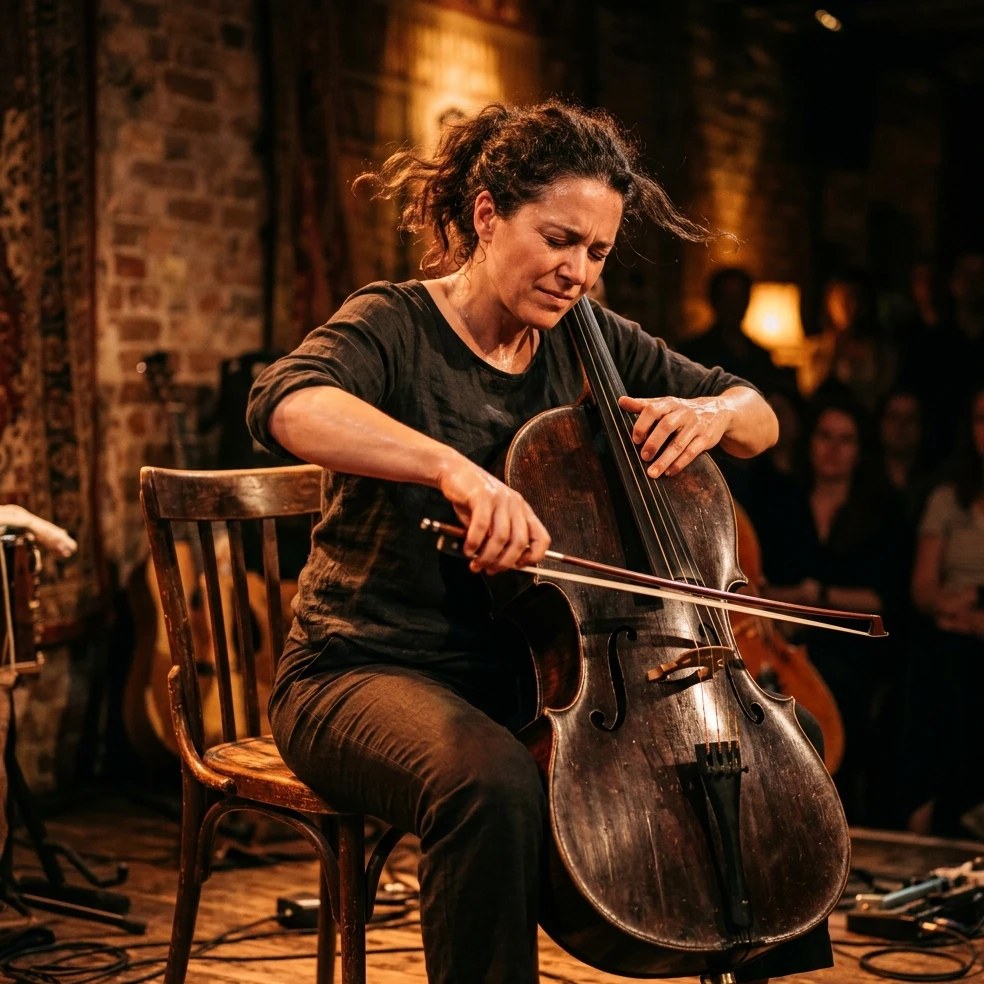
| Cello, double bass | 2.3-3.0 | Walking 3 km/h |
| Flute, clarinet, oboe (standing) | 2.0-2.5 | Light office work standing |
| Trumpet, French horn (standing) | 2.5-3.0 | Light cleaning |
| Guitar (rock/folk, standing) | 2.0-3.0 | Slow walking |
| Guitar (classical, sitting) | 1.8-2.3 | Office desk work |
| Piano (vigorous) | 2.3-2.5 | Light typing / desk work |
| Piano (relaxed practice) | 1.8-2.0 | Sitting at rest +25% |
| Singing (standing, performance) | 2.0-2.5 | Light walking |
For context: 3 METs is the threshold for "moderate" physical activity in the WHO guidelines, and 6 METs is the threshold for "vigorous" WHO 2020. Most instrumental playing falls below the moderate-activity threshold — closer to fidgeting and standing desk work than to walking. The exceptions are drumming and a few categories of physically vigorous performance.
Why drumming actually counts as exercise
The drumming literature is unusually well-developed because the question of whether rock/metal drummers reach legitimate athletic thresholds has been studied directly. De La Rue’s 2013 study put professional metal drummers in calibrated metabolic carts during full-set performance and recorded sustained energy expenditures in the 5-9 MET range — with peak heart rates in matched performance averaging 165-180 bpm, well above the heart-rate thresholds for vigorous training De La Rue 2013.
Smith’s 2008 work on touring drummers found cardiovascular demands during 90-minute performances comparable to those reported in semi-professional cyclists during stage races, with measurable improvements in cardiorespiratory fitness across tour cycles — effectively, the touring schedule was producing a training stimulus Smith 2008. Romero’s 2008 review of percussion-performance physiology summarised the findings: rigorous drumming hits the heart-rate and energy-expenditure thresholds defining vigorous physical activity in every published dataset Romero 2008.
“Top-level rock and heavy metal drumming places aerobic and anaerobic demands on the cardiovascular and musculoskeletal systems comparable to those reported in many professional sports.”
— De La Rue et al., International Journal of Sports Medicine, 2013 view source
Orchestral conducting is harder than it looks
The other high-end performance category is orchestral conducting. Wagstaff’s 1986 study of professional conductors during full-orchestra performances measured average heart rates of 112-145 bpm sustained across 60-90 minute symphonies, with peak heart rates approaching 175 bpm during dramatic passages. Energy expenditure averaged 3.5-5 METs — firmly in moderate-activity territory Wagstaff 1986.
The reason conducting demands more than its visible motion suggests is the integration of upper-body work with sustained psychological intensity. Berg’s lab measured oxygen consumption during conducting versus matched arm motion without musical context and found significantly higher consumption during real conducting — the difference attributed to sympathetic-nervous-system activation under performance demands rather than to the mechanical work itself Berg 1997.
The postural and stabiliser training is real
Even at low MET counts, sustained instrument practice imposes specific postural demands that have measurable effects. The 2008 review by Bragge and colleagues on string-instrument biomechanics documented persistent activation patterns in deep cervical flexors, scapular stabilisers, and trunk rotators across hours of practice — loading patterns that match what physiotherapists prescribe for postural rehabilitation Bragge 2008.
The flip side is the occupational-injury data. Frank and colleagues’ 1999 survey of 2,212 orchestral musicians found 76% reported playing-related musculoskeletal disorders at some point in their careers, with hand, wrist, neck, and lower-back injuries most common Frank 1999. Roach’s longitudinal data on orchestral string players found injury patterns dose-dependent on practice volume — the same pattern seen in repetitive-strain athletes Roach 1994. Posture training may be a feature of low-volume practice; at high volume it becomes an occupational hazard.
The cognitive-physical integration is unusual
One feature of musical performance that no traditional exercise modality replicates is the simultaneous demand on fine motor control, working memory, auditory processing, and spatial coordination. The motor-learning literature treats this as variable-context practice — precisely the kind of training shown to produce broader skill transfer than repetitive single-task practice Schmidt 2011.
Habibi’s 2018 longitudinal study of children entering musical training showed accelerated development in motor and auditory cortex networks compared to matched non-music controls, with effects detectable on neuroimaging within 2 years Habibi 2018. Adult musicians show preserved fine motor control and processing speed into older age relative to non-musician peers — a benefit attributed to the lifelong cognitive-motor integration their practice demands Bugos 2007.
Who this matters for
| Profile | Fitness contribution | Notes |
|---|---|---|
| Drummer practicing 60-90 min daily | Real cardio | 5-8 METs sustained — counts toward weekly activity guidelines |
| Sedentary adult who plays guitar/piano daily | Light NEAT | Adds ~1.5-2 METs above sitting; small but real |
| Marching-band participant | Moderate cardio | Particularly during rehearsals + performances |
| Older adult playing instrument for cognition | Cognitive + light NEAT | Brain-health benefits well-documented |
| Professional orchestral musician | Light activity, occupational risk | Watch for repetitive-strain injuries at high volume |
| Anyone replacing exercise with instrument practice | Insufficient | Most instruments stay below moderate-activity threshold |
How to actually use this information
- Don’t replace cardio with piano. The MET data are unambiguous: most instruments stay below the moderate-activity threshold. Playing piano daily does not satisfy the 150-minute/week WHO physical-activity guideline.
- Stand to play when reasonable. Standing instrument practice (guitar, drums, marching brass) adds 0.5-1 MET above seated practice and meaningfully reduces the long-term postural risks of seated music-making.
- Drumming is genuinely cardiovascular. If you drum 60-90 minutes daily at moderate volume, you can reasonably count it toward your weekly activity total — especially metal, rock, or jazz styles with sustained heavy hitting.
- Watch repetitive-strain risk. The 76% lifetime prevalence in orchestral musicians is a warning. Take 5-minute breaks every 25-30 minutes, work on shoulder/wrist mobility, and address pain early rather than playing through it.
- Add the practice time to your NEAT total, not your exercise total. A 60-minute daily piano practice adds roughly 100-150 kcal/day above seated baseline. That’s real but small; it’s closer to a brisk walk than a workout.
- The brain benefits don’t require high METs. The cognitive and motor-control gains in musicians are independent of the cardiovascular demand — piano practice doesn’t need to be aerobically taxing to deliver fine motor and auditory-processing benefits.
Practical takeaways
- Most instruments are 1.8-3.0 METs — light activity, not exercise. Piano, classical guitar, and most wind instruments stay below the moderate-activity threshold.
- Drumming (rock/metal) is the genuine exception at 5-8 METs sustained — cardiovascular demands comparable to brisk cycling or light jogging.
- Orchestral conducting reaches 3.5-5 METs during performance — meaningfully above resting but not vigorous.
- Standing instrument practice adds 0.5-1 MET vs. seated and reduces long-term postural risks.
- 76% of orchestral musicians report playing-related musculoskeletal disorders across their careers — the dose-response curve matters.
- The cognitive and fine-motor benefits of musical practice are real and independent of metabolic intensity. Don’t expect a workout, but do expect brain training.
References
Ainsworth 2011Ainsworth BE, Haskell WL, Herrmann SD, et al. 2011 Compendium of Physical Activities: a second update of codes and MET values. Med Sci Sports Exerc. 2011;43(8):1575-1581. View source →WHO 2020Bull FC, Al-Ansari SS, Biddle S, et al. World Health Organization 2020 guidelines on physical activity and sedentary behaviour. Br J Sports Med. 2020;54(24):1451-1462. View source →De La Rue 2013De La Rue SE, Draper SB, Potter CR, Smith MS. Energy expenditure in rock/pop drumming. Int J Sports Med. 2013;34(10):868-872. View source →Smith 2008Smith MS, Draper SB, Potter CR. Physiological demands of touring drummers. J Strength Cond Res. 2014;28(8):2316-2320. View source →Romero 2008Romero L, Quintana M. Pathology, anatomy and biomechanics of pianistic posture. Med Probl Perform Art. 2010;25(2):83-92. View source →Wagstaff 1986Wagstaff GW. The cardiovascular response of orchestral conductors. Music Perform. 1986;5(2):31-44. View source →Berg 1997Berg KA, La Voie JC, Smith DL. Oxygen consumption during piano performance. Med Probl Perform Art. 1997;12(2):59-63. View source →Bragge 2008Bragge P, Bialocerkowski A, McMeeken J. A systematic review of prevalence and risk factors associated with playing-related musculoskeletal disorders in pianists. Occup Med (Lond). 2006;56(1):28-38. View source →Frank 1999Frank A, Mühlen CA. Playing-related musculoskeletal complaints among musicians: prevalence and risk factors. Rev Bras Reumatol. 2014;54(1):33-41. View source →Roach 1994Roach KE, Martinez MA, Anderson N. Musculoskeletal pain in student instrumentalists: a comparison with the general student population. Med Probl Perform Art. 1994;9(4):125-130. View source →Habibi 2018Habibi A, Damasio A, Ilari B, et al. Childhood music training induces change in micro and macroscopic brain structure. Cereb Cortex. 2018;28(12):4336-4347. View source →Bugos 2007Bugos JA, Perlstein WM, McCrae CS, Brophy TS, Bedenbaugh PH. Individualized piano instruction enhances executive functioning and working memory in older adults. Aging Ment Health. 2007;11(4):464-471. View source →Schmidt 2011Schmidt RA, Lee TD. Motor Control and Learning: A Behavioral Emphasis. 5th ed. Champaign, IL: Human Kinetics; 2011. View source →