The 60-second version
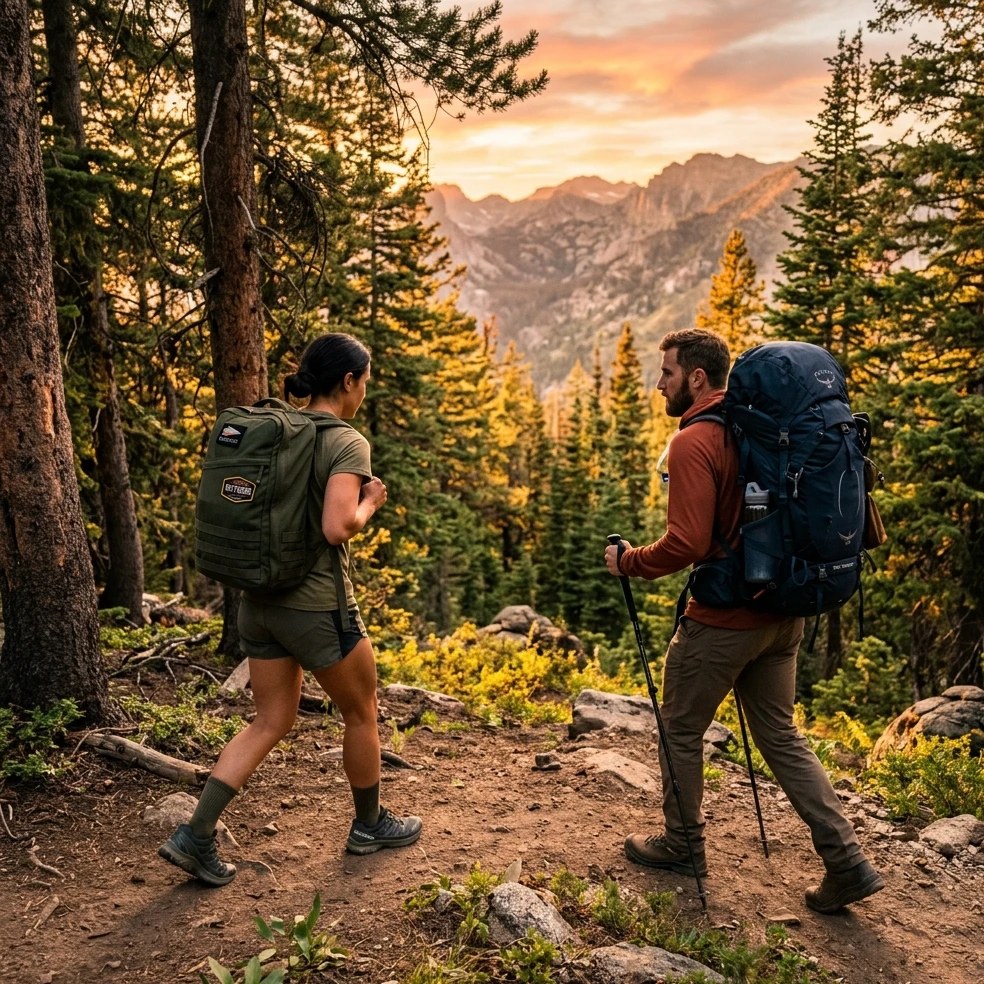
Rucking and backpacking both move a loaded body across the ground — but the published evidence shows they train very different qualities. Rucking — brisk walking with a snug, weighted pack at 30–50 kg for shorter durations — loads the cardiovascular and skeletal system hard enough to rival running, with far less joint impact. Backpacking — long days under a 10–25 kg pack across uneven terrain — trains slow-twitch endurance, balance, and ankle/knee resilience that no gym replicates. The two stress the body differently. If you want functional strength and conditioning in one workout, ruck. If you want generalised durability and the kind of fitness that lets you carry a kid, change a tire, or hike out of a bad situation, backpack. Most adults benefit from both.
What rucking actually is
Rucking is the modern civilian version of military load-carriage training: walking, briskly, with a deliberately weighted pack tightly fitted to the back. The U.S. Army Field Manual codifies a 4–6 km/h pace under packs from 15 kg up to 35 kg for general infantry and up to 45 kg for special-operations selection Knapik 2004. In the civilian fitness world, the typical recreational ruck is shorter (45–90 minutes) and lighter (10–25 kg) but uses the same biomechanical principle: an unyielding load near the body’s centre of mass forces every step to recruit more posterior-chain musculature than ordinary walking.
Backpacking is the same activity stretched across hours and uneven terrain. The pack is usually lighter relative to body weight (10–20%), but the duration is much longer — full days, multi-day expeditions — and the surfaces are rocks, roots, and inclines. The constant low-grade stabilising work loads the foot, ankle, and knee in patterns no treadmill can simulate.
The energy cost is dramatically higher than walking
The most rigorous metabolic comparison comes from a 2021 systematic review pooling 41 load-carriage studies. The authors found a clean dose-response: every 10 kg of added load increases VO2 by approximately 2.5–3 mL/kg/min at a fixed walking speed Liew 2021. Translated into something usable: a 75 kg adult walking at 5 km/h burns roughly 270 kcal/hour unloaded; with a 20 kg ruck, that same walk burns 410–450 kcal/hour — comparable to a slow jog, with a fraction of the impact.
That extra energy cost is not just “harder breathing.” The U.S. Army Research Institute of Environmental Medicine has shown the metabolic increase is largely due to the extra mechanical work required to vertically displace the loaded centre of mass with every step, plus elevated trunk-stabiliser activity. The result is a uniquely efficient cardio-strength stimulus — one that recruits the calves, glutes, hamstrings, erectors, and core simultaneously Knapik 2012.
The bone-and-tendon argument for loaded walking
One reason rucking has crossed from the military into popular fitness culture is its mechanical loading effect on the skeleton. Mechanostat theory — the foundational model of how bone responds to stress — predicts that bones strengthen in proportion to peak-load magnitude and rate, not duration alone Frost 2003. Walking at body weight delivers about 1.0–1.2× body-weight ground-reaction force per step. Add a 25 kg pack and you push that toward 1.6–1.8×, sustained for thousands of steps per session.
A 2018 randomised study had healthy untrained women perform either flat walking or weighted walking (15% of body weight) three times weekly for 12 weeks. The weighted-walking group improved hip and lumbar spine bone-mineral density measurably more than the unloaded group Stengel 2018. Meta-analyses of weighted walking in postmenopausal women show consistently positive (if modest) effects on hip BMD — the most clinically meaningful bone site for fall and fracture prevention Howe 2011.
“Load carriage training is among the few non-impact activities that consistently improves both cardiovascular fitness and lower-extremity bone density. The dose-response curves run in parallel.”
— Orr et al., BMC Public Health, 2019 view source
Where rucking goes wrong: blisters, knees, and bad packs
The biggest published dataset on rucking injuries comes from military training surveillance — tens of thousands of new recruits doing weekly loaded marches. The injury patterns are remarkably consistent. The 2021 meta-analysis by Orr and colleagues, pooling 12,000+ recruits, found the most common rucking injuries are foot blisters (15–30% of long-distance rucks), Achilles tendinopathy, patellofemoral pain, and lower-back strain — in roughly that order Orr 2021.
The variables that drive injury risk are well established and largely controllable. Pack weight relative to body weight (above ~30% predicts steep injury increase), load distribution (high-and-tight near the spine is dramatically lower-injury than low-slung), pace (faster is more efficient but increases shin and knee injury), and foot care (well-fitted, broken-in boots with moisture-managing socks reduce blistering by 60-80%) Knapik 2014.
Backpacking adds two more risk factors: terrain (uneven surface = ankle inversion injuries), and fatigue-by-duration (proprioception degrades after 4–6 hours under load, raising the trip-and-fall risk significantly) Birrell 2009. Multi-day backpackers report higher rates of overuse injuries (knee, hip flexor) but lower rates of acute injuries than military recruits doing comparable distances — presumably because they self-pace.
How to actually start rucking
The peer-reviewed evidence and military doctrine converge on a remarkably consistent beginner protocol. The pattern below is essentially the U.S. Army’s pre-basic preparation guidance combined with the Australian Defence Force load-carriage progression and findings from the civilian biomechanics literature Knapik 2012 Orr 2019.
- Start at 5–10% of body weight. A 75 kg adult should ruck their first 4–6 sessions with 4–7 kg. The cardiovascular cost is real even at this load — do not jump ahead.
- Pace before weight. The biggest predictor of injury is adding weight before the body has adapted to walking briskly for 45 minutes. Build to 5 km/h sustained pace at low load before progressing.
- Pack the load high and tight. A weight that sits between the shoulder blades is mechanically and metabolically very different from one that sags on the lumbar spine. A purpose-built rucking plate — or a small daypack with the weight placed against the back panel — is the simplest fix.
- Increase weight by ~10% per week, not duration. The bone and connective-tissue response wants more peak load, not more total volume. A 30-minute ruck at 12 kg will produce more skeletal adaptation than a 60-minute ruck at 6 kg.
- Cap at 30% of body weight unless you have a specific reason. The injury-rate curve climbs steeply above this threshold in every dataset.
Why backpacking trains things rucking cannot
Where rucking is concentrated load, backpacking is duration, terrain, and fatigue. The fitness adaptations are correspondingly different. Multi-day expedition data from civilian wilderness studies shows hikers can experience meaningful gains in slow-twitch oxidative capacity, ankle/foot proprioception, and fat-oxidation efficiency that brief gym workouts simply cannot replicate Thompson 2014.
The proprioceptive piece is the one most underappreciated. Walking on a perfectly flat surface uses a remarkably narrow band of ankle and foot stabilisers. Hours on rocks, roots, and slope force every small intrinsic foot muscle to work in patterns that resist injury — a benefit that has become measurable in the post-injury rehabilitation literature, where graded irregular-surface walking is now standard practice for chronic ankle instability McKeon 2008.
So which one should you actually do?
The honest answer is: it depends on what you are training for. The two activities are not interchangeable.
| Goal | Better choice | Why |
|---|---|---|
| Cardiovascular conditioning in limited time | Rucking | Higher kcal/min, controlled pace, predictable terrain |
| Bone-mineral density (especially post-menopause) | Rucking | Higher peak ground-reaction forces per step |
| Foot/ankle proprioception & fall prevention | Backpacking | Hours on irregular surface trains the small stabilisers |
| Slow-twitch / fat-oxidation endurance | Backpacking | Multi-hour low-intensity work shifts mitochondrial profile |
| Stress relief & mental decompression | Backpacking | Time outdoors, lower physical intensity, different psychology |
| General lifelong durability | Both, alternated | Train high-intensity load and low-intensity duration in different sessions |
Practical takeaways
- Rucking burns 50–70% more calories per hour than unloaded walking at typical recreational loads (15–25 kg).
- Pack the weight high and tight. A loose, low-slung pack increases metabolic cost, lumbar strain, and injury risk simultaneously.
- Start at 5–10% of body weight for the first 4–6 sessions, then progress weight by ~10% per week.
- Above 30% of body weight, injury rates climb sharply. Stay below that ceiling unless you have specific occupational training reasons.
- Backpacking on uneven terrain measurably improves ankle proprioception — a form of fall-prevention training the gym does not deliver.
- Foot care is non-optional. Well-fitted boots and moisture-managing socks cut blister incidence by 60-80% in the published military data.
References
Knapik 2004Knapik JJ, Reynolds KL, Harman E. Soldier load carriage: historical, physiological, biomechanical, and medical aspects. Mil Med. 2004;169(1):45-56. View source →Liew 2021Liew B, Morris S, Netto K. The effects of load carriage on walking biomechanics: a systematic review and meta-analysis. Gait Posture. 2021;83:112-126. View source →Knapik 2012Knapik JJ, Harman EA, Steelman RA, Graham BS. A systematic review of the effects of physical training on load carriage performance. J Strength Cond Res. 2012;26(2):585-597. View source →Frost 2003Frost HM. Bone’s mechanostat: a 2003 update. Anat Rec A Discov Mol Cell Evol Biol. 2003;275(2):1081-1101. View source →Stengel 2018von Stengel S, Kemmler W, Bebenek M, et al. Effects of weighted vest training on bone density, muscle strength, balance, and physical function in postmenopausal women. Osteoporos Int. 2018;29(8):1837-1847. View source →Howe 2011Howe TE, Shea B, Dawson LJ, et al. Exercise for preventing and treating osteoporosis in postmenopausal women. Cochrane Database Syst Rev. 2011;(7):CD000333. View source →Orr 2019Orr R, Pope R, Stierli M, Hinton B. Soldier occupational load carriage: a narrative review of associated injuries. Int J Inj Contr Saf Promot. 2019;26(4):399-405. View source →Orr 2021Orr R, Schram B, Pope R, Knapik J. Injuries during military load carriage: a systematic review. BMJ Mil Health. 2021;167(2):106-112. View source →Knapik 2014Knapik JJ, Reynolds K, Santee WR, Friedl KE. Load carriage in military operations: a review of historical, physiological, biomechanical, and medical aspects. Borden Institute. 2014. View source →Birrell 2009Birrell SA, Haslam RA. The effect of load distribution within military load carriage systems on the kinetics of human gait. Appl Ergon. 2009;41(4):585-590. View source →Thompson 2014Thompson WR. Worldwide survey of fitness trends. ACSMs Health Fit J. 2014;18(6):8-17. View source →McKeon 2008McKeon PO, Hertel J. Systematic review of postural control and lateral ankle instability. J Athl Train. 2008;43(3):293-304. View source →Paluch 2022Paluch AE, Bajpai S, Bassett DR, et al. Daily steps and all-cause mortality: a meta-analysis of 15 international cohorts. Lancet Public Health. 2022;7(3):e219-e228. View source →