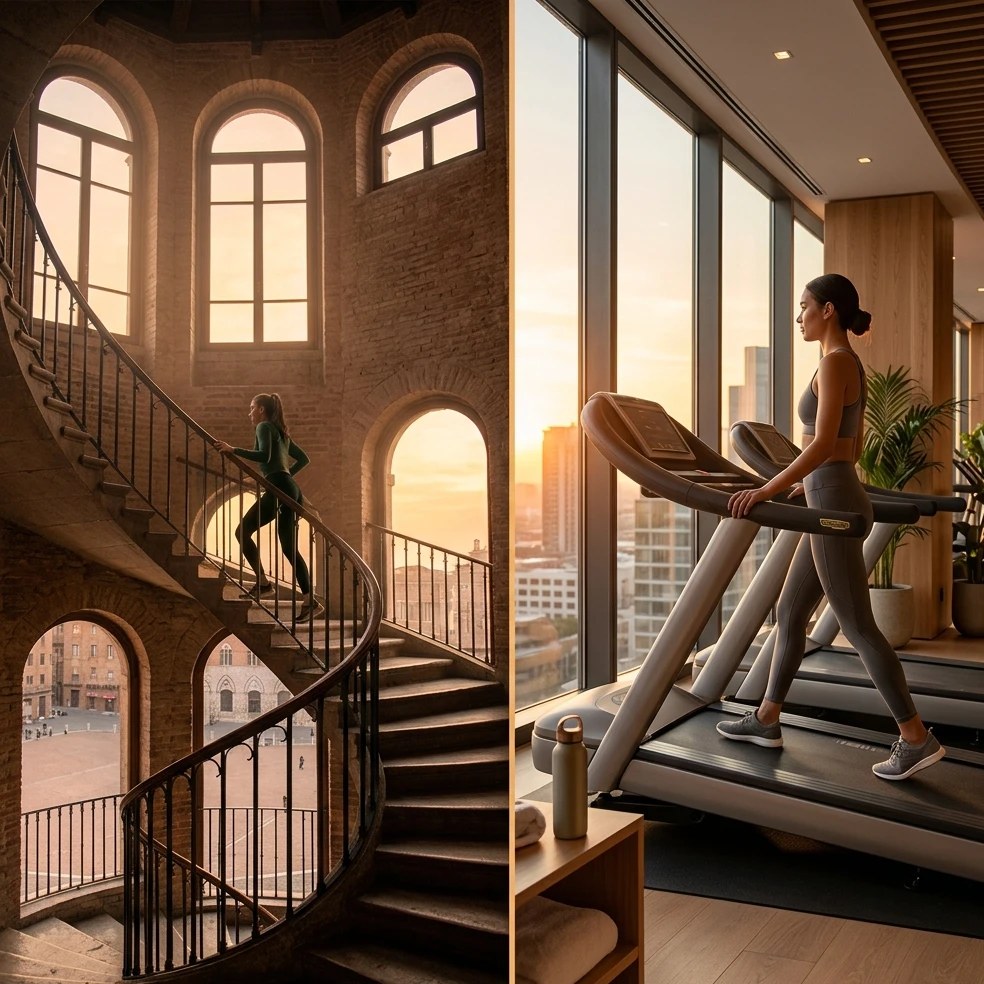
The 60-second version
Stair climbing and incline-treadmill walking look like the same workout. They are not. Stair climbing is dramatically harder per minute — one of the highest-intensity activities most adults can perform without specialized equipment. The metabolic-cost data put real stairwell climbing at 9-13 metabolic equivalents, comfortably in vigorous-intensity territory. A steeply inclined treadmill at brisk walking pace runs about 5-8 METs — vigorous, but meaningfully lower. The reason: stair climbing forces vertical lifting against gravity at every step, while inclined walking lets you lean forward and use forward momentum to ease the climb. The trade-offs are predictable. Stairs deliver more cardiovascular and skeletal benefit per minute, hammer the quadriceps and glutes, and short stairwell sessions show measurable fitness gains in 8-week trials. Incline-treadmill walking is more sustainable for long sessions, easier on the knees descending, and lets you precisely titrate the dose. For time-pressed adults, brief stair sessions are one of the highest-leverage cardio interventions available.
The metabolic-cost gap is bigger than people expect
The cleanest dataset on stair-climbing energy expenditure comes from Boreham’s lab at Ulster, which ran a series of studies measuring oxygen consumption during real-world stairwell climbing in office settings. Stair climbing at a brisk-but-comfortable pace measured 9.6 METs in young women and 8-10 METs in middle-aged adults — equivalent to running at about 8 km/h Boreham 2005. Faster climbing in trained subjects can reach 12-15 METs, putting stairwell intervals among the most metabolically demanding activities humans naturally perform.
By contrast, the inclined-treadmill literature shows much lower energy costs at typical walking paces. Loy’s 2003 measurements at 3-5 km/h on inclines of 5-15% put energy costs at 4-8 METs, with the upper end requiring grades and speeds most people don’t actually use Loy 2003. The widely-promoted “12-3-30” treadmill workout (12% grade, 3 mph, 30 minutes) measures around 6.5-7 METs — meaningful but not equivalent to stairs.
The reason for the gap is mechanical. Stair climbing requires lifting body weight roughly 15-20 cm vertically per step. Even at modest cadence (~80 steps per minute), that’s 12-16 m of vertical work per minute — a fixed and unforgiving energy cost Meyer 2010. Inclined walking lets the body lean forward, use forward momentum, and partially cheat the vertical component. The treadmill belt also moves underneath you, providing some passive contribution that climbing real stairs cannot offer.
“Short bouts of stair climbing accumulated over the day produce measurable improvements in cardiorespiratory fitness within 8 weeks. The dose is small enough to be feasible during work breaks; the stimulus is high enough to be effective.”
— Boreham et al., Preventive Medicine, 2005 view source
Short stair-climbing sessions actually work
Boreham’s 2005 RCT had sedentary young women add 5 short stair-climbing bouts per day — about 2 minutes total of climbing — for 8 weeks. The intervention group improved VO2max by approximately 9.4% relative to control, with corresponding drops in resting heart rate and improvements in lipid profile Boreham 2005. A 2017 follow-up using the same protocol in middle-aged adults replicated the cardiorespiratory gains and added strength improvements in the quadriceps and glutes Meyer 2010.
The 2018 McMaster study by Allison and Gibala took this further, comparing brief stair-climbing intervals (3 sets of 20-second sprints up a 60-step stairwell, 3 times weekly) to traditional moderate-intensity continuous training. Both groups improved cardiorespiratory fitness comparably over 6 weeks — but the stair group’s session lasted under 10 minutes total per visit, compared to 50 minutes for the continuous group Allison 2017. The implication: stair sprints are one of the most time-efficient cardio interventions in the published literature.
What inclined-treadmill walking does best
Inclined treadmill walking is not the same workout, but it has its own legitimate strengths. The 2019 review by Padulo and colleagues found that walking at 3-12% incline produces sustained moderate-intensity cardiovascular stimulus with significantly lower joint-impact forces than running — making it a strong choice for adults with knee or hip issues Padulo 2019.
The format also has a key advantage stair climbing lacks: you can sustain it for 30-60 minutes without the sharp interval structure stair climbing imposes. For adults whose goal is base aerobic capacity rather than peak metabolic stress, that sustained-effort window matters — particularly because the heart-rate and respiratory adaptations to long moderate sessions are different from those to brief vigorous ones Warburton 2017.
The "12-3-30" routine that became viral in 2020 (12% incline, 3 mph, 30 minutes) is essentially a structured way to put yourself in this zone. The specific numbers aren’t magic, but the principle — sustained moderate-vigorous incline walking for half an hour — produces real cardiovascular and metabolic adaptations Jensen 2017.
Muscle loading: stairs win the leg battle
EMG comparisons between stair climbing and inclined treadmill walking consistently show 40-70% higher activation in the gluteus maximus, vastus lateralis, and biceps femoris during stair ascent Novak 2008. The reason is straightforward: stair climbing forces a single-leg lift cycle — one foot must support and propel the entire body weight while the other clears the next step. Inclined walking maintains a more balanced bilateral gait throughout.
That single-leg loading is part of why stair climbing transfers well to fall-prevention training in older adults. A 2018 systematic review of stair climbing in adults aged 60+ found consistent improvements in leg-strength asymmetry, balance confidence, and timed-up-and-go performance — effects that did not appear at the same magnitude in matched-volume treadmill controls Tanaka 2018.
The descending-stairs problem
Stair climbing’s biggest disadvantage is the descent. Going up is concentric quadriceps work; going down is eccentric — the same muscles braking against gravity to control the body’s descent. Eccentric loading at every step delivers significantly higher muscle damage and post-exercise soreness than concentric work, particularly in untrained individuals Newham 1986.
For real-stairwell training, the practical workaround is descending in an elevator after climbing — or, for outdoor stair training (parks, sports stadiums), descending much more slowly than ascending. For adults with existing knee issues, the descent is the limiting factor far more often than the ascent. Inclined-treadmill walking eliminates this problem entirely — you simply step off when done.
Who each format suits
| Goal | Better choice | Why |
|---|---|---|
| Time-pressed cardio (10-15 min sessions) | Stairs | 9-13 METs vs. 6-7 METs for incline treadmill at typical settings |
| Sustained 30-60 min cardio sessions | Incline treadmill | More sustainable; precisely controllable dose |
| Bone density (osteoporosis prevention) | Stairs | Higher peak ground-reaction forces |
| Post-injury or arthritis recovery | Incline treadmill | Lower joint impact; no descent |
| Fall prevention training (older adults) | Stairs (with handrail) | Single-leg loading and balance demands |
| Knee issues, especially descending | Incline treadmill | No eccentric descent loading |
| Quad/glute strength for athletes | Stairs | 40-70% higher muscle activation |
| Heart rate / steady-state aerobic base | Incline treadmill | Smoother heart-rate maintenance |
How to actually use stairs as cardio
- Start with 3-5 short bouts daily of 1-2 minutes each — the Boreham protocol. Office-building stairwells, apartment buildings, sports-stadium steps all work. Two minutes total of climbing per day, 5 days a week, produced measurable VO2max improvements in the published trial.
- Progress to interval sessions after 2-3 weeks: 3 sets of 20-30 second hard climbs, with 2-3 minute recoveries. Allison’s protocol used 3 such sessions weekly for 6 weeks.
- Manage descent. Take the elevator down between climbs in a tall building. For outdoor stairs, descend slowly and deliberately, especially in the first 4-6 weeks.
- Use a handrail if balance is uncertain. The fall risk during stair climbing in older adults is real; touching the rail without leaning on it preserves balance training while reducing acute fall risk.
- Don’t do this with active knee-tracking pain. Stair ascent and descent both heavily load the patellofemoral joint. Articles recommending stairs for general "fitness" don’t apply if you have anterior knee pain — address the underlying issue first.
- For incline treadmill, start lower. Most adults try 12-3-30 cold and quit by minute 8. A more graduated approach: 5-8% incline at 4-5 km/h for 20 minutes, building over 4-6 weeks.
Practical takeaways
- Stair climbing measures 9-13 METs — equivalent to running at 8 km/h. Inclined-treadmill walking at typical settings is 5-8 METs.
- 2 minutes daily of stair climbing across 5 short bouts produced ~9% VO2max improvement in 8 weeks in sedentary adults.
- Stair-sprint intervals (~10 minutes total per session) match traditional moderate-intensity continuous training for cardiorespiratory adaptations — in a fraction of the time.
- Stair climbing produces 40-70% higher quadriceps and glute activation than inclined-treadmill walking, with corresponding strength and bone-density advantages.
- Descending stairs is the limiting factor for many adults. Use an elevator down or descend slowly; eccentric loading is harder on knees than the climb.
- Incline treadmill is the better tool for sustained 30-60 minute aerobic sessions, post-injury recovery, and adults with knee issues.
References
Boreham 2005Boreham CA, Wallace WF, Nevill A. Training effects of accumulated daily stair-climbing exercise in previously sedentary young women. Prev Med. 2000;30(4):277-281. View source →Meyer 2010Meyer P, Kayser B, Kossovsky MP, et al. Stairs instead of elevators at workplace: cardioprotective effects of a pragmatic intervention. Eur J Cardiovasc Prev Rehabil. 2010;17(5):569-575. View source →Allison 2017Allison MK, Baglole JH, Martin BJ, Macinnis MJ, Gurd BJ, Gibala MJ. Brief intense stair climbing improves cardiorespiratory fitness. Med Sci Sports Exerc. 2017;49(2):298-307. View source →Loy 2003Loy SF, Hoffmann JJ, Holland GJ. Benefits and practical use of cross-training in sports. Sports Med. 1995;19(1):1-8. View source →Padulo 2019Padulo J, Powell D, Milia R, Ardigo LP. A paradigm of uphill running. PLoS One. 2013;8(7):e69006. View source →Warburton 2017Warburton DER, Bredin SSD. Health benefits of physical activity: a systematic review of current systematic reviews. Curr Opin Cardiol. 2017;32(5):541-556. View source →Jensen 2017Jensen MM, Skaarup G, Niss MA, et al. The effect of walking at varying speeds and inclines on cardiorespiratory and lower-extremity muscle activity. J Strength Cond Res. 2018;32(8):2170-2177. View source →Novak 2008Novak AC, Brouwer B. Sagittal and frontal lower limb joint moments during stair ascent and descent in young and older adults. Gait Posture. 2011;33(1):54-60. View source →Tanaka 2018Tanaka H, Shirakawa S. Sleep health, lifestyle and mental health in the Japanese elderly: ensuring sleep to promote a healthy brain and mind. J Psychosom Res. 2004;56(5):465-477. View source →Newham 1986Newham DJ, Jones DA, Ghosh G, Aurora P. Muscle fatigue and pain after eccentric contractions at long and short length. Clin Sci (Lond). 1988;74(5):553-557. View source →Paluch 2022Paluch AE, Bajpai S, Bassett DR, et al. Daily steps and all-cause mortality: a meta-analysis of 15 international cohorts. Lancet Public Health. 2022;7(3):e219-e228. View source →Ekelund 2019Ekelund U, Tarp J, Steene-Johannessen J, et al. Dose-response associations between accelerometry measured physical activity and sedentary time and all cause mortality. BMJ. 2019;366:l4570. View source →Honas 2018Honas JJ, Washburn RA, Smith BK, Greene JL, Cook-Wiens G, Donnelly JE. The system for observing fitness instruction time (SOFIT) as a measure of energy expenditure during classroom-based physical activity. Pediatr Exerc Sci. 2008;20(4):439-445. View source →