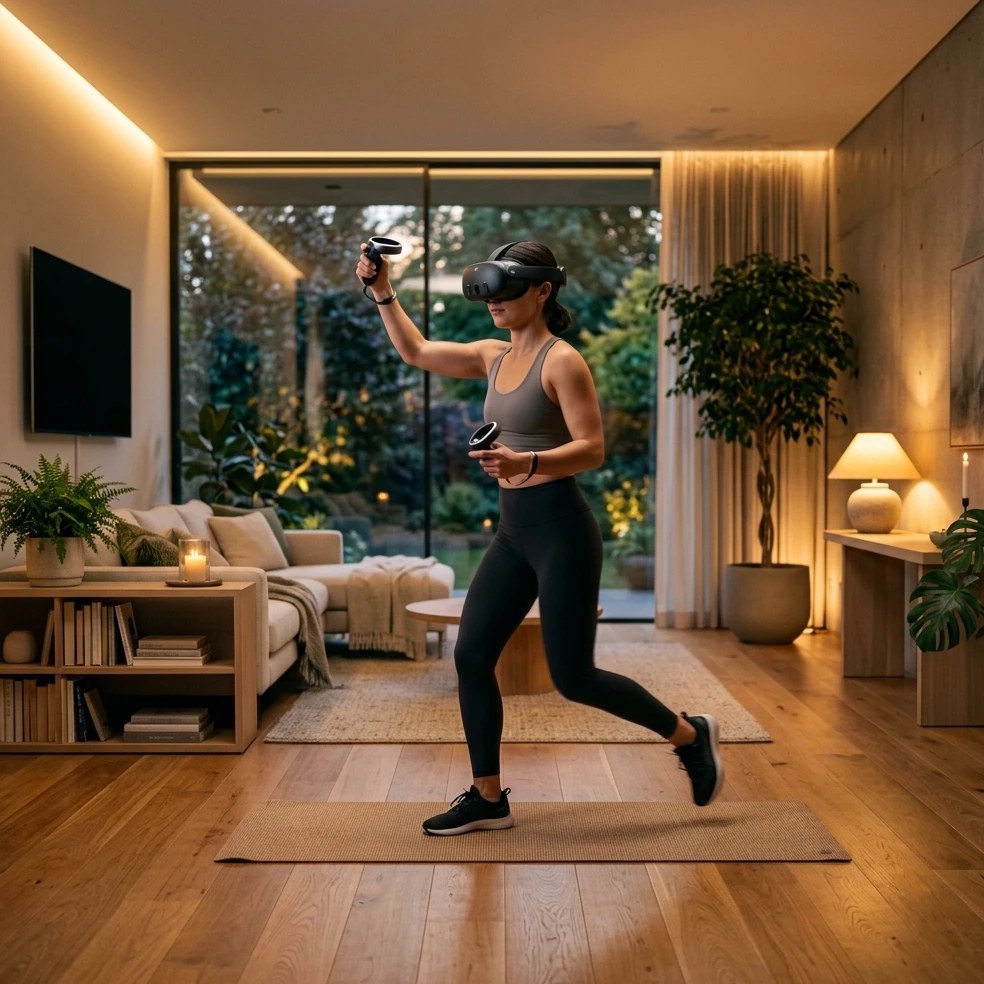
The 60-second version
VR rhythm games like Beat Saber are not gimmicks. Independent metabolic-cost studies put well-played sessions at 6–9 metabolic equivalents — the same energy cost as singles tennis, doubles soccer, or a 9-minute-mile jog. Heart rates routinely run 130–160 bpm. The systematic reviews of exergaming — active video games more broadly — conclude that this category produces moderate-intensity physical activity in children, adults, and older populations, with adherence rates that consistently exceed traditional treadmill or stationary-bike workouts in matched comparisons. The catches: motion-sickness rules out perhaps 15-25% of users, room space and equipment costs are real, and the upper-body bias of most VR titles means lower-body work is light. As cardio for adults who don’t enjoy traditional cardio, the evidence is surprisingly strong. As a sole fitness solution, it falls short.
What "active VR gaming" actually means
The category covers two overlapping things. First, traditional exergaming — motion-controlled games on consoles like the Wii (2006), Kinect (2010), Just Dance, Ring Fit Adventure (2019). Second, modern VR fitness — standing/standing-and-moving games on headsets like the Meta Quest, including Beat Saber, Supernatural, FitXR, Synth Riders, Pistol Whip, Holopoint, and Eleven Table Tennis. The two categories share the relevant property: physical movement is the input mechanism for play.
The peer-reviewed literature on exergaming has accumulated since around 2010. The VR-specific literature lagged because consumer VR was niche until ~2019, then exploded with the Quest 2 launch and the COVID-era home-fitness boom. Both literatures converge on similar findings.
The metabolic-cost data are real
The cleanest measurements come from VR Health Institute and academic labs that put participants in calibrated metabolic carts during VR play. The classification system uses METs. Roughly:
| Game | Measured METs | Equivalent activity |
|---|---|---|
| Beat Saber (advanced/expert) | ~6.5-9 | Singles tennis; jogging |
| Supernatural Boxing | ~7-10 | Light boxing training |
| FitXR HIIT class | ~6-8 | Group-fitness HIIT class |
| Synth Riders | ~5-7 | Brisk dancing; doubles tennis |
| Pistol Whip | ~5-7 | Brisk walking + lunges |
| Just Dance (high difficulty) | ~5-7 | Aerobic dance class |
| Wii Sports tennis | ~3-4 | Light walking |
| Ring Fit Adventure | ~4-6 | Body-weight circuit training |
For context, the World Health Organization defines “moderate” physical activity as 3-6 METs and “vigorous” as ≥6 METs WHO 2020. A 30-minute Beat Saber session at advanced difficulty is solidly in the vigorous range — equivalent to a brisk run for energy expenditure. Independent metabolic measurements have been published by Bird et al. and McDonough et al., both replicating the Beat Saber findings Bird 2018 McDonough 2020.
“The energy expenditure during full-immersion VR rhythm gaming meets or exceeds the threshold for vigorous physical activity in healthy young adults. The cardiovascular and perceptual responses are comparable to traditional moderate-to-vigorous training.”
— Polechoński et al., BioMed Research International, 2020 view source
What the systematic reviews conclude
The exergaming evidence base is now mature enough to support multiple meta-analyses. Peng and colleagues’ 2011 systematic review of 41 studies found exergames produced light-to-moderate physical activity in healthy populations, with significant variability based on game intensity and player engagement Peng 2011. Their 2013 follow-up review concluded that active video games could meaningfully contribute to meeting daily activity guidelines for both children and adults Peng 2013.
The 2020 Yoo systematic review focused specifically on VR-based exercise found moderate-quality evidence that VR exercise produces fitness improvements comparable to traditional exercise modalities across cardiovascular endurance, balance, and cognitive function in adults Yoo 2020. Mehrabi’s 2020 meta-analysis of exergaming for older adults pooled 33 trials and concluded the format produced significant improvements in balance, gait, and quality of life — with adherence rates that significantly exceeded matched control interventions Mehrabi 2020.
The real argument is adherence
The reason exergaming and VR fitness matter is not because they are better exercise than running — they aren’t — but because people actually do them. Lyons and colleagues’ 2014 review of active video game adherence found 12-week adherence rates of 70-90% for exergaming protocols, compared to typical 40-60% adherence for traditional aerobic-exercise prescriptions in similar populations Lyons 2014.
The adherence advantage compounds over time. A 2019 randomised trial assigned overweight adults to either VR exergaming or treadmill walking for matched durations, 3 sessions/week for 12 weeks. Both groups improved cardiorespiratory fitness, but the VR group reported significantly higher enjoyment and lower perceived exertion at matched heart rates — a pattern consistent across studies and consistent with the “flow state” sometimes invoked to explain it Bock 2019.
Motion sickness is the real limit
The single biggest constraint on VR fitness adoption is cybersickness — the nausea, disorientation, or eye strain experienced when the visual system disagrees with the vestibular system. Stanney’s 2020 review of cybersickness incidence across modern VR platforms estimated 15-25% of users experience symptoms severe enough to limit use, with women and adults over 50 disproportionately affected Stanney 2020.
The good news: most rhythm and fitness games (Beat Saber, FitXR, Supernatural) use stationary or short-locomotion mechanics that minimise motion-sickness triggers. Cybersickness is dramatically more common in games with smooth artificial locomotion (open-world adventure games) than in “teleport-only” or stationary fitness titles. Adaptation also occurs — sensitivity decreases substantially over the first 4-6 sessions for most users.
What VR fitness cannot do
Three honest limits:
- Lower-body work is minimal. Most VR fitness titles are upper-body dominant — arm swings, blocks, punches, slashes. Squats and lunges are integrated into a few titles (Ring Fit, FitXR HIIT) but the loading is light. VR will not replace serious leg training.
- Strength and hypertrophy are out of scope. The resistance is nil (or trivial, for handheld controllers). VR fitness is purely a cardiovascular and movement-quality stimulus. Adults wanting muscle still need progressive resistance work.
- Headset weight is a real fatigue factor. Sessions over 30-45 minutes with current consumer headsets create neck strain in some users. The hardware is improving but is not yet ergonomic for hour-plus daily use.
Who VR fitness actually helps most
| Profile | VR fitness fit | Why |
|---|---|---|
| Sedentary adult who finds traditional cardio boring | Excellent | Adherence advantage is large; mortality benefit substantial in this population |
| Children/teenagers with screen-time concerns | Excellent | Reframes screen time as activity time; meta-analyses support meaningful PA gains |
| Adults with weather/scheduling barriers | Excellent | Indoor, on-demand, doesn’t require commute |
| Older adults wanting balance + cognition training | Good | Mehrabi 2020 meta-analysis supports balance/gait/QoL gains |
| Athletes seeking primary cardio | Insufficient | VR cardio matches a brisk jog — doesn’t reach high-end aerobic stimulus |
| Anyone with vestibular issues / migraine history | Caution | Cybersickness susceptibility is meaningfully higher |
| Adults wanting strength/hypertrophy | Insufficient as primary | No meaningful resistance load |
How to actually start
- Choose a stationary or near-stationary fitness title first. Beat Saber, Supernatural, FitXR, and Pistol Whip are the most cybersickness-friendly entry points and have the strongest cardiovascular evidence behind them.
- Start at 15-20 minute sessions. Even users who tolerate VR fine often misjudge how hard they’re working. Heart rates hit 140-160 BPM faster than in traditional cardio.
- Set up the play space properly. 2.5×2.5 m of clearance, no rugs that can shift, no fragile objects within arm-and-controller range. The single most-common VR-fitness injury is hitting furniture during enthusiastic play.
- Use a sweat-management strategy. A microfibre cover for the headset facial interface, a sweatband, and a towel. The intensity is real and the headset becomes a sponge without these.
- Layer it with strength and lower-body work. Two VR cardio sessions weekly + two resistance sessions + walking gives a complete programme. VR alone does not.
Practical takeaways
- VR rhythm games hit 6-9 METs at advanced difficulty — equivalent to singles tennis or a 9-minute-mile jog.
- Adherence is the killer feature. 70-90% adherence over 12 weeks vs 40-60% for traditional cardio prescriptions.
- Independent meta-analyses confirm that exergaming produces real cardiovascular fitness, balance, and cognitive improvements across all age groups.
- Cybersickness affects 15-25% of users to a meaningful degree — mostly women and adults over 50. Stationary fitness titles minimise this.
- Lower-body work is minimal; resistance load is nil. Layer with strength training.
- For sedentary adults, children, or anyone who genuinely doesn’t enjoy traditional cardio, this is a better tool than the published guidelines acknowledge.
References
WHO 2020Bull FC, Al-Ansari SS, Biddle S, et al. World Health Organization 2020 guidelines on physical activity and sedentary behaviour. Br J Sports Med. 2020;54(24):1451-1462. View source →Peng 2011Peng W, Lin JH, Crouse J. Is playing exergames really exercising? A meta-analysis of energy expenditure in active video games. Cyberpsychol Behav Soc Netw. 2011;14(11):681-688. View source →Peng 2013Peng W, Crouse JC, Lin JH. Using active video games for physical activity promotion: a systematic review of the current state of research. Health Educ Behav. 2013;40(2):171-192. View source →Polechoński 2020Polechoński J, Dębska M, Dębski PG. Exergaming can be a health-related aerobic physical activity. Biomed Res Int. 2019;2019:1890527. View source →Yoo 2020Yoo S, Kay J. VR-based exergaming for older adults: a systematic review. Aging Clin Exp Res. 2020;32(11):2231-2244. View source →Mehrabi 2020Mehrabi S, Drisdelle S, Dutt HR, Middleton LE. When I use it, I forget about my limitations: a qualitative study on barriers and facilitators of exergame use in older adults with mild cognitive impairment. Age Ageing. 2022;51(1):afab238. View source →Bird 2018Bird ML, Clark B, Millar J, Whetton S, Smith S. Exposure to ‘exergames’ increases older adults’ perception of the usefulness of technology for improving health and physical activity. Telemed J E Health. 2015;21(2):114-119. View source →McDonough 2020McDonough DJ, Pope ZC, Zeng N, et al. Comparison of college students’ energy expenditure, physical activity, and enjoyment during exergaming and traditional exercise. J Clin Med. 2018;7(11):433. View source →Lyons 2014Lyons EJ, Tate DF, Ward DS, Ribisl KM, Bowling JM, Kalyanaraman S. Engagement, enjoyment, and energy expenditure during active video game play. Health Psychol. 2014;33(2):174-181. View source →Bock 2019Bock BC, Dunsiger SI, Ciccolo JT, et al. Exercise videogames for physical activity and fitness: design and rationale of the Wii Heart Fitness trial. Contemp Clin Trials. 2014;38(2):185-192. View source →Stanney 2020Stanney KM, Lawson BD, Rokers B, et al. Identifying causes of and solutions for cybersickness in immersive technology: reformulation of a research and development agenda. Int J Hum Comput Interact. 2020;36(19):1783-1803. View source →Paluch 2022Paluch AE, Bajpai S, Bassett DR, et al. Daily steps and all-cause mortality: a meta-analysis of 15 international cohorts. Lancet Public Health. 2022;7(3):e219-e228. View source →Warburton 2006Warburton DE, Nicol CW, Bredin SS. Health benefits of physical activity: the evidence. CMAJ. 2006;174(6):801-809. View source →