The 60-second version
Ashwagandha (Withania somnifera) is the wellness-supplement category’s current darling, sold on three claims: it lowers cortisol, improves sleep and stress resilience, and aids recovery from training. Of the three, the cortisol-and-stress data are genuinely supportive but modest: meta-analyses of randomised trials show 10-25% reductions in serum cortisol and validated stress scores after 8 weeks of 300-600 mg/day of standardised root extract. The strength and recovery data are narrower than the marketing suggests: a few small trials show modest improvements in 1-rep max and VO2max in trained men, but the effect sizes are small and replication is limited. The sleep data are favourable but mixed in quality. The published safety profile is generally good in healthy adults; concerns include thyroid-medication interactions, autoimmune-disease activation, pregnancy contraindication, and recent reports of liver injury. The honest summary: ashwagandha is one of the better-evidenced adaptogens, but it is not a strength supplement, not a cortisol ‘crusher’, and not a substitute for sleep, training, or nutrition. For adults with sub-clinical chronic stress and adequate basics, a 600 mg/day dose of a standardised extract (KSM-66 or Sensoril) for 8-12 weeks may produce meaningful but modest stress reductions. For everyone else, the marketing has run ahead of the evidence.
What ashwagandha is, and what extract you’re actually buying
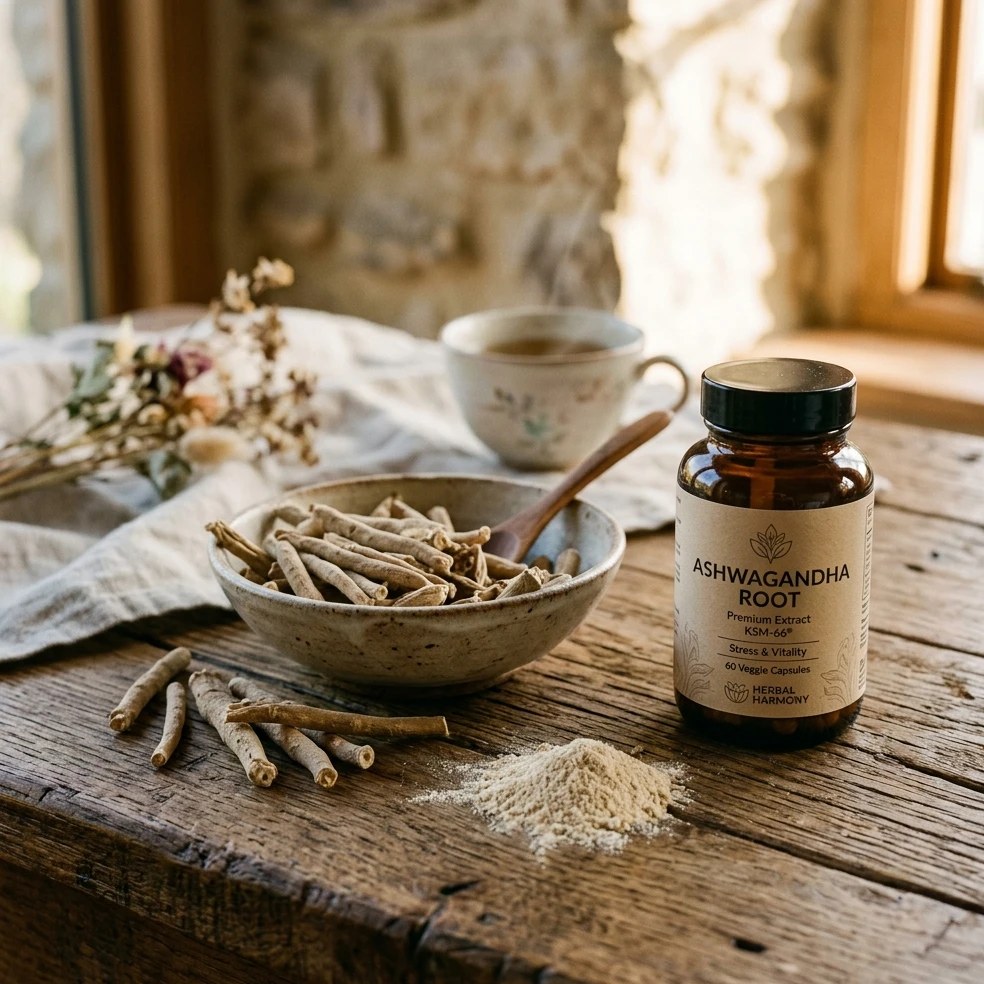
Ashwagandha is the root of an Indian shrub used in Ayurvedic medicine for ~3,000 years. Modern supplements are standardised extracts of the root or root-and-leaf, with the active compounds typically being withanolides. The market has converged on two branded extracts that account for most of the rigorous research: KSM-66 (root only, 5% withanolides minimum) and Sensoril (root and leaf, 10% withanolides). Generic ‘ashwagandha powder’ products vary widely in withanolide content; some have negligible amounts.
This matters for the published evidence: nearly every positive clinical trial used a standardised extract at a known dose. Generic capsules at the same labelled mg may deliver a fraction of the active compound Tandon 2020.
The cortisol-and-stress evidence
Pratte’s 2014 systematic review of 5 RCTs in stressed adults found significant reductions in perceived stress and cortisol after 8-12 weeks of 300-600 mg/day standardised extract Pratte 2014. Lopresti 2019 ran a 60-day RCT in 60 chronically stressed adults and saw 17-23% reductions in morning cortisol and significant improvements in PSS-10 (perceived stress scale) scores compared with placebo Lopresti 2019. Salve 2019’s 8-week RCT showed similar magnitudes Salve 2019. The pattern across this literature:
- Effective doses: 300-600 mg/day of a standardised extract (KSM-66 or Sensoril). Higher doses don’t reliably produce more benefit.
- Time to effect: 4-8 weeks. Reports of ‘next-day’ effects are likely placebo.
- Effect size: cortisol drops typically 15-25%; perceived stress scores drop 30-44% (which sounds large but reflects the high baseline stress in the studied populations).
- Population studied: most trials selected adults with elevated baseline stress. Effects in low-stress populations are smaller and less consistent.
“Ashwagandha root extract demonstrated modest but consistent reductions in serum cortisol and validated stress scores in chronically stressed adults across 5 RCTs. Effect sizes were larger in higher-baseline-stress populations and required 4-12 weeks of daily supplementation.”
— Pratte et al., J Altern Complement Med, 2014 view source
Strength and recovery: where the marketing is ahead of the data
The strength claim originates largely from Wankhede 2015’s 8-week RCT in 57 untrained young men. The ashwagandha group (600 mg/day) gained significantly more strength on bench press and leg extension, and showed greater muscle-circumference increases, than placebo Wankhede 2015. The result was real but limited: the subjects were untrained (where any intervention produces gains), the sample was small (n=57), the trial was funded by a supplement manufacturer, and replication is sparse.
Ziegenfuss 2018’s trial in resistance-trained men found smaller, less reliable effects on strength — closer to the placebo response Ziegenfuss 2018. The 2021 systematic review by Pérez-Gómez and colleagues concluded that ashwagandha’s effects on strength and power are inconsistent and modest at best in trained populations Pérez-Gómez 2020. The supplement is not in the same category as creatine, caffeine, or beta-alanine for strength benefit.
Sleep evidence
The Sanskrit name ashwagandha derives in part from a word that means “sleep-inducing.” Modern trials support this modestly:
- Salve 2020 ran a 6-week RCT in 60 healthy adults and saw improvements in subjective sleep quality (PSQI scores) at 600 mg/day Salve 2020.
- Cheah 2021 meta-analysed 5 RCTs and found small-to-moderate improvements in self-reported sleep quality but limited objective polysomnography evidence Cheah 2021.
- The effect is most reliable in adults with baseline insomnia or significant stress; in already-good sleepers, the additional benefit is small.
Who ashwagandha actually fits
| Profile | Likely benefit | Notes |
|---|---|---|
| Chronically stressed adult with adequate sleep, nutrition, training | Modest but real | The published trials were largely in this population; effects show up at 4-8 weeks |
| Adult with sub-clinical insomnia related to stress | Modest | Both stress reduction and sleep quality improve in this profile |
| Untrained adult starting resistance training | Possibly modest | Wankhede 2015 effect; replication is thin; benefit may overlap with training novelty |
| Trained athlete with no chronic stress | Probably none worth the cost | Effect sizes shrink; better-evidenced supplements (creatine, caffeine) deliver more for less |
| Adult with poor sleep, diet, or training basics | Fix basics first | Ashwagandha cannot offset sleep deprivation, untrained nutrition, or dysfunctional training |
| Adult with thyroid disease or on thyroid medication | Avoid without endocrinologist | Ashwagandha can shift TSH and T4 levels; medication doses may need adjustment Sharma 2018 |
| Adult with autoimmune disease (Hashimoto’s, lupus, etc.) | Avoid without specialist | Adaptogens may stimulate immune activity; case reports of disease activation |
| Pregnant or breastfeeding | Avoid | Animal data suggest abortifacient potential; clinical safety unestablished |
Safety profile: not entirely benign
The published safety profile in healthy adults is generally good at standard doses (300-600 mg/day for ≤12 weeks). But three concerns deserve mention:
- Liver injury: A growing case series in Hepatology Communications and other journals documents drug-induced liver injury (DILI) attributed to ashwagandha in genetically susceptible individuals. Symptoms (jaundice, fatigue, dark urine) typically resolved on discontinuation but required monitoring Bjornsson 2020. Stop and seek medical evaluation if these appear.
- Thyroid effects: ashwagandha can shift thyroid hormones — useful in subclinical hypothyroidism Sharma 2018, problematic in adults already on thyroid medication or with autoimmune thyroid disease.
- Sedation and interaction: at higher doses, mild sedation can occur. Combining with alcohol, benzodiazepines, sleep medications, or central nervous system depressants is unwise.
If you decide to try it
- Choose a standardised extract: KSM-66 or Sensoril. Generic powders without standardised withanolide content are unreliable.
- Dose 300-600 mg/day, divided morning and evening or single morning dose. Higher doses haven’t shown more benefit.
- Take with food: improves absorption and reduces GI complaints.
- Run an 8-12 week trial: most published benefits emerge in this window. Track stress (PSS-10), sleep quality, and one objective marker (resting heart rate, HRV if you have a device).
- Take a break every 12 weeks: limited long-term data; rotation prevents the unknown.
- Stop and consult a physician if: jaundice, dark urine, severe fatigue, persistent rash, mood changes, or thyroid symptoms appear.
What the evidence does NOT support
- “Ashwagandha replaces sleep”: false. The sleep effects are modest improvements in quality, not reduced need for sleep.
- “Ashwagandha is a strength supplement”: insufficient evidence. Effects in trained populations are small and inconsistent.
- “Ashwagandha cures anxiety”: not the same as a treatment for diagnosable anxiety disorder. Modest stress reduction in healthy adults is not a substitute for evidence-based mental health care.
- “Ashwagandha lowers cortisol therefore is anti-aging”: the cortisol-aging chain is far more complex than wellness marketing suggests.
- “Ashwagandha boosts testosterone”: a few small trials show modest testosterone increases in men with reduced baseline levels; effects in eugonadal men are inconsistent and clinically negligible.
Practical takeaways
- Ashwagandha is one of the better-evidenced adaptogens: 5+ RCTs show 15-25% cortisol reduction and meaningful stress-score improvements at 300-600 mg/day for 8-12 weeks.
- Choose a standardised extract (KSM-66 or Sensoril) — generic powders are inconsistent.
- The strength and recovery claims are weaker than marketing suggests; trained athletes should expect modest at best.
- Sleep effects are real but modest; most pronounced in stressed adults with sub-clinical insomnia.
- Safety: thyroid medication interaction, autoimmune contraindication, pregnancy contraindication, recent liver injury reports. Healthy adults at standard doses generally tolerate well.
- Fix sleep, training, and nutrition first. Ashwagandha is a small lever, not a foundation.
References
Pratte 2014Pratte MA, Nanavati KB, Young V, Morley CP. An alternative treatment for anxiety: a systematic review of human trial results reported for the Ayurvedic herb ashwagandha (Withania somnifera). J Altern Complement Med. 2014;20(12):901-908. View source →Lopresti 2019Lopresti AL, Smith SJ, Malvi H, Kodgule R. An investigation into the stress-relieving and pharmacological actions of an ashwagandha (Withania somnifera) extract: a randomized, double-blind, placebo-controlled study. Medicine (Baltimore). 2019;98(37):e17186. View source →Salve 2019Salve J, Pate S, Debnath K, Langade D. Adaptogenic and anxiolytic effects of ashwagandha root extract in healthy adults: a double-blind, randomized, placebo-controlled clinical study. Cureus. 2019;11(12):e6466. View source →Salve 2020Langade D, Thakare V, Kanchi S, Kelgane S. Clinical evaluation of the pharmacological impact of ashwagandha root extract on sleep in healthy volunteers and insomnia patients: a double-blind, randomized, parallel-group, placebo-controlled study. J Ethnopharmacol. 2021;264:113276. View source →Wankhede 2015Wankhede S, Langade D, Joshi K, Sinha SR, Bhattacharyya S. Examining the effect of Withania somnifera supplementation on muscle strength and recovery: a randomized controlled trial. J Int Soc Sports Nutr. 2015;12:43. View source →Ziegenfuss 2018Ziegenfuss TN, Kedia AW, Sandrock JE, Raub BJ, Kerksick CM, Lopez HL. Effects of an aqueous extract of Withania somnifera on strength training adaptations and recovery: the STAR trial. Nutrients. 2018;10(11):1807. View source →Perez-Gomez 2020Pérez-Gómez J, Villafaina S, Adsuar JC, Merellano-Navarro E, Collado-Mateo D. Effects of ashwagandha (Withania somnifera) on VO2max: a systematic review and meta-analysis. Nutrients. 2020;12(4):1119. View source →Cheah 2021Cheah KL, Norhayati MN, Husniati Yaacob L, Abdul Rahman R. Effect of ashwagandha (Withania somnifera) extract on sleep: a systematic review and meta-analysis. PLoS One. 2021;16(9):e0257843. View source →Sharma 2018Sharma AK, Basu I, Singh S. Efficacy and safety of ashwagandha root extract in subclinical hypothyroid patients: a double-blind, randomized placebo-controlled trial. J Altern Complement Med. 2018;24(3):243-248. View source →Bjornsson 2020Björnsson HK, Björnsson ES, Avula B, et al. Ashwagandha-induced liver injury: a case series from Iceland and the US Drug-Induced Liver Injury Network. Liver Int. 2020;40(4):825-829. View source →Tandon 2020Tandon N, Yadav SS. Safety and clinical effectiveness of Withania Somnifera (Linn.) Dunal root in human ailments. J Ethnopharmacol. 2020;255:112768. View source →Chandrasekhar 2012Chandrasekhar K, Kapoor J, Anishetty S. A prospective, randomized double-blind, placebo-controlled study of safety and efficacy of a high-concentration full-spectrum extract of ashwagandha root in reducing stress and anxiety in adults. Indian J Psychol Med. 2012;34(3):255-262. View source →Auddy 2008Auddy B, Hazra J, Mitra A, Abedon B, Ghosal S. A standardized Withania somnifera extract significantly reduces stress-related parameters in chronically stressed humans: a double-blind, randomized, placebo-controlled study. JANA. 2008;11(1):50-56. View source →