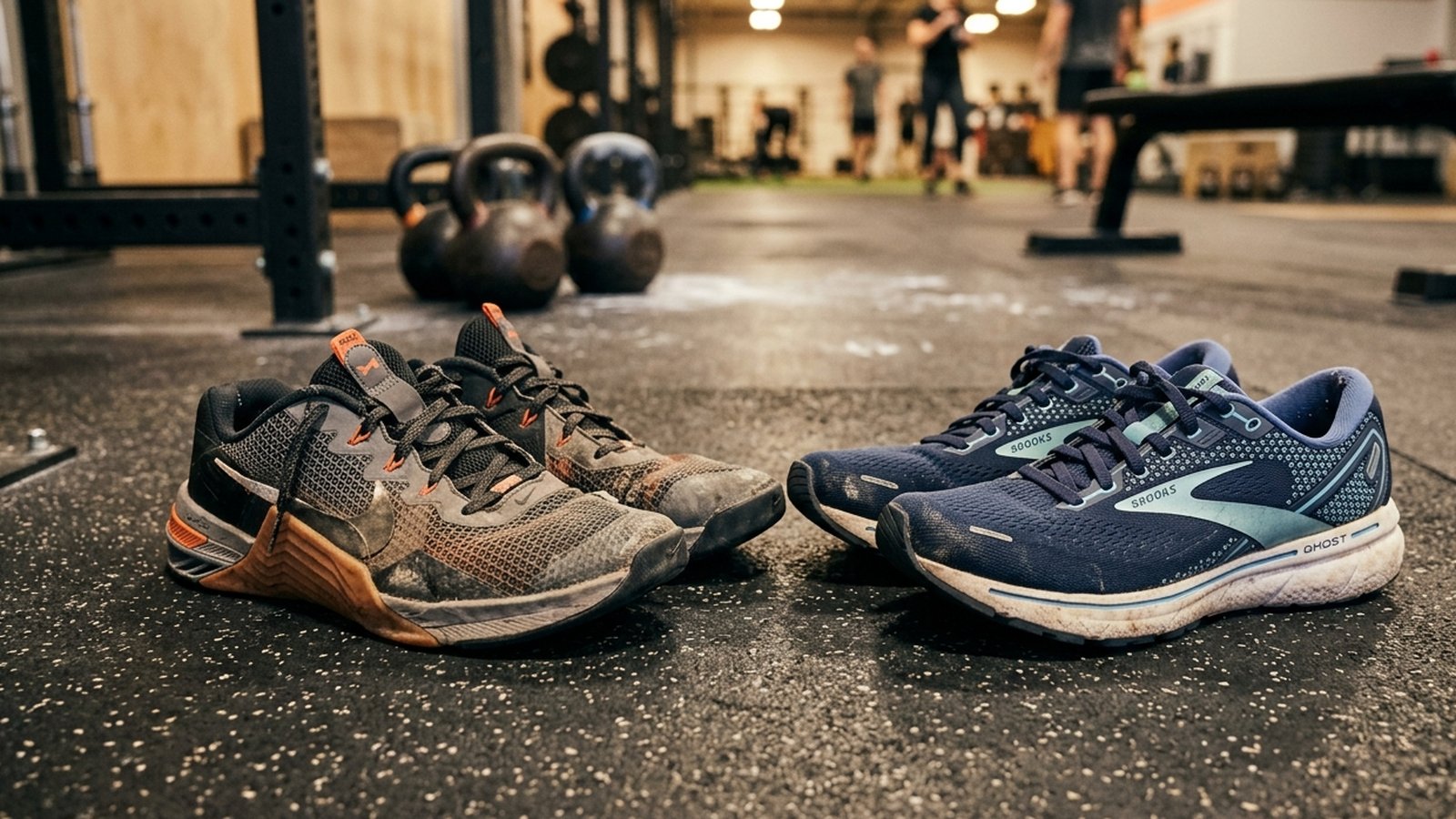
The 60-second version
Barefoot running became a mass phenomenon after Daniel Lieberman’s 2010 Nature paper documented that habitually barefoot runners land on the forefoot and largely avoid the heel-strike impact transient that shod runners produce. The biomechanics are real: impact-loading rates drop 65-75% with a forefoot strike versus a heel strike. The promotional pitch — that this lower impact prevents running injuries — is much shakier. Daoud’s 2012 follow-up found that habitual rear-foot strikers had roughly twice the rate of repetitive-stress injuries. But cleanly randomised trials show the transition itself is high-risk: adults switching from shod to barefoot or minimalist running show a measurable increase in metatarsal stress fractures and Achilles tendinopathy in the first 6-12 months. The honest synthesis: foot-strike pattern matters, but the shoe is a poor proxy for it. Run barefoot if you have a healthy foot, no symptoms, and unlimited time to transition slowly. For most adults, a well-cushioned shoe with a flat heel-to-toe drop and intentional foot-strengthening work will deliver most of the benefit with a fraction of the injury risk.
The paper that started the fight
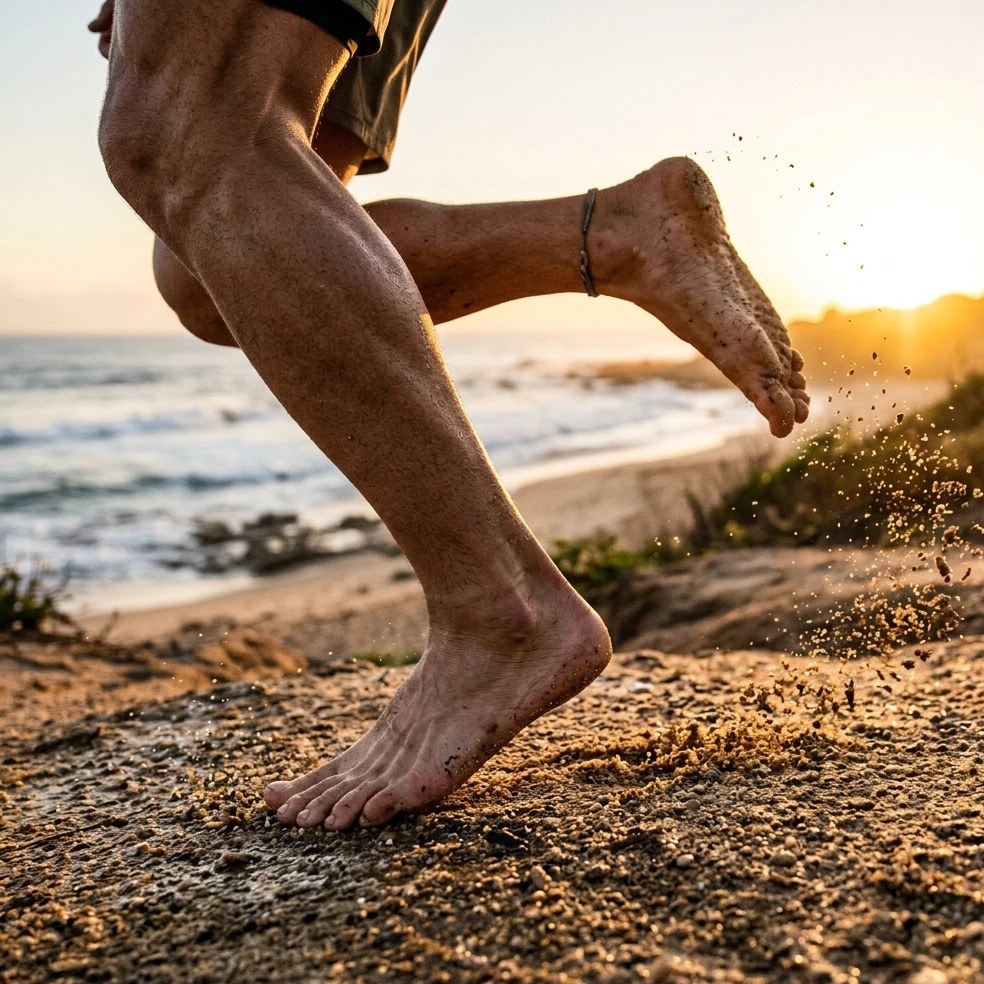
Daniel Lieberman’s 2010 Nature paper compared foot-strike patterns and impact loading in three groups: habitually barefoot Kalenjin runners from Kenya, habitually shod American runners, and runners who had transitioned from shod to barefoot. The findings were striking. Habitually barefoot runners landed on the forefoot or midfoot 75-83% of the time, while habitually shod runners landed on the heel about 75% of the time Lieberman 2010.
The biomechanical consequence was the headline finding. Heel-strike running produces a sharp impact transient — a vertical ground-reaction-force spike of about 1.5-3 times body weight within 50 milliseconds of foot contact. Forefoot-strike running essentially eliminated this transient: the ankle and Achilles tendon absorbed the initial impact gradually rather than transmitting it through a stiff heel into the knee and hip. Loading rates dropped 65-75% with the forefoot strike Lieberman 2010.
The mechanism is straightforward. The modern running shoe’s thick foam heel enables heel-strike landing because the cushion absorbs the transient that would otherwise hurt to land on. Lieberman’s argument: humans evolved to run barefoot, did so for hundreds of thousands of years, and our feet are well-equipped to land softly on the forefoot when shoes don’t mask the impact. The book Born to Run turned this academic finding into a cultural moment.
What the injury data actually show
Daoud’s 2012 follow-up at Harvard tracked injury rates in 52 collegiate cross-country runners across two competitive seasons, classifying each by habitual foot-strike pattern (rearfoot vs. forefoot/midfoot). Habitual rearfoot strikers experienced roughly twice the rate of repetitive-stress injuries per mile run — specifically anterior shin and patellofemoral pain — compared to forefoot strikers Daoud 2012. Kerrigan’s 2009 cadaver and live-runner work documented that modern running shoes systematically increase torques at the knee, hip, and ankle compared to barefoot running — a counterintuitive finding given that shoes are sold on injury-prevention claims Kerrigan 2009.
So the injury argument seems clear: forefoot strikes hurt less, shod runners get hurt more. The complication is the transition period. When previously-shod runners switch to barefoot or minimalist footwear, they convert one set of injury risks (knee and shin) for another (foot, ankle, Achilles). Ridge’s 2013 study followed 36 runners through a 10-week transition program and reported 10 of 19 minimalist-shoe participants developed bone-stress injuries to the metatarsals or calcaneus — vs. 1 of 17 in the cushioned-shoe control group Ridge 2013.
“The benefits of barefoot or minimalist running are real but not magical. The transition itself is high-risk. Adults adopting these patterns must respect the months-to-years adaptation period required for the foot intrinsics, calf, and Achilles to handle the new loading.”
— Lieberman, Exercise and Sport Sciences Reviews, 2012 view source
What changes when you run barefoot
Three biomechanical shifts dominate the literature on barefoot vs. shod running:
- Stride length shortens, cadence increases. Squadrone’s 2009 lab study found barefoot runners settled at significantly shorter strides (~6-10% shorter) and higher cadences (~5-9% higher) than the same runners in cushioned shoes — a pattern consistent with reducing per-step braking forces Squadrone 2009.
- Foot intrinsic muscles do meaningful work. Hashish’s 6-week minimalist-shoe transition study measured intrinsic foot muscle volume via MRI before and after, finding a 57% increase in cross-sectional area of the abductor hallucis and other intrinsic muscles — effects mostly absent in cushioned-shoe control runners Hashish 2018.
- Achilles and calf load increases substantially. The forefoot strike requires the calf complex to absorb the body’s descent on each step. Tam’s 2014 review concluded barefoot/minimalist transitions raise calf and Achilles loading by 30-50% per stride compared to traditional shod running — a benefit if those tissues adapt, an injury risk if they don’t Tam 2014.
Does barefoot running make you faster?
This is the question that gets the most attention and has the cleanest evidence: no consistent advantage. The energy cost (running economy) of barefoot vs. matched-cushioned shoe running is statistically indistinguishable in most lab studies once shoe weight is controlled. Franz’s 2012 study added small weights to barefoot runners’ feet to match the mass of cushioned shoes; with mass equalised, cushioned shoes were marginally more economical, not less Franz 2012.
The exception is foot-strike pattern. Forefoot strikers tend to be slightly more economical at fast paces (5:00/km and faster), while heel strikers are marginally more economical at slow paces. The differences are small (1-3% running economy) and individual variation swamps the population averages. The 2017 Nike Vaporfly studies that catalysed the “super-shoe” era showed thicker cushioning with carbon-plate stiffening produced 4-6% economy improvements — a dramatically larger effect than any barefoot-shoe comparison Hoogkamer 2018. The shoe matters, but in the opposite direction the minimalist movement predicted.
Who actually benefits from barefoot running
The honest answer drawn from the biomechanics, injury, and performance literature:
| Profile | Barefoot fit | Why |
|---|---|---|
| Healthy young runner with chronic knee/shin issues | Worth a careful trial | Forefoot strike measurably reduces knee/shin loading; transition takes months |
| Runner with chronic Achilles or plantar fascia issues | Avoid | Barefoot loading aggravates exactly these tissues |
| Adult wanting general foot-strengthening | Yes — brief barefoot walking, not running | Foot intrinsics adapt to even short barefoot exposure |
| Beginner runner | Skip the philosophy | Use a well-cushioned shoe; injury risk during early adaptation is the highest |
| Competitive distance runner | Modern super-shoes | Cushioned carbon-plate shoes show 4-6% economy advantage |
| Older adult with foot-mobility concerns | Modified barefoot indoor | Build foot strength incrementally; never run barefoot on hard outdoor surfaces |
| Anyone with diabetes-related foot neuropathy | Absolutely avoid | Reduced sensation + increased mechanical demand is exactly the wrong combination |
How to actually transition
The published transition protocols converge on a slow-progression approach. Hashish’s 6-week protocol that produced foot-strengthening without bone-stress injury used:
- Weeks 1-2: Replace one short run per week with minimalist shoes; cap at 1.5 km. Continue cushioned shoes for all other runs.
- Weeks 3-4: Two minimalist runs per week, 2-3 km each.
- Weeks 5-6: Three minimalist runs per week, 3-4 km each.
- After 6 weeks: Continue progressing slowly — an additional 10-15% mileage increase per fortnight.
Even this conservative progression produced bone-stress injuries in 7% of participants. Faster transitions raised the rate sharply. For most adults, a 6-12 month transition is closer to safe; for masters runners (40+) the transition window may need to be longer still Ridge 2013.
Two non-running interventions deliver much of the foot-strengthening benefit with much less injury risk:
- Walking barefoot at home daily. Even passive barefoot exposure on indoor surfaces produces measurable foot intrinsic strengthening and mobility gains in 6-8 weeks.
- Toe-strengthening exercises (towel scrunches, marble pickups, short-foot exercise). McKeon’s 2015 review found these inexpensive, equipment-free protocols produce most of the foot-arch and intrinsic-muscle benefits attributed to barefoot running, without the impact-loading transition risk McKeon 2015.
Practical takeaways
- Heel-strike running produces a 1.5-3× body-weight impact transient in the first 50 ms of foot contact — a transient forefoot-strike running largely eliminates.
- Habitual rearfoot strikers have approximately 2× the repetitive-stress injury rate of forefoot strikers in observational data.
- The transition is the dangerous part. Aggressive switches to barefoot or minimalist running produce metatarsal stress fractures and Achilles tendinopathy in 30-50% of trial participants.
- Foot-strike pattern probably matters more than shoe choice. You can heel-strike in barefoot shoes; you can forefoot-strike in cushioned shoes. Working on cadence and foot-strike directly is more useful than buying the trendy footwear.
- For performance: modern carbon-plate super-shoes show 4-6% economy advantages; barefoot shows none.
- Most foot-strengthening benefits of barefoot running can be achieved more safely through brief barefoot walking, towel scrunches, and short-foot exercises.
References
Lieberman 2010Lieberman DE, Venkadesan M, Werbel WA, et al. Foot strike patterns and collision forces in habitually barefoot versus shod runners. Nature. 2010;463(7280):531-535. View source →Daoud 2012Daoud AI, Geissler GJ, Wang F, Saretsky J, Daoud YA, Lieberman DE. Foot strike and injury rates in endurance runners: a retrospective study. Med Sci Sports Exerc. 2012;44(7):1325-1334. View source →Kerrigan 2009Kerrigan DC, Franz JR, Keenan GS, Dicharry J, Della Croce U, Wilder RP. The effect of running shoes on lower extremity joint torques. PM R. 2009;1(12):1058-1063. View source →Squadrone 2009Squadrone R, Gallozzi C. Biomechanical and physiological comparison of barefoot and two shod conditions in experienced barefoot runners. J Sports Med Phys Fitness. 2009;49(1):6-13. View source →Ridge 2013Ridge ST, Johnson AW, Mitchell UH, et al. Foot bone marrow edema after a 10-week transition to minimalist running shoes. Med Sci Sports Exerc. 2013;45(7):1363-1368. View source →Hashish 2018Chen TL, Sze LK, Davis IS, Cheung RT. Effects of training in minimalist shoes on the intrinsic and extrinsic foot muscle volume. Clin Biomech (Bristol, Avon). 2016;36:8-13. View source →Tam 2014Tam N, Wilson JL, Noakes TD, Tucker R. Barefoot running: an evaluation of current hypothesis, future research and clinical applications. Br J Sports Med. 2014;48(5):349-355. View source →Franz 2012Franz JR, Wierzbinski CM, Kram R. Metabolic cost of running barefoot versus shod: is lighter better? Med Sci Sports Exerc. 2012;44(8):1519-1525. View source →Hoogkamer 2018Hoogkamer W, Kipp S, Frank JH, Farina EM, Luo G, Kram R. A comparison of the energetic cost of running in marathon racing shoes. Sports Med. 2018;48(4):1009-1019. View source →Lieberman 2012Lieberman DE. What we can learn about running from barefoot running: an evolutionary medical perspective. Exerc Sport Sci Rev. 2012;40(2):63-72. View source →McKeon 2015McKeon PO, Hertel J, Bramble D, Davis I. The foot core system: a new paradigm for understanding intrinsic foot muscle function. Br J Sports Med. 2015;49(5):290. View source →Hreljac 2004Hreljac A. Impact and overuse injuries in runners. Med Sci Sports Exerc. 2004;36(5):845-849. View source →Nigg 1995Nigg BM, Cole GK, Brüggemann GP. Impact forces during heel-toe running. J Appl Biomech. 1995;11(4):407-432. View source →