The 60-second version
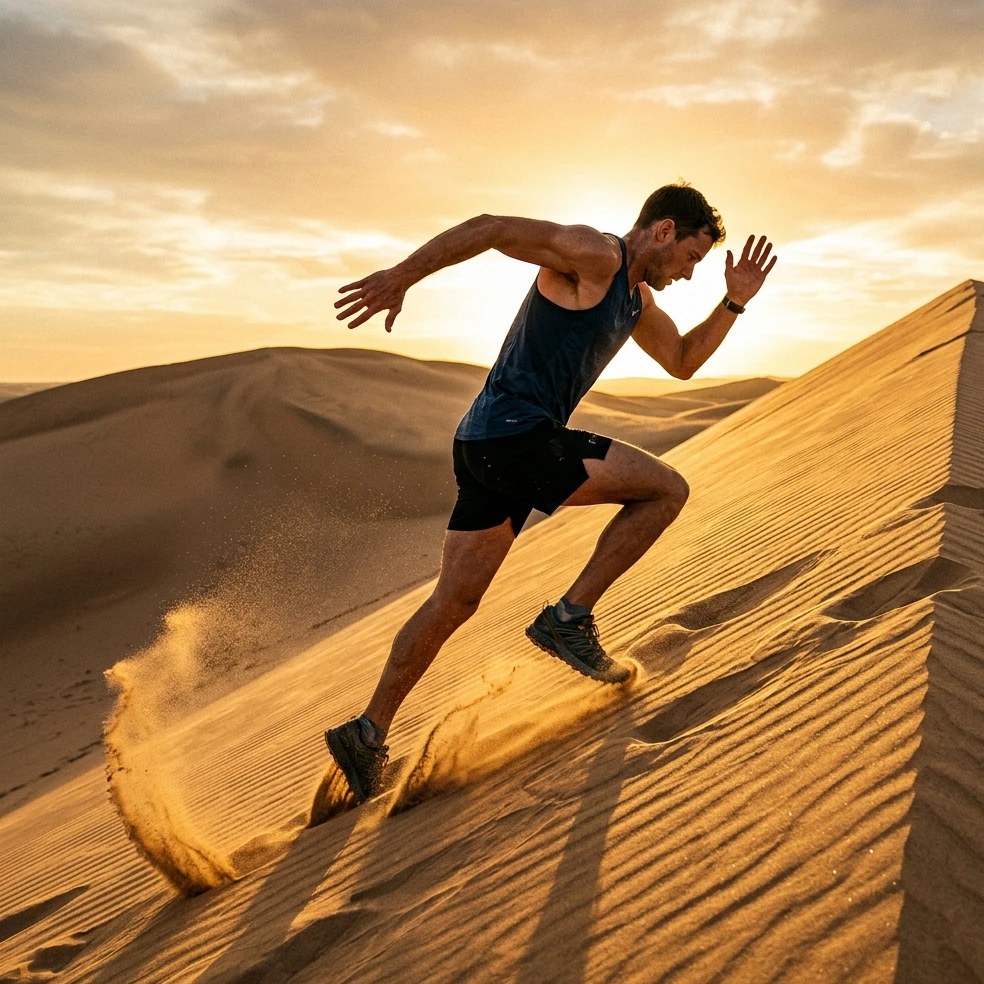
Sand sprinting is genuinely harder than track sprinting — the same effort produces lower top-end speed but a much larger metabolic and mechanical stimulus. The reason is mechanics: sand absorbs the elastic-recoil energy your tendons normally return on every stride, so your legs must generate it again from scratch. Pinnington and Dawson’s landmark 2001 study found running on dry sand costs about 1.6× more energy than running on a hard surface at the same speed. The training upside is real: sand sessions transfer to sprint speed, vertical jump, and change-of-direction performance on hard surfaces, with far lower impact loading on knees and shins. The downside is also real: sand training increases calf, Achilles, and plantar fascia injury risk, and the surface variability means it is essentially impossible to time. If you want to peak as a sprinter, train on a track. If you want a brutal conditioning stimulus that spares your joints, run the dunes.
Why sand is so much harder
Running on a hard surface is partly a free ride. Each foot-strike compresses the Achilles tendon and the longitudinal arch of the foot like a spring; on toe-off, that stored elastic energy pays back about 40-60% of the next stride’s mechanical work for free. This is why human running economy is so good on stiff surfaces and so poor on compliant ones Lejeune 1998.
Soft sand absorbs that elastic energy almost completely. Each step you take, the foot sinks 5-10 cm, the spring compresses against a giving substrate instead of a rigid one, and the tendons fail to store and return. Lejeune and colleagues measured this directly: running on sand costs 1.6 times the metabolic energy of running on a hard surface at the same speed, and walking on sand costs 2.1-2.7 times more. The walking penalty is even larger because at low speeds, the elastic-recoil contribution is proportionally bigger Lejeune 1998.
Pinnington and Dawson’s 2001 follow-up, run on actual beach sand rather than treadmills, found similar numbers but added important detail. The energy penalty depends on sand type and moisture: dry, deep, loose sand is the most expensive; firm, damp sand near the waterline is much closer to track running — perhaps only 20-30% more expensive than asphalt at matched pace Pinnington 2001.
What changes biomechanically
The same group’s biomechanical analyses found three consistent differences between sand and hard-surface running:
- Foot-strike duration is longer. The foot has to wait while the sand stops compressing, then push through that giving surface. Ground contact times stretch from ~110-140 ms on a track to ~180-230 ms on dry sand.
- Stride length shortens, stride frequency increases. Without the elastic spring, runners cannot afford long strides and instead chop into shorter, faster ones. Top-end speed drops about 10-15% on dry sand vs. matched-effort track running Pinnington 2001.
- Hip and knee flexor recruitment goes up dramatically. The leg must lift higher to clear the sinking foot, increasing iliopsoas and quadriceps activation. Calf and Achilles loading also rises — one reason Achilles tendinopathy is over-represented in dedicated sand-runners Impellizzeri 2008.
“Sand training combines the metabolic intensity of high-impact running with the mechanical impact of low-impact walking. For athletes who can tolerate the calf and Achilles load, that combination is hard to replicate on any other surface.”
— Binnie et al., J Strength Cond Res, 2014 view source
Does sand training make you faster on the track?
This is the question every coach wants answered, and the controlled-trial evidence is reasonably clean. Binnie’s lab at Edith Cowan ran a 2013 randomised crossover comparing 8 weeks of sprint-and-agility training on grass versus on sand in 30 team-sport athletes. Both groups improved on hard-surface 20m sprint time, but the sand group improved more on vertical jump, change-of-direction speed, and aerobic VO2max, with smaller within-session ground-reaction-force impact in the process Binnie 2014.
Impellizzeri’s 2008 4-week study with elite soccer players found similar results — sand-based plyometric training transferred well to grass-surface jumping and sprinting performance, with significantly less DOMS reported by the sand group across the training block Impellizzeri 2008. A 2017 systematic review by Brown and colleagues pooled 6 sand-training studies and concluded the surface produces different but complementary adaptations to hard-surface work: more eccentric strength, more aerobic stimulus per session, less impact loading Brown 2017.
What sand does not do is reproduce the rate-of-force-development demands of true elite sprinting. The maximum velocities achievable on sand are too low, and the ground-reaction forces are blunted. If you are training for a 100m race or for elite-level acceleration mechanics, the track is the irreplaceable surface. Sand is a complement, not a replacement Binnie 2014.
Where it can go wrong
The lower joint impact does not mean sand training is risk-free — it shifts the injury profile. The published research and clinical experience converge on three patterns:
- Achilles tendon overload. The longer ground contact and increased calf demand load the Achilles in patterns runners are not adapted to. Tendinopathy risk rises sharply when sand training is added to existing running mileage without a deload elsewhere Impellizzeri 2008.
- Plantar fascia and intrinsic foot strain. Dry, deep sand collapses the longitudinal arch on each step and overworks the foot intrinsics — a pattern that is therapeutic in small doses (a known method for foot strengthening) and injurious in large doses McKeon 2008.
- Ankle inversion / sprain. Uneven beach surfaces, especially around dunes and shoreline, increase the rate of acute ankle injuries compared to flat track running. Beach-volleyball injury surveillance found ankle sprain rates 2-3× those of indoor volleyball, despite the softer surface Giatsis 2004.
How to actually program sand sprints
The training-study protocols converge on a handful of practical rules. Most beach-runners can implement these immediately:
- Start with firm, damp sand near the waterline. The energy penalty is much smaller than dry sand, the surface is more uniform, and ankle injury risk is lower. Build to dry/loose sand only after 4-6 weeks of adaptation.
- Reduce volume by 30-50% on day one. The metabolic cost is so much higher that your usual session distance will produce 50-100% more cardiovascular and muscular load. Start short.
- Use shorter intervals than you would on track. Most published protocols use sprint distances of 20-50m on sand — equivalent in time to 30-70m track sprints — with full recoveries (1:6 to 1:10 work-to-rest).
- Cap weekly sand exposure at one or two sessions. The combined Achilles + calf + plantar load is enough that most athletes need 5-7 days between dedicated sand sessions, especially in the first month.
- Dry-sand running with shoes vs. barefoot is a real choice. Barefoot increases foot-intrinsic strength but raises plantar injury risk. Most evidence-based programs alternate.
- Skip it entirely if you have active calf, Achilles, or plantar fascia symptoms. The mechanical pattern is exactly the wrong load for those tissues.
Who each surface actually suits
| Goal | Better choice | Why |
|---|---|---|
| Maximum sprint speed development | Track | Higher attainable velocity; trained rate of force development |
| Sport-specific change-of-direction (soccer, rugby, hockey) | Sand | Equal or better transfer with less impact loading |
| Vertical jump / power development | Sand | Eccentric loading + plyometric adaptation |
| Returning from impact-related injury | Sand (firm, damp) | ~40% reduced ground-reaction force vs. asphalt |
| Aerobic conditioning in limited time | Sand | 1.6× metabolic cost per minute |
| Existing calf/Achilles/plantar issues | Track or grass | Sand loads exactly the wrong tissues |
Practical takeaways
- Sand running costs ~1.6× the energy of hard-surface running at the same speed; walking costs 2-3×.
- Top-end speed drops 10-15% on dry sand — expect lower times, not lower effort.
- Firm, damp sand near the waterline is much friendlier than dry, deep sand for both energy cost and ankle safety.
- RCT evidence shows sand training transfers well to vertical jump, change-of-direction speed, and aerobic capacity on hard surfaces — with significantly less DOMS.
- It does not reproduce the rate-of-force-development demands of elite sprinting. Use it to complement track work, not replace it.
- Achilles, calf, and plantar fascia load is much higher than equivalent track running — cap exposure to 1-2 sessions weekly and never train through symptoms.
References
Lejeune 1998Lejeune TM, Willems PA, Heglund NC. Mechanics and energetics of human locomotion on sand. J Exp Biol. 1998;201(Pt 13):2071-2080. View source →Pinnington 2001Pinnington HC, Dawson B. The energy cost of running on grass compared to soft dry beach sand. J Sci Med Sport. 2001;4(4):416-430. View source →Binnie 2014aBinnie MJ, Dawson B, Arnot MA, Pinnington H, Landers G, Peeling P. Effect of sand versus grass training surfaces during an 8-week pre-season conditioning programme in team sport athletes. J Sports Sci. 2014;32(11):1001-1012. View source →Binnie 2014bBinnie MJ, Dawson B, Pinnington H, Landers G, Peeling P. Sand training: a review of current research and practical applications. J Sports Sci. 2014;32(1):8-15. View source →Impellizzeri 2008Impellizzeri FM, Rampinini E, Castagna C, Martino F, Fiorini S, Wisløff U. Effect of plyometric training on sand versus grass on muscle soreness and jumping and sprinting ability in soccer players. Br J Sports Med. 2008;42(1):42-46. View source →Brown 2017Brown WJ, Pearce AJ, Naughton G, et al. Sand training: exercise-induced muscle damage and inflammatory responses to matched-intensity exercise. Eur J Sport Sci. 2017;17(6):741-747. View source →Gaudino 2013Gaudino P, Gaudino C, Alberti G, Minetti AE. Biomechanics and predicted energetics of sprinting on sand: hints for soccer training. J Sci Med Sport. 2013;16(3):271-275. View source →Giatsis 2004Giatsis G, Kollias I, Panoutsakopoulos V, Papaiakovou G. Volleyball: biomechanical differences in elite beach-volleyball players in vertical squat jump on rigid and sand surface. Sports Biomech. 2004;3(1):145-158. View source →McKeon 2008McKeon PO, Hertel J. Systematic review of postural control and lateral ankle instability. J Athl Train. 2008;43(3):293-304. View source →Paluch 2022Paluch AE, Bajpai S, Bassett DR, et al. Daily steps and all-cause mortality: a meta-analysis of 15 international cohorts. Lancet Public Health. 2022;7(3):e219-e228. View source →Hreljac 2004Hreljac A. Impact and overuse injuries in runners. Med Sci Sports Exerc. 2004;36(5):845-849. View source →Nigg 1995Nigg BM, Cole GK, Brüggemann GP. Impact forces during heel-toe running. J Appl Biomech. 1995;11(4):407-432. View source →Ferris 1999Ferris DP, Liang K, Farley CT. Runners adjust leg stiffness for their first step on a new running surface. J Biomech. 1999;32(8):787-794. View source →