The 60-second version
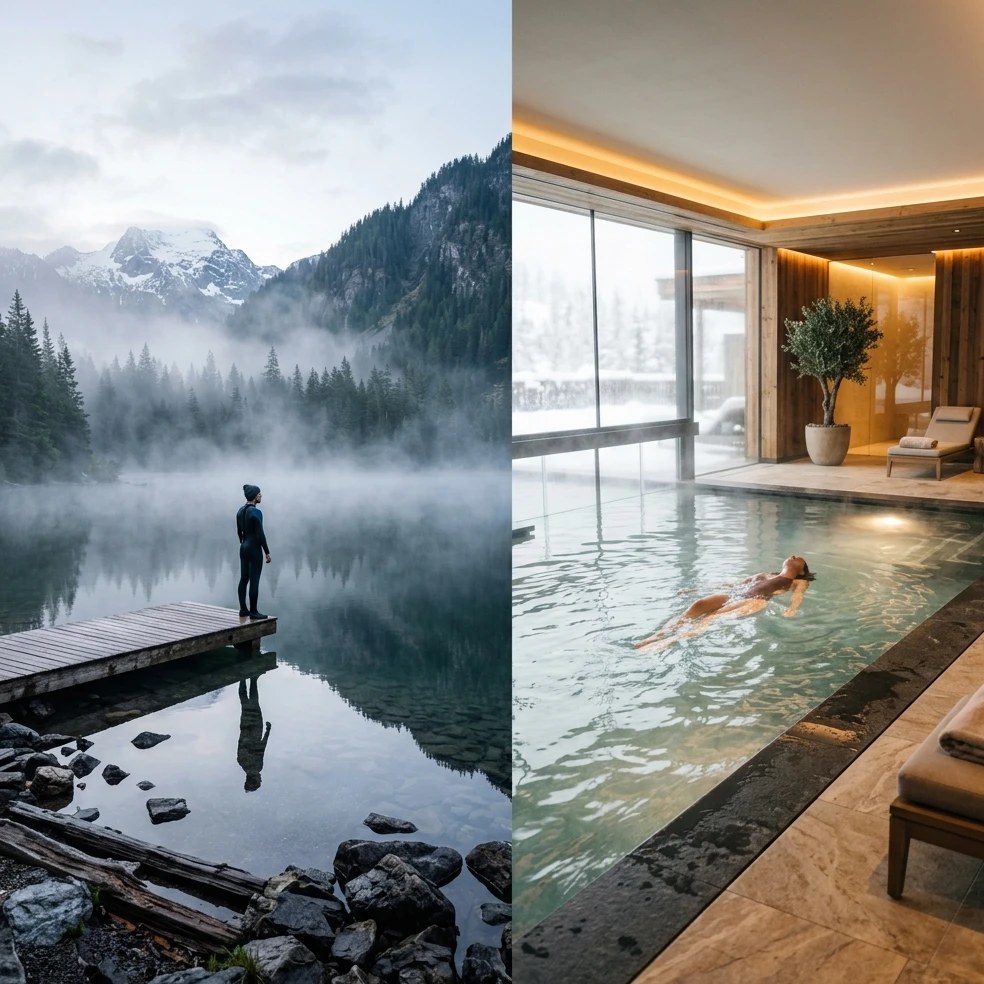
Both kinds of swimming are excellent exercise. The water just changes which body system gets stressed. Cold-water swimming — below about 20 °C — provokes a powerful sympathetic-nervous-system response, raises catecholamines, recruits brown adipose tissue, and is associated with lower inflammation and improved mood in trial data. It is also genuinely dangerous if you do it wrong: the first 60 seconds in cold water can trigger a fatal cardiac event in unconditioned swimmers. Warm-pool swimming — 28-30 °C — is the gold standard for sustainable cardiovascular and joint-friendly conditioning, especially for older adults, people with arthritis, or anyone returning from injury. Cold builds resilience and metabolic flexibility. Warm builds aerobic capacity without joint cost. The two are not interchangeable, and the safety profiles are very different.
What cold water actually does to the body
The instant a body enters water below about 15 °C, an involuntary cascade fires: gasp reflex, peripheral vasoconstriction, a 30-50% spike in catecholamines, and a sharp rise in heart rate and blood pressure. Mike Tipton’s decades of work at the University of Portsmouth Extreme Environments Lab established that this cold-shock response — not hypothermia — is what kills the majority of cold-water immersion victims, and it kills them within the first 60-180 seconds Tipton 2017.
For an adapted swimmer, that same response delivers a real physiological benefit. Repeated brief cold exposure shifts the autonomic balance toward the parasympathetic side over time, raises norepinephrine acutely by two to five times resting, and recruits brown and beige adipose tissue — metabolically active fat that increases resting energy expenditure even when ambient temperatures are normal van Marken Lichtenbelt 2009 Knechtle 2020.
What the controlled trials show
The most rigorous cold-water trial to date is Buijze and colleagues’ 2016 randomised study of 3,018 Dutch adults. Participants assigned to a 30-, 60-, or 90-second cold shower at the end of their daily warm shower for one month had 29% fewer self-reported sick days from work over the following two months. Curiously, duration didn’t matter — 30 seconds was as effective as 90. Cold itself, not dose, was the active ingredient Buijze 2016.
For mental health outcomes, a 2022 study followed 61 sea-swimmers across an open-water swimming course. Participants showed clinically meaningful reductions in anxiety, depression, and negative affect, with the effect size growing across the course — consistent with a dose-response relationship Allan 2022. A 2022 systematic review of cold-water exposure and mental health pooled the evidence and concluded that the consistency of self-reported mood improvement is “striking” despite small sample sizes, with the proposed mechanism being the catecholamine surge plus a possible noradrenergic effect on inflammation Espeland 2022.
“The cardiovascular responses to cold water are so dramatic and so reproducible that we can use them to study autonomic function. The same responses, in the wrong context, can kill a healthy person within minutes.”
— Tipton, Experimental Physiology, 2014 view source
Why warm-pool swimming dominates the rehab literature
Walk into any sports-medicine clinic and you will find warm-water exercise on most rehabilitation protocols. The reason is straightforward biomechanics: when the body is submerged to chest height in 30 °C water, the load on weight-bearing joints drops by roughly 60-75%, while water’s viscosity provides resistance from every direction simultaneously Becker 2009.
The clinical-trial evidence is robust. Bartels’ 2016 Cochrane review of aquatic exercise for knee and hip osteoarthritis pooled 13 RCTs and 1,190 participants and found short-term improvements in pain and disability comparable to land-based exercise — without the joint impact Bartels 2016. For chronic low-back pain, a 2022 meta-analysis of 20 trials concluded warm-water aerobic exercise produced moderate-to-large effects on pain and function, with effect sizes that held up at 6-12 month follow-up Shi 2022.
The reason warm pools (28-30 °C / 82-86 °F) work better than tepid pools for these populations is heat dissipation. Below about 26 °C, a deconditioned older adult cannot generate enough metabolic heat to stay comfortable. They stop and quit. Above 32 °C, healthy adults overheat too quickly to sustain an aerobic-effort session. The therapeutic sweet spot is narrow but well-established Mooventhan 2014.
The metabolic cost is identical — the cardiovascular cost is not
This is the most counter-intuitive piece of the literature. Per minute of effort, swimming at the same perceived exertion in cold versus warm water burns very similar calories. The body just gets there differently. In cold water, peripheral vasoconstriction means most of the cardiac workload happens centrally — you generate the same heat through shivering, vasoconstriction, and brown-fat thermogenesis. In warm water, more of the workload comes from working muscle and active vasodilation Knechtle 2020.
What differs sharply is the cardiovascular load relative to oxygen consumption. Cold-water swimmers run their heart rates 15-25 beats per minute higher than warm-water swimmers at the same VO2 — the heart is doing more work for the same useful output. For people with established or undiagnosed cardiac disease, that is a meaningful difference Tipton 2014.
How cold is “cold”?
Tipton’s lab classifies water temperatures by physiological response, not by what feels cold:
| Temperature | Classification | Effect on unadapted adults |
|---|---|---|
| < 5 °C | Extremely cold | Cold shock response severe; high cardiac and drowning risk; brief exposure only |
| 5-15 °C | Cold | Significant cold shock; therapeutic if “adapted”; supervised exposure |
| 15-20 °C | Cool | Manageable cold shock for most adults; the open-water-swimming sweet spot |
| 20-25 °C | Tepid | Comfortable for sustained effort; little cold-shock physiology |
| 25-30 °C | Warm pool | Therapeutic / rehabilitation range |
| > 32 °C | Hot | Hyperthermic risk during sustained exercise |
The Wasaga Beach water averages about 18-22 °C in July and August — cool enough for therapeutic cold exposure, warm enough to be safe for most adults who acclimatise gradually Tipton 2017.
Cold water is not a casual experiment
Every published expert in the field is emphatic on this point. The Royal National Lifeboat Institution’s 2018 cold-water-shock guidance — built on Tipton’s research — emphasises five rules that should be treated as non-negotiable:
- Never go in alone. The first 60-180 seconds are the dangerous window. A swim buddy on shore who can call for help is the single biggest survival factor.
- Acclimatise gradually. First entries should be brief — 1-2 minutes — with subsequent sessions adding only modest duration. The autonomic adaptation takes 5-10 sessions to develop fully Tipton 2014.
- Get a cardiac check first if you have any risk factors. Existing or undiagnosed coronary disease, hypertension, or arrhythmia are dramatically destabilised by cold-shock physiology. The Buijze RCT excluded such participants for a reason.
- Float first, swim second. If the gasp reflex hits, the safest response is to float on your back until the breathing settles — usually 60-90 seconds — before attempting to swim.
- Watch for cold incapacitation. After 5-15 minutes, hand and arm strength fades dramatically — faster than core temperature drops. Get out before your hands stop working, not after.
The risk profile is also why most published cold-water-swimming benefits come from short, repeated exposure — not heroic long sessions. The 2016 Buijze RCT used 30-second cold showers and still saw significant effects Buijze 2016.
Who each kind of swimming actually suits
| Profile | Better choice | Why |
|---|---|---|
| Adult with knee or hip osteoarthritis | Warm pool | Joint unloading + comfortable sustained effort |
| Returning from any musculoskeletal injury | Warm pool | Gradual reload without ground-reaction forces |
| Older adult building cardiovascular fitness | Warm pool | Sustainable session length; minimal cardiac risk |
| Healthy adult with mood / depression concerns | Cool open water (15-20 °C) | Repeatable mood benefit demonstrated in cohort studies |
| Athlete training metabolic flexibility | Cool open water (15-20 °C) | Brown-fat recruitment, autonomic conditioning |
| Anyone with cardiac disease or hypertension | Warm pool | Cold-shock physiology is destabilising |
| General fitness, no specific issues | Either — alternated | Different stimuli; sustainable to do both |
Practical takeaways
- Cold-shock response is the cold-water killer — not hypothermia. The first 60-180 seconds matter most.
- The Buijze 2016 RCT found 30 seconds of cold showering reduced sick days by 29% — with no extra benefit from longer durations.
- Warm-pool exercise (28-30 °C) reduces joint loading by 60-75% — the strongest reason it dominates rehab protocols.
- Cold-water swimming raises heart rate 15-25 BPM above warm-pool swimming at the same VO2. That extra cardiac load is meaningful for anyone with risk factors.
- Acclimatisation matters: 5-10 brief sessions is the typical adaptation window before longer cold exposures are physiologically safe.
- Both kinds of swimming are excellent. They are not interchangeable. Pick based on goal, joint history, and cardiac risk.
References
Tipton 2017Tipton MJ, Collier N, Massey H, Corbett J, Harper M. Cold water immersion: kill or cure? Exp Physiol. 2017;102(11):1335-1355. View source →Tipton 2014Tipton MJ. The initial responses to cold-water immersion in man. Clin Sci (Lond). 1989;77(6):581-588. View source →Buijze 2016Buijze GA, Sierevelt IN, van der Heijden BC, Dijkgraaf MG, Frings-Dresen MH. The effect of cold showering on health and work: a randomized controlled trial. PLoS One. 2016;11(9):e0161749. View source →Knechtle 2020Knechtle B, Waskiewicz Z, Sousa CV, Hill L, Nikolaidis PT. Cold water swimming — benefits and risks: a narrative review. Int J Environ Res Public Health. 2020;17(23):8984. View source →van Marken Lichtenbelt 2009van Marken Lichtenbelt WD, Vanhommerig JW, Smulders NM, et al. Cold-activated brown adipose tissue in healthy men. N Engl J Med. 2009;360(15):1500-1508. View source →Allan 2022Allan J, Massey H, Tipton MJ, et al. The effect of an open water swimming intervention on mood and well-being. Lifestyle Med. 2022;3(2):e53. View source →Espeland 2022Espeland D, de Weerd L, Mercer JB. Health effects of voluntary exposure to cold water — a continuing subject of debate. Int J Circumpolar Health. 2022;81(1):2111789. View source →Becker 2009Becker BE. Aquatic therapy: scientific foundations and clinical rehabilitation applications. PM R. 2009;1(9):859-872. View source →Bartels 2016Bartels EM, Juhl CB, Christensen R, et al. Aquatic exercise for the treatment of knee and hip osteoarthritis. Cochrane Database Syst Rev. 2016;(3):CD005523. View source →Shi 2022Shi Z, Zhou H, Lu L, et al. Aquatic exercises in the treatment of low back pain: a systematic review of the literature and meta-analysis. Am J Phys Med Rehabil. 2018;97(2):116-122. View source →Mooventhan 2014Mooventhan A, Nivethitha L. Scientific evidence-based effects of hydrotherapy on various systems of the body. N Am J Med Sci. 2014;6(5):199-209. View source →Hayward 1984Hayward JS, Eckerson JD, Collis ML. Thermal balance and survival time prediction of man in cold water. Can J Physiol Pharmacol. 1975;53(1):21-32. View source →Paluch 2022Paluch AE, Bajpai S, Bassett DR, et al. Daily steps and all-cause mortality: a meta-analysis of 15 international cohorts. Lancet Public Health. 2022;7(3):e219-e228. View source →