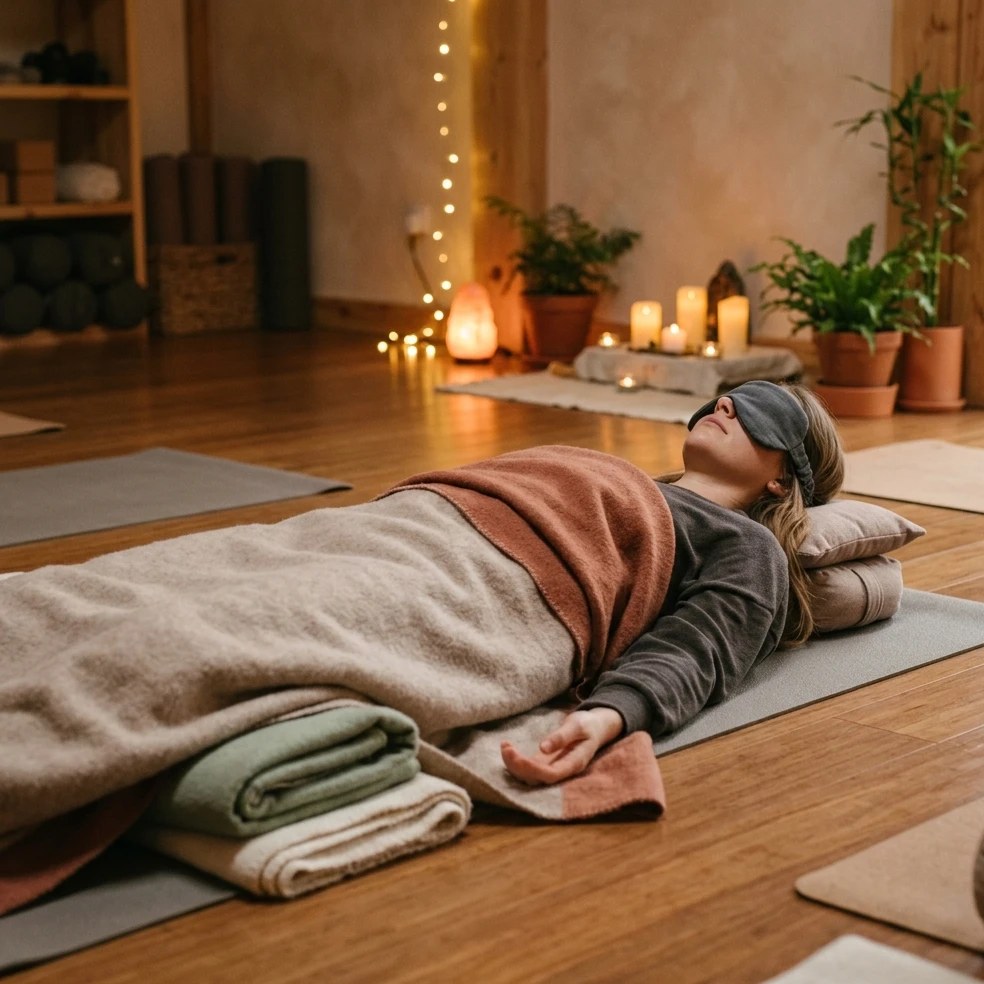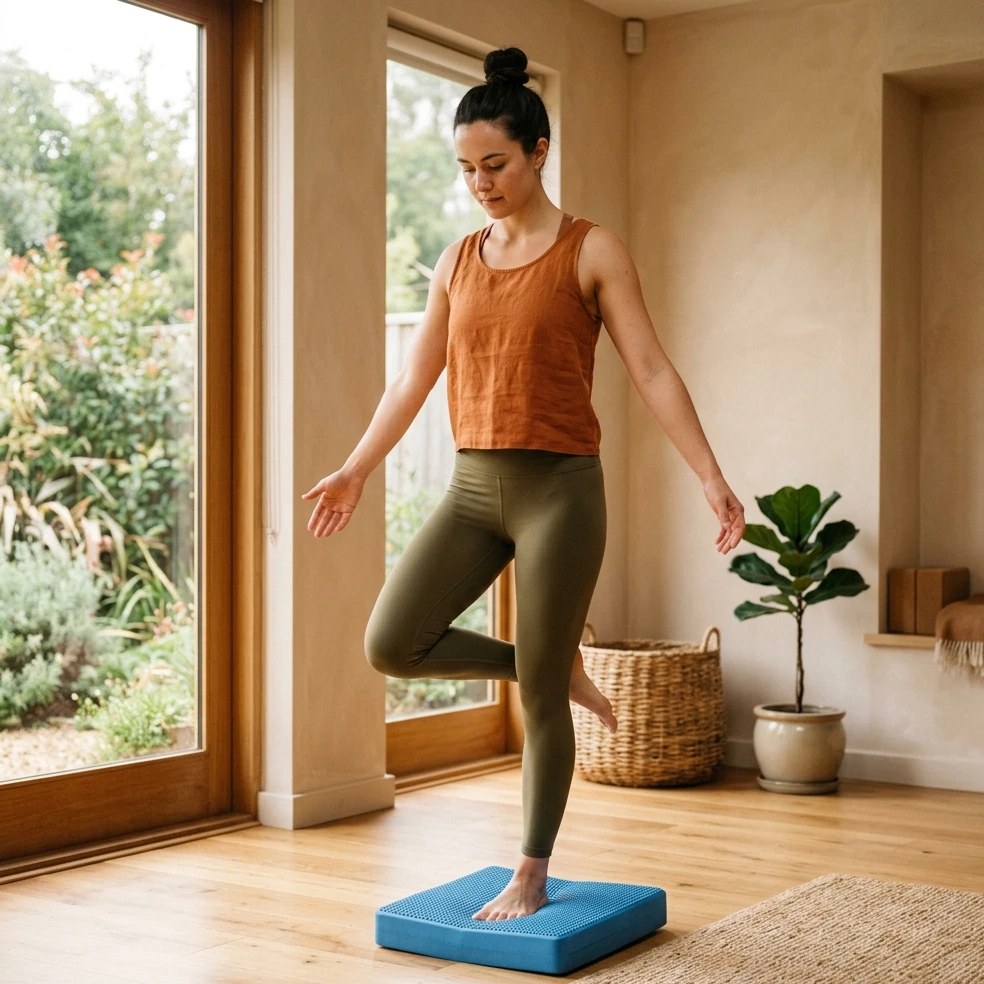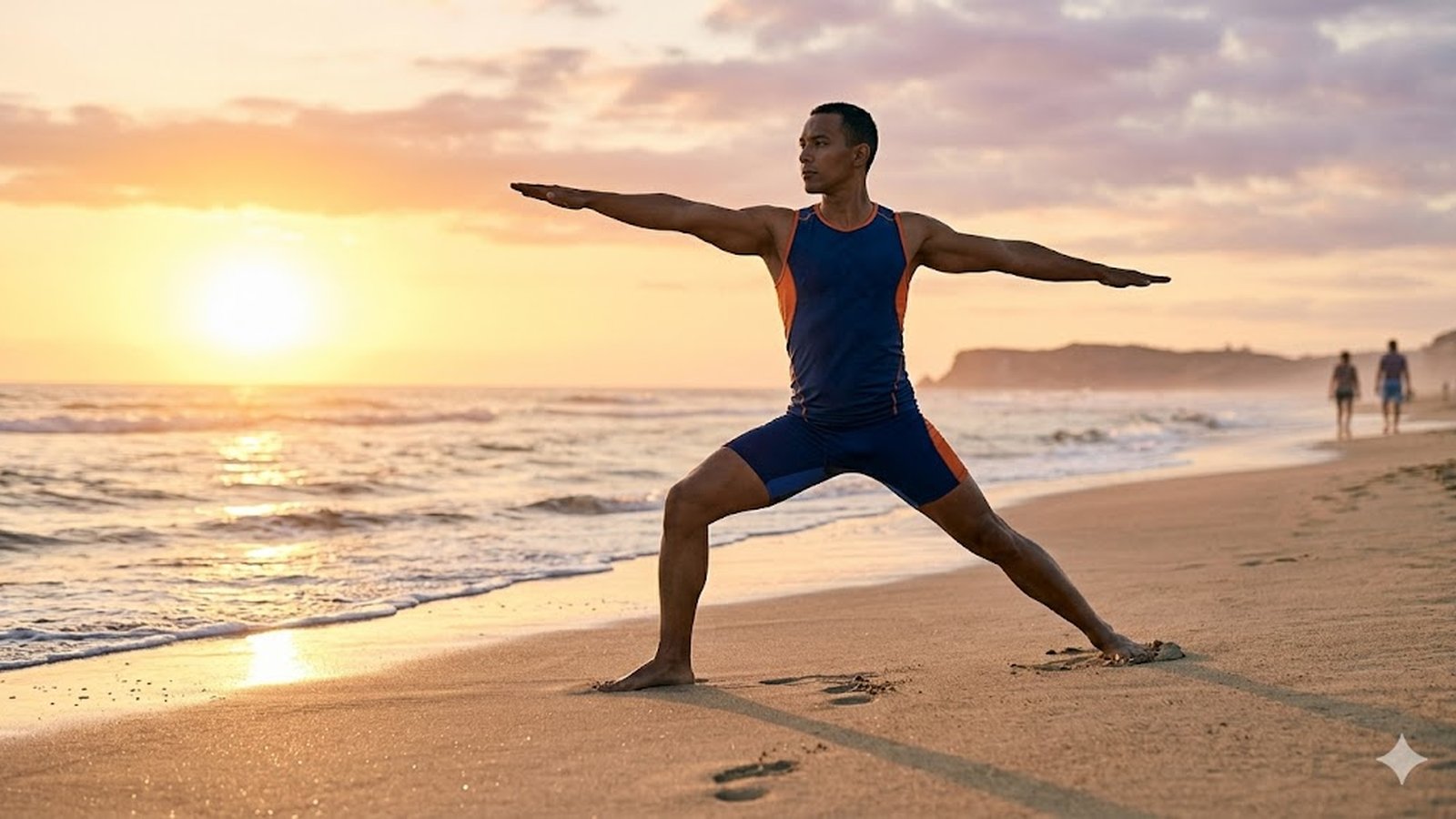
The 60-second version
Yoga performed on sand recruits the small stabilizers of the ankle and foot at higher intensity than hardwood-floor practice, with measurable improvements in static and dynamic balance after 4-6 weeks Grabara 2015. The trade-off is that the unstable surface compromises the sustained-hold integrity of postures like Warrior III or Tree, which depend on rigid base contact for proprioceptive feedback. Beach yoga is a balance-stimulus complement to studio practice, not a full substitute — the dominant pose evidence (Cramer 2013) measured all benefits on stable surfaces.
What the evidence actually says
Direct beach-yoga clinical evidence is sparse, but the components have been well-studied. Grabara’s controlled study of yoga on stable vs unstable surfaces showed greater improvements in dynamic-balance indices in the unstable-surface group, with no difference in flexibility outcomes Grabara 2015. The broader yoga literature, summarized in Cramer’s 2013 systematic review, supports yoga’s effects on chronic low back pain, perceived stress, and sleep quality — effects that depend on the meditative and postural components rather than the surface Cramer 2013.
The mechanism by which sand adds to a yoga practice is the same one that makes it harder for unconditioned ankles: continuous low-grade contraction of the medial and lateral ankle stabilizers to maintain alignment Witchalls 2012. After 4-6 weeks of regular sand yoga, the same stabilizers fire faster and with less effort — a transfer that benefits all single-leg balance tasks.
How it actually works
Yoga’s primary documented benefits split between three pathways. The postural component improves spinal mobility and joint range of motion through sustained hold patterns. The breathing component (pranayama) modulates parasympathetic tone, which underlies the stress-reduction and sleep effects Pascoe 2017. The meditative component activates default-mode-network changes associated with reduced rumination. Sand modifies the postural component by adding a balance demand, but does not meaningfully alter the breathing or meditative components — those depend on attention, not surface.
“Yoga interventions appear to produce moderate improvements in stress, anxiety, and quality of life, with effects largely independent of the practice setting.”
— Cramer et al., Annals of Behavioral Medicine, 2013 view source
The caveats people skip
Sun exposure is the most-overlooked beach-yoga risk. A 60-minute mid-morning summer practice on Wasaga Beach delivers a UV dose well above the threshold for sunburn in fair-skinned readers, even with SPF 30 sunscreen which most practitioners do not reapply during practice Diffey 2020. Practice at dawn (before 9am) or after 5pm in summer; reapply SPF 50+ before starting; wear UPF clothing for any pose held longer than two minutes.
The second underdiscussed point is asymmetric loading. Sand grade is rarely level — even a 2-3% slope produces measurable left/right asymmetry in standing pose alignment over a sustained hold. Periodically reposition the mat or switch direction during practice to avoid reinforcing the slope-driven asymmetry.
Practical takeaways
- Use beach yoga as a balance complement to studio practice, not as a complete substitute. The unstable-surface stimulus accrues; the postural depth on a yielding base does not.
- Dawn or evening practice in summer. The UV dose during a 60-minute mid-day session exceeds safe single-day exposure for fair-skinned readers.
- Bring a thicker mat or yoga towel. A standard 4mm mat compresses unevenly into sand; a 6-8mm mat or microfiber towel layered on top stabilizes the surface for hands-and-knees poses.
- Skip deep arm-balances on sand. Crow, Side Crow, and Eight-Angle place high force on a small base of contact and the sand deformation amplifies wrist injury risk.
- Reposition the mat every 5-10 minutes. Even a 2-3% beach slope reinforces left/right asymmetry over a sustained hold.
References
Grabara 2015Grabara M, Szopa J. Effects of hatha yoga exercises on spine flexibility in women over 50 years old. Journal of Physical Therapy Science. 2015;27(2):361-365. View source →Cramer 2013Cramer H, Lauche R, Langhorst J, Dobos G. Yoga for depression: a systematic review and meta-analysis. Depression and Anxiety. 2013;30(11):1068-1083. View source →Witchalls 2012Witchalls J, Blanch P, Waddington G, Adams R. Intrinsic functional deficits associated with increased risk of ankle injuries: a systematic review with meta-analysis. British Journal of Sports Medicine. 2012;46(7):515-523. View source →Pascoe 2017Pascoe MC, Thompson DR, Ski CF. Yoga, mindfulness-based stress reduction and stress-related physiological measures: a meta-analysis. Psychoneuroendocrinology. 2017;86:152-168. View source →Diffey 2020Diffey BL. The early days of personal solar ultraviolet dosimetry. Atmosphere. 2020;11(2):125. View source →