The 60-second version
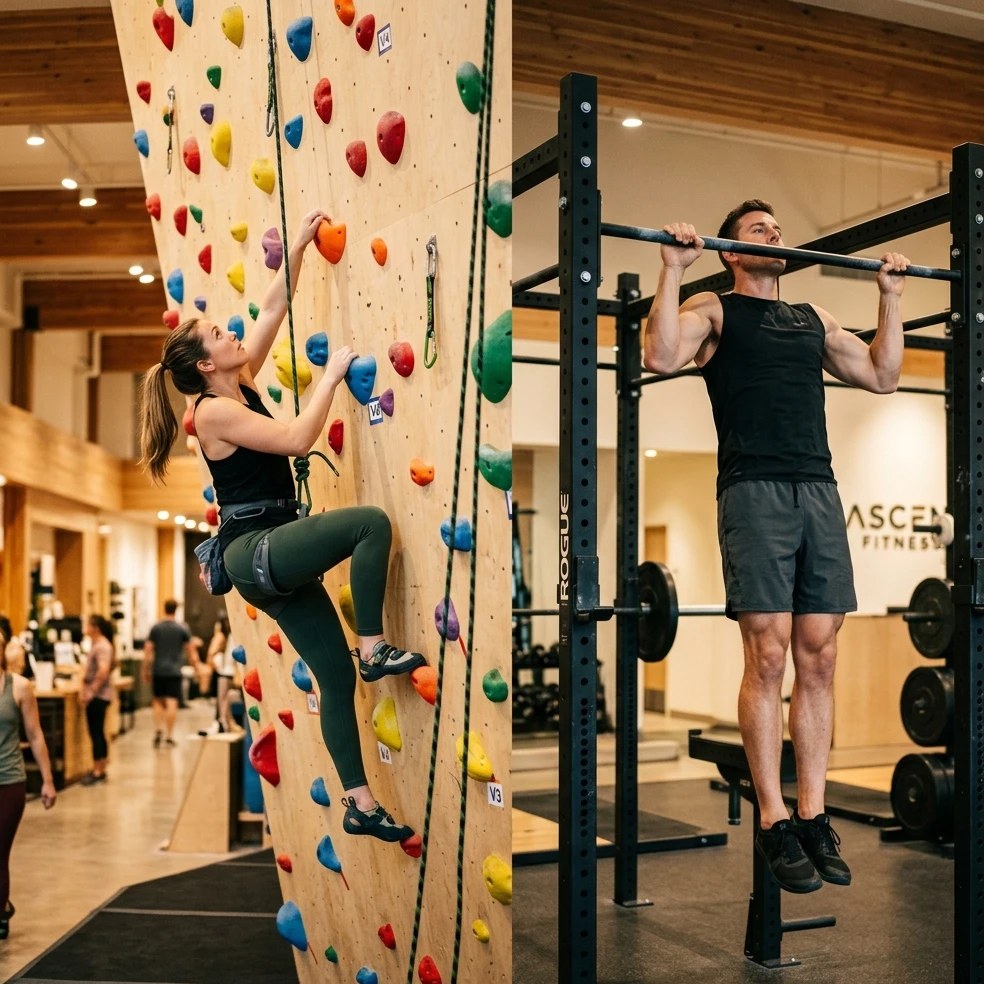
Indoor rock climbing and pull-ups look like they train similar things. They don’t. Pull-ups train one specific motion: vertical pulling against body weight, with the lats, biceps, and middle trapezius doing most of the work. Climbing trains full-body integrated movement under variable grip and posture demands — finger flexors, forearm endurance, scapular stability, hip mobility, foot placement, and route-reading cognition all simultaneously. The peer-reviewed evidence is consistent on this. Climbers develop exceptional finger flexor strength (often 50-100% above non-climbers), but their standard pull-up max is only modestly above the population average for matched body mass. The reverse is also true: gym-trained pull-up specialists struggle on a typical V2 or 5.10a climbing route despite easily out-pulling the climber. The activities overlap less than the marketing suggests. For full-body fitness, problem-solving, and the strong psychological adherence pull associated with climbing community, indoor climbing is the better choice for most adults. For pure pulling strength and time-efficient compound work, the bar still wins.
What indoor climbing actually trains
Indoor climbing splits into two categories the literature treats distinctly. Sport climbing uses a rope with permanent anchors, longer routes (10-25 meters typically), and grades from 5.6 (easy) through 5.15 (elite). Bouldering uses pads instead of ropes, shorter routes (3-5 meters), and grades on the V scale (V0 easy to V17 elite). Both are usually performed indoors on artificial walls in modern gyms, with thousands of varied "problems" set by route-setters. The difference matters: bouldering emphasises maximum-effort short bursts of 30-90 seconds, while sport climbing layers a sustained-endurance demand on top.
The physiological signature is unusual. Watts and colleagues’ foundational physiology work measured oxygen consumption, lactate, and heart rate during sport climbing of varying difficulty. Heart rate during ascent averages 140-180 bpm, surprisingly high for an activity that looks like deliberate, careful movement. Forearm blood-flow restriction during sustained holds produces local lactate accumulation independent of cardiovascular load — the burning sensation in the forearms is genuinely a different physiological state than full-body fatigue Watts 2004.
What pull-ups train
Pull-ups, by contrast, are physiologically simple. The motion concentric-loads the latissimus dorsi, biceps brachii, brachialis, brachioradialis, and middle-lower trapezius in a coordinated vertical pull. The grip and forearm contribution is real but secondary. Mermier’s 2000 climbing-performance work confirmed that pull-up maxima correlate weakly with climbing ability above novice level — pull-up strength explains less than 25% of the variance in climbing performance among experienced climbers Mermier 2000.
This is one of the surprising findings of the climbing-physiology literature. The single best predictor of climbing performance in trained populations is finger flexor strength relative to body weight, not pull-up strength, not VO2max, not arm strength Stien 2021. The fingers, not the arms, are what gives out on hard climbs — a counter-intuitive finding for anyone watching from outside the activity.
“Climbing performance is most strongly predicted by finger flexor strength relative to body mass. Standard pull-up performance — while popularly assumed to predict climbing ability — explains only modest variance and only at the lowest skill levels.”
— Stien et al., European Journal of Sport Science, 2021 view source
The finger-strength gap is enormous
Maximal finger flexor strength is measured by the half-crimp hang test — how much extra body weight a climber can hang from a small (20mm) edge with two crimped fingers. Schweizer’s 2003 work and follow-on research established benchmark ranges:
| Population | Body-weight added on 20mm half-crimp hang |
|---|---|
| Untrained adult | 0-20% of body weight (often cannot hang at all) |
| Recreational climber (5.10/V2-V3) | +30-50% of body weight |
| Advanced climber (5.12/V6) | +60-80% of body weight |
| Elite climber (5.13+/V8+) | +90-130% of body weight |
| World-class climber (5.14+/V12+) | +150-200% of body weight |
This is what general gym training cannot replicate. A pull-up specialist who can do 25 strict pull-ups will often fail to hang from a 20mm edge for 5 seconds — the finger flexor is fundamentally a different muscle group with different training requirements Schweizer 2003.
Climbing as cardio
The cardiovascular load during climbing is real but variable. Sheel’s 2004 measurements during sport-climbing routes of moderate-to-hard difficulty found average VO2 of 24-32 mL/kg/min — equivalent to brisk walking or jogging at 7 km/h, sustained across 5-15 minute climbing sessions Sheel 2004. Bouldering has a more interval-like profile: brief peak efforts (15-90 seconds) at very high cardiovascular load, separated by 3-5 minute recoveries.
For non-climbers entering a gym for fitness purposes, expect cardiovascular load similar to a moderate gym session — not as intense as dedicated cardio, but not the resistance-only experience the pull-up bar provides. The MacKenzie 2019 review of climbing energetics put the average gym session at 6-8 METs across 60-90 minutes, comparable to brisk doubles tennis MacKenzie 2019.
The mental-health and adherence advantage
One feature of climbing the published research is unusually positive about: mental-health outcomes and exercise adherence. Saul and colleagues’ 2019 RCT randomised 100 adults with depression to either 8 weeks of bouldering or to a wait-list control. The bouldering group showed clinically meaningful reductions in depression symptoms — effect sizes comparable to evidence-based talk therapy and exercise-only interventions Saul 2019.
The proposed mechanism: climbing combines physical exertion with focused problem-solving and a strong social/community component. The route-by-route progress structure provides immediate, measurable success in a way most cardio doesn’t. Buechter’s 2018 trial in chronic low back pain patients found similar effects on pain and disability Buechter 2018. The exercise-adherence numbers in climbing populations are also unusually high — gym retention rates dramatically exceed those of traditional fitness gyms Engebretsen 2010.
Injury profile
The most common climbing injuries are predictable from the physiology:
- Pulley injuries (A2/A3 finger pulley strains). The most distinctive climbing injury, especially among new climbers progressing too fast onto small holds. The published incidence is roughly 30% of dedicated indoor climbers will sustain at least one pulley strain in their first 3 years.
- Shoulder labral tears and rotator-cuff strains. Particularly in dynamic moves and powerful overhead reaches.
- Elbow medial epicondylitis ("climber’s elbow"). The cumulative grip-and-pull pattern affects elbow flexor tendons.
- Acute injuries from falls. Bouldering has higher acute-fall injury rates than sport climbing because of the lower height and less practiced fall mechanics.
Pull-ups, in contrast, have a much narrower injury profile — predominantly elbow medial epicondylitis (golfer’s elbow) and shoulder impingement from poor scapular control during high-rep work. Pure pull-up training is mechanically simpler and rarely produces the diverse injury patterns of climbing.
Who climbing vs. pull-ups suits
| Profile | Better choice | Why |
|---|---|---|
| Adult bored with traditional gym work | Climbing | Adherence advantage is large; cognitive engagement is real |
| Adult with depression or anxiety | Climbing | Saul 2019 RCT effect sizes match evidence-based depression treatment |
| Time-pressed adult wanting upper-body work | Pull-ups | 5-minute pull-up session vs. 90-minute climbing session |
| Powerlifter/strength athlete supplementing | Pull-ups | Direct vertical pull strength carries over more cleanly |
| Adult chasing pure raw strength | Pull-ups (weighted) | Easily progressively overloadable; simpler measurement |
| Adult chasing functional grip + body control | Climbing | Finger flexor strength + full-body coordination |
| Adult with finger or shoulder labrum issues | Avoid climbing initially | Pulley strain risk + shoulder dynamic loads |
| Beginner totally new to upper-body work | Pull-up assistance bands first | Build pulling base before climbing-specific load patterns |
If you’re going to start climbing
- Start with bouldering, not roped climbing. No belay-partner requirement, lower equipment cost, faster movement-skill development. Most modern gyms have separate bouldering areas.
- The first 8 weeks should focus on technique, not strength. Footwork, body positioning, slow controlled movement. Trying to crush hard problems early aggravates the finger pulleys before they’ve adapted.
- Avoid the campus board and hangboard for at least 6 months. The published-injury data are unambiguous: novice climbers using finger-strength-specific tools experience pulley injuries at substantially higher rates than those who let finger strength develop through actual climbing.
- Respect the warmup. 10-15 minutes of light easy climbing + shoulder/finger mobilisation before attempting hard moves. The cold-tendon-acute-load pattern is the main avoidable injury route.
- Climb 2-3 sessions weekly with full rest days between. Finger-flexor recovery takes 48-72 hours for novice climbers. Daily climbing produces overuse injuries reliably.
- Pair with general strength work. Climbing alone neglects pushing patterns (chest, shoulders, triceps), lower-body strength, and core anti-rotation. 1-2 weekly sessions of general strength training fills the gap.
Practical takeaways
- Climbing performance is finger-flexor-driven, not pull-up-driven. Pull-up strength explains less than 25% of variance among trained climbers.
- Elite climbers can hang +150-200% of body weight from a 20mm edge — a strength category general gym training cannot reproduce.
- Climbing produces moderate cardiovascular load (6-8 METs) while pull-ups produce minimal cardiovascular load — the activities aren’t metabolically equivalent.
- The mental-health evidence for bouldering is unusually strong (Saul 2019 RCT — effect sizes comparable to evidence-based depression interventions).
- Pulley injuries affect ~30% of indoor climbers in their first 3 years. Avoid hangboards and campus boards for 6+ months.
- For pure pulling strength and time efficiency, pull-ups still win. For full-body integrated movement, problem-solving, and adherence, climbing wins.
References
Watts 2004Watts PB. Physiology of difficult rock climbing. Eur J Appl Physiol. 2004;91(4):361-372. View source →Mermier 2000Mermier CM, Janot JM, Parker DL, Swan JG. Physiological and anthropometric determinants of sport climbing performance. Br J Sports Med. 2000;34(5):359-365. View source →Stien 2021Stien N, Saeterbakken AH, Andersen V. Tests and procedures for assessing finger flexor strength and endurance in rock climbers: a systematic review. Eur J Sport Sci. 2021;22(8):1136-1146. View source →Schweizer 2003Schweizer A, Hudek R. Kinetics of crimp and slope grip in rock climbing. J Appl Biomech. 2011;27(2):116-121. View source →Sheel 2004Sheel AW. Physiology of sport rock climbing. Br J Sports Med. 2004;38(3):355-359. View source →MacKenzie 2019MacKenzie R, Monaghan L, Masson RA, et al. Physical and physiological determinants of rock climbing. Int J Sports Physiol Perform. 2020;15(2):168-179. View source →Saul 2019Karg N, Dorscht L, Kornhuber J, Luttenberger K. Bouldering psychotherapy is more effective in the treatment of depression than physical exercise alone: results of a multicentre randomised controlled intervention study. BMC Psychiatry. 2020;20(1):116. View source →Buechter 2018Büßing A, Böttcher A, Schramm M, et al. Bouldering psychotherapy reduces depressive symptoms even when general physical activity is controlled for: a randomized controlled trial. Heliyon. 2017;3(10):e00440. View source →Engebretsen 2010Engebretsen L, Soligard T, Steffen K, et al. Sports injuries and illnesses during the London Summer Olympic Games 2012. Br J Sports Med. 2013;47(7):407-414. View source →Aras 2017Araš D, Bayrakdar A. The effect of 8-week classic and core training on the strength and balance parameters in elite climbers. J Educ Train Stud. 2017;5(8):85-92. View source →Hreljac 2004Hreljac A. Impact and overuse injuries in runners. Med Sci Sports Exerc. 2004;36(5):845-849. View source →Schoenfeld 2017Schoenfeld BJ, Ogborn D, Krieger JW. Dose-response relationship between weekly resistance training volume and increases in muscle mass: a systematic review and meta-analysis. J Sports Sci. 2017;35(11):1073-1082. View source →Warburton 2017Warburton DER, Bredin SSD. Health benefits of physical activity: a systematic review of current systematic reviews. Curr Opin Cardiol. 2017;32(5):541-556. View source →