The 60-second version
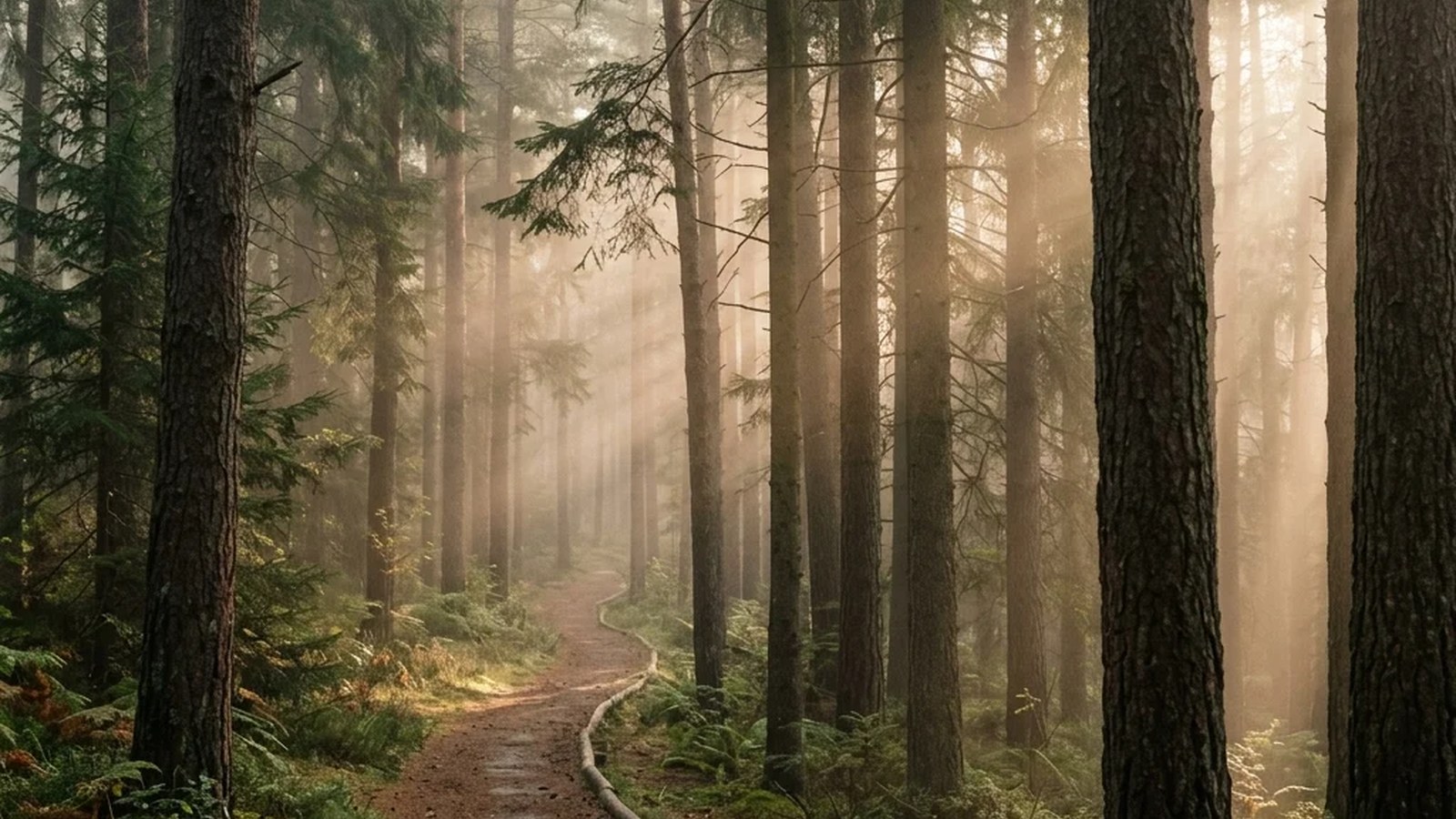
Forest bathing — shinrin-yoku, formalized in Japan in the 1980s — means a slow, sensory walk in a forested area. The peer-reviewed evidence supports three clear effects: measurable reductions in salivary cortisol after a single 1–2 hour session, small but reliable decreases in resting blood pressure and heart rate during and after sessions, and improved mood scores on standardized inventories that persist for 24–48 hours. The immune-boosting claims (sustained NK-cell activation from inhaled phytoncides) are weaker; the original studies showed effects, but replications have been mixed and the doses are hard to translate to ordinary practice. The honest summary: forest bathing is a real stress-reduction intervention with measurable cardiovascular and psychological benefits. It is not a substitute for sleep, exercise, or treatment for clinical anxiety or depression.
Origin and the strong claims
The Japanese Ministry of Agriculture, Forestry and Fisheries formalized shinrin-yoku in 1982 as a public-health intervention. Two decades of research from Japanese forest-medicine groups produced the foundational evidence base. The strongest claims: forest sessions reduce stress hormones, lower blood pressure, improve mood, and via inhaled volatile organic compounds (phytoncides) boost immune function, particularly natural-killer (NK) cell activity.
The cortisol effect is robust
Park's 2010 controlled study compared 24 forest sites against 24 urban sites with 280 participants in a within-subject crossover. Salivary cortisol after a 30-minute forest walk was on average 12% lower than after an equivalent urban walk; pulse rate was lower by 6%; sympathetic nervous activity (heart rate variability) shifted toward parasympathetic dominance Park 2010. The effect sizes are small-to-moderate but consistent across multiple replications.
Twohig-Bennett's 2018 systematic review pooled 143 studies of green-space exposure and broader health outcomes and confirmed the cortisol-lowering and BP-lowering effects across diverse populations and study designs Twohig-Bennett 2018. This is among the better-replicated findings in the wellness-research literature.
“Forest environments produce measurable reductions in cortisol concentration, blood pressure, and pulse rate, alongside improvements in self-reported mood and parasympathetic nervous-system activity. The effects are detectable after a single 30–60 minute session and replicated across rural, suburban, and urban-park settings.”
— Park et al., Environ Health Prev Med, 2010 view source
The NK-cell story is genuinely interesting but weaker
Li's 2008 work showed that 3-day forest immersion increased NK-cell activity by ~50% with effects lasting up to 30 days, attributed to inhaled phytoncides — volatile organic compounds released by trees, particularly conifers Li 2008. The result was striking and sparked a decade of follow-up.
The replication record is mixed. Subsequent studies in non-Japanese forest types (European deciduous, North American mixed) have shown smaller and less consistent NK-cell effects. The dose — 3 days of total immersion — is also far above what most readers will achieve. The honest takeaway: there's a real signal, the mechanism is plausible, but the practical application is unclear.
The mood and anxiety effect
Within-subject mood improvements after forest sessions are reliable across studies, with effect sizes in the 0.3–0.6 range on standardized profile-of-mood-states (POMS) inventories. Effects on clinical depression and generalized anxiety disorder are smaller and less consistent — forest bathing is a useful adjunct to standard care, not a primary treatment.
A sensible weekly protocol
The published research that produced reliable effects converges on:
- 60–90 minutes per session; effects plateau beyond ~2 hours.
- Slow walking pace — about 2 km/hour, much slower than ordinary trail walking. Slower pace correlates with larger HRV shifts.
- Sensory attention (texture of bark, smell of pine, sound of wind in leaves) — not headphones-on cardio. The mindfulness element appears in nearly every protocol that produced large effects.
- Twice-monthly minimum for cumulative effect; weekly is associated with the strongest published cardiovascular signals.
- Forest type matters less than forest density. The published research is conducted across pine, mixed deciduous, eucalyptus, and broadleaf forests with similar effects; the consistent feature is canopy cover and visual screening from urban infrastructure.
If a forest isn't accessible
Urban green-space studies show smaller but real effects. Park visits, large gardens, and even prolonged window-views of green space all produce measurable cortisol and mood effects, scaled down from forest immersion Twohig-Bennett 2018. The principle is consistent: dense vegetation, low artificial-stimuli load, slow pace, and sensory attention.
Practical takeaways
- Treat forest bathing as a stress-reduction intervention, not a medical treatment. The cortisol, blood-pressure, and mood effects are real and replicated.
- Aim for one 90-minute session per week, slowly walking with phone-on-airplane-mode and full sensory attention.
- Don’t expect a single session to fix anxiety or depression. Effects on clinical psychiatric conditions are smaller and adjunctive at best.
- If a forest isn’t accessible, urban parks and gardens deliver scaled-down versions of the same effect. The dose-response is real.
- Don’t inflate the immune-boosting claim. The original studies showed it; replications have been inconsistent; the dose is impractical for most readers.
References
Park 2010Park BJ, Tsunetsugu Y, Kasetani T, Kagawa T, Miyazaki Y. The physiological effects of Shinrin-yoku (taking in the forest atmosphere or forest bathing): evidence from field experiments in 24 forests across Japan. Environ Health Prev Med. 2010;15(1):18-26. View source →Twohig-Bennett 2018Twohig-Bennett C, Jones A. The health benefits of the great outdoors: A systematic review and meta-analysis of greenspace exposure and health outcomes. Environ Res. 2018;166:628-637. View source →Li 2008Li Q, Morimoto K, Kobayashi M, et al. Visiting a forest, but not a city, increases human natural killer activity and expression of anti-cancer proteins. Int J Immunopathol Pharmacol. 2008;21(1):117-127. View source →Hansen 2017Hansen MM, Jones R, Tocchini K. Shinrin-Yoku (Forest Bathing) and Nature Therapy: A State-of-the-Art Review. Int J Environ Res Public Health. 2017;14(8):851. View source →White 2019White MP, Alcock I, Grellier J, et al. Spending at least 120 minutes a week in nature is associated with good health and wellbeing. Sci Rep. 2019;9(1):7730. View source →