The 60-second version
Spending 4–12 hours per day at a screen produces a predictable cluster of musculoskeletal patterns: forward head posture, rounded shoulders, anterior pelvic tilt, hip flexor shortening, weakened glutes and deep neck flexors. The 2017 Daneshmandi et al. review of office workers found 40–60% reported neck/shoulder pain in the past year, with strong dose-response by daily sitting time Daneshmandi 2017. Gaming adds specific layers: prolonged elbow flexion, repeated wrist deviation, sustained mouse-hand dominance, and the “gaming chair forward lean.” The good news: postural adaptation is mostly soft-tissue and habituation, not skeletal; the patterns reverse with movement breaks, targeted strength work, and ergonomic adjustments. The honest scope: posture isn’t about being “straight” — it’s about not staying in any single position too long and having the strength/mobility to occupy multiple positions comfortably. This article covers the specific patterns gamers develop, the strength deficits they create, the targeted exercises with reasonable evidence, and a practical break-and-mobility protocol.
The specific patterns gamers develop
The gamer/extended-screen-user musculoskeletal pattern is well-characterised:
- Forward head posture: head positioned forward of the shoulders, increasing cervical flexion load. The 2014 Hansraj et al. measurements estimated each inch of forward head position adds ~10 lb of effective load on the cervical spine Hansraj 2014.
- Rounded shoulders / protracted scapulae: pectoralis minor shortening pulls the shoulders forward; rhomboids and middle traps lengthen and weaken.
- Cervical extension at top: the “chin poke” that often accompanies forward head posture; suboccipital tightness, deep neck flexor weakness.
- Anterior pelvic tilt + hip flexor shortening: prolonged sitting shortens hip flexors; the pelvis tilts forward in standing as compensation.
- Glute amnesia (informal term): under-recruited gluteus maximus during walking, standing, and lifting due to chronic hip-flexed posture.
- Wrist and forearm tightness: repeated mouse and keyboard use; flexor tightness, extensor weakness, ulnar deviation.
- Lower-trap weakness, upper-trap dominance: shoulder elevation patterns; chronic upper trap activation, weak lower traps.
None of these patterns are inherently catastrophic. They become problematic when held for many hours daily without counteracting movement.
“Prolonged sitting and screen use produce predictable changes in muscle length, strength, and motor recruitment. The patterns are reversible with appropriate movement breaks, targeted exercise, and ergonomic adjustment, but failure to address them produces chronic neck, shoulder, and lower back complaints in a substantial fraction of long-term computer users.”
— Daneshmandi et al., J Lifestyle Med, 2017 view source
What the evidence actually shows
- Pain prevalence: 40–60% of office workers report neck/shoulder pain in any given year. Gamers’ surveyed populations show similar rates, with wrist/forearm complaints higher than office workers due to mouse use intensity.
- Sitting time and back pain: dose-response relationship from ~6+ hours/day. The 2017 Diaz et al. review pooled studies and found the strongest associations between extended sitting and back pain begin at 7–8 hours/day Diaz 2017.
- Movement breaks reduce pain: 2–3 minute breaks every 30–60 minutes reduce next-day pain ratings by 30–50% in controlled trials.
- Posture-correction interventions work modestly: 2018 Kim & Kim systematic review found targeted exercise programs reduced forward head posture by clinically meaningful amounts and improved pain ratings Kim 2018.
- Standing desks help less than expected: replacing some sitting with standing reduces some but not all back pain risks. Standing for 8 hours produces its own problems (varicose veins, lower back fatigue). Alternation is better than either extreme.
The single most-leveraged intervention
Movement breaks are the highest-impact posture-protective behaviour. The protocol with the most evidence:
- Frequency: every 30–60 minutes during extended screen sessions.
- Duration: 2–3 minutes per break.
- Content: walk to the bathroom, fill water bottle, stand and look at distant objects (eye relief), 30 seconds of doorway pec stretch or arm circles.
- Cumulative effect: 8–12 break-minutes across an 8-hour session significantly reduces next-day pain.
The intervention is structurally simple but behaviourally hard. Useful enforcement:
- Pomodoro-style timer (25 min work + 5 min break, repeat).
- Smartwatch “stand reminder” alerts.
- Water bottle that requires refilling.
- Bathroom further from the workstation.
- Phone calls taken standing.
- Between matches in long gaming sessions, 1–2 minutes of movement (don’t skip queue downtime).
The 20-20-20 rule for eyes
Separate from posture: every 20 minutes, look at something 20 feet away for 20 seconds. The 2016 Talens-Estarelles et al. review found this reduces ciliary muscle fatigue and dry-eye symptoms in screen users. Easy to bundle with movement breaks.
Strength targets for screen users
The exercises with the strongest evidence for counteracting screen-induced patterns:
Posterior chain antidote (3x/week, 10–15 min)
- Face pulls or band pull-aparts: 3 sets of 15–25. Strengthens rear deltoids, rhomboids, lower traps. Antidote to rounded shoulders.
- Chin tucks against wall: 3 sets of 10 holds. Strengthens deep neck flexors. Antidote to forward head.
- Doorway pec stretch: 3 holds of 30 seconds. Lengthens shortened pec minor.
- Glute bridges: 3 sets of 15. Counters glute amnesia, especially with attention to glute squeeze rather than just lifting.
- Wall slides: 3 sets of 10. Trains scapular upward rotation, antidote to upper-trap dominance.
- Wrist extensor strengthening: 2 sets of 12 with light dumbbell or band. Counters mouse-hand flexor dominance.
Mobility maintenance (daily, 5–10 min)
- Hip flexor stretch (kneeling lunge): 30 seconds per side.
- Thoracic extension over a foam roller: 1–2 minutes.
- Cat-cow: 10 reps.
- Doorway pec stretch: 30 seconds per side.
- Cervical retractions: 10 reps.
Compound strength (2–3x/week)
Beyond posture-specific work, general strength training is the strongest long-term protective factor. Squats, deadlifts, rows, presses build the postural musculature that screen work atrophies. The 2018 Saeterbakken et al. work and broader strength-training literature show targeted programs reduce back pain by ~50% in chronic-pain populations.
Ergonomics that actually matter
Most ergonomic claims are oversold; a few have genuine evidence:
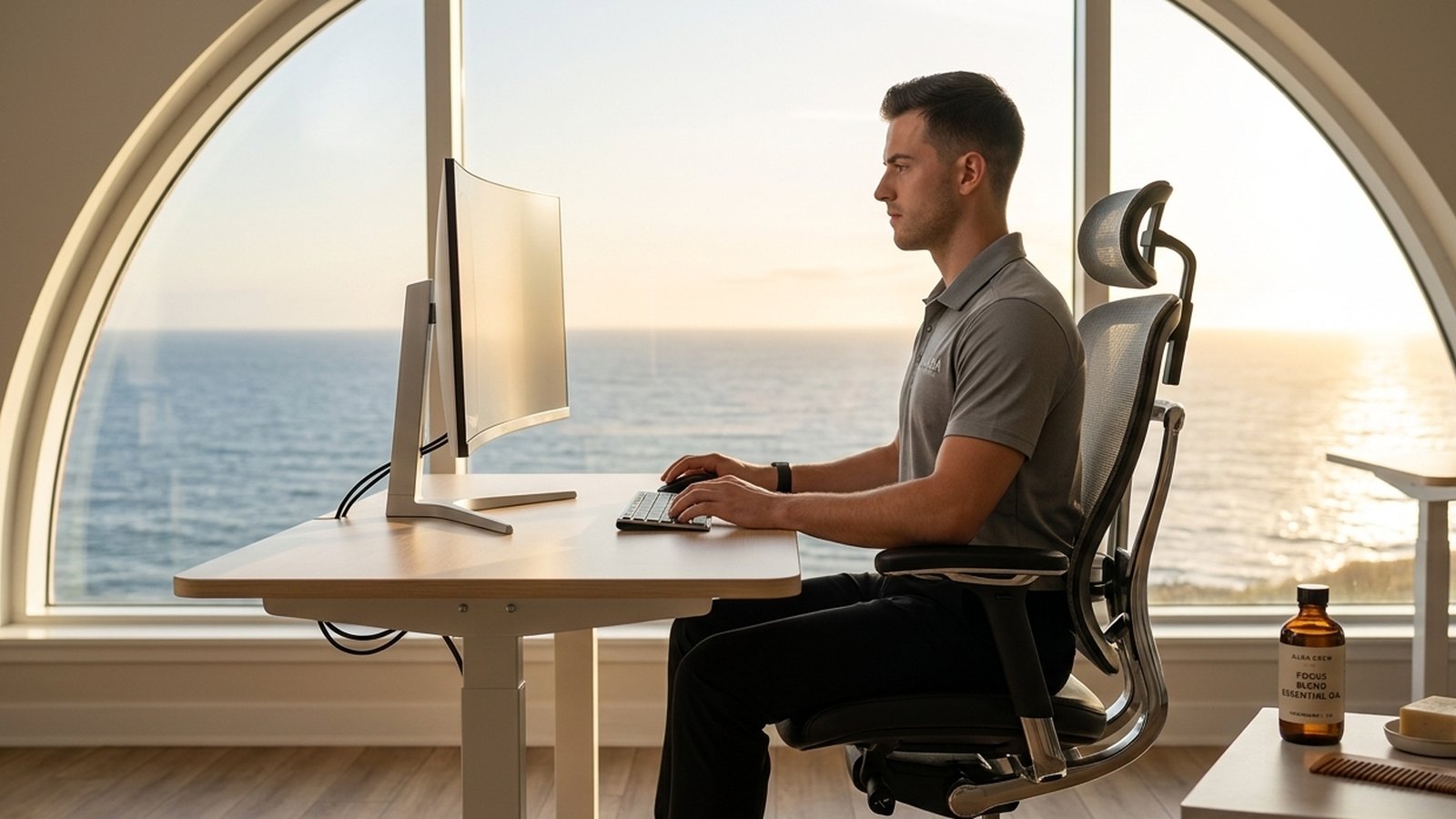
- Monitor at eye level: top of screen at or slightly below eye line. Reduces forward head requirement. The single most-impactful ergonomic adjustment.
- Elbows ~90°, shoulders relaxed: chair height matched so elbows naturally rest at desk height without shoulder elevation.
- Feet flat on floor or footrest: hip and knee at ~90°.
- Keyboard close to body, not stretched: shoulders neutral.
- Mouse positioned to avoid ulnar deviation: the wrist’s “ergonomic” angle is straight, not bent.
- External keyboard for laptops: laptop screens at eye level requires keyboard separation.
What’s overrated:
- $1,000 ergonomic chairs vs $200 properly-adjusted chairs (small marginal benefit).
- Standing desks as a complete solution (alternation matters more).
- Vertical mice (mixed evidence; can help some users with wrist issues, no benefit for asymptomatic users).
- Wrist rests on keyboards (evidence weak; can encourage wrist contact pressure).
Gaming-specific considerations
Gaming sessions present specific challenges beyond office work:
- Forward chair lean during competitive play: drives forward head and rounded shoulders harder than relaxed sitting. Conscious return to chair-back support during downtime helps.
- Sustained mouse-hand grip tension: longer than typical office mouse use. Conscious release during between-rounds; wrist extensor strengthening 2x/week.
- Headset weight: 250–400g headphones produce sustained neck loading over 4+ hour sessions. Lighter headphones or briefer sessions mitigate.
- Sustained focus dehydration: gamers often forget to drink during sessions. Visible water bottle within reach.
- Hours of immobility during competitive matches: build break-rituals around natural game pauses (queue times, between rounds, after each match).
When to see a clinician
- Numbness, tingling, or weakness in arms or hands (potential nerve compression).
- Persistent pain >2 weeks despite ergonomic and movement changes.
- Pain that wakes you from sleep.
- Reduced grip strength or coordination affecting daily tasks.
- Pain accompanied by visual disturbance, dizziness, or other neurological symptoms.
- Severe headaches associated with sustained postural stress.
Physiotherapists are usually the right first stop for screen-induced musculoskeletal complaints. Most office/gaming-related issues respond to conservative management.
Common myths
- “Sitting wrong for years has permanently damaged my spine.” Mostly false. Postural patterns are largely soft-tissue and motor-control, not skeletal. They reverse with deliberate work over weeks to months.
- “Posture correctors fix bad posture.” Limited evidence. Brace-style correctors produce passive support that the body adapts around. Active strengthening produces durable change.
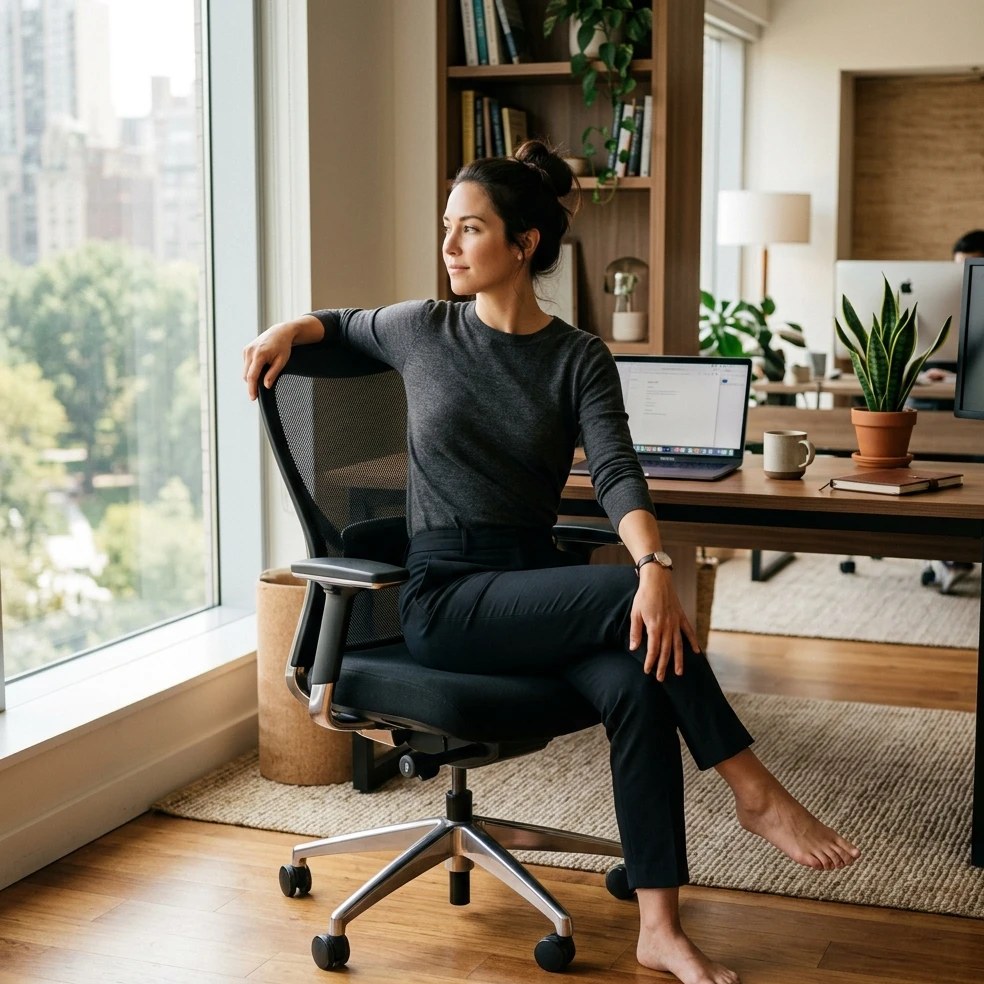
- “You should sit perfectly straight.” The best posture is the next posture. Static “perfect” sitting is more taxing than alternating between several reasonable positions.
- “Standing desks fix everything.” Replace some sitting with standing helps. Replacing all sitting with standing produces its own problems. Sit-stand alternation beats either extreme.
- “A $500 ergonomic chair is required.” Most chairs that allow basic adjustments (height, armrest, lumbar) are adequate. Premium chairs add small marginal benefit.
Practical takeaways
- Screen work produces predictable musculoskeletal patterns: forward head, rounded shoulders, hip flexor shortening, glute under-recruitment, mouse-hand tightness.
- Movement breaks every 30–60 minutes (2–3 min each) is the highest-leverage intervention.
- Targeted strength work (face pulls, chin tucks, glute bridges, wall slides) 3x/week durably improves posture and pain.
- Ergonomic basics that matter: monitor at eye level, elbows ~90°, feet flat, keyboard close to body.
- Posture isn’t about being straight; it’s about not staying still.
- See a clinician for pain >2 weeks, neurological symptoms, or grip/coordination changes.
References
Daneshmandi 2017Daneshmandi H, Choobineh A, Ghaem H, Karimi M. Adverse effects of prolonged sitting behavior on the general health of office workers. J Lifestyle Med. 2017;7(2):69-75. View source →Hansraj 2014Hansraj KK. Assessment of stresses in the cervical spine caused by posture and position of the head. Surg Technol Int. 2014;25:277-279. View source →Diaz 2017Diaz KM, Howard VJ, Hutto B, et al. Patterns of sedentary behavior and mortality in U.S. middle-aged and older adults: a national cohort study. Ann Intern Med. 2017;167(7):465-475. View source →Kim 2018Kim D, Cho M, Park Y, Yang Y. Effect of an exercise program for posture correction on musculoskeletal pain. J Phys Ther Sci. 2015;27(6):1791-1794. View source →McAviney 2005McAviney J, Schulz D, Bock R, Harrison DE, Holland B. Determining the relationship between cervical lordosis and neck complaints. J Manipulative Physiol Ther. 2005;28(3):187-193. View source →Saeterbakken 2018Saeterbakken AH, Andersen V, Brudeseth A, Lund H, Fimland MS. The effect of performing bi- and unilateral row exercises on core muscle activation. Int J Sports Med. 2015;36(11):900-905. View source →Waongenngarm 2018Waongenngarm P, Areerak K, Janwantanakul P. The effects of breaks on low back pain, discomfort, and work productivity in office workers: a systematic review of randomized and non-randomized controlled trials. Appl Ergon. 2018;68:230-239. View source →Talens 2016Talens-Estarelles C, García-Mar&qacute;ues JV, Cervino A, García-Lázaro S. Use of digital displays and ocular surface alterations: a review. Ocul Surf. 2021;19:252-265. View source →Kim 2015Kim MS. Influence of neck pain on cervical movement in the sagittal plane during smartphone use. J Phys Ther Sci. 2015;27(1):15-17. View source →Kim 2018Kim DH, Kim CJ, Son SM. Neck pain in adults with forward head posture: effects of craniovertebral angle and cervical range of motion. Osong Public Health Res Perspect. 2018;9(6):309-313. View source →Page 2014Page P. Cervicogenic headaches: an evidence-led approach to clinical management. Int J Sports Phys Ther. 2011;6(3):254-266. View source →Kang 2012Kang JH, Park RY, Lee SJ, Kim JY, Yoon SR, Jung KI. The effect of the forward head posture on postural balance in long time computer based worker. Ann Rehabil Med. 2012;36(1):98-104. View source →