The 60-second version
Children dehydrate faster than adults during heat exposure for two reasons: their surface-area-to-mass ratio is higher (so they gain heat from the environment more quickly), and their sweat rate per unit of body mass is lower (so evaporative cooling is less efficient) Bar-Or 2001. The practical implications: kids need scheduled fluid breaks, not on-demand drinks; the cup-not-bottle problem (kids drink less than they think when they self-pour from a shared bottle) is a major source of family-context dehydration; and the ACSM and Sawka 2007 thresholds for adult athletes need adjustment for the under-12 set Sawka 2007. The Canadian Paediatric Society’s 2019 guidance lays out the practical thresholds: 100–250 mL every 20 minutes during sustained warm-weather activity, with electrolyte support for sessions over 60 minutes CPS 2019.
Why kids dehydrate faster than adults
The thermoregulatory differences between children and adults are physiological, not behavioural. Bar-Or’s 2001 review of pediatric thermoregulation laid out the three mechanisms that put kids at higher dehydration risk in the heat Bar-Or 2001. First, surface-area-to-mass ratio: a typical 7-year-old has roughly 35–40% more skin surface per kilogram of body mass than an adult, which means more heat absorption from the environment when ambient temperature exceeds skin temperature.
Second, sweat rate. Pre-pubertal children sweat at 40–60% of the adult rate per unit of body mass under matched conditions. Sweat is the body’s primary heat-dissipation mechanism, so reduced sweat output means more reliance on cardiovascular adjustment (skin blood flow) and therefore higher core temperatures for the same heat load Bar-Or 2001. The practical implication: a 30-minute beach soccer session that an adult tolerates with one water bottle requires roughly twice that fluid replacement for a 9-year-old.
Third, perception. Kids’ thirst signal is less reliable than adults’ under heat stress. Rowland’s 2008 work on pediatric exercise hydration showed that children consistently underdrink relative to fluid loss when relying on thirst alone, even when offered palatable drinks Rowland 2008. The honest framing: thirst is a lagging indicator for everyone, but it lags more for kids.
The WHO and ACSM thresholds, adjusted for kids
Sawka’s 2007 ACSM position stand on exercise and fluid replacement is the cleanest synthesis of the adult literature: 400–800 mL/hour during sustained activity in warm conditions, with electrolyte support for sessions over 60 minutes Sawka 2007. The same paper acknowledges that pediatric thresholds need separate development because of the thermoregulatory differences Bar-Or 2001 documents.
The Canadian Paediatric Society’s 2019 hydration guidance for active children translates the adult literature into pediatric practice CPS 2019. The headline recommendation: 100–250 mL every 20 minutes during sustained warm-weather activity, scaled by body size (toward the lower end for under-25 kg children, toward the higher end for over-50 kg adolescents). Pre-activity loading of 200–400 mL 30 minutes before exposure improves the buffer.
For sessions exceeding 60 minutes — a long beach day, a soccer tournament, an extended bike ride — the same guidance recommends some carbohydrate and electrolyte content (a sports drink at half-strength, or water plus a salty snack), not just water. The mechanism is the same as for adults: prolonged sweat losses deplete sodium, and pure-water replacement at high volumes risks dilutional hyponatremia Sawka 2007.
The cup-not-bottle problem in family hydration
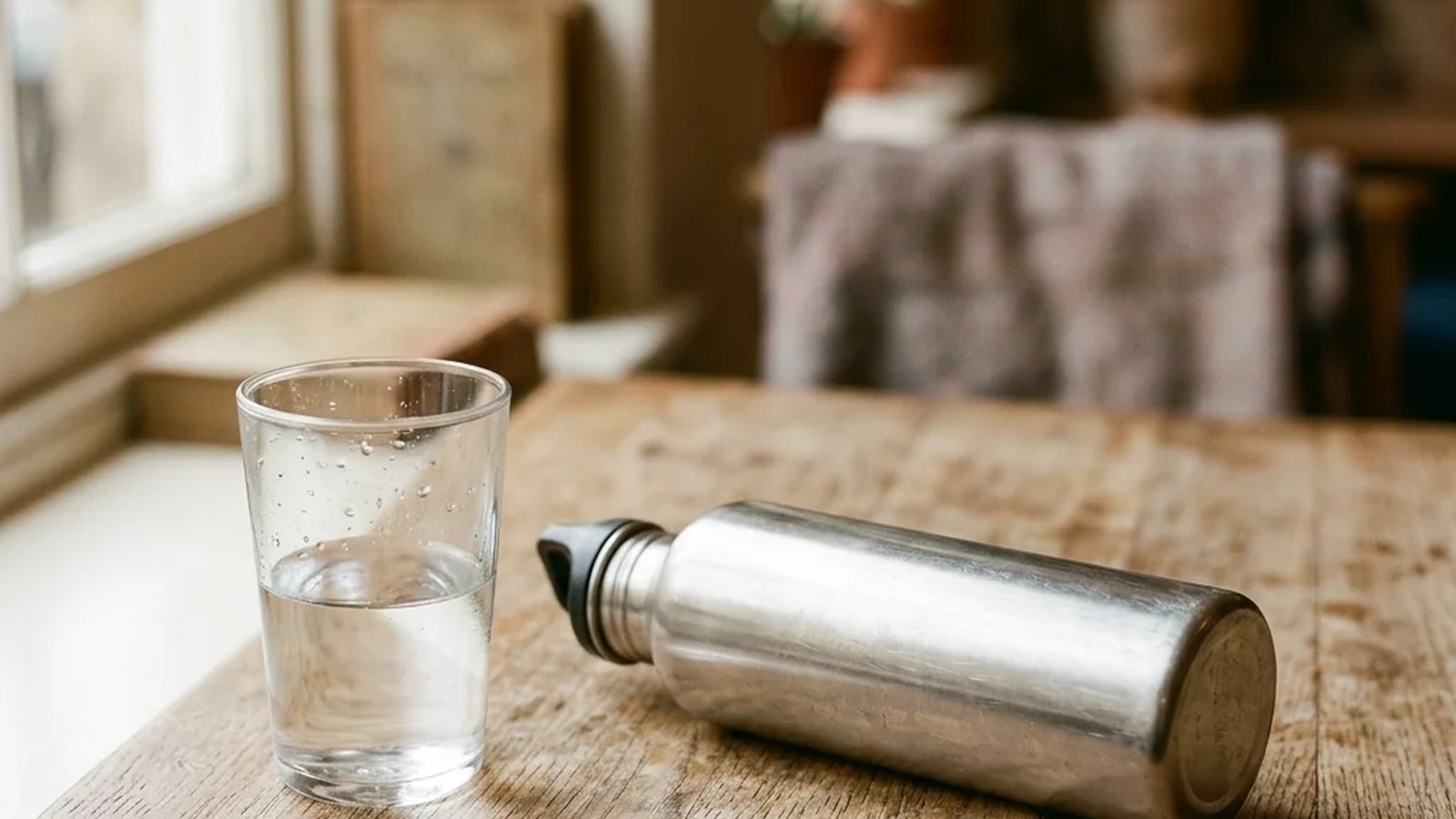
One of the largest gaps between “evidence-based hydration guidance” and “what actually happens at the beach” is structural. When kids self-pour from a shared family water bottle, they consistently underdrink relative to scheduled cup pours. Rowland 2008’s observational work on pediatric drinking behaviour during sustained exercise found that scheduled cup-based offerings increased fluid intake by roughly 40–70% versus on-demand bottle access Rowland 2008.
The mechanism is partly attentional — kids in active play don’t notice mild thirst — and partly social: a shared bottle creates a small barrier (find it, open it, decide how much to take) that suppresses small-but-frequent drinking. Individual cups offered on a schedule remove both barriers. The practical implementation: a labelled cup or small bottle per kid, refilled and offered every 20 minutes during warm-weather activity.
The same principle applies to flavour. Bar-Or 2001 and Rowland 2008 both note that children drink more total fluid when offered palatable beverages (lightly flavoured water, dilute juice, sports drinks at half-strength) than plain water under matched conditions Bar-Or 2001. The honest framing for families: flavour is a compliance lever; the choice between “ideal beverage” and “beverage that gets drunk” is structurally similar to the post-activity stretching compliance question.
Recognizing dehydration in kids before it gets serious
Mild-to-moderate dehydration (2–5% body weight loss) presents differently in kids than in adults. The classic adult signs — thirst, fatigue, headache — are present but kids often don’t articulate them clearly. The pediatric-relevant signs are behavioural: irritability disproportionate to the situation, withdrawal from active play, dark or infrequent urination (parents who haven’t seen a bathroom trip in 4+ hours during a warm day should treat that as a yellow flag).
More serious signs — capillary refill greater than 2 seconds, sunken eyes, dry mucous membranes, lethargy — warrant cooling, oral rehydration, and clinical assessment. The CPS 2019 guidance flags that emergency department presentation rates for heat-related illness in children peak in the first hours of unusually warm conditions, when families haven’t yet adjusted to the day’s heat load CPS 2019.
The asymmetric risk worth flagging: heatstroke (core temperature above 40°C) in children can progress quickly and is a medical emergency. Move the child to shade, remove excess clothing, sponge with cool (not cold) water, offer fluids if conscious and able to swallow, and call emergency services if mental status changes, vomiting begins, or temperature does not respond. The honest framing: hydration is the prevention; recognition is the next-line tool when prevention has fallen short.
A practical hydration routine for a beach day
The routine that lines up with CPS 2019 and Sawka 2007 looks like this in family-context implementation. Pre-activity (30 minutes before): 200–400 mL water per child, scaled by body size. During activity: 100–250 mL every 20 minutes, offered in individual cups or small labelled bottles, with a flavoured option available for picky drinkers. Post-activity: continue offering fluids for 1–2 hours after exposure ends, scaled to the duration and intensity of the activity CPS 2019.
For a typical 4-hour beach day with a 7-year-old (roughly 25 kg), the math works out to about 1.5–2 L of fluid intake total, distributed across the day. For a 12-year-old (roughly 45 kg), 2–2.5 L. Both totals are higher than parents typically realize and require active offering on the 20-minute interval rather than passive on-demand access.
For sessions longer than 60 minutes in moderate-to-warm conditions, electrolyte support — a half-strength sports drink, water plus a salty snack like a few pretzels — matters for the same dilutional-hyponatremia reason it does in adults. Sawka 2007 frames this as the “over-60-minute threshold,” and the CPS 2019 pediatric-application of that threshold is unchanged Sawka 2007.
What the evidence does not support
Several common family-context hydration practices don’t hold up well to the literature, and naming them is part of the honest read.
Pre-activity fluid loading well above the 200–400 mL CPS 2019 threshold doesn’t produce additional benefit; it just produces a bathroom break in the first 30 minutes of activity. The thermoregulatory buffer comes from being normally hydrated entering activity, not from being hyperhydrated Bar-Or 2001.
“Coconut water as a magic electrolyte solution” is a marketing framing the evidence does not support over a half-strength sports drink for matched cost. The electrolyte profile of coconut water is high in potassium but relatively low in sodium — the opposite of what sustained sweat loss preferentially depletes. It is fine as a beverage; it is not specifically optimized for pediatric heat-stress hydration Sawka 2007.
“Salt tablets” for kids are unnecessary and risk overshooting in the typical family-activity context. The half-strength sports drink or the salty-snack-plus-water approach delivers the right sodium dose without the gastric-irritation risk of concentrated salt tabs. The CPS 2019 guidance notes that pediatric oral rehydration solutions exist for clinical dehydration but should not be used prophylactically for routine activity CPS 2019.
Post-activity rehydration and the rest of the day
Post-activity rehydration matters for the same physiological reasons mid-activity hydration does. Sweat losses continue at a low rate for 30–60 minutes after activity ends, and the kid who comes off the beach already 2–3% dehydrated needs active fluid offering through that window to return to baseline before the dinner-and-bedtime sequence. Sawka 2007’s recovery-rehydration framework specifies 1.5 L of fluid per kg of body weight lost during activity for full restoration Sawka 2007.
For pediatric application, the practical translation is straightforward: continue offering fluids in 100–150 mL increments every 20–30 minutes for the first hour after activity ends, with a meal containing both salt and water content (a sandwich and watermelon, pasta and a glass of milk) within 60–90 minutes. The CPS 2019 guidance treats post-activity rehydration as a substantial part of the daily-fluid math, not a brief afterthought CPS 2019.
The bedtime caveat: avoid pushing large fluid volumes within 1–2 hours of sleep, particularly for younger children whose bladder capacity is the limit. The trade-off Bar-Or 2001 implicitly highlights is between full rehydration and uninterrupted sleep Bar-Or 2001; for most family beach-day patterns, finishing the rehydration with dinner and stopping fluid loading by an hour before bed is the practical balance.
Environmental modifiers: humidity, sun, and shade availability
The CPS 2019 thresholds assume reasonable environmental conditions; high-humidity days, prolonged direct-sun exposure, and absence of shade all increase the fluid demand. Bar-Or 2001’s thermoregulation work specifies that high humidity reduces sweat evaporation efficiency, which means the kid sweats more total fluid for the same cooling effect Bar-Or 2001. The hydration adjustment: bump the per-20-minute offering toward the high end of the 100–250 mL range on hot, humid, full-sun days.
Shade availability is the other modifier. A beach day with reliable shade access (umbrella, tree line, pavilion) produces meaningfully lower fluid loss than the same hours of direct sun. Rotating into shade for 10–15 minutes every hour is the practical lever; the perception that “more sun equals more beach” is one of the most common reasons families overshoot the appropriate exposure for kids.
The Wasaga and Georgian Bay context: most provincial-park and municipal beach areas in southern Ontario have decent shade availability through tree lines along the back of the beach, and the on-shore breeze typical of the region helps with evaporative cooling. The honest framing: the regional context is friendlier than southern Florida or Arizona, but the same hydration principles apply. The CPS 2019 framework is the appropriate baseline regardless of geography CPS 2019.
Practical takeaways
- Kids dehydrate faster than adults due to higher surface-area-to-mass ratio and lower sweat rate (Bar-Or 2001).
- 100–250 mL every 20 minutes during sustained warm-weather activity is the CPS 2019 pediatric threshold.
- Cups offered on a schedule beat on-demand bottles by 40–70% on actual fluid intake (Rowland 2008).
- Add electrolytes for sessions exceeding 60 minutes (Sawka 2007 threshold).
- Behavioural signs (irritability, withdrawal from play) precede classical physical signs in kids.
- Pre-loading 200–400 mL 30 minutes before activity improves the buffer; more is not better.
References
Bar-Or 2001Bar-Or O. Nutritional considerations for the child athlete. Canadian Journal of Applied Physiology. 2001;26(Suppl):S186-S191. View source →Rowland 2008Rowland T. Thermoregulation during exercise in the heat in children: old concepts revisited. Journal of Applied Physiology. 2008;105(2):718-724. View source →Sawka 2007Sawka MN, Burke LM, Eichner ER, Maughan RJ, Montain SJ, Stachenfeld NS. American College of Sports Medicine position stand: exercise and fluid replacement. Medicine and Science in Sports and Exercise. 2007;39(2):377-390. View source →CPS 2019Canadian Paediatric Society. Promoting physical activity for children and youth (statement). Paediatrics & Child Health. 2019. View source →