The 60-second version
The thirst mechanism that reliably tells a 30-year-old when to drink water becomes substantially less reliable after age 60. Reduced hypothalamic osmoreceptor sensitivity, blunted angiotensin II response, and altered renal water-handling all degrade with age, leaving older adults vulnerable to reaching significant fluid deficits before subjective thirst registers Kenney 2001. The European geriatric nutrition guidelines (Volkert 2019) recommend 1.6 L/day total water intake for women and 2.0 L/day for men aged 65+ Volkert 2019. Stookey’s 2005 cross-sectional work in The Journal of the American Dietetic Association found roughly 20-30 percent of community-dwelling older adults showed biomarkers of inadequate hydration Stookey 2005. Hooper’s 2014 Cochrane review documented the consequences: increased risk of cognitive impairment, falls, urinary tract infections, and hospital admissions Hooper 2014. The practical fix is replacing thirst with a structural reminder system — activity-anchored routines outperform timer-based reminders for adherence, and marked water bottles are a low-cost, high-effectiveness implementation.
Why thirst stops being a reliable signal after 60
The age-related decline in thirst sensitivity is one of the better-characterized physiological changes in geriatric medicine, with multiple complementary mechanisms documented across decades of research Kenney 2001. The hypothalamic osmoreceptors that detect plasma osmolality — the primary trigger for the thirst sensation — show reduced sensitivity in older adults, requiring larger osmolality shifts to produce the same subjective thirst rating that a 30-year-old experiences. Angiotensin II, the second major thirst trigger acting through the subfornical organ, shows blunted response in older adults as well. The combined effect is that an older adult can reach a 1-2 percent body-weight deficit (the threshold at which younger adults reliably feel thirsty) without experiencing more than mild dryness of the mouth.
The renal handling of water also shifts with age. Concentrating capacity declines, meaning the kidneys produce more dilute urine for any given fluid load, which compounds the thirst-sensitivity problem. Aldosterone and antidiuretic hormone responses are altered. Net effect: the same fluid intake that maintains hydration in a 35-year-old produces a measurable deficit in a 75-year-old, and the warning signal that would prompt corrective drinking is muted.
The clinical implication is that ‘drink when you’re thirsty’ — reasonable advice for most healthy adults under 60 — becomes inadequate guidance for the over-65 population. Structural replacements for the thirst signal (scheduled drinking, activity-anchored routines, marked water bottles) become the appropriate substitute. The shift from intuitive to structured fluid management is one of the more important practical adaptations for healthy aging.
The 1.5-2L daily target the geriatric literature supports
The European Society for Clinical Nutrition and Metabolism (ESPEN) guideline on geriatric nutrition published by Volkert and colleagues in 2019 represents the current consensus on hydration targets for older adults Volkert 2019. The recommended total water intake from beverages is 1.6 L/day for women and 2.0 L/day for men aged 65 and older. The figure is calculated from European Food Safety Authority adequate-intake values, adjusted for the typical food-water contribution in a Western diet, and validated against hydration biomarkers in older-adult cohorts.
The 1.6/2.0 L target applies in the absence of additional fluid losses. Hot weather, exercise, fever, certain medications (diuretics, in particular), and gastrointestinal losses all increase the requirement. For an active older adult on a hot Ontario summer day, the working target moves to 2.0-2.5 L. For an older adult on a thiazide diuretic for hypertension, the target moves up by 200-400 mL to compensate for the medication-induced loss. The baseline is the floor, not the ceiling.
Beverage choice is more flexible than the older ‘water only’ framing suggested. Tea, coffee (in moderation — roughly 3-4 cups per day), milk, juice, and soup all count toward the total water intake. The diuretic effect of caffeine is real but modest at habitual intake levels and does not produce a net negative fluid balance in habituated drinkers. The Volkert 2019 guideline explicitly counts coffee and tea toward the daily target, which is a useful liberalization of older recommendations.
The cost of chronic mild dehydration in older adults
Hooper’s 2014 Cochrane review on dehydration in older adults pulled together the evidence on consequences Hooper 2014. Mild dehydration (1-2 percent body-weight deficit, often without subjective symptoms) is associated with measurable cognitive impairment — reduced attention, slower processing speed, and impaired short-term memory. The effect sizes are modest at the mild end but become clinically significant at 3-4 percent deficit, which is reachable in the unaware-thirst older adult during a hot day or a viral illness.
Falls risk is the second major endpoint. Mild dehydration produces orthostatic hypotension — the blood-pressure drop on standing — in roughly 15-25 percent of community-dwelling older adults, and the orthostatic-hypotension episode is one of the most common precipitants of falls in this population. The mechanism is straightforward: reduced plasma volume means inadequate compensation for the gravity-induced blood-pressure shift, which produces a brief cerebral perfusion drop, which produces dizziness and the fall.
Urinary tract infections are the third major endpoint. Concentrated urine and reduced bladder flushing both increase UTI risk in older adults, and UTIs are a leading cause of acute hospital admission in this population. The Hooper review documented a roughly 50 percent reduction in UTI incidence in community-dwelling older adults in trials that successfully increased fluid intake to the 1.5-2 L target. The hydration intervention is one of the more cost-effective preventive measures available for this complaint.
The biomarker evidence: how common is inadequate hydration?
Stookey and colleagues’ 2005 cross-sectional study in The Journal of the American Dietetic Association examined plasma hypertonicity (a biomarker of cell-water deficit) in community-dwelling adults aged 65-84 from the Framingham Heart Study Stookey 2005. Roughly 40 percent of participants showed plasma sodium concentrations above 145 mmol/L — the threshold for hypertonic dehydration — on at least one assessment. The prevalence was higher in men, in adults over 75, and in those taking medications affecting fluid balance.
The clinical interpretation of a 40 percent prevalence is sobering. These were healthy community-dwelling adults, not nursing-home residents or hospitalized patients (where the prevalence is higher still). The proportion of adults walking around with measurable cell-water deficits suggests that the gap between the recommended hydration target and actual intake is the rule rather than the exception in this population.
Subsequent biomarker work using urine specific gravity, urine colour, and serum osmolality has converged on similar prevalence estimates of 20-30 percent inadequately-hydrated community-dwelling older adults at any given assessment. The figure is high enough that any clinician or family member working with adults over 70 should treat hydration adequacy as something to actively check rather than something to assume.
Which reminder systems actually work
The behavioural-intervention literature on hydration reminders has tested multiple approaches with varying success. Phone-based timer reminders (a hydration-reminder app pinging every 60-90 minutes) produce short-term adherence improvements but tend to lose effectiveness as users habituate to ignoring the notifications. The decay curve is similar to other notification-based behaviour-change interventions: initial bump, gradual return to baseline within 4-8 weeks.
Activity-anchored routines outperform timer-based reminders in the longer-term adherence studies. Examples that the literature supports: one full glass of water with each meal (covers 600-750 mL across breakfast, lunch, and dinner), one glass after each bathroom visit (a self-reinforcing loop because adequate hydration produces more bathroom visits), one glass with each medication time (already a structured cue for most older adults), and one glass before bed (modulated by overnight bathroom-frequency tolerance). Stacking these covers most of the 1.6-2.0 L target without requiring additional behavioural overhead.
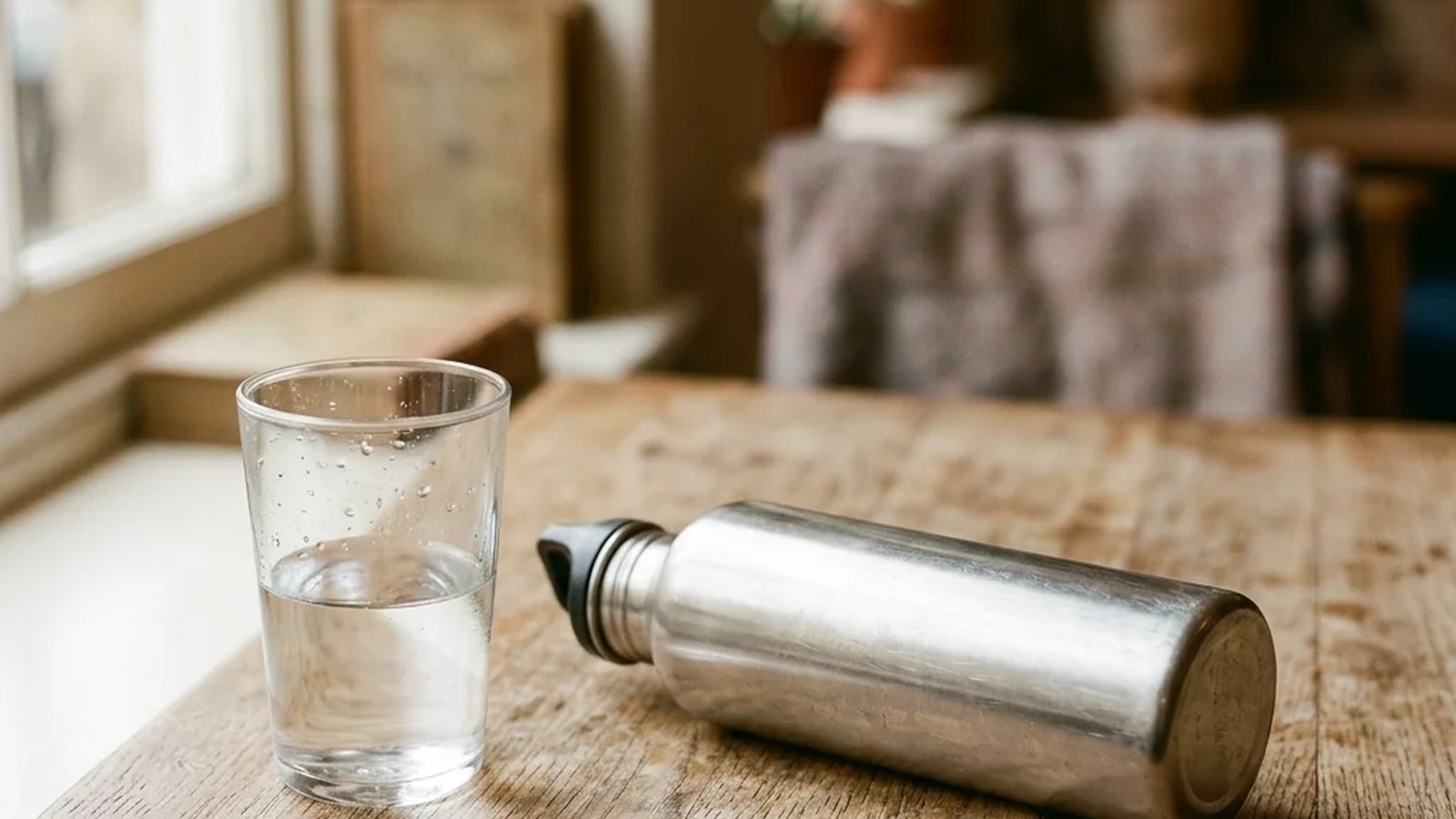
Marked water bottles — bottles with hourly fill-line targets printed on the side — are the lowest-tech, highest-adherence intervention in most trials. The bottle provides constant visual feedback on progress against the daily target, which addresses the ‘I don’t know how much I’ve had’ problem that confounds informal hydration tracking. For roughly fifteen Canadian dollars, a 32-oz (950 mL) bottle with marked targets and refill-twice-a-day instructions covers the geriatric guideline with minimal cognitive load. This is the intervention worth recommending first.
Special cases: medications and chronic conditions
Several common older-adult medications meaningfully affect hydration requirements. Thiazide and loop diuretics (used for hypertension and heart failure) increase fluid loss and necessitate target adjustments — typically 200-400 mL/day above baseline. SGLT2 inhibitors (newer diabetes medications like empagliflozin) increase glucose excretion and consequent osmotic water loss. Lithium (used in mood disorders) requires consistent fluid intake to maintain therapeutic levels safely. The hydration target for an older adult on multiple medications affecting fluid balance is typically the high end of the Volkert 2019 range plus a clinical adjustment, calculated in consultation with the prescribing physician or pharmacist.
Chronic kidney disease at moderate-to-severe stages (eGFR below 30) requires the opposite consideration: fluid intake may need to be restricted rather than encouraged. The general ‘drink more water’ advice is inappropriate for this population without nephrologist guidance. Heart failure with significant fluid-balance issues is the second condition where the standard hydration advice does not apply uncritically. Both populations need individualized fluid-management plans, not the population-average target.
For the majority of healthy community-dwelling older adults without these conditions, the 1.6/2.0 L target plus the activity-anchored or marked-bottle reminder system is the practical default. The clinician’s role is to identify the population for whom this advice does not apply rather than to micromanage the population for whom it does.
One under-appreciated practical detail: caregivers and family members of older adults are often the most effective hydration-reminder system. A spouse, adult child, or home-care worker who routinely refills the marked water bottle and gently encourages a sip at each visit covers the gap that the degraded thirst signal leaves open. The intervention is low-tech but the evidence on social-support effects in geriatric care broadly suggests that this human-scaffolding component meaningfully improves adherence beyond what bottles or reminders alone produce. Building hydration awareness into the existing care-and-conversation rhythm of the household is one of the highest-yield, lowest-cost adjustments available.
Practical takeaways
- Thirst becomes an unreliable signal after 60. Multiple physiological mechanisms (osmoreceptor sensitivity, angiotensin II response, renal handling) all degrade with age (Kenney 2001).
- The Volkert 2019 ESPEN target is 1.6 L/day for women, 2.0 L/day for men aged 65+. Tea, coffee (3-4 cups), milk, and soup all count toward the total.
- Roughly 20-40 percent of community-dwelling older adults show biomarkers of inadequate hydration. Stookey 2005 documented hypertonicity in 40 percent of the Framingham older-adult cohort.
- Mild dehydration carries real consequences: cognitive impairment, falls via orthostatic hypotension, UTIs, hospital admissions. Hooper 2014 Cochrane review documented all four.
- Activity-anchored routines beat timer-based reminders for adherence. Glass with each meal, after bathroom visits, with medications — stacking covers most of the target.
- Marked water bottles are the highest-value single intervention. Hourly fill-line targets on a 32-oz bottle, refilled twice daily, covers the guideline with minimal cognitive load.
References
Kenney 2001Kenney WL, Chiu P. Influence of age on thirst and fluid intake. Medicine & Science in Sports & Exercise. 2001;33(9):1524-1532. View source →Volkert 2019Volkert D, Beck AM, Cederholm T, et al. ESPEN guideline on clinical nutrition and hydration in geriatrics. Clinical Nutrition. 2019;38(1):10-47. View source →Hooper 2014Hooper L, Bunn D, Jimoh FO, Fairweather-Tait SJ. Water-loss dehydration and aging. Mechanisms of Ageing and Development. 2014;136-137:50-58. View source →Stookey 2005Stookey JD, Pieper CF, Cohen HJ. Plasma hypertonicity: another marker of frailty? Journal of the American Dietetic Association. 2005;105(8):1231-1239. View source →