The 60-second version
Phillips’ 2016 meta-analysis of 49 RCTs found 1.6–2.2 g/kg/day of high-quality protein optimised lean-mass and strength outcomes Phillips 2016. For active adults a 80–100 g target across the day is the working number. Westerterp-Plantenga 2012 documented protein’s satiety advantage over carbohydrate and fat at matched calories Westerterp-Plantenga 2012. The Layman 2015 review argued for distributing 25–30 g per meal across 3–4 feeds Layman 2015. Practical translation: a beach day that includes 2–3 portable protein servings (bar, jerky, hard-boiled eggs) keeps you on target without a cooler full of meal-prep. The satiety vs sugar tradeoff is real — a bar with 18 g protein and 22 g sugar fills you for less time than 18 g protein with 6 g sugar.
What the protein-target evidence actually shows
Phillips’ 2016 systematic review and meta-analysis pooled 49 randomised trials with 1,863 subjects and concluded that protein intakes of 1.6–2.2 g/kg/day, distributed across 3–5 meals, optimised resistance-training adaptation in adults Phillips 2016. The effect size on lean mass was modest in absolute terms (about 0.3 kg over 12 weeks vs lower-protein controls) but reliably positive across the included trials.
Layman 2015 added the per-meal distribution argument. The leucine threshold for maximal muscle-protein-synthesis stimulation is around 2.5–3 g per meal, which corresponds to roughly 25–30 g of high-quality animal protein or 35–40 g of plant blends Layman 2015. A 75 kg active adult targeting 2 g/kg lands at 150 g daily — readily achievable as 4 feeds of 35–40 g.
The translation for a beach day: if breakfast and dinner cover 60–70 g, the midday and afternoon protein needs to come from portable sources. That’s the practical problem the bar-and-jerky aisle exists to solve, with widely varying success.
The satiety question: why protein is different
Westerterp-Plantenga’s 2012 review of protein’s thermogenic and satiety effects synthesised four decades of feeding-trial data. Per matched calorie, protein produced 20–30% greater post-meal satiety than carbohydrate and 50–100% greater than fat in most studies Westerterp-Plantenga 2012. The mechanism involves both gut peptide signalling (GLP-1, peptide YY) and a higher thermic effect of feeding (20–30% of protein calories burn during digestion vs 5–15% for carb and 0–3% for fat).
For beach days specifically, the satiety advantage matters because food storage is constrained and re-supply may be a 30-minute drive. A 200-calorie protein-forward snack that holds satiety for 3–4 hours is operationally different from a 200-calorie carb-heavy snack that holds for 90 minutes — the latter triggers earlier hunger and the temptation of beach-stand fries.
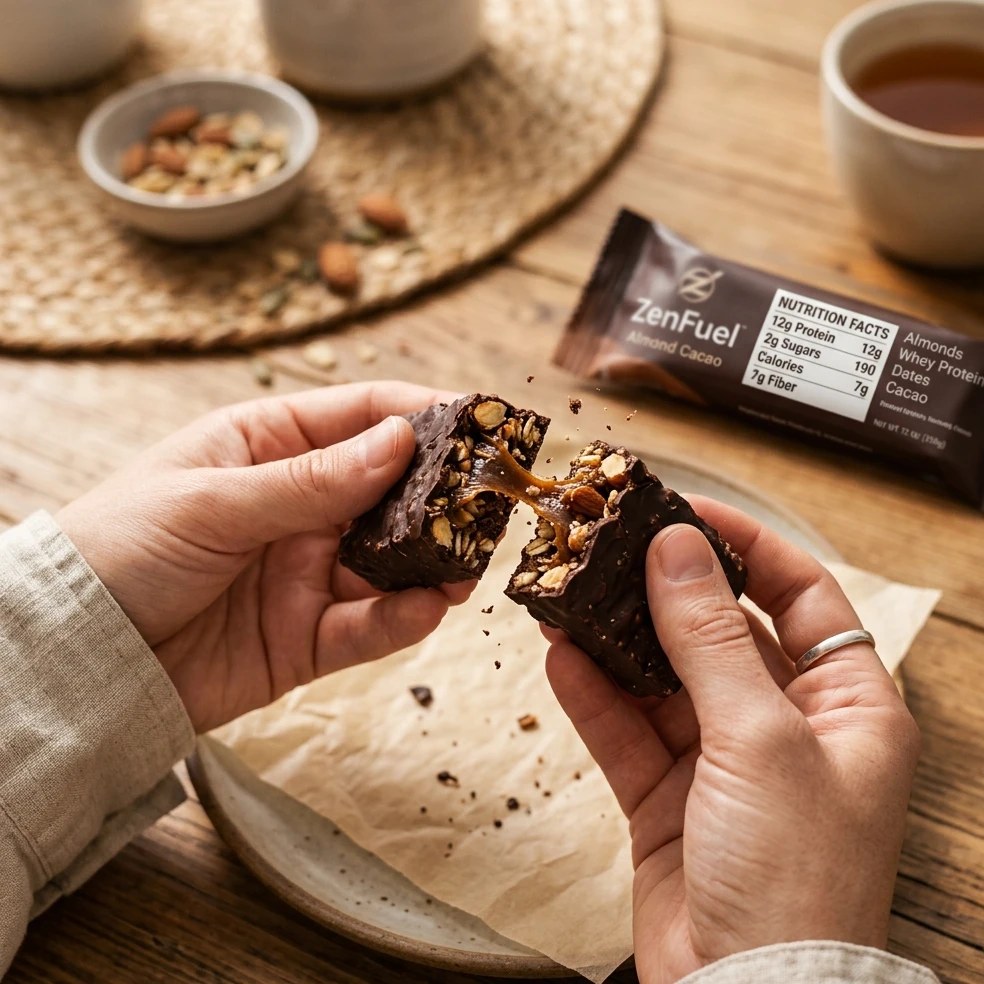
The catch is that commercial “protein bars” vary wildly. A 200-calorie bar with 20 g protein and 5 g sugar performs near pure-protein satiety. A 250-calorie bar with 12 g protein and 25 g sugar performs close to a candy bar with a protein dusting. The label is the difference, not the marketing.
What a commercial-bar review actually shows
Carrillo-Lozano 2022 reviewed 167 commercially available protein bars across European, North American, and Asian markets, scoring them on protein density (g protein per 100 kcal), added-sugar content, fibre, and ingredient quality Carrillo-Lozano 2022. The median bar carried 9.6 g protein per 100 kcal — well below the 12–15 g per 100 kcal threshold the review identified as “genuinely protein-forward.” About 28% of bars exceeded 15 g sugar per serving, putting them functionally closer to a candy bar plus a protein dusting.
The honest read: roughly one bar in three on a Canadian grocery shelf meets a defensible “portable protein” standard (12+ g protein per 100 kcal, under 10 g sugar, recognisable ingredients). The rest sit on a continuum from “sweetened protein-fortified snack” to “chocolate bar with marketing.”
For readers, the practical filter is: turn the bar over, check protein-to-sugar ratio (target 2:1 or better), and check the first three ingredients (whey, milk, or nut should appear; corn syrup, glycerin, or sugar should not lead). Chocolate-coated bars run hotter on the sugar side; nut-based and crisped-rice bars run cleaner.
The jerky question: dense protein, dense sodium
Beef and turkey jerky run 9–13 g protein per 28 g serving with negligible sugar in unsweetened varieties, and tolerate 25°C ambient temperature for 4–6 hours without food-safety concern (vs the 2-hour USDA limit on perishable meats). For beach-day protein density, jerky is the operationally simplest source.
The catch is sodium. A typical 28 g jerky serving carries 350–700 mg sodium — 15–30% of the 2,300 mg daily upper limit Health Canada publishes. For an active adult sweating heavily on a hot beach day, that sodium load is functionally desirable; the article on electrolyte timing covers the same logic. For a sedentary or sodium-restricted reader, the fit is poorer.
Practical filter: pick low-sodium jerky variants (under 350 mg per serving) for sedentary days, regular variants for active sweat-heavy days. Avoid the teriyaki and honey-glazed lines — those re-introduce 8–15 g of sugar that defeats the satiety advantage.
Hard-boiled eggs and cheese: the no-package options
Two hard-boiled eggs deliver 12–14 g protein for about 140 kcal, hold safely in an insulated cooler for 2–3 hours at beach-bag temperatures, and avoid the added-sugar tradeoff entirely. The DIAAS protein-quality score on whole egg sits at 113 — near the top of any food source. They’re messier than a wrapped bar but operationally clean.
String cheese and individually-wrapped cheese sticks deliver 6–8 g protein per serving with similar shelf-life characteristics in a cooler. Calcium load is a bonus; saturated-fat content is the consideration for readers managing cardiovascular markers, though the AHA 2017 advisory noted whole-food dairy isn’t the same risk as added-saturated-fat sources.
For a 6-hour beach day, a credible portable protein pattern is: 2 hard-boiled eggs (mid-morning) + 1 jerky serving (afternoon) + 1 cheese stick (late afternoon). Total: 30–40 g protein across the day-portion, no added sugar, and tested-tolerable in a soft cooler with one ice-pack.
Plant-based portable options: where they hold up
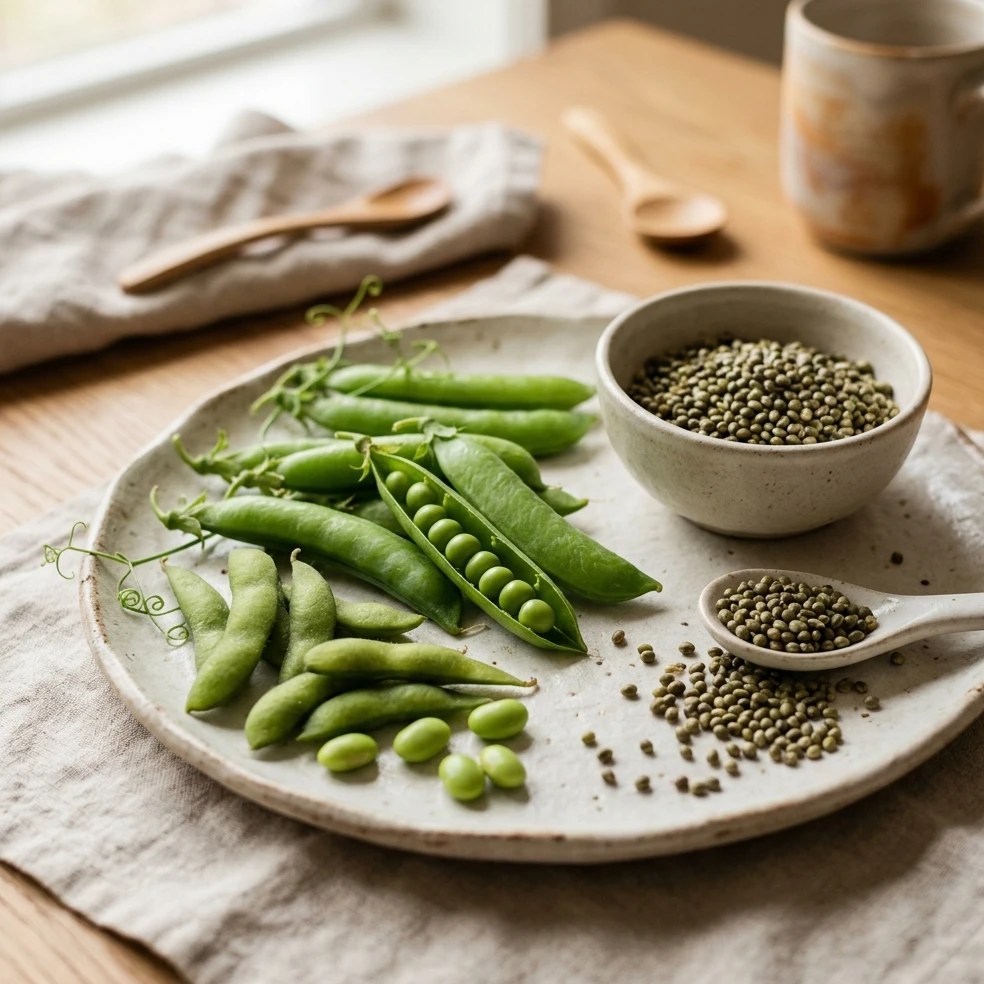
Roasted chickpeas, edamame snacks, and pumpkin seeds carry 8–12 g protein per 30 g serving with the satiety advantage of fibre attached. Pea-protein bars and brown-rice-based bars run 10–15 g protein per 100 kcal, comparable to mid-tier dairy bars. Hevia-Larrain’s 2021 12-week trial showed plant-protein-matched diets produced equivalent muscle and strength gains to whey at matched per-meal protein doses.
The fit issue is that plant-protein bars often add more sugar to compensate for lower amino-acid density — check the same protein-to-sugar ratio (2:1 target). Roasted-chickpea snacks and edamame are typically the cleanest plant-portable options, hitting the satiety target without the added-sugar tradeoff.
The amino-acid completeness consideration matters less for one snack and more for the daily total. If breakfast and dinner are mixed-source (eggs, dairy, meat, fish), the midday plant-protein snack is amino-acid-redundant rather than limiting.
A practical beach-day eating pattern
Combining the Phillips 2016 daily target, the Layman 2015 distribution argument, and the Westerterp-Plantenga 2012 satiety framework, a defensible beach-day pattern for a 70–80 kg active adult is: breakfast 30–40 g (eggs/dairy/oats), 9–10 AM portable protein 1 (bar or jerky, 15–20 g), early-afternoon portable 2 (cheese or eggs, 10–15 g), late-afternoon portable 3 (yogurt cup or another bar, 15–20 g), dinner 30–40 g. Total: 100–135 g protein for the day, distributed across 5 feeds, satisfying the 1.6–2.0 g/kg target and the per-meal leucine threshold.
For lighter activity days — reading on the beach, family supervision, no swim or paddle workout — the same pattern works at the lower end (80–100 g daily). For heavier activity (morning swim, paddleboard session, beach run), push toward the higher end and add a fourth portable feed.
The cooler storage requirement is modest: 4–5 portable items in a 6 L soft cooler with one freezer pack maintains under 4°C for 5–6 hours, which covers the food-safety floor on the perishable items (eggs, cheese, yogurt). Jerky, roasted chickpeas, and most bars are shelf-stable and don’t need the cooler.
Where commercial-bar marketing overreaches
Three claims worth flagging. First, “keto-friendly” on bars labelled with under 5 g net carbs is technically accurate but operationally misleading — many use sugar alcohols (maltitol, erythritol) that produce GI distress in 15–25% of consumers and don’t deliver the satiety advantage of true low-carb food. Second, “clean ingredients” framing without a defined standard is marketing language; the protein-to-sugar ratio and ingredient list are the verifiable signals. Third, the “meal replacement” framing on 250–300 calorie bars is a stretch — full meals in the protein literature deliver 400–600 calories with 30+ g protein, fibre, and meaningful micronutrient content; bars are snacks.
The honest editorial position is that portable-protein products have improved measurably over the last decade. The mid-1990s “protein bar” was effectively a candy bar with a protein dusting; the mid-2020s shelf includes genuinely protein-forward options. Reading labels remains the price of admission — the “protein bar” category as a whole is not what it appears to be.
For Canadian readers, the practical filter is simple: protein density (12+ g per 100 kcal), sugar restraint (under 10 g, ideally under 6 g), recognisable ingredients (whey, milk, nut, oat), no sugar-alcohol GI distress for those susceptible. Apply the filter once at the grocery store; the daily decision becomes routine.
Seasonal context and shelf-stability
Wasaga summer beach temperatures regularly reach 28–32°C ambient with sun-exposed surfaces touching 50°C+. Most commercial protein bars carry “may melt above 25°C” warnings on the chocolate-coated lines, which translates to a misshapen but still-safe product. The food-safety question is for the perishable items in the cooler, not the shelf-stable bars and jerky.
USDA FSIS 2020 publishes a 2-hour rule for perishable foods above 32°C ambient (cheese, eggs, dairy snacks, sliced meats) USDA FSIS 2020. The cooler-engineering article in this series covers the timing math; the practical translation here is that perishable portable proteins want a cooler with one freezer pack, jerky and bars don’t need one.
For winter beach reading or off-season Wasaga shoreline walks, the storage problem inverts — freezing a soft bar to brittle and cold-cracking a hard-boiled egg make some options operationally tough. The shelf-stable jerky and roasted-chickpea options become the dominant pick.
Bottom line: what fits a beach-day eating pattern
The bottom line for active Canadian adults: the protein-target evidence (Phillips 2016) and the per-meal distribution argument (Layman 2015) make portable protein a real practical problem on outdoor days. The satiety advantage of protein over carb at matched calories (Westerterp-Plantenga 2012) makes the right portable-protein choice operationally different from a sweetened-snack alternative — not a marginal difference, but a several-hours-of-hunger-resistance difference. The commercial-bar review (Carrillo-Lozano 2022) shows roughly a third of bars meet a defensible standard.
Practical translation: pre-build a 2–3 item portable-protein kit (1 bar, 1 jerky pack, 2 hard-boiled eggs in the cooler) sized to 30–50 g protein across the beach-day window. Filter bars by the 12 g per 100 kcal protein-density and 2:1 protein-to-sugar ratio. Carry the cooler-engineering article’s 2-hour-rule awareness for perishable items. The system is unspectacular and works; the alternative is the all-too-common 3 PM low-protein hunger spike that ends in a beach-stand fries decision.
For the editorial honesty layer: this is one piece of a broader nutrition portfolio (sleep, hydration, total daily protein, total daily calories, food quality at home). It is not a transformational intervention — the evidence-supported daily protein target works whether the midday feed comes from a bar or a salmon poke bowl. The beach-day kit is the convenience layer that lets the daily target survive the logistics of a 6-hour outdoor day.
Practical takeaways
- Daily protein target 1.6–2.0 g/kg is the working number. Phillips 2016 meta-analysis pooled 49 RCTs and put the optimal range here for active adults.
- Distribute across 4–5 feeds of 25–30 g. Layman 2015 per-meal leucine-threshold argument: each feed needs ~2.5 g leucine to maximally stimulate muscle-protein synthesis.
- Protein satiety beats carb satiety at matched calories. Westerterp-Plantenga 2012 reviewed the evidence: 20–30% greater satiety per calorie vs carbohydrate.
- Filter bars by 12+ g protein per 100 kcal and 2:1 protein-to-sugar. Carrillo-Lozano 2022 review of 167 bars found about 1 in 3 met a defensible “genuinely protein-forward” standard.
- A 2–3 item portable kit covers a 6-hour beach day. Bar + jerky + 2 hard-boiled eggs delivers 30–50 g across the outdoor window.
- Soft cooler with 1 freezer pack handles perishable picks. USDA FSIS 2020 2-hour rule applies; the cooler-engineering math covers the timing.
References
Phillips 2016Phillips SM. The impact of protein quality on the promotion of resistance exercise-induced changes in muscle mass. Nutrition & Metabolism. 2016;13:64. View source →Westerterp-Plantenga 2012Westerterp-Plantenga MS, Lemmens SG, Westerterp KR. Dietary protein — its role in satiety, energetics, weight loss and health. British Journal of Nutrition. 2012;108(S2):S105-S112. View source →Carrillo-Lozano 2022Carrillo-Lozano E, Sebastian-Valles F, Knott-Torcal C. Marketing claims and nutritional quality of protein-rich snack bars. Foods. 2022;11(9):1264. View source →Layman 2015Layman DK, Anthony TG, Rasmussen BB, et al. Defining meal requirements for protein to optimize metabolic roles of amino acids. American Journal of Clinical Nutrition. 2015;101(6):1330S-1338S. View source →USDA FSIS 2020United States Department of Agriculture, Food Safety and Inspection Service. Keep food safe! Food safety basics. 2020. (Two-hour rule for perishable foods above 32°C ambient.) View source →