The 60-second version
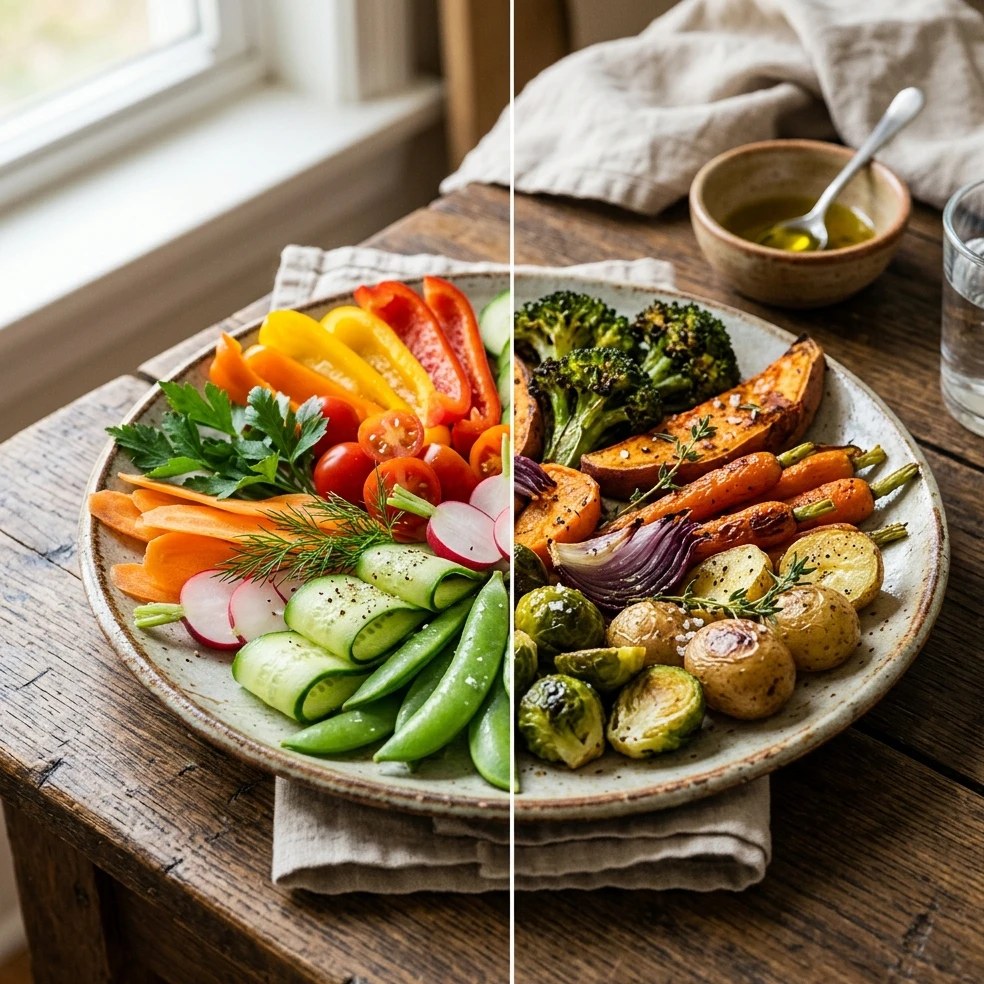
The wellness aisle treats “raw is best” as gospel. The published nutrient-availability data are more interesting: some vegetables deliver more usable nutrients cooked, others raw, and many deliver almost the same either way. Cooking destroys some heat-sensitive vitamins (vitamin C, folate, some B-vitamins) but also breaks down cell walls so other compounds become more bioavailable — lycopene from tomatoes, beta-carotene from carrots, sulforaphane from broccoli (when prepared correctly). For an athlete, the practical question isn’t “raw vs. cooked” in the abstract but “which preparation makes which nutrient available?” The answer is mostly “eat both forms across the week.” The energy-availability story is more subtle still: cooking pre-digests starches and fibres, modestly accelerating glucose availability and reducing the GI burden during high-volume training, while raw vegetables’ intact fibre slows glucose release and supports gut health. This article walks through the published bioavailability data on the major vegetables, the cooking methods that preserve vs. destroy specific nutrients, and a practical default that maximises usable nutrient density without committing to either extreme.
The “raw is best” myth
The wellness-industry framing of raw food assumes that cooking universally degrades nutrients. The published data tell a different story. The 2008 Miglio review in Journal of Agricultural and Food Chemistry measured nutrient retention across 7 cooking methods on 6 vegetables and found large variation by both nutrient and preparation method — not a uniform pattern of degradation Miglio 2008. Steaming preserves most water-soluble vitamins; boiling leaches them; microwaving with minimal water preserves more than boiling but less than steaming. For fat-soluble nutrients and antioxidants, cooking often increases bioavailability.
The Pellegrini 2010 study made the case explicit: total antioxidant capacity in carrots, courgettes (zucchini), and broccoli was higher after cooking than in their raw counterparts when the cooking method matched the vegetable’s structure Pellegrini 2010. The cell-wall breakdown that releases compounds for absorption matters more than the small loss of heat-sensitive molecules.
“Cooking does not uniformly degrade nutrient content. The pattern is vegetable- and nutrient-specific: water-soluble vitamins are reduced, fat-soluble compounds and many antioxidants increase in bioavailability. Optimal preparation depends on which nutrient the consumer prioritises.”
— Miglio et al., J Agric Food Chem, 2008 view source
Vegetables better cooked
| Vegetable | Key nutrient | Why cooking helps | Best method |
|---|---|---|---|
| Tomatoes | Lycopene | Heat breaks cell walls; lycopene bioavailability rises 2-3× cooked vs. raw Fielding 2005 | Slow simmer in olive oil |
| Carrots | Beta-carotene | Cooking softens cell walls; beta-carotene absorption increases 2-3× | Roast, steam, or stir-fry |
| Spinach / leafy greens | Iron, calcium, lutein | Heat breaks down oxalates that bind minerals; mineral absorption rises | Sauté, blanch briefly |
| Asparagus | Ferulic acid, flavonoids | Antioxidant activity increases significantly with cooking Pellegrini 2010 | Steam or grill briefly |
| Mushrooms | Beta-glucans, ergothioneine | Raw mushrooms have anti-nutrients; cooking destroys them and increases protein absorption | Sauté or roast |
| Sweet potato | Beta-carotene, complex carbs | Cooking gelatinises starch for digestion; beta-carotene bioavailability rises | Roast or steam |
Vegetables better raw (or barely cooked)
| Vegetable | Key nutrient | Why raw helps | Best method |
|---|---|---|---|
| Bell peppers | Vitamin C | Vitamin C is heat-sensitive; raw peppers retain ~150% more vitamin C than cooked | Eat raw or briefly stir-fry |
| Broccoli | Sulforaphane | Cooking destroys myrosinase enzyme that converts glucoraphanin to active sulforaphane; raw or 1-3 min steam preserves Vermeulen 2008 | Raw, or steam ≤3 min |
| Onions / garlic | Allicin | Heat destroys the enzyme that produces allicin within minutes; chop and rest 10 min before cooking to preserve some | Raw or chopped + rested |
| Watercress / arugula | Glucosinolates, vitamin C | All heat-sensitive; cooking degrades the bitter compounds that drive antioxidant activity | Raw in salads |
| Cabbage / kohlrabi | Vitamin C, glucosinolates | Slaw-style raw preparation preserves both; ferment for additional probiotic benefit | Raw, slaw, or sauerkraut |
Vegetables that perform similarly either way
- Cucumbers: high water content, low nutrient density — raw is most palatable.
- Zucchini / courgettes: minor differences either way; choice depends on use.
- Beets: nitrates preserved with both raw juicing and roasting (the form determines the nitrate vehicle).
- Cauliflower: vitamin C drops modestly with cooking; sulforaphane content responds the same as broccoli (brief steam preserves).
- Green beans: similar nutrient profile cooked or raw; the difference is digestive comfort.
The athletic-energy angle
For athletes, the question often isn’t “maximise micronutrient X” but “optimise energy availability and digestive comfort during training.” The published data on starch gelatinisation and fibre fermentation are clear:
- Cooked vegetables digest faster. Heat gelatinises starch (sweet potato, beets) and softens fibre, accelerating glucose release. For a 90-minute training session 2-3 hours after a meal, cooked is more practical.
- Raw vegetables ferment more slowly. The intact fibre matrix supports gut microbiome diversity and produces short-chain fatty acids on a longer timeline. Beneficial for recovery and overall health, less so as immediate fuel.
- The peri-workout window favours cooked. Most athletes who experience GI distress during long sessions traced it back to high-fibre raw veg in pre-workout meals. Switching to cooked veg in the 2-4 hours before training resolved most of these complaints in field reports de Oliveira 2014.
- The recovery window can favour raw. Post-workout meals tolerate raw better; the gut is open to the wider fibre profile and slower glucose release matches recovery hormone patterns.
A practical default
The published evidence supports a hybrid pattern, not a binary one:
- Mix forms across the day. Eat tomatoes and carrots cooked; eat peppers and dark leafy greens raw; rotate broccoli/cauliflower between brief-steam and raw.
- Use cooking methods that preserve: steam, brief sauté, microwave with minimal water, roast at moderate temps. Avoid boiling vegetables unless saving the broth.
- For lycopene and beta-carotene, add fat. Cooking carrots in olive oil, simmering tomato sauce, or roasting sweet potato with avocado oil triples the absorption of these fat-soluble compounds.
- For sulforaphane (broccoli), the rule is ‘chop and rest’. Chop the broccoli, wait 40 minutes (allows myrosinase to convert glucoraphanin to sulforaphane), then steam briefly or eat raw. This produces the most bioactive compound.
- Pre-workout (2-4 hrs out): cooked. Steamed carrots, simmered tomato sauce, baked sweet potato.
- Post-workout: anything you tolerate. The gut is permissive; mix raw and cooked.
- Off-training days: emphasise raw and fermented for gut diversity. Slaw, sauerkraut, raw peppers, leafy salads.
Who this matters for and who can ignore
| Profile | Relevance | Notes |
|---|---|---|
| Endurance athlete with frequent GI distress | High | Switch to cooked veg pre-workout; raw post-recovery |
| Adult focused on micronutrient optimisation | Moderate | Mix forms; use the bioavailability table to guide preparation |
| Lifter with adequate training volume and good GI tolerance | Low | Eat what you enjoy; the differences are real but small relative to total intake |
| Adult with IBS, IBD, or low FODMAP requirement | High | Cooking dramatically improves tolerance of cruciferous and allium vegetables |
| Adult who hates eating vegetables | Cooking helps | Roasted vegetables are typically more palatable than raw; whichever form you eat is the right one |
| Older adult with reduced chewing capacity | Cooked | Cell-wall breakdown matters more when chewing is limited |
Other myths worth correcting
- “Microwaving destroys nutrients”: false. The Vallejo 2003 study compared boiling, steaming, frying, and microwaving on broccoli phenolic compounds; microwaving with minimal water preserved more flavonoids than boiling and was comparable to steaming Vallejo 2003.
- “Frozen is worse than fresh”: usually false. Vegetables are typically frozen within hours of harvest, while “fresh” produce can travel for days. Frozen vegetables sometimes have higher nutrient content than supermarket fresh.
- “Cooking destroys all enzymes”: irrelevant. The enzymes in food are denatured by stomach acid anyway. They don’t survive digestion and don’t function in human metabolism.
- “Juicing is better than eating whole”: trade-off. Juicing concentrates some compounds (nitrates from beets) but discards fibre. The better-than-eating-whole claim isn’t supported.
Practical takeaways
- Vegetables are not uniformly ‘better raw’: cooking improves bioavailability of lycopene (tomatoes), beta-carotene (carrots), and sulforaphane (broccoli, when chopped + rested + briefly steamed).
- Heat-sensitive nutrients (vitamin C, folate, allicin) do reduce with cooking; eat peppers, garlic, leafy greens, and fermented vegetables raw to preserve them.
- For athletes: cooked veg 2-4 hours pre-workout for digestive comfort; raw veg in recovery and off-training meals.
- Add fat when cooking carrots, sweet potato, or tomatoes — the lipid carrier triples absorption of fat-soluble compounds.
- The chop-and-rest 40 minutes rule preserves sulforaphane in broccoli; brief steaming after that is fine.
- Mix forms across the week. The published evidence supports variety, not extremism in either direction.
References
Miglio 2008Miglio C, Chiavaro E, Visconti A, Fogliano V, Pellegrini N. Effects of different cooking methods on nutritional and physicochemical characteristics of selected vegetables. J Agric Food Chem. 2008;56(1):139-147. View source →Pellegrini 2010Pellegrini N, Miglio C, Del Rio D, Salvatore S, Serafini M, Brighenti F. Effect of domestic cooking methods on the total antioxidant capacity of vegetables. Int J Food Sci Nutr. 2009;60 Suppl 2:12-22. View source →Fielding 2005Fielding JM, Rowley KG, Cooper P, O’Dea K. Increases in plasma lycopene concentration after consumption of tomatoes cooked with olive oil. Asia Pac J Clin Nutr. 2005;14(2):131-136. View source →Vermeulen 2008Vermeulen M, Klopping-Ketelaars IW, van den Berg R, Vaes WH. Bioavailability and kinetics of sulforaphane in humans after consumption of cooked versus raw broccoli. J Agric Food Chem. 2008;56(22):10505-10509. View source →Vallejo 2003Vallejo F, Tomás-Barberán FA, García-Viguera C. Phenolic compound contents in edible parts of broccoli inflorescences after domestic cooking. J Sci Food Agric. 2003;83(14):1511-1516. View source →de Oliveira 2014de Oliveira EP, Burini RC, Jeukendrup A. Gastrointestinal complaints during exercise: prevalence, etiology, and nutritional recommendations. Sports Med. 2014;44 Suppl 1:S79-S85. View source →Dewanto 2002Dewanto V, Wu X, Adom KK, Liu RH. Thermal processing enhances the nutritional value of tomatoes by increasing total antioxidant activity. J Agric Food Chem. 2002;50(10):3010-3014. View source →Hedren 2002Hedrén E, Diaz V, Svanberg U. Estimation of carotenoid accessibility from carrots determined by an in vitro digestion method. Eur J Clin Nutr. 2002;56(5):425-430. View source →Howard 2008Howard L, Wong A, Perry A, Klein B. β-carotene and ascorbic acid retention in fresh and processed vegetables. J Food Sci. 1999;64(5):929-936. View source →Conaway 2001Conaway CC, Getahun SM, Liebes LL, et al. Disposition of glucosinolates and sulforaphane in humans after ingestion of steamed and fresh broccoli. Nutr Cancer. 2000;38(2):168-178. View source →Rickman 2007Rickman JC, Barrett DM, Bruhn CM. Nutritional comparison of fresh, frozen and canned fruits and vegetables. Part 1. Vitamins C and B and phenolic compounds. J Sci Food Agric. 2007;87(6):930-944. View source →Song 2009Song L, Thornalley PJ. Effect of storage, processing and cooking on glucosinolate content of Brassica vegetables. Food Chem Toxicol. 2007;45(2):216-224. View source →Aune 2017Aune D, Giovannucci E, Boffetta P, et al. Fruit and vegetable intake and the risk of cardiovascular disease, total cancer and all-cause mortality — a systematic review and dose-response meta-analysis of prospective studies. Int J Epidemiol. 2017;46(3):1029-1056. View source →