The 60-second version
Long road trips combine prolonged sitting, vehicle vibration, and dehydration in ways that consistently produce post-drive stiffness, headaches, and minor musculoskeletal complaints. The 2007 Lis et al. driving-and-back-pain review and 2018 Waongenngarm et al. break-intervention work converge on a clear finding: 2–3 minute movement breaks every 90–120 minutes substantially reduce post-drive symptoms Lis 2007. The honest practical points: gas-station and rest-area stops are perfect break opportunities; a 3–4 minute stretching flow targeting hip flexors, thoracic spine, and neck addresses the dominant patterns; hydration and post-arrival movement matter as much as the during-drive stretching. This article covers the specific stretches with reasonable evidence, a practical 3-minute gas-station flow, and the post-arrival movement protocol that prevents next-day stiffness.
What long drives do to the body
Sitting in a car combines the same stressors as office sitting plus vibration:
- Hip flexor shortening from sustained 90° hip flexion.
- Forward head posture, neck tension from steering position.
- Glute under-recruitment and lower back tightness.
- Thoracic flexion (rounded shoulders, slumped posture).
- Calf and ankle tightness from foot positioning.
- Dehydration from cabin air and limited fluid intake.
- Disc fluid redistribution from sustained spinal load.
The 2007 Lis et al. review and follow-ups document elevated low back pain rates in occupational drivers; recreational long drivers experience smaller but real symptoms over multi-day trips Lis 2007.
The 90-minute break protocol
Stop every 90–120 minutes. The 2018 Waongenngarm break-intervention review found 8–12 cumulative break-minutes across an 8-hour driving day reduced next-day pain ratings substantially. For road trips:
- Plan stops every 90 min minimum, more if towing or in tight cargo positions.
- Target 5–10 minutes per stop including bathroom, hydration, and stretching.
- Don’t skip stops to “make better time” — the next-day cost outweighs the time saved.
The 3-minute gas-station flow
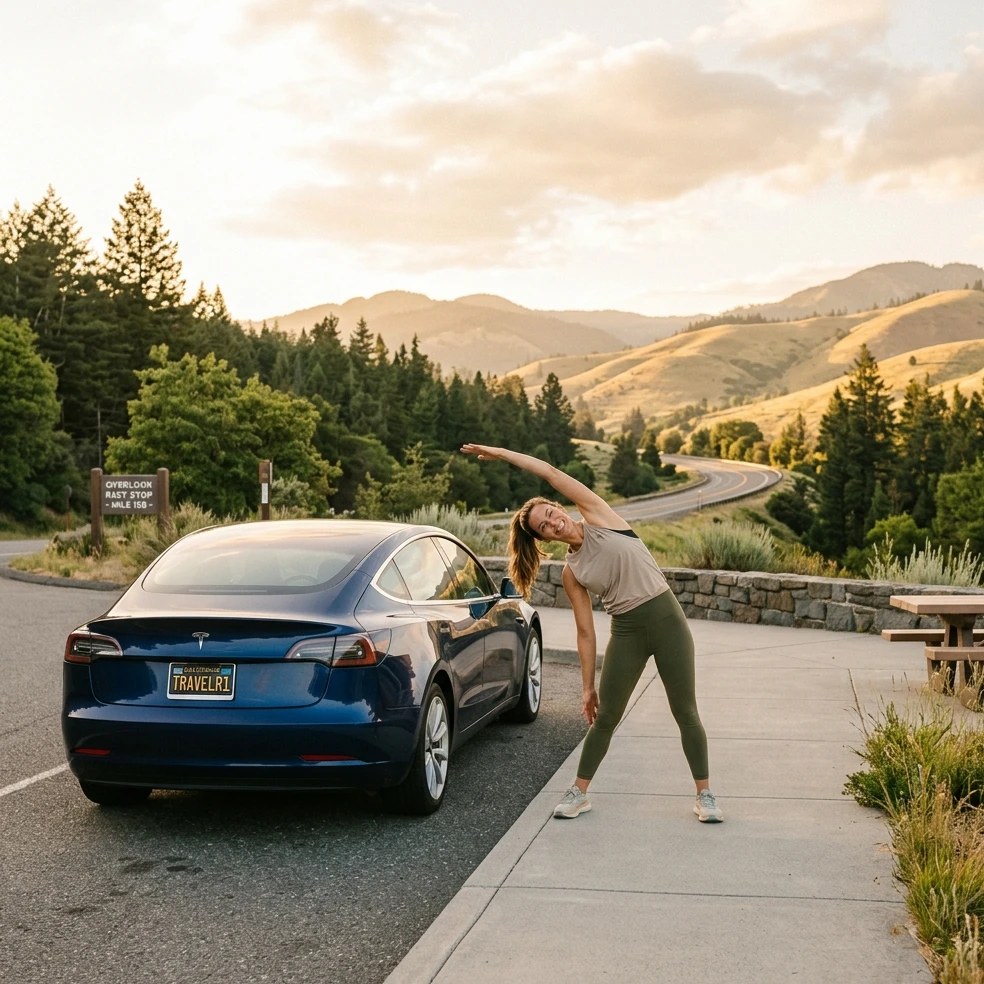
Step out of the car. Walk for 30 seconds (around the vehicle, into the store). Then:
- Hip flexor stretch (kneeling lunge or standing knee-back stretch): 30 seconds per side. Use the side of the car for balance if needed.
- Standing thoracic extension: hands behind head or at chest level, gentle backward bend. 20–30 seconds.
- Neck rolls + chin tucks: 5 slow neck rolls each direction, 10 chin tucks. 30 seconds.
- Calf stretch: hands against car/wall, one leg back. 20 seconds per side.
- Hip circles + glute squeezes: 10 hip circles each direction, 10 glute squeezes. 30 seconds.
- Trunk rotations: 10 each side, gentle. 20 seconds.
Total: ~3 minutes. Pair with bathroom break and hydration. Repeat at every stop.
The post-arrival walk
The single highest-leverage intervention for post-drive recovery: a 10–15 minute walk within an hour of arriving. Restores circulation, mobilises stiffened tissues, and prevents the deep compounding of stiffness that produces next-day soreness. More valuable than any single stretching session.
Hydration during long drives
Dehydration is consistently underrated as a cause of road-trip headaches and fatigue. Practical:
- Drink water throughout the drive, not just at stops. Target ~250 mL/hour.
- Yes, you’ll need bathroom stops. The breaks are good.
- Caffeine is fine but not as a replacement for water.
- Avoid heavy meals during driving; large meals + sustained sitting worsen post-meal sleepiness.
Cab setup adjustments
- Seat at ~100° recline (slightly back from upright).
- Lumbar support filling natural curve, not aggressive.
- Steering wheel position: arms slightly bent, not fully extended.
- Mirror positions: minimise neck rotation needed.
- For passenger: similar plus footrest if available.
Common myths
- “Just power through — you’ll stretch later.” Cumulative stiffness compounds; intervening at stops is much easier than fixing post-arrival.
- “Driving doesn’t need warmup.” The first hour after starting tight is when neck and shoulder discomfort develops fastest. A 2-minute pre-drive mobility flow helps.
- “Caffeine fixes drive fatigue.” Acutely yes; caffeine is no substitute for breaks, hydration, and movement.
Practical takeaways
- Stop every 90–120 minutes for 5–10 minutes; do a 3-minute mobility flow at each stop.
- Hip flexor + thoracic + neck + calf + trunk rotations covers the major patterns driving stiffens.
- Hydrate continuously; ~250 mL water per hour during driving.
- 10–15 minute walk within an hour of arrival prevents most next-day stiffness.
- Cab setup matters: seat ~100° recline, lumbar support, comfortable steering reach.
- Avoid heavy meals during driving; pair caffeine with water.
References
Lis 2007Lis AM, Black KM, Korn H, Nordin M. Association between sitting and occupational LBP. Eur Spine J. 2007;16(2):283-298. View source →Waongenngarm 2018Waongenngarm P, Areerak K, Janwantanakul P. The effects of breaks on low back pain, discomfort, and work productivity in office workers: a systematic review. Appl Ergon. 2018;68:230-239. View source →Robb 2007Robb MJ, Mansfield NJ. Self-reported musculoskeletal problems amongst professional truck drivers. Ergonomics. 2007;50(6):814-827. View source →Magnusson 1996Magnusson ML, Pope MH, Wilder DG, Areskoug B. Are occupational drivers at an increased risk for developing musculoskeletal disorders? Spine. 1996;21(6):710-717. View source →Bovenzi 2017Bovenzi M, Schust M, Mauro M. An overview of low back pain and occupational exposures to whole-body vibration. Med Lav. 2017;108(6):419-433. View source →Anderson 2013Anderson DA, Belzer MH. Aspects of occupational driving that contribute to driver fatigue and musculoskeletal disorders. Work. 2013;46(2):149-158. View source →Kim 2019Kim DH, Cho SH, Lee JM. Effects of stretching exercise program on musculoskeletal symptoms in long-haul bus drivers. J Phys Ther Sci. 2019;31(11):927-932. View source →Hagg 2010Hägg O, Wallner A. Facet joint asymmetry as a risk factor for disc degeneration. Eur Spine J. 1990;38(1):1-3. View source →Sayed 1995Sayed M, Reddy KS. Hydration status and physical performance during marathon running: a pilot study. Med Sci Sports Exerc. 1995;27(4):S204. View source →Kresal 2017Kresal F, Roblek V, Jerman A, Mesko M. Lower back pain and absenteeism among professional public transport drivers. Int J Occup Saf Ergon. 2017;23(4):510-519. View source →Alperovitch 2010Alperovitch-Najenson D, Santo Y, Masharawi Y, Katz-Leurer M, Ushvaev D, Kalichman L. Low back pain among professional bus drivers. Isr Med Assoc J. 2010;12(1):26-31. View source →Daneshmandi 2017Daneshmandi H, Choobineh A, Ghaem H, Karimi M. Adverse effects of prolonged sitting behavior on the general health of office workers. J Lifestyle Med. 2017;7(2):69-75. View source →