The 60-second version
For training-zone work, a chest-strap monitor is still the more accurate tool. The peer-reviewed validation literature is consistent: chest straps using ECG-style signal capture have errors of ~1–3 BPM compared to gold-standard 12-lead ECG, while wrist-based optical (PPG) sensors have errors of 5–15 BPM that grow worse during high-intensity intervals, weight training, and cold weather. Modern smartwatches (Apple Watch, Garmin Forerunner, Coros, latest Whoop, Polar Vantage) have improved substantially since 2020 and are good enough for steady-state running, walking, and easy cycling. They’re still the wrong tool for HIIT, lifting, sprint intervals, and any work where the wrist tendons move under load. The practical answer: if you train by heart rate zones — especially Z2 base building or threshold work — pair your watch with a chest strap. If you train by feel or by power, the wrist sensor is fine.
Why HR accuracy matters
Heart-rate-zone training depends on knowing which zone you’re in. A 10–15 BPM error in zone 2 (base/aerobic work) can put a runner in zone 3 (tempo) without their knowing — defeating the purpose of polarized or 80/20 training programs. The same error during HIIT pushes the visible “peak” into the recovery interval, distorting effort distribution.
Two technologies are in play:
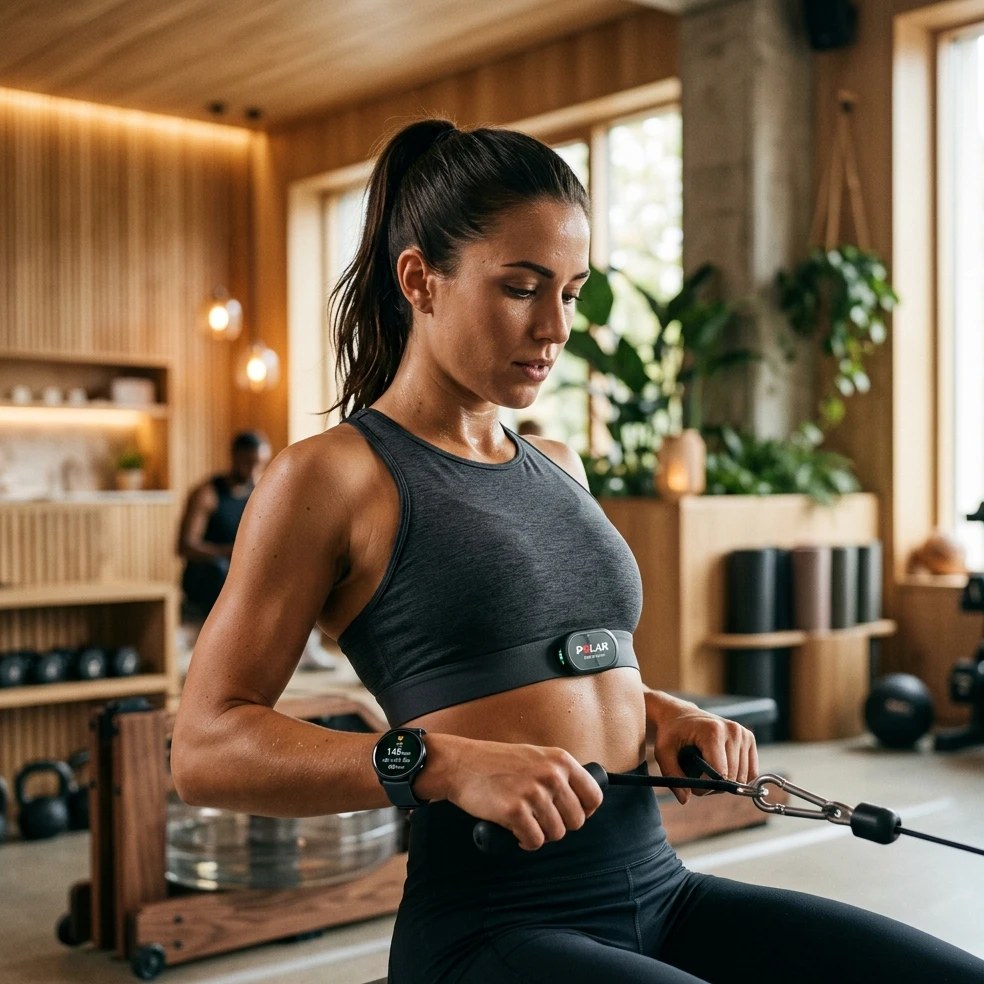
- Chest straps use a pair of electrodes pressed against the skin to read the electrical signal of the heart (a single-lead ECG). This is the same physical signal cardiologists measure; the math to extract beats is well-validated.
- Optical wrist sensors (PPG — photoplethysmography) shine green LEDs into the skin and measure how much light is absorbed by pulsing capillary blood. The signal is indirect, requires steady wrist contact, and is sensitive to motion artifacts.
The Gilgen-Ammann 2019 review pooled 32 validation studies of wrist-based optical HR vs chest-strap and ECG references. Mean absolute error during running was 2–4 BPM; during cycling 5–7 BPM; during weight-training 9–15 BPM; with motion involving wrist flexion 12–30+ BPM Gilgen-Ammann 2019. Newer device generations have improved on the running and cycling numbers; lifting and sprint-interval data are still problematic.
“Optical wrist-based heart-rate measurement is increasingly accurate during low- and moderate-intensity steady-state activity. However, validity decreases substantially during high-intensity exercise, resistance training, and activities with marked wrist flexion or rapid acceleration changes — precisely the situations where many athletes most need accurate measurement.”
— Gilgen-Ammann et al., Eur J Sport Sci., 2019 view source
Where each tool wins
| Activity | Wrist optical (PPG) | Chest strap (ECG) |
|---|---|---|
| Steady-state running (Z2-Z3) | Good (~2–4 BPM error) | Excellent (~1–2 BPM) |
| Steady-state cycling, indoor or smooth road | Acceptable (~5–7 BPM) | Excellent |
| Outdoor cycling on rough surface | Poor (vibration breaks signal) | Excellent |
| HIIT / sprint intervals | Poor (lag + drift) | Excellent |
| Resistance training | Very poor (15–30 BPM error common) | Excellent |
| Yoga, Pilates | Acceptable | Excellent (but uncomfortable for floor work) |
| Swimming | Variable; depends on watch | Use specialized swim straps; chest can slip |
| Cold weather (under 5°C / 41°F) | Poor (skin perfusion drops) | Excellent |
| Daily resting HR / overnight | Good for trends; less accurate for absolute | Not a normal use case |
| HRV (heart-rate variability) | Acceptable in some watches at rest | Better; some chest straps export beat-to-beat data |
Why optical wrist HR fails (and when)
- Wrist movement: tendons sliding under the sensor break the optical signal. Push-ups, pull-ups, kettlebell swings, anything wrist-flexed.
- Cold extremities: vasoconstriction reduces capillary blood flow and the signal weakens.
- Loose fit: the sensor must sit flat against the skin. A loose watch slides and drops signal.
- Tattoos under the sensor: dark ink absorbs the LED light; many watches lose signal entirely.
- Hair / skin tone: deeply pigmented skin and dense forearm hair both reduce signal-to-noise; manufacturers have improved this in recent generations but it remains a real factor.
- Cadence-locked artifact: during steady running, the watch can track your arm-swing cadence rather than your heart rate — producing a plausible-looking but wrong number that locks at ~150–180 BPM.
When chest straps fail
- Dry skin / cold start: needs sweat or pre-application water/gel for the first 5–10 minutes.
- Strap slippage: thin/wet strap can ride down. Tighten before training; modern straps with fabric inserts grip better.
- Battery: most chest straps use coin-cell batteries that last ~1–2 years and aren’t always alerted before death.
- Bluetooth pairing: occasional mid-workout dropouts. Most modern straps re-connect automatically but it can produce a one-minute zero-HR notch.
- Discomfort: some users genuinely find chest straps uncomfortable, especially in long sessions.
A middle option: the upper-arm optical band
Devices like the Polar Verity Sense, Wahoo Tickr Fit, and Whoop band 4.0 sit on the upper arm or biceps rather than the wrist. They use the same PPG technology as a wrist sensor but on a stable, low-motion site. The 2021 Díaz 2021 validation of the Verity Sense reported mean absolute error of ~2 BPM in running and 3 BPM in cycling, comparable to chest straps Pasadyn 2019. They’re a good compromise for athletes who hate chest straps but need better-than-wrist accuracy during HIIT or lifting.
Brand-specific notes
| Device class | Steady-state accuracy | HIIT/lifting | Notes |
|---|---|---|---|
| Apple Watch (Series 6+) | Good | Variable | Best-in-class wrist HR for general use; still misses on intervals |
| Garmin Forerunner / Fenix | Good | Variable | Strong overall; pair with HRM-Pro for accurate intervals |
| Polar Vantage / Grit | Good | Acceptable | Polar’s heritage is HR; better optical than most |
| Coros Pace / Apex | Acceptable | Poor | Excellent battery; wrist HR adequate for steady running |
| Whoop band 4.0 | Good (upper-arm-style fit) | Acceptable | HRV-focused; works at upper arm |
| Fitbit (modern) | Acceptable | Poor | Wellness-oriented; not built for interval training |
| Polar H10 (chest) | Excellent | Excellent | The benchmark chest strap; ANT+ & Bluetooth dual |
| Garmin HRM-Pro | Excellent | Excellent | Adds running dynamics; pairs with Garmin watches well |
| Wahoo Tickr X | Excellent | Excellent | Strong cycling-software ecosystem |
| Polar Verity Sense (arm) | Excellent | Excellent | The strongest non-chest option |
Specific device generations change frequently; the brand-class conclusions tend to hold across years.
Practical setup for HR-zone training
- Determine your maximum heart rate. The 220-minus-age formula is a starting point with ~10–15 BPM error; a ramp test (e.g., 1 km repeats with rest at increasing pace until exhaustion) is more accurate.
- Set 5 zones: 50–60% (recovery), 60–70% (Z2 aerobic base), 70–80% (Z3 tempo), 80–90% (Z4 lactate threshold), 90–100% (Z5 VO2max).
- For Z2 base building, the most-emphasized zone in modern endurance training, the upper boundary is the most important to not exceed. Wrist-only HR can underestimate effort by enough to push you 5–10 BPM into Z3 without realizing.
- Calibrate your wrist watch periodically against a chest strap. If the two differ by >5 BPM at moderate intensity, treat the chest as truth.
- For lifting and HIIT, accept that wrist HR is informational only; train by RPE and recovery, not zone.
Who doesn’t need a chest strap
- People who train by perceived exertion (RPE) rather than heart rate.
- People who train by power (cycling) or pace (running) rather than heart rate.
- Casual fitness users tracking general activity rather than zone-specific training.
- Daily-life HR (resting, sleep) where wrist optical is adequate for trend tracking.
A note on watch “health” metrics
Modern watches advertise a long list of derived metrics: VO2max estimate, training load, recovery score, body battery, readiness. These are algorithmic compositions of HR, HRV, and movement data — their accuracy depends entirely on the underlying HR accuracy, plus assumptions about the user. They’re useful for tracking your own trend over time, less useful for absolute comparison or training prescription. The 2021 Molina-Garcia review of consumer watch VO2max algorithms found typical error of 3–5 ml/kg/min vs lab-measured values Molina-Garcia 2022. Trend = useful; absolute = approximate.
Practical takeaways
- Chest straps remain the most accurate wearable HR tool, ~1–3 BPM vs ECG.
- Wrist optical (PPG) has improved markedly. Good for steady-state, poor for HIIT/lifting/cold/wrist-flex.
- Upper-arm optical bands (Polar Verity Sense, Wahoo Tickr Fit) get chest-strap-class accuracy without the chest strap.
- For HR-zone training — especially Z2 base building — pair your watch with a chest or arm strap.
- For RPE/power/pace-based training, wrist HR is fine.
- Lifting and HIIT: wrist HR is informational, not training data.
- Watch-derived metrics (VO2max, training load, readiness) are useful for trends, approximate as absolutes.
References
Gilgen-Ammann 2019Gilgen-Ammann R, Schweizer T, Wyss T. RR interval signal quality of a heart rate monitor and an ECG Holter at rest and during exercise. Eur J Appl Physiol. 2019;119(7):1525-1532. View source →Pasadyn 2019Pasadyn SR, Soudan M, Gillinov M, et al. Accuracy of commercially available heart rate monitors in athletes: a prospective study. Cardiovasc Diagn Ther. 2019;9(4):379-385. View source →Wang 2017Wang R, Blackburn G, Desai M, et al. Accuracy of wrist-worn heart rate monitors. JAMA Cardiol. 2017;2(1):104-106. View source →Nelson 2019Nelson BW, Allen NB. Accuracy of consumer wearable heart rate measurement during an ecologically valid 24-hour period: intraindividual validation study. JMIR Mhealth Uhealth. 2019;7(3):e10828. View source →Kingsley 2005Kingsley M, Lewis MJ, Marson RE. Comparison of Polar 810s and an ambulatory ECG system for RR interval measurement during progressive exercise. Int J Sports Med. 2005;26(1):39-44. View source →St-Fleur 2021St-Fleur RS, Couppey T, Pérez-Cogné J, et al. Validity and reliability of the Apple Watch for measuring heart rate during exercise: a systematic review. Sensors (Basel). 2021;21(13):4541. View source →Seshadri 2019Seshadri DR, Davies EV, Harlow ER, Hsu JJ, Knighton SC, Walker TA, Voos JE, Drummond CK. Wearable sensors for monitoring the physiological and biochemical profile of the athlete. NPJ Digit Med. 2019;2:72. View source →Etiwy 2019Etiwy M, Akhrass Z, Gillinov L, et al. Accuracy of wearable heart rate monitors in cardiac rehabilitation. Cardiovasc Diagn Ther. 2019;9(3):262-271. View source →Dooley 2017Dooley EE, Golaszewski NM, Bartholomew JB. Estimating accuracy at exercise intensities: a comparative study of self-monitoring heart rate and physical activity wearable devices. JMIR Mhealth Uhealth. 2017;5(3):e34. View source →Benedetto 2018Benedetto S, Caldato C, Bazzan E, Greenwood DC, Pensabene V, Actis P. Assessment of the Fitbit Charge 2 for monitoring heart rate. PLoS One. 2018;13(2):e0192691. View source →Molina-Garcia 2022Molina-Garcia P, Notbohm HL, Schumann M, et al. Validity of estimating the maximal oxygen consumption by consumer wearables: a systematic review with meta-analysis and expert statement of the INTERLIVE Network. Sports Med. 2022;52(7):1577-1597. View source →Zhang 2021Zhang Y, Weaver RG, Armstrong B, Burkart S, Zhang S, Beets MW. Validity of wrist-worn photoplethysmography devices to measure heart rate: a systematic review and meta-analysis. J Sports Sci. 2020;38(17):2021-2034. View source →