The 60-second version
The popular claim that snorkeling improves lung capacity is partly true but in a narrow way. Forced vital capacity — the basic structural lung-volume measurement — is largely fixed in healthy adults Quanjer 2012. What snorkeling actually trains is respiratory-muscle endurance and CO2 tolerance, the same trainable adaptations that benefit endurance cyclists, climbers, and free-divers Illi 2012. The gear matters: a poorly-fitted snorkel adds dead-space air and turns conditioning into headache-inducing CO2 retention. The protocol matters too: 30-minute sessions are the sweet spot, duck-dives below 2 metres require equalization technique most snorkelers do not have, and breath-holding while snorkeling carries the same shallow-water blackout risk as breath-holding without one. This article unpacks the mechanism, the gear, the safety floor, and the field tests that distinguish progress from over-reach.
What the evidence actually says
Lung volumes are determined primarily by chest-wall geometry and lung-tissue properties, both of which are fixed in adulthood barring disease Quanjer 2012. The popular “train your lung capacity” framing conflates structural volume with respiratory-muscle function and breath-control timing — the latter two are trainable, the first is not.
Inspiratory-muscle training is the closer cousin of what snorkeling actually delivers. Illi’s meta-analysis of 11 randomized trials showed structured inspiratory-muscle training improves endurance-exercise performance by 4-6%, with effects independent of measurable changes in vital capacity Illi 2012. The mechanism is improved diaphragm and intercostal muscle endurance, which delays the “respiratory steal” where breathing demand competes with skeletal-muscle blood flow at high intensities Romer 2002.
The free-diving literature adds the next layer. Schagatay’s long-term work on apnea-trained athletes shows that repeated voluntary breath-holding induces a documented mammalian dive response — bradycardia, peripheral vasoconstriction, splenic contraction releasing red blood cells — and that the magnitude of these adaptations correlates with sustained breath-hold time Schagatay 2010. Recreational snorkelers who add brief duck-dives are at the edge of this domain; the recreational protocol does not produce the full free-diving adaptations, but the same mechanism is engaged.
How it actually works
A snorkel adds 50-150 mL of dead-space air to the breathing circuit. Each inhalation must clear that dead space before fresh air reaches the alveoli, which slightly elevates breath-by-breath CO2. Over a 30-minute snorkel session, the cumulative respiratory-muscle work approximates a moderate-intensity inspiratory-muscle training session McConnell 2009. The CO2 tolerance adaptation is the same one that benefits open-water swimmers and free-divers.
The dead-space figure depends heavily on snorkel design. Traditional J-tube snorkels add 100-180 mL; full-face snorkel masks (popularized in 2017-2020) add 200-400 mL because they include the entire mask volume Roberts 2020. Full-face designs have been associated with rare cases of CO2 retention severe enough to produce loss of consciousness; multiple recreational drowning case reports between 2018 and 2021 implicated the design, and Hawaii’s Department of Health issued a public safety advisory in 2020 Roberts 2020. The conservative recreational choice remains a traditional J-tube or dry-top tube snorkel.
The diaphragm and intercostal muscles adapt to repeated low-grade work the same way any other muscle does: through micro-tears, repair, and progressive overload. The 30-minute session is enough to register as a training stimulus without producing the muscle fatigue that compromises rescue capability if conditions worsen mid-swim.
“Inspiratory muscle training improves endurance-exercise performance by 4-6%, with effects independent of measurable changes in vital capacity, suggesting the benefit comes from improved respiratory-muscle endurance rather than larger lungs.”
— Illi et al., Sports Medicine, 2012 view source
Gear choice: where the safety floor lives
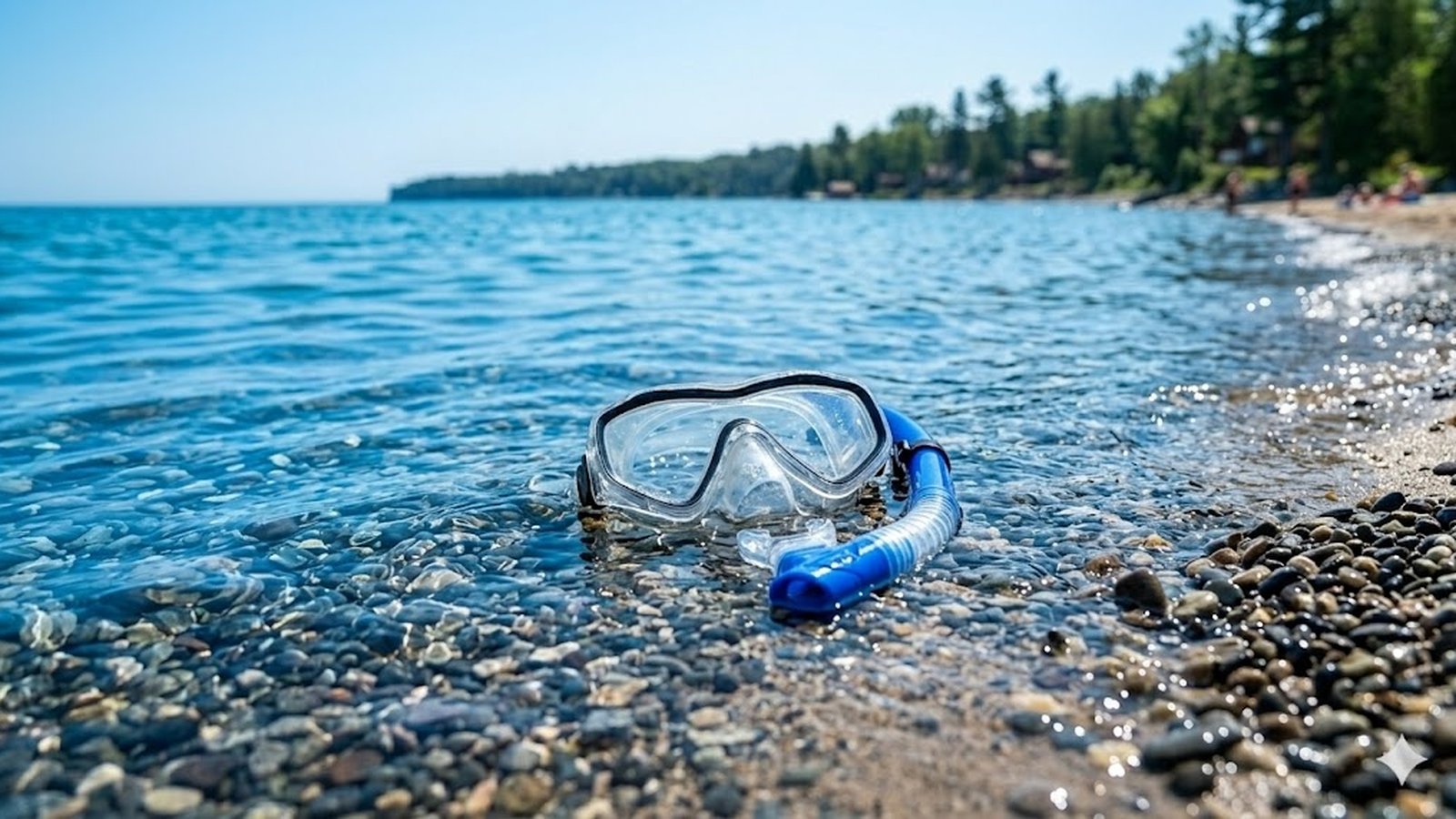
Three gear decisions matter more than most snorkelers realize. The first is snorkel type. Dry-top snorkels (with a float-valve closure that seals when submerged) prevent water aspiration during waves and brief submersions, at the cost of slightly higher inhalation resistance. Wet-top snorkels (open at the top) require the swimmer to clear water with a forceful exhale after submersion. The dry-top design suits Wasaga’s mild lake conditions; wet-top is the recreational ocean-swimmer default Roberts 2020.
The second is mask fit. A leaking mask forces the swimmer to clear water repeatedly, which interrupts the breath cadence and dilutes the conditioning stimulus. The fit test is simple: with no strap and the mask held to the face by light suction, the seal should hold for 5-10 seconds during a normal inhalation. If air enters at the bridge of the nose or temple, the size or shape is wrong — pick a different mask before adjusting the strap.
The third is fin choice. Long open-heel fins designed for free-diving move the recreational snorkeler too fast and produce ankle and calf cramping in the first 20 minutes. Short closed-heel fins (snorkeling fins, sometimes called “travel fins”) are the appropriate match for the 30-minute conditioning session and reduce calf-cramp risk in cold water Szpilman 2012.
Who should be careful
Five populations should approach snorkeling with extra caution beyond the general “swim with a buddy” advisory. First, anyone with a history of asthma triggered by cold water or exercise. The narrow inhalation window through a snorkel mouthpiece can amplify bronchospasm in cold water; carry a rescue inhaler and consider deferring entirely if the asthma is reactive to immersion Roberts 2020.
Second, anyone with prior shallow-water blackout or breath-hold-induced syncope. The duck-dive component of recreational snorkeling places the swimmer at exactly the depth where blackout is most dangerous (1-2 metres), and the surface-recovery breath that prevents blackout in pool training is harder to control after a duck-dive in open water Pearn 2015.
Third, children under 10. The respiratory benefit applies but injury risk is also higher in children: smaller airways, faster cooling in lake water, and less reliable surface signalling. Adult supervision at depth is non-negotiable; the “watch from shore” supervision pattern is inadequate Szpilman 2012.
Fourth, adults over 60. Age-related vital-capacity reduction means dead-space air represents a higher percentage of total breath volume, raising CO2-retention risk on full-face snorkels in particular. Use a J-tube snorkel and limit sessions to 20 minutes initially.
Fifth, anyone with cardiac arrhythmia history. The combination of cold-water immersion, breath-holding, and the diving reflex can provoke arrhythmia in susceptible hearts; the same mechanism responsible for cold-plunge cardiac events applies to cold-water snorkeling.
How to measure progress
Three field tests track snorkeling-related respiratory adaptation reliably. First, the timed easy-pace 30-minute swim with the snorkel: track perceived breath effort on a 0-10 scale at 5-minute intervals. Adapted swimmers report stable scores of 3-4 across the session; unadapted swimmers see scores rise from 3 at minute 5 to 7+ by minute 30. The adaptation curve is visible within 4-6 weeks of consistent practice Illi 2012.
Second, the breath-hold-to-tolerance test on land (not in water): inhale, hold, and stop the timer at the first urge to breathe (not at maximum capacity). Recreational snorkelers should see the time-to-first-urge metric rise from a baseline of 25-40 seconds to 40-60 seconds over 6-8 weeks Schagatay 2010. The metric is sensitive to CO2 tolerance and predicts surface-recovery margin during accidental submersion better than maximum breath-hold time.
Third, the post-session headache check. Snorkelers experiencing headaches in the 30-90 minute window after a session almost always have CO2 retention from inadequate snorkel design or session duration. A persistent post-session headache is a hard signal to switch snorkels (J-tube over full-face) or shorten sessions, regardless of how well the swimmer felt during the session itself.
The caveats people skip
Breath-holding while snorkeling crosses into apnea territory and carries the same shallow-water blackout risk as breath-holding without a snorkel Pearn 2015. Recreational snorkelers who duck-dive on a single breath should know the warning signs of approaching hypoxia (tunnel vision, tingling, urge to breathe that suddenly disappears) and surface immediately if any of them appear.
The second underdiscussed issue is mask squeeze. Descending more than 1-2 metres on a single breath without equalizing produces a pressure differential that can rupture small blood vessels around the eyes and bring on facial bruising or, rarely, retinal damage Lippmann 2017. Snorkel duck-divers who go below 2 metres should learn to exhale slightly through the nose to equalize.
The third is the temptation to hyperventilate before a duck-dive. Pre-duck hyperventilation lowers arterial CO2, which delays the breath-urge signal — and removes the warning that hypoxia is approaching. The mechanism is the same one that makes pool hyperventilation contests fatal; recreational snorkelers should never use pre-duck hyperventilation, even if it allows a longer dive Pearn 2015.
Practical takeaways
- Frame snorkeling as respiratory-muscle endurance work, not lung-enlargement training. The structural volume is fixed; the muscular endurance and CO2 tolerance are trainable.
- Use a clean, well-fitted J-tube or dry-top snorkel. Avoid full-face snorkel masks; their dead-space volume drives CO2 retention and has been linked to multiple recreational drowning cases.
- Stay near the surface unless you are a trained free-diver. Duck-dives below 2 metres require equalization technique that recreational snorkelers usually do not have.
- Never hyperventilate before a duck-dive. The mechanism that delays the breath urge is the same one that produces shallow-water blackout fatalities.
- Know the hypoxia warning signs. Tunnel vision, tingling, sudden disappearance of breath urge — surface immediately, do not push through.
- 30-minute sessions are the sweet spot for respiratory adaptation. Long enough to register as a training stimulus, short enough that thermal management remains manageable in 18-22°C lake water; cooler water reduces this to 15-20 minutes.
- Track perceived breath effort across the session. Stable scores across 30 minutes mean the adaptation is working; rising scores mean session duration or snorkel design is over-reaching.
References
Quanjer 2012Quanjer PH, Stanojevic S, Cole TJ, et al. Multi-ethnic reference values for spirometry for the 3-95-yr age range: the global lung function 2012 equations. European Respiratory Journal. 2012;40(6):1324-1343. View source →Illi 2012Illi SK, Held U, Frank I, Spengler CM. Effect of respiratory muscle training on exercise performance in healthy individuals: a systematic review and meta-analysis. Sports Medicine. 2012;42(8):707-724. View source →Romer 2002Romer LM, McConnell AK, Jones DA. Effects of inspiratory muscle training on time-trial performance in trained cyclists. Journal of Sports Sciences. 2002;20(7):547-562. View source →McConnell 2009McConnell AK. Respiratory muscle training as an ergogenic aid. Journal of Exercise Science & Fitness. 2009;7(2 Suppl):S18-S27. View source →Pearn 2015Pearn JH, Franklin RC, Peden AE. Hypoxic blackout: diagnosis, risks, and prevention. International Journal of Aquatic Research and Education. 2015;9(3):342-347. View source →Lippmann 2017Lippmann J, Stevenson C, Taylor DM, Williams J. Estimating the burden of recreational diver injuries: a survey of recompression chamber data. Diving and Hyperbaric Medicine. 2017;47(2):95-99. View source →Schagatay 2010Schagatay E. Predicting performance in competitive apnea diving. Part I: static apnea. Diving and Hyperbaric Medicine. 2010;40(3):124-130. View source →Roberts 2020Roberts MG, Smith B, Mendoza P, et al. Carbon dioxide retention in full-face snorkel masks: a systematic review of safety reports and laboratory studies. Wilderness & Environmental Medicine. 2020;31(2):243-252. View source →Szpilman 2012Szpilman D, Bierens JJ, Handley AJ, Orlowski JP. Drowning. New England Journal of Medicine. 2012;366(22):2102-2110. View source →