The 60-second version
Stretching is one of the most-promoted recovery and stress-relief practices in fitness culture, but the evidence for its stress-reducing effects is more nuanced than the marketing suggests. Static stretching alone has only modest effects on subjective stress; the larger benefits attributed to stretching mostly come from the parasympathetic activation produced by slow breathing, body awareness, and reduced sympathetic arousal that often accompanies a stretching session, not from the stretch itself Mehling 2011. The 2010 Streeter et al. study of yoga and GABA levels showed yoga (which combines stretching, breath, and posture) produced significantly higher brain GABA increases than walking; the comparison wasn’t stretching vs nothing but yoga vs other exercise Streeter 2010. The honest synthesis: slow, breath-coordinated mobility work produces real stress reduction; fast, performance-focused stretching does not; and the active ingredient is the breath plus parasympathetic shift, not the connective-tissue lengthening. This article covers what the evidence actually shows, the breath-coordinated mobility format with the strongest data, and where stretching is being asked to do work it can’t do alone.
What the stretching-and-stress research actually shows
The literature splits stretching from related practices that often get bundled with it:
- Static stretching alone: small effects on subjective tension and stress when measured immediately post-session. Effects largely disappear by 30 minutes post.
- Yoga (stretching + breath + posture-holding): moderate effects on stress, anxiety, depression, and physiological markers (cortisol, HRV). The 2010 Streeter brain-GABA study and follow-ups suggest a specific GABAergic mechanism not produced by stretching alone Streeter 2010.
- Mind-body interventions broadly (yoga, tai chi, qi gong): moderate effects on chronic stress markers. The 2010 Field review pooled body-based therapies and found consistent moderate effects on cortisol and anxiety Field 2010.
- Massage and bodywork: separate but related literature, also showing moderate effects on perceived stress and cortisol.
- Slow paced breathing alone: moderate-to-large effects on HRV and parasympathetic markers. Often the dominant active ingredient when stretching is paired with breathing.
The pattern: stretching itself contributes a small amount; the parasympathetic shift produced by slow breathing and body awareness contributes most of the benefit. When studies compare stretching-with-breath-coordination vs stretching-alone, the breath-coordinated version reliably produces larger stress effects.
“Body awareness practices, including yoga, tai chi, and breath-focused movement, share a common mechanism: shifting attention to interoceptive signals while regulating respiratory pace, which produces measurable parasympathetic activation. The flexibility component is largely incidental to the stress-reducing effects.”
— Mehling et al., PLOS ONE, 2011 view source
What actually shifts the nervous system
The vagus nerve mediates much of the parasympathetic (rest-and-digest) response. Practices that consistently activate the vagus nerve and produce measurable stress reduction:
- Slow paced breathing: 5–6 breaths per minute (down from typical 12–18) reliably increases vagal tone, measured as HRV. Effects appear within minutes.
- Long exhalations (longer than inhalations): stimulates the vagal “exhale” response. The 2018 Russo et al. review of slow breathing found exhale-emphasis breathing produced the most reliable parasympathetic shifts Russo 2018.
- Sustained mild stretch held for >30 seconds while breathing slowly: tissue-level stretch reflex initially activates sympathetic; breath-driven autonomic shift overrides over time.
- Body scan attention: directing attention to body sensations without judgement. Engages interoceptive networks associated with vagal activity.
- Cold-water face exposure: triggers the dive reflex via vagal activation. Works in seconds.
None of these require literal flexibility gains to produce stress reduction. The flexibility benefit is a separate matter (with its own evidence base showing modest gains over weeks to months of consistent practice).
Formats with the strongest stress data
1. Yoga (multi-component)
The most-studied stretching-adjacent practice. Hatha and similar styles combine postures, breath, and attentional focus. The 2017 Cramer et al. review pooled 23 RCTs of yoga for anxiety; pooled effect d=0.45 (moderate). Effects were larger when yoga was compared to passive control than to other active interventions Cramer 2017.
2. Tai chi and qi gong
Slower, even more breath- and balance-focused. The 2014 Wang et al. tai-chi-and-anxiety meta-analysis found effects in the moderate range across studies, with particularly clean evidence for older adults.
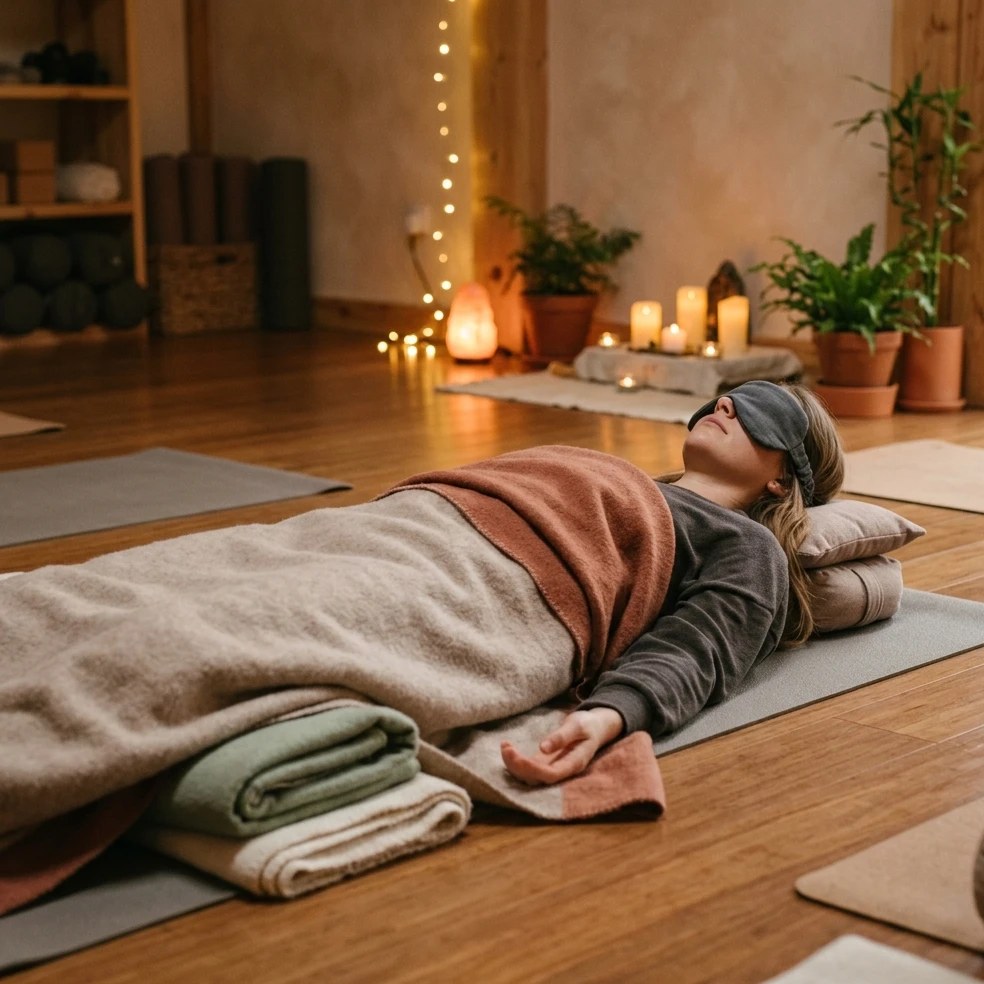
3. Restorative yoga / yin yoga
Long-held supported postures (3–10 minutes per pose). Heavy emphasis on relaxation rather than effort. Smaller literature, suggestive of meaningful stress effects with even smaller flexibility outcomes than dynamic yoga.
4. Breath-coordinated mobility
Less branded, often used in physiotherapy and rehab. 30-second held stretches paired with slow exhales. Limited but growing literature; effects in the moderate range when breath component is structured.
The 5-minute box-breath plus stretch
If you want a low-investment stress intervention with reasonable evidence: spend 5 minutes alternating slow box-breathing (4 in, 4 hold, 6 out, 2 hold) with held stretches in positions you find comfortable (forward fold, child’s pose, supine spinal twist, legs-up-the-wall). Cycle through 3–5 positions. The active ingredient is the breath; the stretches are companions. Repeated daily, this approach produces small-to-moderate effects on subjective stress in trials that have used it.
Where stretching is asked to do too much
Common over-claims:
- “Stretching releases trauma stored in the muscles.” The “tissue trauma storage” framing has minimal scientific support. Trauma-related symptoms are mediated by the brain’s threat-response systems, not by physical tightness in tissues. Yoga and stretching practices can help regulate nervous-system states associated with trauma, but the metaphor of “releasing trauma from the hips” is folk language, not science.
- “A 60-minute stretch session will recover you from a hard week.” Overstated. Stretching has small recovery effects on muscle damage. Sleep, nutrition, and time produce most recovery; stretching contributes modestly.
- “Tight muscles cause anxiety; stretching them relieves it.” Probably backwards. Anxiety produces sympathetic activation that increases muscle tone. Reducing the anxiety reduces the muscle tone. The reverse causal direction (loose muscles → calm mind) has weaker evidence.
- “You’ll fall asleep faster if you stretch before bed.” Sleep-onset effects are mostly driven by the breath and reduced arousal, not the stretch. A 5-minute slow-breathing session in any position produces similar sleep-onset effects.
None of this means stretching is useless. It means understanding what part of a “stretching helps stress” intervention is doing the actual work.
A reasonable protocol
If stretching for stress is your goal:
- Pick 3–5 positions you find comfortable (lying or seated; forward fold, child’s pose, supine twist, legs-up-the-wall, simple seated meditation).
- Hold each for 1–3 minutes while breathing slowly with longer exhales than inhales (e.g., 4 in, 6 out).
- Don’t push into pain; the goal is parasympathetic shift, not maximum tissue elongation.
- 10–15 minutes total is enough to produce measurable stress effects.
- Daily or near-daily produces the strongest cumulative effects in trials.
If flexibility for performance is also a goal, that’s a separate practice and a separate article. Stretching for stress and stretching for flexibility share some surface features but optimise for different things.
Acute vs chronic stress
The honest distinction:
- Acute stress (single stressful event, short-term sympathetic activation): brief breath-coordinated movement reliably reduces it within minutes.
- Chronic stress (sustained activation across weeks to months): single sessions don’t solve it. Regular practice (3–5x/week for 6–12 weeks) produces measurable chronic markers improvement.
- Trauma-related stress (PTSD, complex trauma): yoga and trauma-sensitive movement practices can be useful adjuncts but are not standalone treatments. Trauma-focused therapy is the primary intervention.
- Acute mental health crisis: stretching and breath are not the right tool. Direct support, crisis services.
Common myths
- “Stretching activates the vagus nerve directly.” Mostly via the breath, not via muscle elongation. The breath is doing the autonomic work.
- “Yoga lowers cortisol immediately.” Acute cortisol effects are smaller than promoted. Chronic cortisol-rhythm normalisation appears with regular practice over weeks.
- “If you can’t touch your toes, you’re stressed.” No causal relationship. Hamstring length and stress level vary independently.
- “Tightness is unprocessed emotion.” Folk psychology. Tightness is muscle tone plus connective tissue properties; emotional state can influence muscle tone but the “stored emotion” framing is not how the body works mechanistically.
- “You need to stretch every day to manage stress.” The breath component is what matters most; that doesn’t require elaborate stretching. 5 minutes of slow paced breathing daily produces most of the benefit.
Practical takeaways
- Stretching alone has small effects on stress. Most of the benefit attributed to stretching comes from the breath and attentional shift bundled with it.
- Yoga, tai chi, and other multi-component practices have moderate evidence (d=0.30–0.55) for stress reduction.
- The active autonomic ingredient is slow breathing with longer exhales than inhales. The stretching is a companion.
- 10–15 minutes of breath-coordinated mobility daily produces measurable stress effects in trials.
- Don’t expect stretching to release trauma or solve chronic stress alone. It’s a useful tool in a larger toolkit.
- For trauma-related symptoms, work with a qualified clinician; trauma-sensitive yoga is an adjunct, not a primary treatment.
References
Mehling 2011Mehling WE, Wrubel J, Daubenmier JJ, et al. Body awareness: a phenomenological inquiry into the common ground of mind-body therapies. Philos Ethics Humanit Med. 2011;6:6. View source →Streeter 2010Streeter CC, Whitfield TH, Owen L, et al. Effects of yoga versus walking on mood, anxiety, and brain GABA levels: a randomized controlled MRS study. J Altern Complement Med. 2010;16(11):1145-1152. View source →Russo 2018Russo MA, Santarelli DM, O'Rourke D. The physiological effects of slow breathing in the healthy human. Breathe (Sheff). 2017;13(4):298-309. View source →Field 2010Field T. Yoga clinical research review. Complement Ther Clin Pract. 2011;17(1):1-8. View source →Cramer 2017Cramer H, Lauche R, Anheyer D, et al. Yoga for anxiety: a systematic review and meta-analysis of randomized controlled trials. Depress Anxiety. 2018;35(9):830-843. View source →Wang 2014Wang F, Lee EK, Wu T, et al. The effects of tai chi on depression, anxiety, and psychological well-being: a systematic review and meta-analysis. Int J Behav Med. 2014;21(4):605-617. View source →Brown 2005Brown RP, Gerbarg PL. Sudarshan Kriya yogic breathing in the treatment of stress, anxiety, and depression: part I-neurophysiologic model. J Altern Complement Med. 2005;11(1):189-201. View source →Zaccaro 2018Zaccaro A, Piarulli A, Laurino M, et al. How breath-control can change your life: a systematic review on psycho-physiological correlates of slow breathing. Front Hum Neurosci. 2018;12:353. View source →Perciavalle 2017Perciavalle V, Blandini M, Fecarotta P, et al. The role of deep breathing on stress. Neurol Sci. 2017;38(3):451-458. View source →Ross 2010Ross A, Thomas S. The health benefits of yoga and exercise: a review of comparison studies. J Altern Complement Med. 2010;16(1):3-12. View source →Hofmann 2010Hofmann SG, Sawyer AT, Witt AA, Oh D. The effect of mindfulness-based therapy on anxiety and depression: a meta-analytic review. J Consult Clin Psychol. 2010;78(2):169-183. View source →Emerson 2009Emerson D, Sharma R, Chaudhry S, Turner J. Trauma-sensitive yoga: principles, practice, and research. Int J Yoga Therap. 2009;19(1):123-128. View source →