The 60-second version
Gentle yoga for adults over 65 is one of the better-studied movement interventions in the joint-mobility space. Sivaramakrishnan’s 2019 meta-analysis of 22 randomized controlled trials in older adults found small-to-moderate improvements in physical function, depressive symptoms, and quality of life from yoga compared with usual care or active control Sivaramakrishnan 2019. Cramer’s earlier 2013 meta-analysis on yoga for chronic low back pain (a common over-65 complaint) found similar effect sizes Cramer 2013. The crucial design choice is style: Iyengar yoga, with its emphasis on alignment, prop use, and held postures, is the form most studied in older adults and the form that respects arthritic joints best Patel 2012. Vinyasa or power yoga, with their flowing transitions and floor-to-standing shifts, are higher-risk and not the appropriate first style for the 65+ beginner. The morning timing matters less than the consistency: 2-3 sessions per week of 30-45 minutes is the dose where the literature shows clean benefit at 8-12 weeks.
The peer-reviewed evidence base
The yoga-for-seniors literature has grown from a handful of underpowered pilot studies in the early 2000s to a respectable evidence base by the late 2010s. Sivaramakrishnan and colleagues published the most comprehensive systematic review in 2019, pooling 22 randomized controlled trials of yoga interventions in adults aged 60 and older Sivaramakrishnan 2019. The pooled effect on physical function was a standardized mean difference of 0.61 (small-to-moderate); the effect on depressive symptoms was 0.43; the effect on quality of life was 0.40. All three reached statistical significance and all three exceeded the effect sizes typically observed for stretching-only controls.
Cramer’s earlier 2013 meta-analysis specifically examined yoga for chronic low back pain — a complaint that affects roughly 30 percent of adults over 65 in Canadian population data Cramer 2013. The pooled effect on pain was a standardized mean difference of 0.48 versus usual care, with similar effects on disability. The trials in Cramer’s analysis used Iyengar, Hatha, and Viniyoga styles — all of which share the held-posture, alignment-focused approach that the senior-yoga literature favours.
Patel and colleagues’ 2012 work in the Journal of Aging and Physical Activity examined yoga adherence and adverse-event rates specifically in the 65-and-over population Patel 2012. Adherence to twice-weekly Iyengar sessions across 12 weeks was 78 percent — comparable to other supervised exercise interventions in this age group. Adverse events were rare and minor (transient soreness, no falls or fractures). The combination of feasibility and safety supports yoga’s position as a defensible first-line movement intervention for this population.
The Iyengar-vs-vinyasa decision for adults over 65
Style selection is the highest-leverage decision a 65+ beginner makes. The differences between yoga styles are not aesthetic preferences in this population; they map directly onto injury risk and mobility benefit. Iyengar yoga, developed by B.K.S. Iyengar in mid-20th-century India, emphasizes precise alignment, the use of props (blocks, straps, bolsters, chairs) to make postures accessible to bodies that cannot yet reach the ‘classical’ expression, and held static postures of 30 seconds to several minutes. The combination of alignment focus, prop use, and held postures is the form that the senior-yoga literature has most thoroughly validated Roland 2011.
Vinyasa yoga, by contrast, links postures with flowing breath-coordinated transitions. The transitions are often dynamic (chaturanga to upward dog to downward dog repeatedly), the postures are typically held for one breath, and the overall effort is closer to a calisthenics workout than to the held-mobility approach Iyengar favours. For a 25-year-old with healthy joints, vinyasa is fine. For a 70-year-old with knee osteoarthritis and reduced shoulder mobility, vinyasa’s transitional load and the time-pressure of staying in sequence with the class are higher-risk than the held-Iyengar alternative.
The practical implication for a beginner over 65 is to seek explicitly Iyengar-trained instructors or studios that offer ‘gentle yoga’, ‘chair yoga’, or ‘yoga for healthy aging’ classes. The labels ‘flow’, ‘power’, ‘hot’, and ‘vinyasa’ should be avoided as starting points. The first 4-6 weeks of practice matter most for setting safe movement patterns; an inappropriate style during this window is the most common producer of the early-injury experiences that lead older adults to abandon yoga before its benefits accumulate.
A joint-protection sequence the evidence supports
The specific pose sequence the senior-yoga trials use varies, but the design principles are remarkably consistent. Postures that load the knees in deep flexion (low lunges, hero pose without props, deep squats) are minimized or modified. Postures that load the wrists weight-bearing (full plank, downward-facing dog held long) are minimized for adults with wrist osteoarthritis or reduced bone density. Postures that compress the cervical spine (full headstand, shoulder stand) are excluded for the over-65 population entirely.
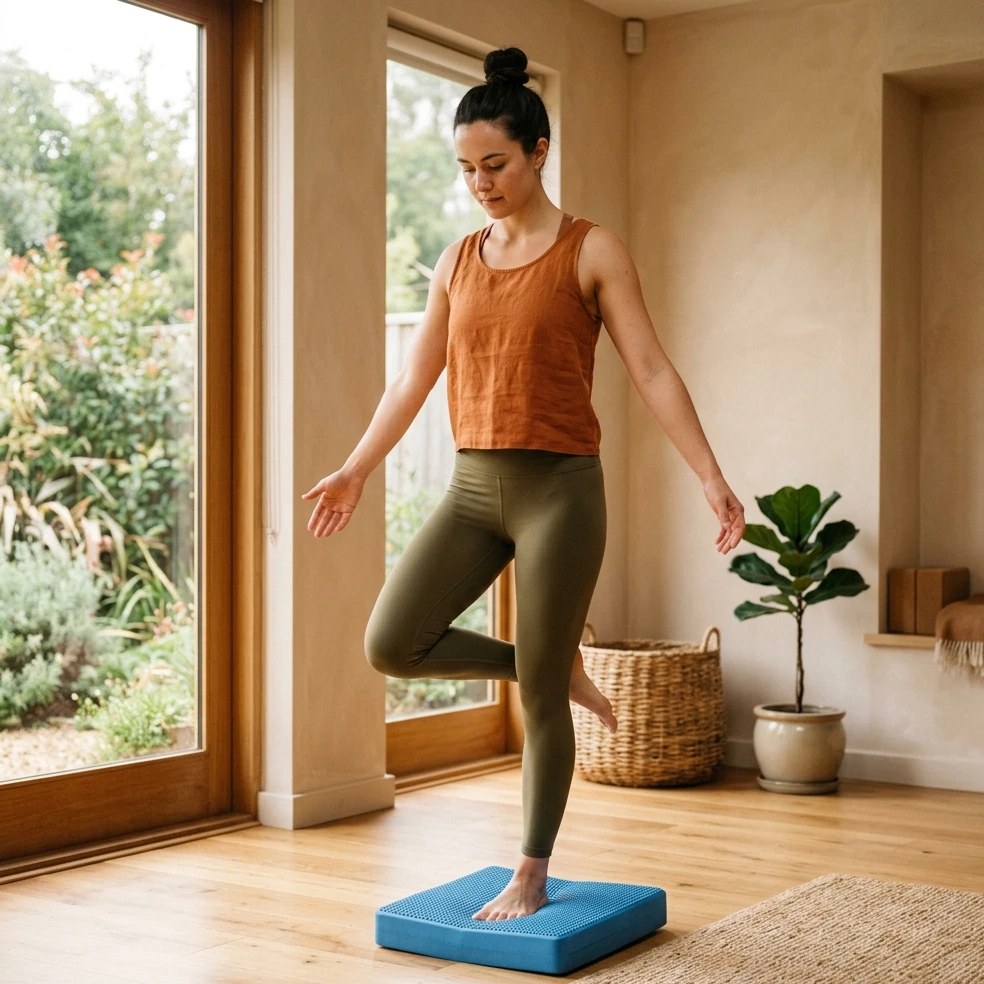
What remains is still a substantial sequence. Standing postures (mountain pose, modified warrior I and II with chair support, tree pose with wall support) build leg strength and balance — both of which are first-line falls-prevention interventions in the over-65 population. Seated postures (easy pose, cobbler pose, seated forward fold with prop support) target hip mobility. Supine postures (knees-to-chest, supine spinal twist, legs-up-the-wall) provide the lumbar mobilization that the Cramer 2013 chronic-low-back-pain literature supports. A typical sunrise-gentle session moves through these in 30-45 minutes with extended use of bolsters, blankets, and chairs to make each posture accessible.
The closing relaxation (savasana, or corpse pose) is not optional in this population. The 5-10 minute supine rest at the end of practice is where the parasympathetic nervous-system shift that yoga produces consolidates. The senior-yoga trials that excluded savasana saw smaller effects on the depression and quality-of-life endpoints than trials that included it. For a 30-45 minute session, the final 8-10 minutes should be supine rest with optional bolster support under the knees.
Why morning specifically: timing and the sunrise question
The ‘sunrise’ framing is partly aesthetic and partly practical. Practically, morning yoga sessions take advantage of two physiological alignments. First, the natural cortisol rhythm peaks in the first hour after waking, which provides the metabolic readiness for movement without the late-day fatigue that accumulates in older adults. Second, the joint-stiffness pattern that follows overnight immobility is most responsive to gentle morning mobilization — the ‘morning stiffness’ complaint of osteoarthritis typically resolves with movement, and a 30-minute gentle sequence at 7 AM addresses it more effectively than waiting until the afternoon.
The aesthetic side of sunrise yoga — outdoor practice, natural light, the ritual of starting the day with movement — is supported by the broader morning-light literature on circadian alignment. Roughly 30 minutes of natural light in the first hour after waking is the dose that the circadian-rhythm research supports for sleep-quality benefit. A 30-45 minute outdoor or window-facing yoga session covers that requirement as a side effect of the practice itself.
The honest framing is that the morning timing is supportive but not load-bearing. The yoga itself is what produces the joint-mobility, balance, and mood benefits the literature documents. A 65-year-old who practices gentle Iyengar at 5 PM gets most of the same benefit as one who practices at 7 AM. The morning advocates have the better claim on consistency (morning routines tend to stick better than evening ones in older adults) and the side-benefit of circadian light exposure; the evening practitioner has the trade-off of better tissue warmth at the end of a moving day. Both are defensible.
Contraindications and the modification mindset
A short list of conditions warrants medical clearance before starting gentle yoga. Recent cardiac events (within 6 months), uncontrolled hypertension, recent joint replacement (within 3 months), severe osteoporosis with prior vertebral fracture, and active glaucoma all require physician input on which postures are safe. None of these are absolute contraindications to gentle yoga — they are signals that the modification choices need to come from the patient’s clinical team rather than from a generic class instructor.
The modification mindset is the heart of senior-appropriate yoga practice. Every classical pose has a chair-supported variant, a wall-supported variant, a prop-assisted variant, and a supine variant. The competent gentle-yoga instructor offers two-or-three options for each pose and explicitly invites the student to choose the version that respects their body that day. The Iyengar tradition is built around this modification philosophy; the studios and instructors that have adopted it are reliably better fits for the 65+ beginner than studios that emphasize achieving the ‘full expression’ of poses.
Specific high-risk modifications worth knowing: replace full forward folds with chair-supported forward leans (preserves hamstring lengthening, removes the dizziness risk of the head-below-heart position); replace full plank with wall-plank or knee-supported plank (preserves shoulder-girdle activation, removes the wrist-loading and balance-loading); replace deep lunges with high lunges with the back knee on a folded blanket (preserves hip-flexor lengthening, removes the knee-cartilage compression); replace headstand and shoulder stand entirely with legs-up-the-wall (most of the venous-return and parasympathetic benefit, none of the cervical compression risk).
Building a sustainable practice: the first 12 weeks
The trial data converges on a sustainable starter dose for adults over 65: two-to-three sessions per week, 30-45 minutes per session, for at least 8-12 weeks before evaluating whether the practice is producing benefit. Most readers notice morning-stiffness reduction in 2-3 weeks; balance improvements in 4-6 weeks; mood and sleep effects in 6-8 weeks; and the deeper functional changes (timed-up-and-go, stair-climbing capacity) in 8-12 weeks. The patience required is real but the curve is reliable.
Format choice matters less than consistency for the first 12 weeks. Studio classes (in-person, instructor-supervised) provide the safety scaffolding that a beginner needs. Live-online classes (Zoom-based) work well for readers in rural Canadian areas without local studios; the instructor can still offer real-time corrections. Recorded classes are the lowest-supervision option and should not be the first choice for a 65+ beginner with arthritis or balance issues — the absence of real-time correction tends to produce the misalignment patterns that lead to the early-injury experiences mentioned earlier.
The cost-benefit calculus favours an in-person studio for the first 12 weeks even if the per-class cost is higher than online alternatives. After 12 weeks of supervised practice, the home-based or recorded-class option becomes more viable because the practitioner has internalized the alignment rules and can self-correct. The transition from studio-supervised to home-supplemented practice is a common pattern in the senior-yoga adherence literature and tends to produce the longest-term consistency.
Practical takeaways
- Yoga for adults over 65 produces small-to-moderate improvements in physical function, mood, and quality of life. Effect sizes from 22 RCTs (Sivaramakrishnan 2019) are clinically meaningful.
- Iyengar style is the form most studied in older adults and the safest first choice. Vinyasa, power, and hot yoga are not appropriate starting points for the 65+ beginner.
- The joint-protection sequence respects arthritis. Modified standing, seated, and supine postures cover the mobility benefit; deep knee flexion, weight-bearing wrists, and inversions are minimized.
- Morning timing is supportive but not load-bearing. The yoga itself produces the benefit; sunrise practice adds circadian light exposure as a side benefit.
- 2-3 sessions per week of 30-45 minutes is the dose where the trials show clean benefit at 8-12 weeks. Patience for the first 8-12 weeks is required but the response curve is reliable.
- Studio supervision for the first 12 weeks is worth the cost. Real-time correction prevents the early-injury experiences that derail many beginners.
References
Sivaramakrishnan 2019Sivaramakrishnan D, Fitzsimons C, Kelly P, et al. The effects of yoga compared to active and inactive controls on physical function and health-related quality of life in older adults: systematic review and meta-analysis of randomised controlled trials. International Journal of Behavioral Nutrition and Physical Activity. 2019;16(1):33. View source →Cramer 2013Cramer H, Lauche R, Haller H, Dobos G. A systematic review and meta-analysis of yoga for low back pain. The Clinical Journal of Pain. 2013;29(5):450-460. View source →Patel 2012Patel NK, Akkihebbalu S, Espinoza SE, Chiodo LK. Perceptions of a community-based yoga intervention for older adults. Journal of Aging and Physical Activity. 2012;20(3):281-292. View source →Roland 2011Roland KP, Jakobi JM, Jones GR. Does yoga engender fitness in older adults? A critical review. Journal of Aging and Physical Activity. 2011;19(1):62-79. View source →