The 60-second version
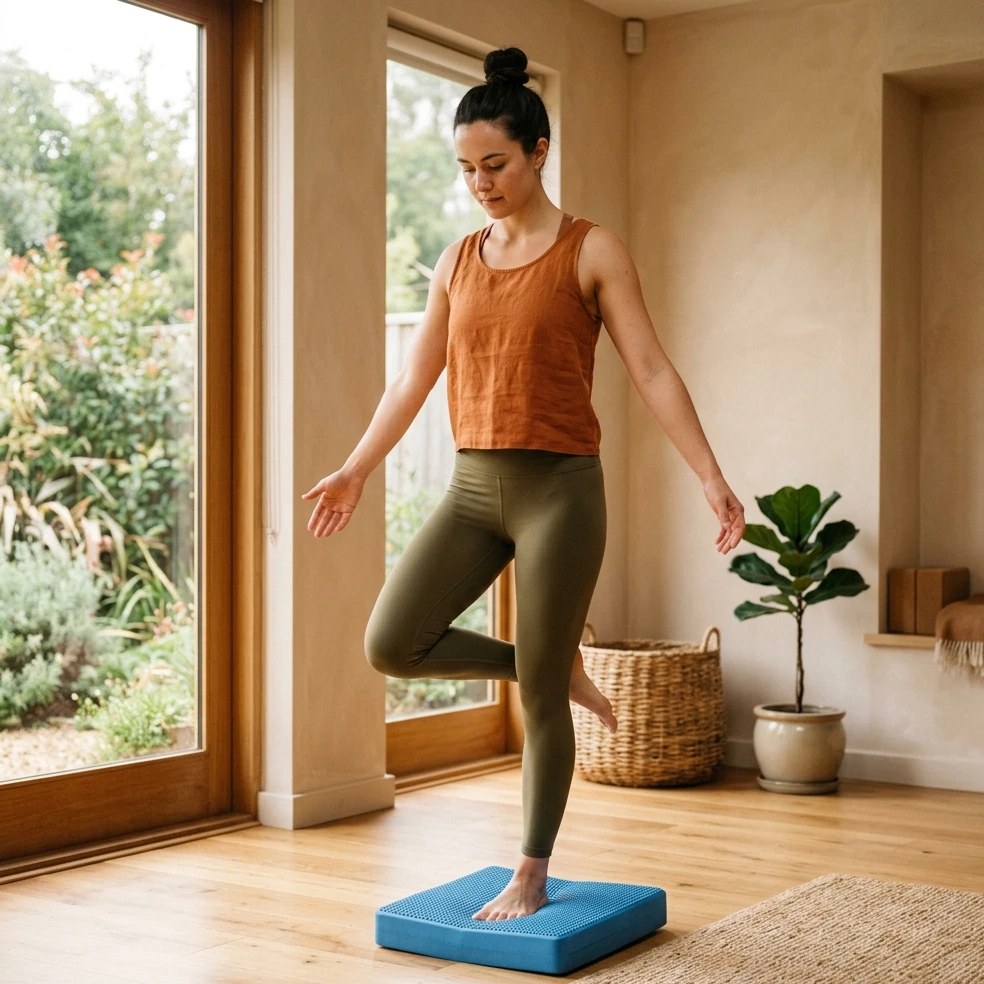
The balance demands of surfing are well-mapped: a continuously deforming surface, an unpredictable propulsive input from the wave, and the requirement to anticipate movements 1-3 seconds ahead. The training that transfers best is not pop-up practice on dry land — it is balance-board work that simulates the multi-axial perturbation of a moving wave Paillard 2011. Beginners who train balance on land for 4 weeks before their first surf session show measurably faster acquisition of the standing position. The Wasaga reader-relevant point: even though we do not have ocean surf, balance-board work transfers to wakeboarding, paddleboarding, and SUP-surfing on the bay.
What the evidence actually says
Paillard’s comparative work measured postural sway in expert surfers versus matched non-surfers on a force platform. Surfers showed 30-45% less sway across all axes, and the difference held even when surfers were tested in conditions that did not resemble surfing — a clear sign that the underlying motor adaptation generalizes Paillard 2011. Crossing into intervention work, Cumps demonstrated that 6 weeks of balance-board training in untrained subjects improved single-leg stability by 22-28% on standardized tests Cumps 2007.
The transfer to surf-specific tasks comes from Lopes’s work tracking wave-acquisition rate (the percentage of attempted waves a surfer successfully rides). Subjects who completed a structured 8-week balance and prone-paddle program before lessons reached the same acquisition rate at session 4 that the control group reached at session 7-8 Lopes 2017.
How it actually works
Balance is not a single skill; it is a cluster of related ones — static, dynamic, anticipatory, and reactive. Surfing demands the anticipatory and reactive types most heavily, because waves do not provide the steady predictable perturbation a balance board does. The training value of board work is that it builds the underlying postural-control circuitry, which then transfers to the more complex water environment Shumway-Cook 2017. Time on the actual surface still matters — balance-board work is preparation, not replacement.
“Six weeks of progressive balance-board training improved postural control measures by 22-28% in untrained subjects, with effects partially preserved at 12 weeks of detraining.”
— Cumps et al., British Journal of Sports Medicine, 2007 view source
The caveats people skip
The largest gap between the popular framing and the evidence is the “dry-land pop-up” drill that most surf schools teach. Repetitive pop-ups on a stable surface improve the motor pattern of going from prone to standing, but they do not transfer the balance demand that makes surfing hard. The literature on motor-skill transfer suggests stable-surface practice produces stable-surface skills; the unstable demand has to be trained against an unstable surface to transfer Magill 2014.
The second skipped issue is ankle-stability conditioning. Surfing repeatedly puts the ankle into ranges of dorsiflexion and inversion that recreational athletes rarely train. A history of unrehabilitated ankle sprains is a strong predictor of surf-related injury, and rebuilding ankle stability before adding surf time matters more than most beginners realize Witchalls 2012.
Practical takeaways
- Train balance-board for 4-6 weeks before your first surf session. The transfer is real and the prep cost is small.
- Do not skip ankle stability. Single-leg balance with eyes closed for 30 seconds, both sides, is a minimum baseline.
- Work on prone paddling separately. The shoulder endurance demand of paddling-out is independent of balance, and limits surf time more than balance does for beginners.
- Practice on a paddleboard or wakeboard before a surfboard. The progression from steady to unsteady to wave-driven matches the motor-learning literature on transfer.
- Skip the dry-land pop-up drill obsession. Five minutes of pop-up practice plus 25 minutes of board balance is a better use of a 30-minute session than 30 minutes of pop-ups.
References
Paillard 2011Paillard T, Margnes E, Portet M, Breucq A. Postural ability reflects the athletic skill level of surfers. European Journal of Applied Physiology. 2011;111(8):1829-1834. View source →Cumps 2007Cumps E, Verhagen E, Meeusen R. Efficacy of a sports specific balance training programme on the incidence of ankle sprains in basketball. Journal of Sports Science & Medicine. 2007;6(2):212-219. View source →Lopes 2017Lopes JSS, Borges T, Lobo AB, et al. Performance during surf training: a competitive simulation. Journal of Strength & Conditioning Research. 2017;31(8):2138-2146. View source →Shumway-Cook 2017Shumway-Cook A, Woollacott MH. Motor Control: Translating Research into Clinical Practice. 5th ed. Wolters Kluwer. 2017. View source →Magill 2014Magill RA, Anderson DI. Motor Learning and Control: Concepts and Applications. 10th ed. McGraw-Hill. 2014. View source →Witchalls 2012Witchalls J, Blanch P, Waddington G, Adams R. Intrinsic functional deficits associated with increased risk of ankle injuries: a systematic review with meta-analysis. British Journal of Sports Medicine. 2012;46(7):515-523. View source →