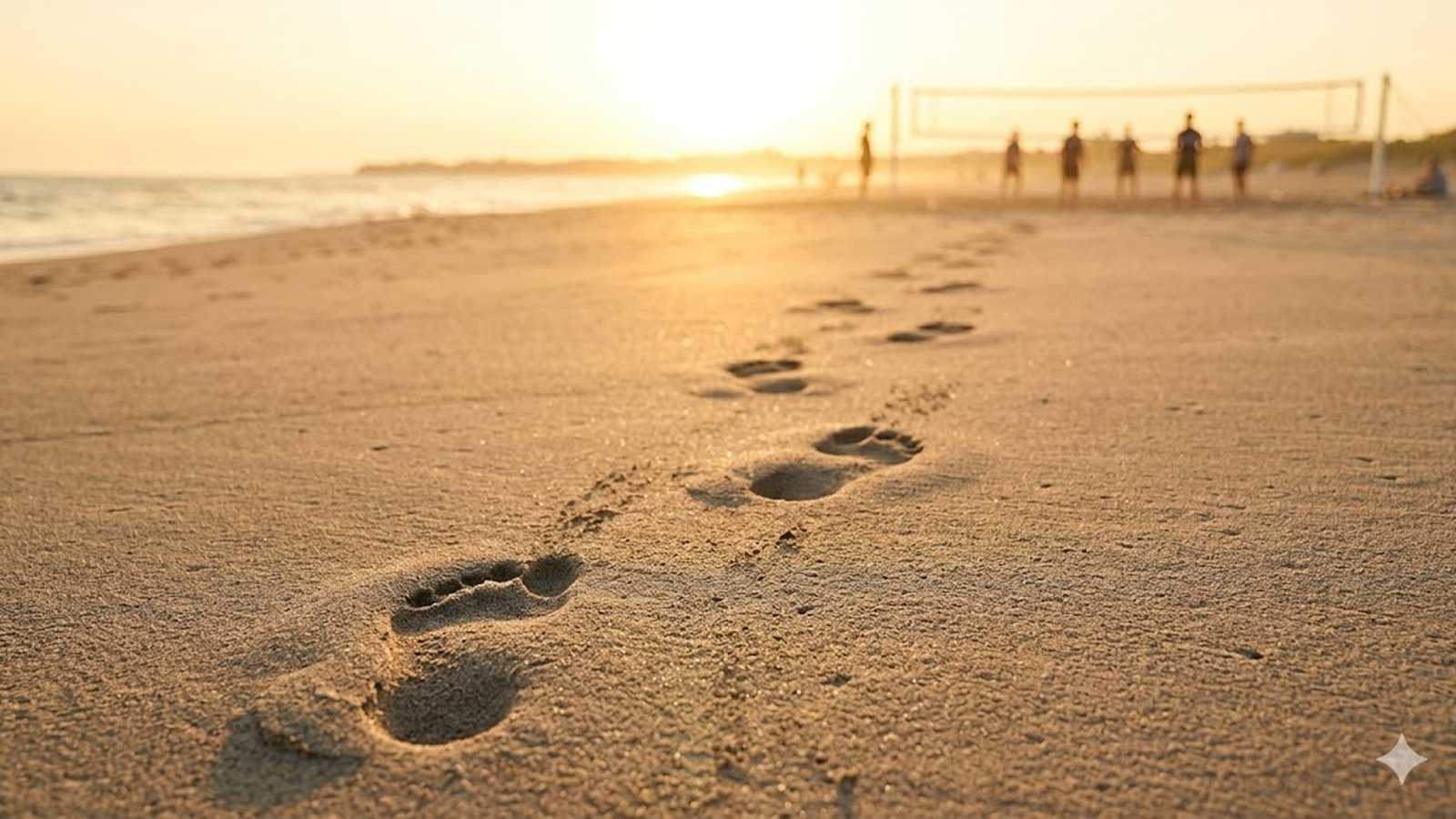
The 60-second version
Soft-sand walking burns roughly 1.6 to 2.7 times the calories of road walking at the same pace, and the difference is mostly stabilizer work — not magic fat-burning. Hard-packed wet sand by the waterline performs almost identically to pavement; soft dry sand near the dunes is where the metabolic premium appears Zamparo 1992. For Wasaga readers chasing a fat-loss benefit, the practical play is to walk in the soft sand near the dunes for the first half of the route and the hard sand by the water for the return, balancing intensity with sustainable pace.
What the evidence actually says
The pivotal work comes from Zamparo and colleagues, who measured oxygen consumption during walking and running on hard ground versus soft sand. At a typical walking pace of 4 km/h, soft-sand walking required 2.1 to 2.7 times the energy of equivalent road walking; at jogging pace the multiplier dropped toward 1.6 because the elastic-energy advantage of running is partially preserved even on yielding surfaces Zamparo 1992. Lejeune later replicated and extended this with cleaner gait analysis, confirming the energy cost is dominated by the work done against the deforming substrate rather than friction or air resistance Lejeune 1998.
What this means in calories: a 70 kg adult walking briskly on pavement burns roughly 4 kcal per minute. The same person walking soft sand at the same pace burns 8-11 kcal per minute. Over a 30-minute beach walk, that is roughly 240 vs 120 kcal — a real but modest difference, and one that depends entirely on staying in the soft section.
How it actually works
Three things are happening physically. The substrate deforms under each step, absorbing 30-50% of the elastic energy that would normally return through the calf and Achilles tendon during the push-off phase Pinnington 2005. The foot must propel from a constantly-shifting base, requiring continuous low-grade contraction of the small muscles around the ankle and along the medial arch. And the medio-lateral instability recruits the gluteus medius and tensor fasciae latae to maintain hip alignment, muscles that sit nearly silent during pavement walking.
“The energy cost of walking on sand is 2.1 to 2.7 times greater than that of walking on a hard surface at the same speed.”
— Zamparo et al., European Journal of Applied Physiology, 1992 view source
The caveats people skip
The fat-loss framing is misleading. The total caloric difference per hour of effort is real but small in the context of weekly energy balance — about 200-400 extra kcal compared to pavement walking. That is one slice of bread. Long-term fat loss tracks far more reliably with consistent dietary energy deficit than with terrain choice Hall 2017.
What the soft sand reliably delivers is the secondary benefit: stabilizer recruitment and mild plantar-fascia conditioning. For runners returning from injury, walking in soft sand is a useful intermediate-load progression. For sedentary readers starting an exercise habit, the same recruitment can produce calf and arch soreness; start with shorter distances on the hard wet sand and graduate to the soft section over 2-3 weeks.
Practical takeaways
- Walk the soft sand for fitness gain, not for calorie magic. The 2× multiplier is real but only 200-400 kcal per hour of effort.
- Alternate soft outbound, hard return. Lets you sustain pace without overloading calves and arches in a single session.
- Build over 2-3 weeks if you have plantar-fascia history. The yielding surface conditions the arch but can also irritate it during rapid progression.
- Skip the soft sand in midday summer heat. Surface temperatures over 45°C transfer through thin shoes; train at dawn or evening.
- Track time on terrain, not pace. Step rate matters less than continuous time in the soft section, where the metabolic premium accrues.
References
Zamparo 1992Zamparo P, Perini R, Orizio C, Sacher M, Ferretti G. The energy cost of walking or running on sand. European Journal of Applied Physiology and Occupational Physiology. 1992;65(2):183-187. View source →Lejeune 1998Lejeune TM, Willems PA, Heglund NC. Mechanics and energetics of human locomotion on sand. Journal of Experimental Biology. 1998;201(Pt 13):2071-2080. View source →Pinnington 2005Pinnington HC, Lloyd DG, Besier TF, Dawson B. Kinematic and electromyography analysis of submaximal differences running on a firm surface compared with soft, dry sand. European Journal of Applied Physiology. 2005;94(3):242-253. View source →Hall 2017Hall KD, Guo J. Obesity energetics: body weight regulation and the effects of diet composition. Gastroenterology. 2017;152(7):1718-1727. View source →