The 60-second version
The Allenwood Beach Conservation Loop is a 4.6 km low-impact trail along the easternmost edge of the Wasaga Beach Provincial Park boundary, near the village of Allenwood. Unlike the central Wasaga beach corridor, this loop sees fewer than 30 visitors per day in summer — it’s the local secret for genuine wildlife observation, including breeding bank swallows in the active sand banks south of the trail and the resident piping plovers that nest sporadically on the eastern shoreline. The trail is flat, well-marked, dog-friendly on-leash, and works year-round. Best used as a slow-paced wildlife observation walk rather than a training trail; pairs naturally with a Schoonertown Wetland forest-bathing session as a paired-half-day low-stimulation outing. Free, no permit, parking at the Allenwood Beach access lot off Allenwood Beach Road.
Where it is and why almost no one finds it
The Allenwood Beach Conservation Loop is at the eastern edge of the Wasaga Beach Provincial Park, accessed via Allenwood Beach Road, which branches off River Road East roughly 4 km east of central Wasaga. Most visitors miss this access entirely because it’s past the popular Areas 1-6 numbered beach corridors, and there’s no commercial draw — no concessions, no rentals, no patio bars. The municipal signage is minimal.
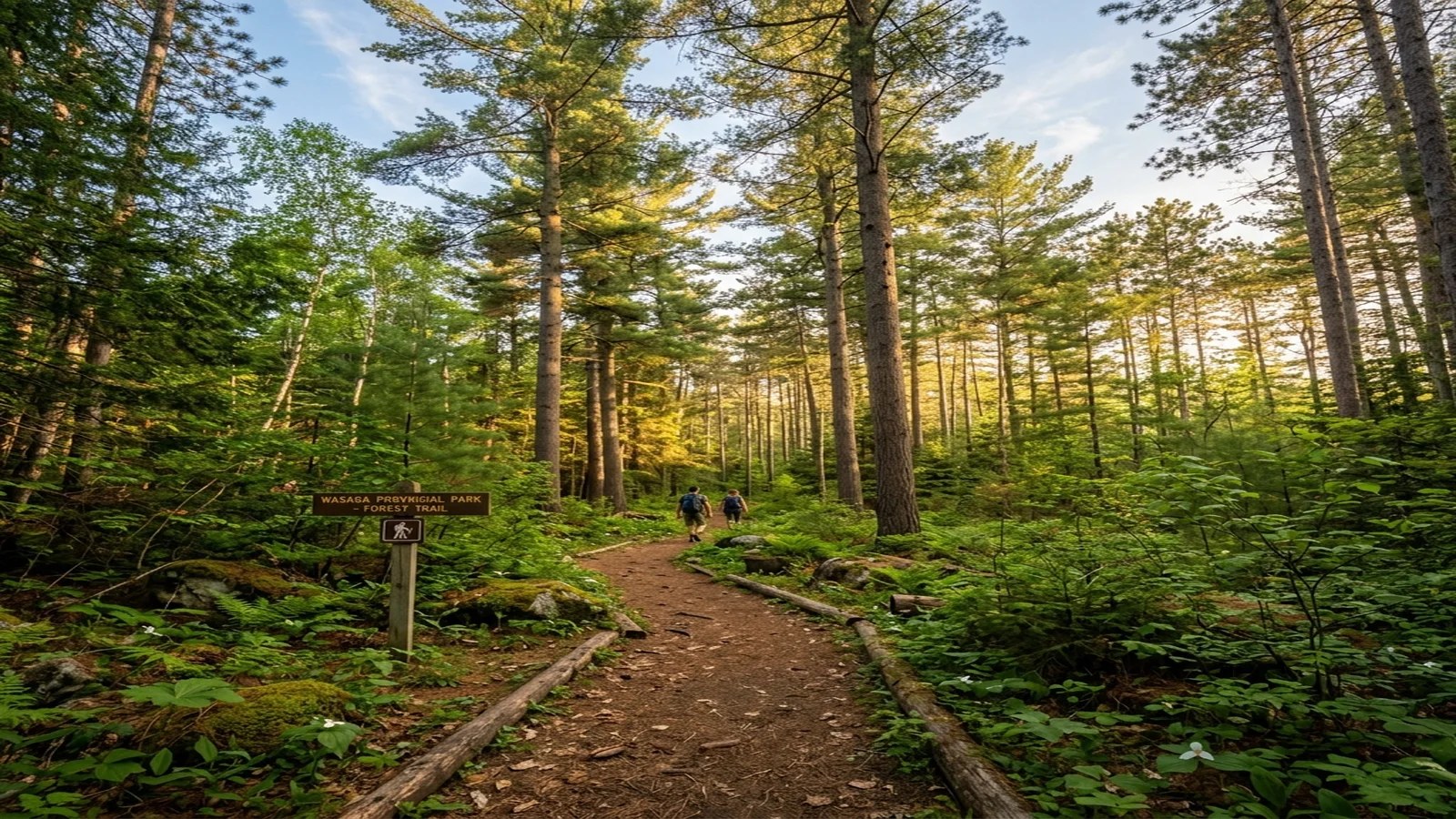
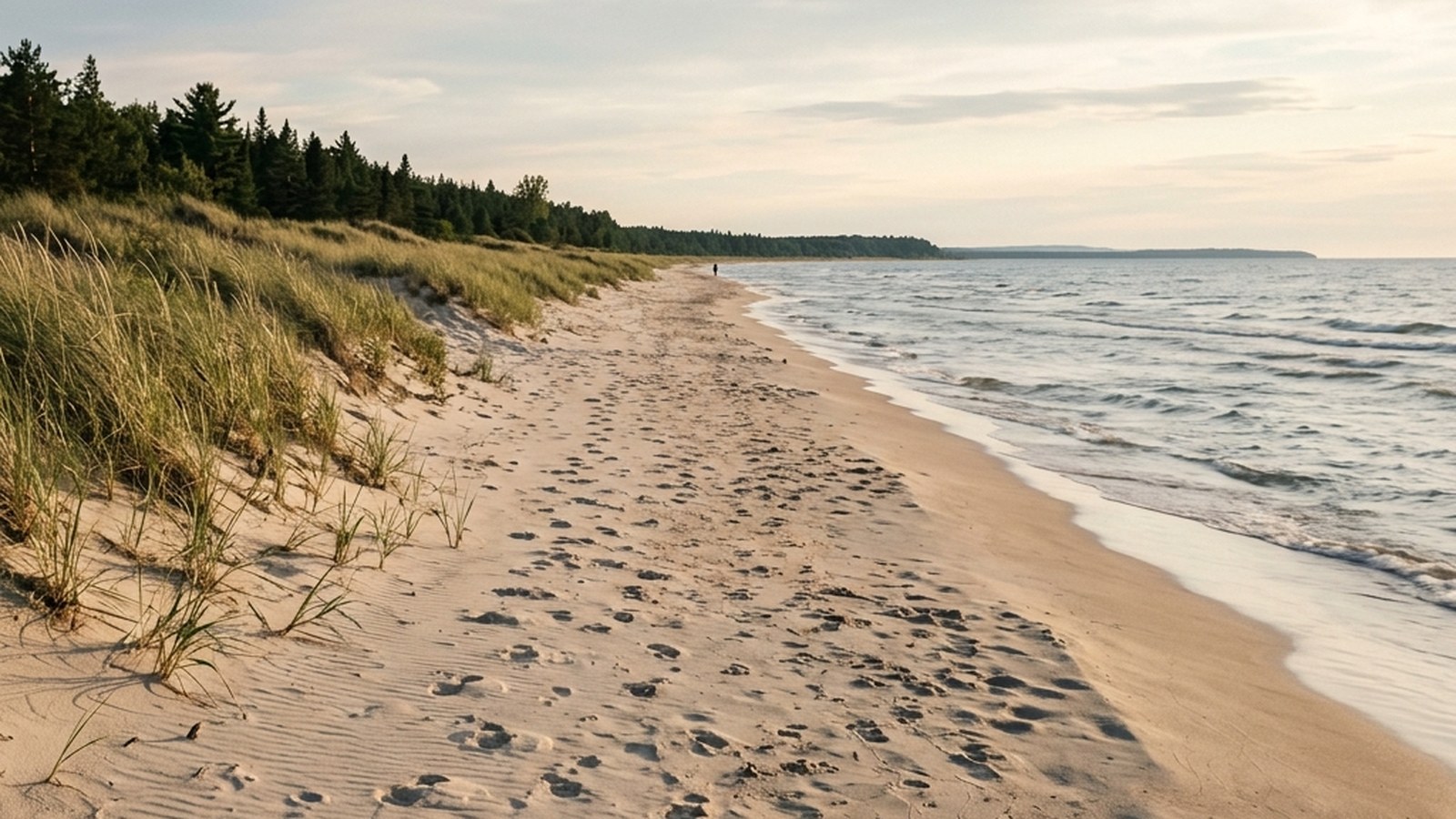
The trail itself starts at the small paved parking lot (capacity ~15 cars) and follows the dune line east-then-south-then-back-west in a soft figure-8 that totals 4.6 km. Roughly 60% of the loop traces the active sand-and-grass dune system; the remaining 40% loops back through a stand of cedar-and-balsam-fir forest just inland from the dunes.
The wildlife observation case
What makes Allenwood worth the drive past the central beach is the wildlife density per visitor. Three species are the headline draws:
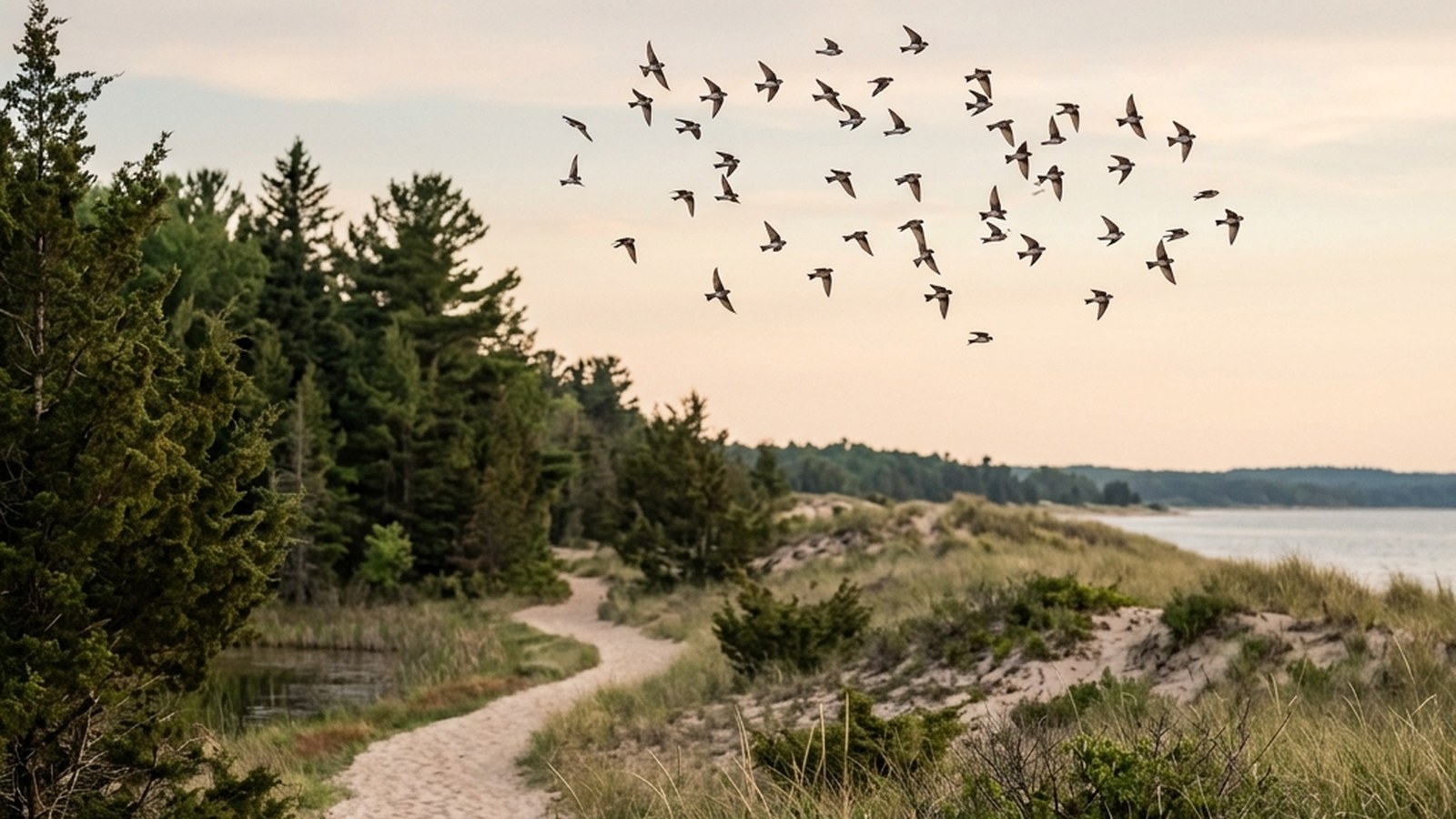
- Bank swallows — this colonial bird species nests in the actively-eroding sand banks south of the trail. May through July, hundreds of birds work the dune-edge airspace catching insects. The trail’s southern arc passes within 50 metres of the largest active colony. Bank swallows are designated Threatened in Canada (COSEWIC 2013); the trail routing was specifically designed to allow observation without disturbing nesting.
- Piping plovers — this Endangered shorebird (COSEWIC 2014) nests sporadically on the eastern Wasaga shoreline, including occasional nests within 200 metres of the Allenwood trail. When nesting occurs, a roped-off no-entry zone is established by the Friends of Wasaga Beach Park volunteer group. Respect the rope — piping plover recovery is one of the few real conservation success stories in southern Georgian Bay.
- White-tailed deer — the eastern Wasaga forest pocket holds a year-round herd of 12-20 deer. They cross the trail mostly at dawn and dusk; the cedar grove section is where they’re most likely to be visible from the trail.
Other regular sightings: red foxes, minks along the dune-water edge, a half-dozen warbler species during May migration, and the occasional black bear in spring and fall (low concern; the bears here keep distance from human-frequented trails).
When to visit for the wildlife
Mid-May through mid-July is peak bank swallow activity and possible piping plover observation. Visit between 6:30 and 9 am or 6 and 8 pm for highest songbird activity and visible swallow foraging. Bring binoculars (8x42 is the standard birding spec); the dune-bank distance is just outside naked-eye comfort.
Late August through September is fall warbler migration; bring a field guide or the Merlin app. October-November is rutting season for the deer, which makes them more visible (and slightly less cautious about the trail).
December through March is quieter but still rewarding for tracking practice — deer, fox, mink, and occasional otter tracks are clearly visible in fresh snow along the cedar-grove section.
A wildlife-observation protocol that actually works
Most visitors talk loudly, walk fast, and wonder why they don’t see wildlife. The protocol that actually surfaces the resident species:
- Walk slowly. 1.5-2 km/h; the loop should take 90-120 minutes if you’re actually trying to see things.
- Stop frequently. Wildlife emerges 3-5 minutes after the human noise stops. Standing-still pauses every 200 metres are how the trail produces.
- Soft conversation only. Talking is fine but at a volume below the wind in the cedars.
- Phones on silent. Notification chimes scatter wildlife 50+ metres ahead of you.
- Binoculars in hand, not in the backpack. The bank swallow window is 3-5 seconds when one banks across your line of sight.
This is a low-stimulation outing. It pairs naturally with a Schoonertown Wetland forest-bathing session as a paired-half-day — both have the same nervous-system-shift orientation rather than a training-stimulus orientation.
Accessibility and trail surface
The trail is mostly flat (about 8 metres total elevation gain) on a packed-sand-and-pine-needle surface. The forest sections are firm; the dune-line sections have softer footing that will be effortful for visitors with mobility challenges. Wheelchair access is limited — the first 400 metres from the parking lot are firm enough for some all-terrain wheelchairs, but the dune transitions are not negotiable.
For visitors with a stroller or a mobility-impaired walker, the recommendation is to do the first 1 km out-and-back on the firm forest portion only, which still produces wildlife observation in the cedar grove without committing to the full 4.6 km loop with its softer sand sections.
Practicalities
- Parking: Allenwood Beach Road parking lot, ~15 cars capacity. Free year-round.
- Washrooms: seasonal portable washroom at the parking lot (May-October). None on the trail itself.
- Water: no potable water. Carry your own.
- Cell coverage: Bell and Rogers both work throughout the loop.
- Dogs: permitted on-leash. Off-leash is strictly prohibited because of bank swallow and piping plover nesting; enforcement is occasional but real.
- Drones: not permitted within the Provincial Park boundary, which includes most of the trail. Federal Migratory Birds Convention Act compliance.
Where it fits in the local rotation
Allenwood is not a training trail. It’s a wildlife observation trail that happens to also be a pleasant 90-minute walk. As a parasympathetic-shift outing it pairs with Schoonertown Wetland; as part of a wildlife-and-nature day the combination of Allenwood (morning, for swallows) and Schoonertown (afternoon, for forest bathing) is one of the best low-impact local outings available.
If you’re visiting Wasaga Beach as a tourist and want to see something other than the central beach, Allenwood is the under-the-radar pick. If you’re a local resident, this is the trail your friends-from-out-of-town should be brought to instead of the crowded central beach in mid-July.
Month-by-month observation calendar
For visitors who want to plan their trip around what’s most likely visible:
- March-April: red-winged blackbirds return; first deer fawns visible in cedar grove; tracking still readable in last snow.
- May: peak warbler migration; bank swallows arrive and begin nesting prep; piping plover arrival (sporadic).
- June-July: bank swallow colony at full activity; nesting deer with fawns; possible piping plover chicks.
- August: swallow fledging and pre-migration aggregations; deer most visible at dawn and dusk.
- September-October: fall warbler migration; deer in pre-rut; swallow colonies depart by mid-September.
- November: deer rutting season; coyote activity uptick; mink along the dune-water edge.
- December-February: tracking season; resident deer, fox, mink, occasional otter prints in fresh snow.
Cross-referencing this calendar with the Friends of Wasaga Beach Park social-media posts (which surface unusual sightings within days) is the way to time visits to maximise the chance of headline-species observation.
How to contribute back to the trail
The Friends of Wasaga Beach Park, the volunteer association that maintains the conservation areas including Allenwood, runs a small annual fundraising drive in late spring to fund piping plover protection materials (signage, exclosures, monitoring volunteer hours). Membership is $20/year and includes a printed seasonal newsletter with sighting summaries that the trail signage doesn’t carry. For the cost of a single coffee per month, a Friends membership directly funds the conservation work that makes the trail a wildlife venue rather than just another walking path.
Practical takeaways
- 4.6 km low-traffic conservation loop at the eastern edge of Wasaga Beach Provincial Park. Free, year-round, ~15 cars parking.
- Three headline species: bank swallows (Threatened), piping plovers (Endangered, sporadic), white-tailed deer (year-round herd).
- Visit early morning or evening for songbird and swallow activity. Bring 8x42 binoculars.
- Walk slowly, stop frequently, phone on silent. The 90-120 minute slow-protocol is what produces sightings.
- Pairs naturally with Schoonertown Wetland as a paired half-day low-stimulation outing.
References
COSEWIC 2013Committee on the Status of Endangered Wildlife in Canada. Bank Swallow assessment and status report. 2013. View source →COSEWIC 2014Committee on the Status of Endangered Wildlife in Canada. Piping Plover assessment and status report. 2014. View source →Park 2010Park BJ, Tsunetsugu Y, Kasetani T, Kagawa T, Miyazaki Y. The physiological effects of Shinrin-yoku (forest bathing): evidence from field experiments in 24 forests across Japan. Environmental Health and Preventive Medicine. 2010;15(1):18-26. View source →