The 60-second version
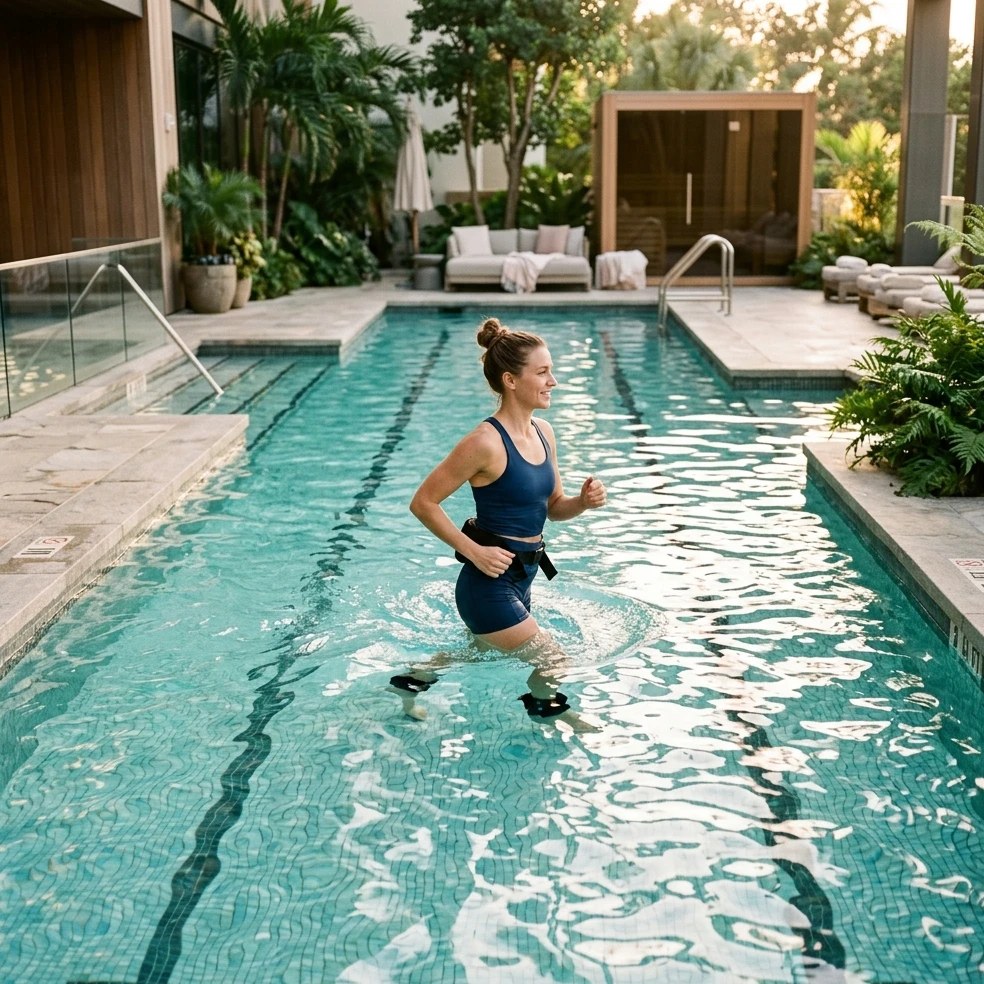
Shallow-water aerobics — rhythmic exercise performed at chest- to navel-deep water — produces measurable cardiovascular gains in deconditioned and arthritic populations Batterham 2011. Becker’s 2009 synthesis identifies the buoyancy-and-hydrostatic-pressure combination as the mechanism: 60–75% of body weight is offloaded at chest-deep immersion, while hydrostatic pressure assists venous return and reduces cardiac afterload Becker 2009. Reichert’s 2018 systematic review of upright aquatic training found consistent improvements in resting blood pressure across adult and elderly cohorts Reichert 2018, and Bocalini’s 12-week trial in older women documented VO2max gains of approximately 42% from a water-based programme matched to a walking-on-land control Bocalini 2008. The variables that determine training dose are depth (deeper unloads more), temperature (cooler permits higher work output), and pace.
The mechanism: buoyancy and hydrostatic pressure
Becker’s 2009 synthesis of aquatic-therapy biomechanics gives the load-bearing mechanism: at xiphoid (chest-bone) immersion, the body retains roughly 25–35% of its weight on the lower extremities; at navel immersion, roughly 50%; at mid-thigh, roughly 75% Becker 2009. The depth-vs-load curve is non-linear, which matters for prescription: a patient who can tolerate 50% body-weight loading but not 75% should be at navel depth, not mid-thigh, even though the mid-thigh option feels ‘more like land’ to the patient.
Hydrostatic pressure is the second mechanism and the underrated one. Standing immersed to chest depth applies approximately 60–100 mmHg of hydrostatic pressure to the lower legs, which assists venous return from the legs to the heart. The clinical effects are increased stroke volume at submaximal exercise intensities, reduced peripheral edema in patients with venous insufficiency, and lower heart rate at any given metabolic load. The cardiac-output efficiency is why aquatic exercise produces cardiovascular gains at lower perceived exertion than land-based training in deconditioned and arthritic populations.
The third mechanism is water resistance — viscous drag that scales with the square of velocity through the medium. The practical consequence is that effort scales rapidly with movement speed in water: doubling the speed quadruples the resistance. This makes water aerobics naturally self-regulating — participants who push harder encounter immediate resistance feedback rather than the delayed cardiac stress that can fatigue them on land. The self-regulation is part of why aquatic exercise has a strong safety profile in cardiac-rehabilitation and elderly populations.
Who benefits most: the population segmentation
Batterham 2011’s systematic review of land vs aquatic exercise in hip and knee osteoarthritis found comparable improvements in function and pain scores between modalities, with aquatic exercise showing a small advantage for pain reduction in the immediate post-session window Batterham 2011. The clean implication: for the OA population, aquatic exercise is at least equivalent to land exercise in long-term outcomes and superior in same-day comfort. This makes aquatic exercise the entry-level prescription for moderate-to-severe OA where land exercise produces post-session symptom flare.
Bocalini’s 2008 randomised trial in 50 healthy sedentary women aged 62–65 compared 12 weeks of water-based exercise (3x/week, 50 minutes/session, 70% age-predicted maximum heart rate) against an equivalent walking-on-land programme and a sedentary control. The water-based group achieved a VO2max increase of approximately 42%, comparable to the walking-on-land group’s gains, with significantly less knee pain reported during sessions Bocalini 2008. The translation: the cardiovascular training stimulus is equivalent to land-based moderate-intensity continuous training when matched for heart-rate intensity, with reduced joint-impact cost.
Reichert’s 2018 meta-analysis of upright-position aquatic training (water aerobics, water walking, water jogging) across 21 studies found mean systolic blood pressure reductions of 6–7 mmHg and diastolic reductions of 3–4 mmHg in adult and elderly cohorts Reichert 2018. These effect sizes are clinically meaningful — comparable to the blood-pressure effect of moderate-intensity land-based aerobic training, achieved at lower joint-impact cost. The hypertensive elderly population is the cleanest beneficiary: cardiovascular training stimulus delivered at zero-impact dose.
Depth, temperature, and pace: the dose variables
Depth determines the impact-reduction and venous-return assistance. For the joint-protection use case, chest-depth immersion (xiphoid level) is the target — 65–75% body-weight offloading. For the cardiac-conditioning use case in patients without joint pathology, navel depth is sufficient and allows higher movement velocity (more cardiovascular stimulus per unit time). Patients should be coached to find the depth where they can sustain rhythmic movement for 30–45 minutes without joint discomfort, which is most often chest-depth for older or arthritic populations and navel-depth for healthier deconditioned adults.
Temperature is the variable most pools get wrong for cardiovascular training. Lap pools at 27–29°C are cool enough that participants can sustain moderate-to-vigorous intensity for 45+ minutes without overheating. Recreational pools at 30–32°C limit the sustainable intensity to low-moderate before thermal regulation becomes the limiter. Therapeutic pools at 33–34°C are appropriate for arthritic or stiff populations doing flexibility work but limit cardiovascular dose to short sessions. The Becker 2009 synthesis notes that 28–30°C is the optimal range for cardiovascular conditioning sessions of 30–60 minutes Becker 2009.
Pace is the third variable. Water resistance scales with velocity squared, so the perceived effort difference between ‘easy’ and ‘moderate’ pace is much larger in water than on land. The practical pacing rule is that ‘moderate’ in water aerobics terms is roughly the pace at which the participant can speak in short phrases but not full sentences — equivalent to 60–75% age-predicted maximum heart rate, the same training-zone the Bocalini protocol used Bocalini 2008. Heart rate runs roughly 10 bpm lower in water than on land at equivalent perceived exertion because of the venous-return assistance, so the perceived-exertion scale matters more than direct heart-rate transfer from land protocols.
Group vs individual aquatic exercise
Group aquatic-aerobics classes are the most common delivery format and deliver the largest documented adherence advantage of any exercise modality in older populations. Adherence to group aquatic classes typically runs 70–85% over 12 weeks vs 40–60% for individual land-based programmes — the social and structured-time-of-day variables explain most of this gap. For older adults whose primary risk is sedentary behaviour, the adherence advantage is the load-bearing benefit, not the specific water-vs-land mechanics.
Individual aquatic exercise — a swimmer doing self-directed water walking or shallow-water jogging during open lap-swim hours — lacks the adherence advantage but allows precise dose control. For the post-rehabilitation patient working through a structured progression, individual sessions during off-peak pool hours are more practical than group classes that may not match the target intensity. The Bocalini protocol structure (3x/week, 50 minutes, 70% HR max) translates well to individual practice with a heart-rate monitor calibrated to the water-vs-land 10-bpm offset Bocalini 2008.
The cleanest pattern for most populations is group classes 1–2 times per week for the social and adherence variables, supplemented by individual sessions 1–2 times per week for the structured-progression variable. Total weekly volume of 3–4 sessions of 30–50 minutes each is the dose where the cardiovascular literature shows the cleanest gains.
Contraindications and what to flag with a clinician
Aquatic exercise is contraindicated in uncontrolled cardiac failure (the venous-return assistance can transiently overload a failing heart), severe uncontrolled hypertension (the immersion bradycardia and blood-pressure response are unpredictable), open or infected wounds (pool exposure risks cross-contamination), uncontrolled epilepsy (drowning risk in unattended sessions), and severe incontinence (hygiene and dignity considerations). Each of these is a category-not-individual contraindication, meaning patients with controlled versions of these conditions can usually participate with appropriate clinical clearance.
Cautions that warrant a clinician conversation rather than blanket avoidance: Type 1 diabetes (immersion alters insulin sensitivity transiently), pregnancy (third-trimester immersion is generally safe but warrants OB clearance), pulmonary disease (the chest hydrostatic pressure can increase the work of breathing), and post-recent abdominal or thoracic surgery (the pressure and movement may exceed the surgical recovery limits). Becker 2009 emphasises that aquatic exercise has a strong safety profile in well-screened populations but the screening is non-trivial Becker 2009.
The honest framing is that aquatic exercise is high-leverage for the population intersection of impact-intolerance plus cardiovascular-deconditioning, but it is not a default-safe modality for all older or arthritic patients. The clinical screening that group fitness instructors are not trained to do (cardiac status, surgical history, medication review) is the variable that determines whether participation is safe at the individual level.
One additional caution worth flagging is the in-pool fall risk on slippery decks and ladder transitions, which is the most common adverse-event category in older-adult aquatic programmes. Pool-side handrails, grip-soled aqua shoes, and instructor supervision during pool entry and exit are the practical mitigations that the literature confirms reduce this risk substantially in supervised group-class settings Becker 2009.
Bottom line: prescribing aquatic aerobics
The most defensible bottom line is that shallow-water aerobics is at least equivalent to land-based moderate-intensity continuous training for cardiovascular outcomes in deconditioned and arthritic adult populations, with substantial advantages on joint comfort and adherence. The Bocalini 12-week trial provides the cleanest single-study evidence of equivalent VO2max gains (42% improvement) at reduced joint-impact cost Bocalini 2008. Reichert 2018 documents the population-level blood-pressure benefit Reichert 2018. Batterham 2011 confirms equivalence with land exercise in OA populations Batterham 2011.
The practical prescription for the typical beneficiary — sedentary or mildly hypertensive older adult, OA patient, post-rehabilitation patient — is 3–4 sessions per week of 30–50 minutes, at chest-depth immersion in 28–30°C water, at conversational-but-not-easy pace (60–75% HR max minus the 10-bpm water offset). Group classes for adherence, individual sessions for dose control, ideally a mix of both. The honest editorial framing is that aquatic exercise is one of the higher-leverage modalities the deconditioning-and-OA population has access to, and one of the few where the comfort-and-adherence advantage and the physiological-outcome advantage point in the same direction.
Practical takeaways
- Chest-depth immersion offloads 65–75% of body weight. The depth-vs-load curve is non-linear; chest-depth is the joint-protection target.
- Water-based exercise produces VO2max gains comparable to land-based. Bocalini 2008 documented 42% VO2max increase over 12 weeks in older women.
- Blood pressure drops 6–7 mmHg systolic across populations. Reichert 2018 meta-analysis confirms clinically meaningful BP effects.
- Optimal pool temperature for cardio is 28–30°C. Therapeutic pools at 33–34°C limit cardiovascular dose; lap pools at 27–29°C support 45+ min sessions.
- Heart rate runs ~10 bpm lower in water at equivalent effort. Use perceived exertion or heart-rate adjusted targets, not direct land-protocol transfer.
- Adherence to group aquatic classes runs 70–85% in older adults. The social and structured-time-of-day variables explain most of the adherence advantage over individual programmes.
References
Becker 2009Becker BE. Aquatic therapy: scientific foundations and clinical rehabilitation applications. PM&R. 2009;1(9):859-872. View source →Batterham 2011Batterham SI, Heywood S, Keating JL. Systematic review and meta-analysis comparing land and aquatic exercise for people with hip or knee arthritis. BMC Musculoskeletal Disorders. 2011;12:123. View source →Reichert 2018Reichert T, Kanitz AC, Delevatti RS, et al. Aquatic training in upright position as an alternative to improve blood pressure in adults and elderly: a systematic review and meta-analysis. Sports Medicine. 2018;48(7):1727-1737. View source →Bocalini 2008Bocalini DS, Serra AJ, Murad N, Levy RF. Water- versus land-based exercise effects on physical fitness in older women. Geriatrics & Gerontology International. 2008;8(4):265-271. View source →