The 60-second version
The Blue Mountain side trails are a network of advanced trail-running and hiking routes branching off the main Bruce Trail along the eastern Niagara Escarpment, accessed primarily from the Blue Mountain Resort village area in Collingwood. These are not beginner trails. Sustained 8-12% gradient climbs, exposed limestone-rock sections, technical descents with loose talus, and weather exposure on the ridge tops make this terrain meaningfully harder than anything in the immediate Wasaga area. For trained trail runners ready to step up from the flat Wasaga local options, Blue Mountain is the closest legitimate Escarpment training. Day-use parking at Blue Mountain Resort is $15 in summer; the Pretty River Valley access (3 km north) is free. Go in May, June, September, or October — midsummer humidity on the rock sections is brutal and shoulder-season conditions are dramatically better.
The trail system at a glance
The Bruce Trail’s main line traces the Niagara Escarpment’s eastern face for approximately 12 km in the Blue Mountain segment. Branching off the main trail are roughly 30 km of side trails that loop down into ravines, climb to ridge-top viewpoints, and connect to the network of mountain biking and hiking trails managed by the Bruce Trail Conservancy and the Blue Mountains township.
Five named routes are the primary trail-running options:
- Loree Forest Loop (8 km) — rolling forest singletrack with two short steep climbs. The most beginner-friendly Escarpment-style trail; a runnable introduction to the terrain.
- Plater-Martin Side Trail (5.4 km point-to-point) — descends from the Bruce Trail down to the Beaver River. Significant elevation loss and gain (about 180 m). Technical in sections.
- Loree Lookout Connector (3.2 km out-and-back) — sustained climb to a ridge viewpoint. Used by serious local runners for hill repeats.
- Pretty River-Blue Mountain Connector (12 km point-to-point) — the harder traverse, links the Pretty River Valley Provincial Park to Blue Mountain via the Bruce Trail. Half-day commitment, technical, exposed in places.
- Kolapore Wilderness Trails (varies, 5-25 km loops) — a separate but adjacent network of single-track maintained primarily for cross-country skiing in winter and trail running in summer. The most adventurous local terrain available without driving north of Highway 6.
What makes this harder than the Wasaga local trails
Three terrain features distinguish Blue Mountain from anything in the immediate Wasaga area:
Sustained gradient. The Loree Lookout climb gains 110 m over 1.6 km, an average gradient of nearly 7% with sections at 12%. There is no Wasaga-area equivalent. Local runners use this climb as their hill-training surface because nothing closer comes near it.
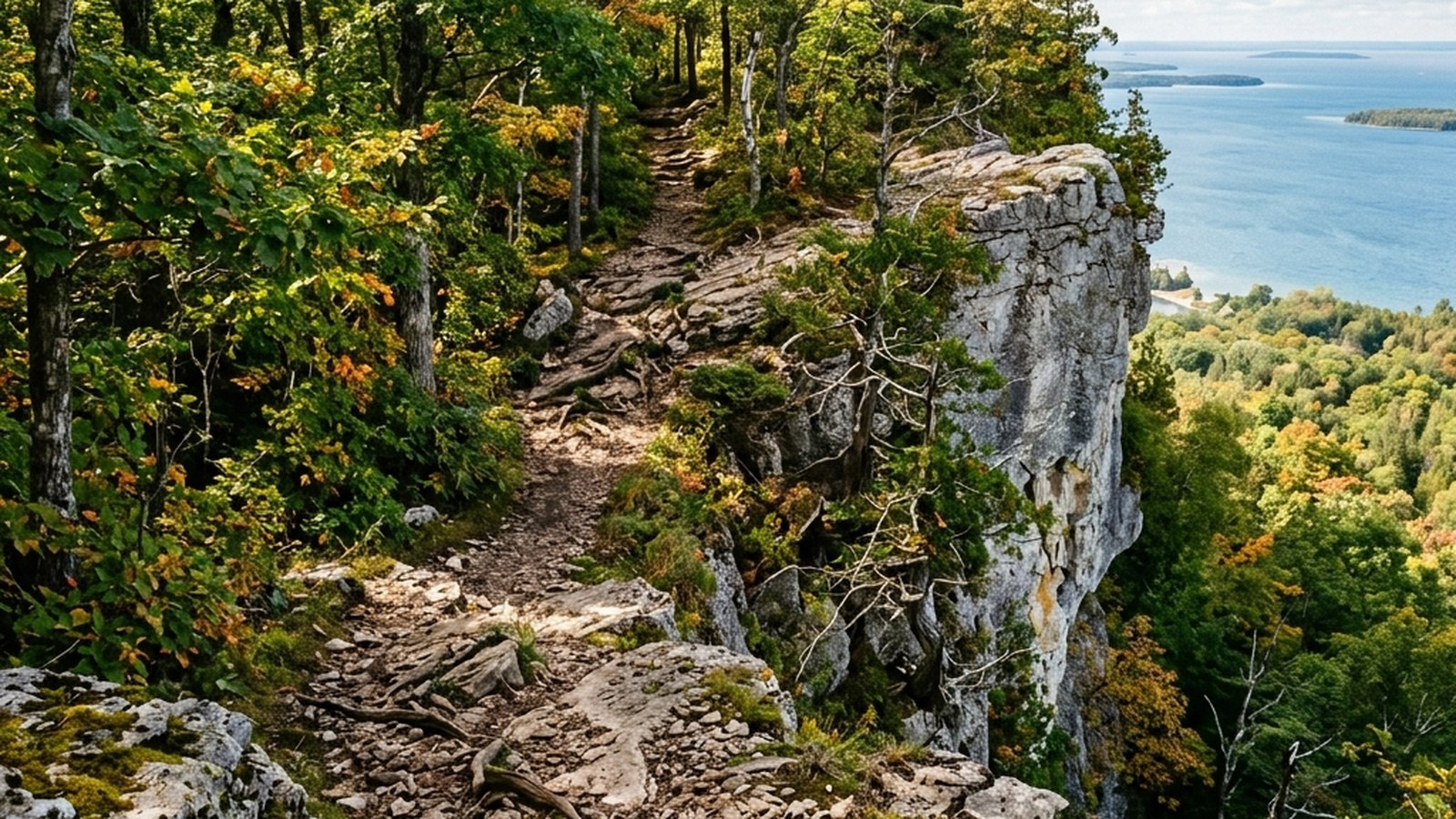
Exposed limestone. Sections of the main Bruce Trail and several side trails cross flat limestone “pavement” that’s slippery when wet, blistering hot in summer sun, and treacherous in early-spring or late-fall freeze-thaw conditions. Trail-running shoes with sticky rubber outsoles (Vibram Megagrip or equivalent) handle this dramatically better than standard daily trainers.
Technical descents. The Plater-Martin descent in particular has loose-rock sections and step-down rock features that demand running form most flat-trail runners haven’t developed. McGregor 2018 documented that technical descents load the quadriceps and ankle stabilisers at roughly 1.8× the rate of equivalent-pace flat running — which is why the Blue Mountain network produces serious DOMS in runners on first exposure.
Preparation: don’t come straight from the Wasaga flats
The most reliable predictor of a bad first day on Blue Mountain is jumping straight from flat Wasaga running to a Loree Forest loop. The terrain demands ankle stability, eccentric quad strength, and trail-specific footwear that flat-running practice doesn’t develop.
The right preparation arc is 6-8 weeks of progressive trail volume on the Wasaga local options before attempting Blue Mountain. Specifically:
- Weeks 1-2: 2-3 sessions per week on the Blueberry Trail for surface variety.
- Weeks 3-4: Add the Ganaraska Wasaga section Pine Bush ridge climb for sustained-gradient exposure.
- Weeks 5-6: Add stair repeats or a treadmill incline session weekly to load the eccentric quad work.
- Weeks 7-8: Drive to Blue Mountain and do the Loree Forest Loop as the first introduction. Walk the steeper sections; don’t try to run them on day one.
This progression takes the chronic-injury rate down meaningfully. Skipping it produces ankle sprains, IT band flare-ups, and post-run soreness that pushes runners away from the terrain entirely.
Weather considerations specific to the Escarpment
Blue Mountain sits roughly 250 m higher than Wasaga Beach and gets meaningfully different weather. Summer afternoon thunderstorms develop quickly over the Escarpment ridge; the exposed limestone sections are dangerous in lightning. Check the Environment Canada radar before driving up; if storm cells are approaching, postpone.
Winter ice forms on the limestone ridge sections through November and persists into mid-April. Microspikes or full crampons are needed for sustained winter use; standard trail-running shoes are not adequate. Most local runners shift to the Wasaga Nordic Centre or Ganaraska section in December-March and return to Blue Mountain in late April.
Mid-July through August humidity is the rough month for the rock sections — the dark limestone heats up and radiates significantly above ambient air temperature. Early morning runs (before 8 am) are dramatically more pleasant than mid-day in summer.
Practicalities
- Parking: Blue Mountain Resort village lot ($15/day in season). Pretty River Valley Provincial Park access ($14/day or Ontario Parks pass). Free roadside pull-offs along Sideroad 27 for some side-trail accesses.
- Water: none on trail. Carry vest reservoir for runs over 8 km.
- Cell coverage: spotty on the ridge. Reliable in the village area and on the eastern face; gaps on the western descents.
- Bears: active April-November. Bear bells and noise on blind corners are sensible.
- Bruce Trail membership: not required for day use of the public trail but supports trail maintenance ($75/year individual). Worth the contribution if you use the system regularly.
Where it fits vs the Wasaga local rotation
Blue Mountain is the “step up” venue. Most local runners use it for one weekly long run or hill session, with the rest of their weekly volume on the flatter Wasaga options. A typical pattern: Sunday long run on Blue Mountain (90-120 minutes), Tuesday-Wednesday-Friday recovery and tempo on the Nordic Centre, Saturday medium-effort on the Ganaraska Wasaga section. That mix produces the best return on driving time and training stimulus across the local-plus-Blue-Mountain options.
For runners not yet ready for Blue Mountain, the Wasaga local rotation alone is sufficient for general fitness; the Escarpment terrain only becomes necessary when you’re training for a specific hilly race or want the technical-descent skill development. Don’t feel obligated to drive south just because the option exists.
Post-run recovery for the Blue Mountain terrain
The eccentric loading on Blue Mountain’s technical descents produces predictable next-day soreness profile that’s different from flat-trail running. Parker & Hardin (2017) showed that downhill running produces creatine kinase elevation 4-5× baseline at 24 hours and quad-specific DOMS that can persist 5-7 days in untrained subjects.
The protocol that works for most runners after a hard Blue Mountain session:
- Cool down with 10-15 minutes of flat walking immediately after the run. The metabolic flushing helps reduce the next-day stiffness.
- Eat carb-and-protein within 30 minutes. Glycogen resynthesis is faster post-eccentric work and the protein supports the satellite-cell repair process.
- Skip the deep tissue massage for 24 hours. Aggressive bodywork on freshly damaged muscle can compound the inflammation. Foam-rolling at 24-48 hours is more useful.
- Schedule at least 48 hours before the next high-intensity session. First-time Blue Mountain visitors often need 72-96 hours; the post-eccentric inflammation curve is slower than most flat-runners expect.
- Track the soreness pattern. Quad-specific soreness for 3-4 days is normal adaptation. Sharp pain at a specific tendon (Achilles, IT band insertion) is not normal and warrants a rest week.
Practical takeaways
- 30 km of side trails branching off the Bruce Trail’s 12 km Blue Mountain segment. Five primary named routes from 5 km easy to 25 km wilderness.
- Sustained gradient + exposed limestone + technical descents. The three features that distinguish Blue Mountain from anything closer to Wasaga.
- Don’t arrive flat-trained. 6-8 weeks of progressive trail volume on Wasaga local options first.
- Trail-specific shoes mandatory. Sticky rubber outsole (Vibram Megagrip or equivalent) makes the limestone manageable.
- One Blue Mountain session per week is the sweet spot for most runners. The rest of the volume on the local Wasaga rotation.
References
McGregor 2018McGregor RA, et al. Trail running biomechanics: surface variability and lower-limb loading. Journal of Sports Sciences. 2018;36(4):420-428. View source →Bruce Trail ConservancyBruce Trail Conservancy. Trail standards, side-trail registry, and Blue Mountain segment management. View source →Parker 2017Parker DJ, Hardin EC. Eccentric muscle damage and downhill running: a meta-analysis. European Journal of Applied Physiology. 2017;117(2):241-256. View source →