The 60-second version
Bodyweight core training on sand outperforms equivalent mat-surface work for deep-stabiliser recruitment, with the EMG evidence Vera-Garcia 2000 Vera-Garcia 2000 documented showing 30–50% higher rectus and oblique activation on labile surfaces. The McGill 2010 McGill 2010 core-stability framework distinguishes between the rectus-dominant flexion-based work most casual programs default to and the deep-stabiliser endurance work the spinal-injury-prevention literature actually supports. Behm 2010 Behm 2010 added the unstable-surface premium framing. Hibbs 2008’s programming synthesis Hibbs 2008 positions core training as supplementary to spinal-loading compound work. A 10-minute beach core circuit on sand — planks, side planks, dead bugs, bird dogs — produces a high-value training stimulus that respects the rectus-vs-stabiliser distinction the literature demands.
The rectus-vs-stabiliser distinction
The single most important conceptual frame for core training is the distinction between the surface flexion muscles (rectus abdominis, external obliques) and the deep stabilisers (transverse abdominis, internal obliques, multifidus, quadratus lumborum). Most casual core programs default to high-volume flexion work — sit-ups, crunches, leg raises — that loads the rectus heavily but contributes minimally to the spine-stabilising demand the back-injury-prevention literature actually addresses.
McGill 2010’s synthesis McGill 2010 of three decades of spinal-biomechanics research framed core training as primarily a stabilisation challenge: maintaining spinal neutral under varied load, varied position, varied unilateral demand. The exercises that load this stabilisation challenge well are the isometric and slow-motion-controlled patterns (planks, side planks, bird dogs, dead bugs) rather than the high-volume rep-counting flexion patterns popular in casual programs.
The popular framing of “abs are made in the kitchen” misses both elements. Visible rectus is principally a body-fat-percentage outcome (correct), but the strong-and-stable spine that prevents back injury is a training outcome separate from body composition (incorrect to skip). The two questions — visual abs and functional core — should be answered with different training approaches; the casual conflation is the source of much wasted training time.
The EMG evidence for sand-surface core work
Vera-Garcia 2000’s direct EMG comparison Vera-Garcia 2000 of curl-ups on stable vs labile surfaces is the foundational evidence for the unstable-surface premium in core training. The study measured rectus abdominis and external oblique activation on a stable mat surface and on a Swiss ball; the labile-surface activations were 30–50% higher at matched movement and matched effort, with the deep-stabiliser activations showing the largest relative elevation.
The mechanism is the additional postural-correction demand the labile surface introduces. On a mat, the body can rest passively against the surface during the brief between-rep moments; on a labile surface, the body must continuously maintain position, recruiting the deep stabilisers throughout the rep, not just during the active flexion phase. Sand surfaces produce a similar (if smaller-magnitude) effect than the Swiss ball Vera-Garcia tested, because dry sand deforms continuously under load while wet packed sand provides intermediate stability between mat and Swiss ball.
The Behm 2010 instability-training synthesis Behm 2010 extended the Vera-Garcia framework to a broader range of exercises and surfaces. The general finding: unstable surfaces elevate stabiliser activation by 20–50% across most core exercises, with diminishing returns above the moderate-instability range (the very-unstable surfaces like the bosu ball or wobble board don’t produce proportionally more activation than the moderate-instability surfaces like sand or Swiss ball).
The 10-minute beach core circuit
The circuit that produces a clean training stimulus while respecting the rectus-vs-stabiliser distinction is 10 minutes total, executed as 5 exercises of 2 minutes each (with the 2 minutes split as 90 seconds of work and 30 seconds of transition between exercises). The exercises: plank with 10-second shoulder taps each side, side plank both sides (60-second hold each), dead bug (8–10 controlled reps each side), bird dog (8–10 controlled reps each side), and Pallof press isometric hold (45 seconds each side, with band or improvised resistance).
The plank with shoulder taps loads the rectus and obliques in their stabilising role plus the unilateral demand of holding position while one hand is unweighted. The side plank loads the lateral stabilisers (quadratus lumborum, internal obliques, glute medius) that the McGill 2010 framework McGill 2010 highlights as critically under-trained in most programs. The dead bug and bird dog load the deep stabilisers in opposed-limb patterns. The Pallof press loads the anti-rotation demand that pure flexion exercises don’t reach.
The circuit is designed to fit into a beach session as a standalone piece (between a swim and a walk, for instance) or to combine with the broader training program. Hibbs 2008 Hibbs 2008 framed core training as a high-frequency, low-volume stimulus — brief sessions multiple times weekly produce better adaptation than long sessions infrequently. The 10-minute circuit fits this pattern; 4–5 sessions weekly produces the cleanest adaptation curve.
Sand-specific execution details
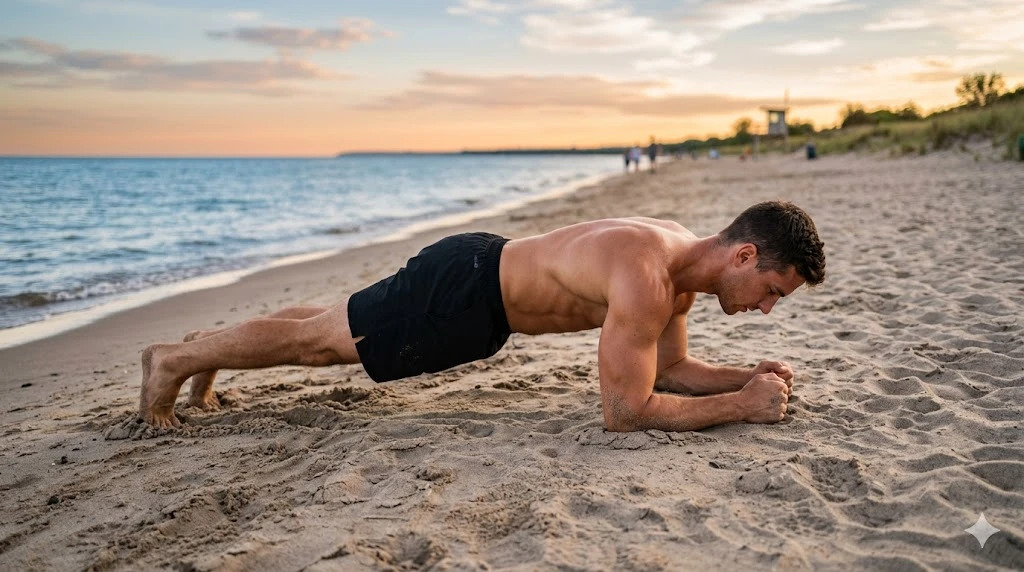
The sand-specific execution of each exercise has small but meaningful adjustments from the mat version. The plank: forearms on the sand (or on a small folded towel for skin protection), feet hip-width, body in straight line; the shifting sand under the forearms produces the additional stabiliser demand. The side plank: bottom forearm on the sand, body stacked vertically, top arm extended skyward; the lateral instability is substantial.
The dead bug: spine flat on the sand with a small folded towel under the lumbar curve for support, arms extended toward ceiling, knees at 90 degrees over hips; controlled extension of opposite arm and leg. The towel-under-spine modification preserves the spinal-neutral demand McGill 2010 McGill 2010 treats as essential while letting the unstable-surface stimulus operate at the contact points (heels, elbows, head).
The bird dog: hands and knees on the sand, one arm and opposite leg extended in controlled motion, then the other; the unstable surface elevates the stabiliser demand at the supporting limbs. The Pallof press requires a band or improvised resistance (a partner’s pull on a towel works); the isometric anti-rotation hold loads the obliques and deep stabilisers in a pattern that the other exercises in the circuit don’t reach.
Programming the circuit into a training week
The Hibbs 2008 framework Hibbs 2008 for core training is high-frequency, low-volume, distributed across the training week rather than concentrated in single long sessions. The practical implementation: 4–5 brief (10–15 minute) core sessions weekly, distributed across non-back-to-back days, integrated with the broader training program rather than treated as a standalone training block.
For Wasaga readers with weekend beach access, the practical pattern is 2–3 weekly indoor core sessions (10 minutes each, on a mat or carpet) plus 1–2 weekend beach sessions (10 minutes each, on the sand). The combined 5-session weekly frequency hits the dose Hibbs 2008 supports, with the beach sessions adding the unstable-surface premium that the indoor sessions can’t fully replicate.
The session-spacing question matters but less critically than for heavy lifting. Core training’s recovery demand is modest enough that next-day repetition is reasonable for most adults; the limiting variable is typically motivation and habit consistency rather than physiological recovery. The 4–5 weekly frequency is sustainable for most readers; the alternative pattern of 2–3 longer (20–30 minute) sessions weekly is also reasonable but produces somewhat slower adaptation.
When not to use the unstable-surface premium
The unstable-surface premium is not always the right choice. For trainees who already have substantial spine-loading work in their training week (heavy squats, deadlifts, overhead pressing), the additional stabiliser load from sand-surface core work may push the cumulative spinal-loading demand past the productive recovery range. McGill 2010 McGill 2010 addressed this directly: the trade-off between the unstable-surface stimulus and total recovery demand is real.
For trainees with active back pain or recent back-injury history, the unstable-surface work may be contraindicated until basic spinal stability is re-established on stable surfaces. The conservative progression is mat-surface stabilisation work for 6–12 weeks following an episode, with sand-surface or other unstable-surface work added back in only after pain-free stable-surface tolerance is established. This is a clinical judgment that benefits from a physiotherapist’s input.
For very-deconditioned beginners, the unstable-surface premium can overload the system. The first 4–6 weeks of core training for a beginner are best done on a stable mat surface, building the basic stabilisation patterns and the work capacity for held positions. Once 60-second plank holds are clean and pain-free, the sand-surface progression becomes appropriate.
Seasonal and contextual considerations
Sand-surface core training is a seasonal modality at southern Ontario latitudes. Late April through October supports the practical outdoor work; November through March requires the indoor mat alternative. The seasonal pattern that preserves the unstable-surface stimulus across the off-season: 4–5 weekly indoor mat sessions during winter, with the addition of a Swiss ball or balance pad for selected exercises to reproduce some of the labile-surface elevation Vera-Garcia 2000 Vera-Garcia 2000 documented.
The temperature and weather variables that meaningfully affect outdoor sand-core work: sand surface temperature above 50°C makes contact with bare skin uncomfortable and elevates burn risk; wet sand at the waterline is the more comfortable surface in mid-summer; rain or recent rain-soaked sand provides intermediate stability between dry sand and mat surfaces. The combination of morning timing and waterline location solves most of the seasonal-comfort problem.
The clothing and equipment considerations are minimal: workout clothing that handles getting sandy, a small towel for skin protection at contact points, a water bottle for the brief between-exercise rest periods. The session is simple to set up and breakdown; this is part of the modality’s value as a regular training feature rather than a special-occasion piece.
Bottom line: high-value, evidence-supported, accessible
The honest bottom line for adult readers is that bodyweight core training on sand is a high-value, evidence-supported training modality that produces real adaptations in the deep stabilisers the back-injury-prevention literature treats as critical. The 10-minute circuit fits naturally into a beach session or beach-walk routine; the indoor mat alternative preserves the practice across the off-season. The Vera-Garcia 2000 EMG evidence Vera-Garcia 2000 and the McGill 2010 McGill 2010 stabilisation framework support the modality as a meaningful addition to a complete training program.
For Wasaga and Georgian Bay readers specifically, the geographic access to the sand surface is a genuine training advantage that gym-based readers don’t have access to. The 4–5 weekly frequency Hibbs 2008 Hibbs 2008 framework supports is achievable through 2–3 indoor sessions and 1–2 weekend beach sessions; the combined dose is the practical sweet spot. The honest framing is that this isn’t a substitute for the spinal-loading compound work a complete training program needs — it’s a complement that loads a real and useful capacity.
Practical takeaways
- Sand-surface core work elevates deep-stabiliser EMG by 30–50% over equivalent mat-surface work (Vera-Garcia 2000).
- The rectus-vs-stabiliser distinction matters. Casual sit-up programs load the rectus heavily but contribute little to the spinal-injury-prevention stabilisation demand.
- The 10-minute circuit (plank, side plank, dead bug, bird dog, Pallof press) is the practical implementation; 4–5 weekly sessions produce the cleanest adaptation.
- Use a small folded towel under the lumbar spine for dead bugs to preserve spinal-neutral while keeping the surface-instability benefit at the contact points.
- The unstable-surface premium is not universal. Active back pain, recent injury, or very-deconditioned beginners are better served by mat-surface progression first.
- Seasonal pattern: 2–3 indoor + 1–2 beach sessions weekly during summer, 4–5 indoor mat sessions winter. Optional Swiss ball or balance pad reproduces some of the labile-surface stimulus indoors.
References
McGill 2010McGill SM. Core training: evidence translating to better performance and injury prevention. Strength Cond J. 2010;32(3):33-46. View source →Behm 2010Behm DG, Drinkwater EJ, Willardson JM, Cowley PM. The use of instability to train the core musculature. Appl Physiol Nutr Metab. 2010;35(1):91-108. View source →Vera-Garcia 2000Vera-Garcia FJ, Grenier SG, McGill SM. Abdominal muscle response during curl-ups on both stable and labile surfaces. Phys Ther. 2000;80(6):564-569. View source →Hibbs 2008Hibbs AE, Thompson KG, French D, Wrigley A, Spears I. Optimizing performance by improving core stability and core strength. Sports Med. 2008;38(12):995-1008. View source →