The 60-second version
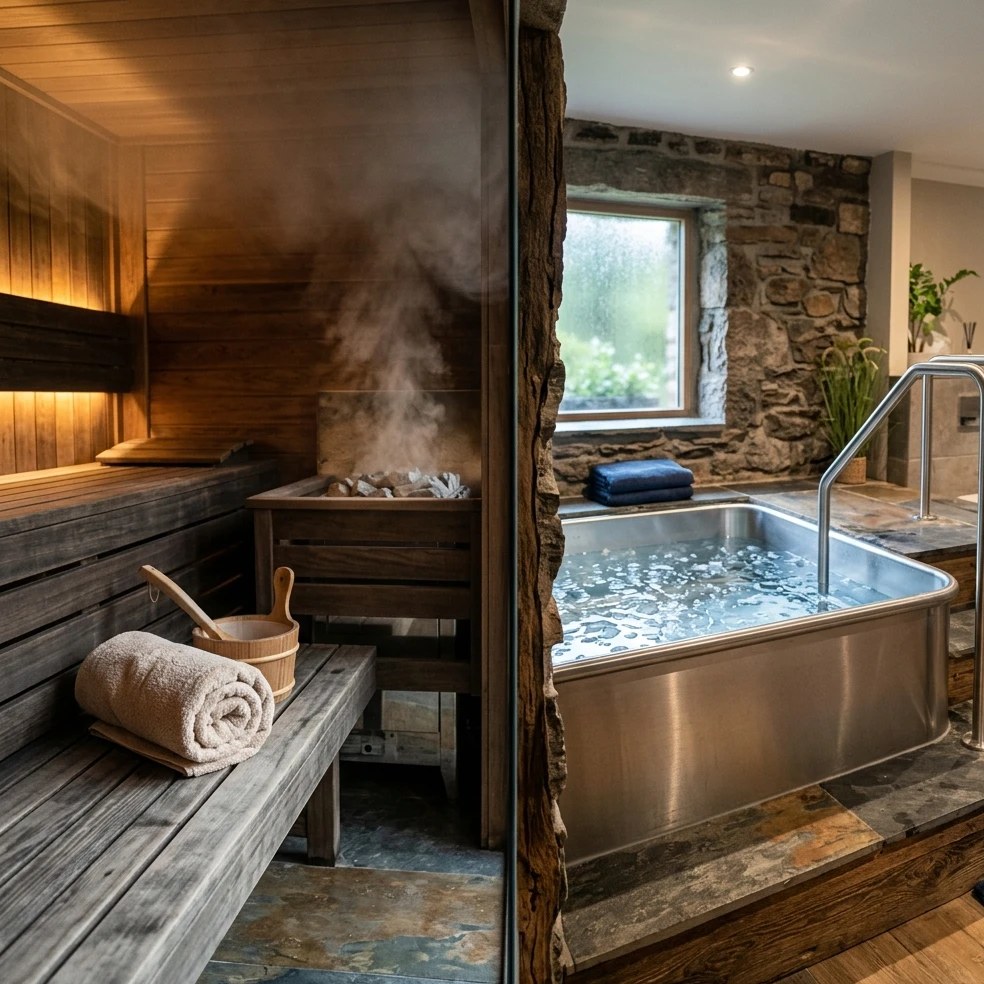
Cold-water immersion (cold plunges, ice baths) and heat exposure (sauna, hot baths) both modify post-exercise inflammation, but in opposite directions and with different consequences. The peer-reviewed evidence converges on a clear distinction: cold immediately after resistance training BLUNTS the very inflammation that drives hypertrophy adaptation — multiple trials show 5–15% smaller long-term gains in muscle size and strength when cold is used regularly post-lifting. Heat exposure (sauna 20–30 min, 80–100°C, 3–5×/week) has accumulating evidence for cardiovascular benefit comparable to moderate aerobic exercise, plus modest growth-hormone and heat-shock-protein effects that may support muscle. The honest framing: cold for acute soreness/recovery between events, not after hypertrophy training; heat for general health and post-workout recovery. Both have safety considerations (cardiovascular, pregnancy, medications) that deserve attention. The popular framing of “cold for recovery” oversells one tool and under-sells the other.
Why this matters — the mechanism difference
Cold and heat are not symmetric tools. They activate different pathways and have different consequences for adaptation:
- Cold-water immersion (CWI): vasoconstriction, reduced muscle blood flow, suppression of post-exercise inflammation (lower IL-6, TNF-α), reduced acute soreness, BLUNTED satellite cell activation and protein synthesis signaling.
- Heat exposure (sauna, hot bath): vasodilation, increased plasma volume over weeks, heat-shock-protein (HSP70, HSP90) upregulation, modest GH increase, cardiovascular conditioning effect, no blunting of training adaptation.
The 2015 Roberts et al. RCT in J Physiol directly compared 12 weeks of post-resistance-training CWI (10 min, 10°C) vs active recovery. Findings:
- CWI group: 50% less muscle mass gain.
- CWI group: 38% less strength gain on leg extension 1RM.
- Mechanism: blunted activation of satellite cells and ribosomal biogenesis pathways measured via muscle biopsy Roberts 2015.
Subsequent trials replicated and extended this. The 2017 Frohlich and 2017 Fyfe analyses across multiple replications: regular post-training CWI reduces hypertrophy and strength adaptation by ~15–30%. The effect is largest when CWI is used immediately post-workout and reduced (but still present) when delayed by 4+ hours Fyfe 2019.
“Cold-water immersion immediately following resistance training attenuates the long-term gains in muscle mass and strength that would otherwise occur. The mechanism is blunting of the inflammatory and anabolic signaling cascade that drives the adaptation. Athletes whose primary goal is strength or hypertrophy should avoid post-training cold exposure.”
— Fyfe et al., J Physiol, 2019 view source
When cold actually helps
The blunting effect is bad for hypertrophy but the same mechanism (reduced inflammation, faster perceived recovery) is useful in other contexts:
| Use case | Cold benefit |
|---|---|
| Multi-event same-day competition (track meet, multi-round tournament) | High — faster perceived recovery between events trumps long-term adaptation concern |
| Multi-day stage race (cycling, ultra-running) | High — daily performance maintenance over weeks |
| Acute soreness / DOMS management | Moderate — short-term comfort; minimal benefit if you’re training again 24+ hours later |
| Heat-stress training (recovery from heat-acclimation sessions) | High — clinical-grade cooling for safety |
| Acute injury (within 48 hours) | Modest — the “RICE” framework has been partially walked back; limited evidence for long-term benefit |
| General “wellness” / cold plunge as a habit | Mixed — alertness/mood effects acute; long-term data still emerging |
| Post-hypertrophy / strength training | NEGATIVE — blunts the adaptation you trained for |
| Endurance training adaptation | Mixed — some evidence cold may blunt mitochondrial adaptations too, though smaller effect |
The sauna evidence base
Heat exposure has accumulated a more uniformly positive evidence base, particularly in Finnish-cohort observational data and supporting RCT mechanism work:
- Laukkanen 2015 KIHD cohort: prospective study of 2,315 Finnish men over 20 years. 4–7 sauna sessions/week vs 1/week was associated with 40% lower all-cause mortality and 63% lower sudden cardiac death. The dose-response was clean across sauna duration and frequency Laukkanen 2015.
- Cardiovascular markers: reduced blood pressure, improved arterial stiffness, increased plasma volume.
- Heat-shock proteins: HSP70/90 upregulation supports protein quality control, may aid muscle recovery without blunting adaptation.
- GH and prolactin: modest acute increases (different mechanism than cold).
- Mortality and cardiac event reduction: replicated in multiple Finnish-cohort papers; the effect size is comparable to moderate-intensity aerobic exercise of equivalent time investment Laukkanen 2018.
The 2018 Patrick & Johnson review of sauna and exercise concluded the cardiovascular adaptation profile mimics moderate aerobic exercise: passive heart-rate elevation, plasma volume expansion, vascular endothelial function improvement Patrick 2021.
Practical protocols
Cold-water immersion (when used)
- Temperature: 10–15°C (50–59°F).
- Duration: 10–15 minutes per session.
- Timing: NOT immediately post-resistance training. For event recovery: within 30 minutes of finishing.
- Frequency for hypertrophy adaptation impact: 1×/week is small; 3×/week is meaningful; daily produces large blunting.
- For competition recovery: 2 sessions of 10 min separated by 1 hour.
Sauna (traditional Finnish, dry heat)
- Temperature: 80–100°C (176–212°F).
- Humidity: 10–20% (Finnish style); higher (40–60%) for steam.
- Duration: 15–30 minutes per session.
- Frequency: 3–5×/week for cardiovascular adaptation; 4–7×/week was the dose in the strongest Finnish cohort.
- Hydration: 500 mL water before, 500–1000 mL after (sauna sweat losses are real).
- Timing relative to training: post-workout fine and may add cardiovascular conditioning; pre-workout reduces performance.
- Recovery between rounds: 5–10 minutes cool-down between sauna rounds for those doing multi-round protocols.
Contrast therapy (alternating)
- Sauna 10–15 min → cold 1–3 min → rest → repeat 2–3 cycles.
- Evidence is moderate; some perceived recovery benefit; less long-term hypertrophy blunting than CWI alone (the heat between cold rounds may rescue some signaling).
- Better for combat sport, multi-event athletes than for hypertrophy-focused trainees.
Who benefits from each
| Profile | Cold | Sauna |
|---|---|---|
| Hypertrophy / strength athlete | Skip post-workout; OK on rest days | Yes — post-workout fine, cardiovascular benefit |
| Endurance athlete in hard training block | Selective: post-key-events only | Yes — classic Finnish-cohort use case |
| Combat sport / multi-event athlete | Yes for between-event recovery | Yes — weight-cut or general recovery |
| Adult with cardiovascular risk factors | Caution — the cold-shock pressor response can be dangerous | Yes if cleared by doctor; the evidence here is strongest |
| Adult with hypertension on medication | Caution; rapid BP swings can be problematic | Yes with monitoring; sauna lowers BP modestly long-term |
| Adult on blood thinners (warfarin, anticoagulants) | Caution — cold-shock and bruising risk | Generally safe; consult prescriber |
| Pregnant women | Caution — cold shock not well-studied | Limit body-temperature elevation; avoid hot tubs and saunas in 1st trimester per ACOG |
| Older adult (65+) | Significant cardiovascular risk; avoid unless cleared | Strong evidence for benefit; reduced session duration (15 min) |
| Adolescent | Generally OK in moderation | Generally OK in moderation; avoid extreme protocols |
Safety: the under-discussed cardiovascular issue
Both cold plunges and sauna activate strong cardiovascular responses. The 2014 Mooventhan & Nivethitha review and subsequent case-series literature document:
- Cold-shock response: rapid BP spike, HR spike, autonomic surge. Has triggered cardiac events in undiagnosed coronary disease.
- Vasovagal response in some users: faint events with cold-water immersion, especially if facial submersion is involved.
- Heat syncope: post-sauna BP can drop sharply when standing; hydration and gradual cool-down matter.
- Cardiac arrhythmia risk: rare but documented, especially in undiagnosed heart conditions.
- Hyperthermia: extended sauna exposure (30+ min, especially with alcohol or dehydration) has caused fatalities Mooventhan 2014.
Practical implications:
- Don’t cold-plunge or sauna alone if you’re older, have cardiovascular disease, or have had any cardiac symptoms.
- Don’t combine sauna with alcohol. Alcohol-related sauna deaths are documented.
- Hydrate adequately for both modalities.
- Build up gradually: 30 seconds in cold, 5 minutes in sauna for first sessions.
- Listen for warning signs: chest pain, light-headedness, severe nausea = exit immediately.
- Discuss with your doctor before starting either if you have cardiovascular risk factors, are pregnant, or take medications.
Common myths
- “Cold plunges boost metabolism and burn fat.” The acute calorie burn is small (~50–100 cal per session); brown fat activation is real but modest in adults; not a weight-loss tool.
- “Cold plunges every morning improve everything.” Effects on alertness/mood are real and acute; long-term data is mixed; if you’re training for hypertrophy, daily cold plunges work against you.
- “Saunas detoxify the body.” The kidneys and liver detoxify. Sauna sweat is mostly water and a few electrolytes. Real benefits exist; “detox” isn’t one of them.
- “Infrared saunas are better than traditional.” Evidence is much weaker for IR saunas. Most of the cardiovascular literature is on traditional Finnish dry heat. IR saunas are not bad, but the evidence base for the bigger claims is thinner.
- “You should always ice an injury immediately.” The RICE protocol has been partially walked back. The evidence for ice in acute injury is weaker than the “medical orthodoxy” framing suggests; some experts now favor reduced reliance on it.
- “If you sweat a lot in sauna, it’s working harder.” Sweat rate varies by individual and is not a measure of cardiovascular benefit.
- “Heat-shock proteins cure aging.” HSP upregulation is real and has cellular benefits; it doesn’t cure aging or any specific disease.
Combining with training intelligently
| Goal | Recommendation |
|---|---|
| Hypertrophy / strength as primary goal | Sauna post-workout if desired; NO cold plunge within 4–6 hours of training |
| Endurance + strength hybrid | Sauna 3–5×/week post-cardio; cold only post-event, not post-strength |
| Tournament / multi-event same-day | Cold between events for fast recovery; chronic adaptation can wait |
| Multi-day stage race | Cold protocols designed for daily competition; works because adaptation isn’t the immediate goal |
| General health, no specific athletic goal | Sauna 3–4×/week is the better single intervention |
| Cardiovascular conditioning who hates cardio | Sauna can partially substitute (passive heart-rate elevation); not a complete replacement but a real adjunct |
| Combat sport / weight management | Sauna for cuts; CWI for between-rounds recovery |
| Off-day / rest day | Either works; cold has alertness benefit; sauna has cardiovascular benefit |
Practical takeaways
- Cold-water immersion BLUNTS hypertrophy and strength adaptation when used post-resistance-training. The Roberts 2015 / Fyfe 2019 / Frohlich 2017 evidence is consistent.
- Cold IS useful for between-event recovery (multi-round competition, stage racing) where adaptation is not the immediate goal.
- Sauna has accumulated cardiovascular evidence comparable to moderate aerobic exercise — 40% lower all-cause mortality and 63% lower sudden cardiac death at 4–7 sessions/week in the Finnish cohort.
- Sauna does NOT blunt training adaptation; safe to use post-workout for general health and recovery.
- Combine intelligently: skip post-lift cold plunges; sauna is generally safe pre or post training.
- Both tools have real cardiovascular safety considerations: cold-shock response, heat syncope, undiagnosed heart disease, alcohol+sauna fatalities.
- Don’t buy the marketing on either side. Cold isn’t a fat-loss miracle; sauna isn’t a detox cure.
- Best single intervention for general health: sauna 3–4×/week if you have access. Best between-event recovery tool: cold plunge.
References
Roberts 2015Roberts LA, Raastad T, Markworth JF, et al. Post-exercise cold water immersion attenuates acute anabolic signalling and long-term adaptations in muscle to strength training. J Physiol. 2015;593(18):4285-4301. View source →Fyfe 2019Fyfe JJ, Broatch JR, Trewin AJ, et al. Cold water immersion attenuates anabolic signaling and skeletal muscle fiber hypertrophy, but not strength gain, following whole-body resistance training. J Appl Physiol. 2019;127(5):1403-1418. View source →Laukkanen 2015Laukkanen T, Khan H, Zaccardi F, Laukkanen JA. Association between sauna bathing and fatal cardiovascular and all-cause mortality events. JAMA Intern Med. 2015;175(4):542-548. View source →Laukkanen 2018Laukkanen JA, Laukkanen T, Kunutsor SK. Cardiovascular and other health benefits of sauna bathing: a review of the evidence. Mayo Clin Proc. 2018;93(8):1111-1121. View source →Patrick 2021Patrick RP, Johnson TL. Sauna use as a lifestyle practice to extend healthspan. Exp Gerontol. 2021;154:111509. View source →Frohlich 2014Fröhlich M, Faude O, Klein M, et al. Strength training adaptations after cold-water immersion. J Strength Cond Res. 2014;28(9):2628-2633. View source →Mooventhan 2014Mooventhan A, Nivethitha L. Scientific evidence-based effects of hydrotherapy on various systems of the body. N Am J Med Sci. 2014;6(5):199-209. View source →Kunutsor 2018Kunutsor SK, Khan H, Zaccardi F, Laukkanen T, Willeit P, Laukkanen JA. Sauna bathing reduces the risk of stroke in Finnish men and women: a prospective cohort study. Neurology. 2018;90(22):e1937-e1944. View source →Hohenauer 2018Hohenauer E, Costello JT, Stoop R, et al. Cold-water or partial-body cryotherapy? A systematic review and meta-analysis of post-exercise muscle recovery. Phys Ther Sport. 2018;31:79-90. View source →Ihsan 2016Ihsan M, Watson G, Abbiss CR. What are the physiological mechanisms for post-exercise cold water immersion in the recovery from prolonged endurance and intermittent exercise? Sports Med. 2016;46(8):1095-1109. View source →Scoon 2007Scoon GS, Hopkins WG, Mayhew S, Cotter JD. Effect of post-exercise sauna bathing on the endurance performance of competitive male runners. J Sci Med Sport. 2007;10(4):259-262. View source →Kim 2020Kim K, Monroe JC, Gavin TP, Roseguini BT. Local heat therapy to accelerate recovery after exercise-induced muscle damage. Exerc Sport Sci Rev. 2020;48(4):163-169. View source →