The 60-second version
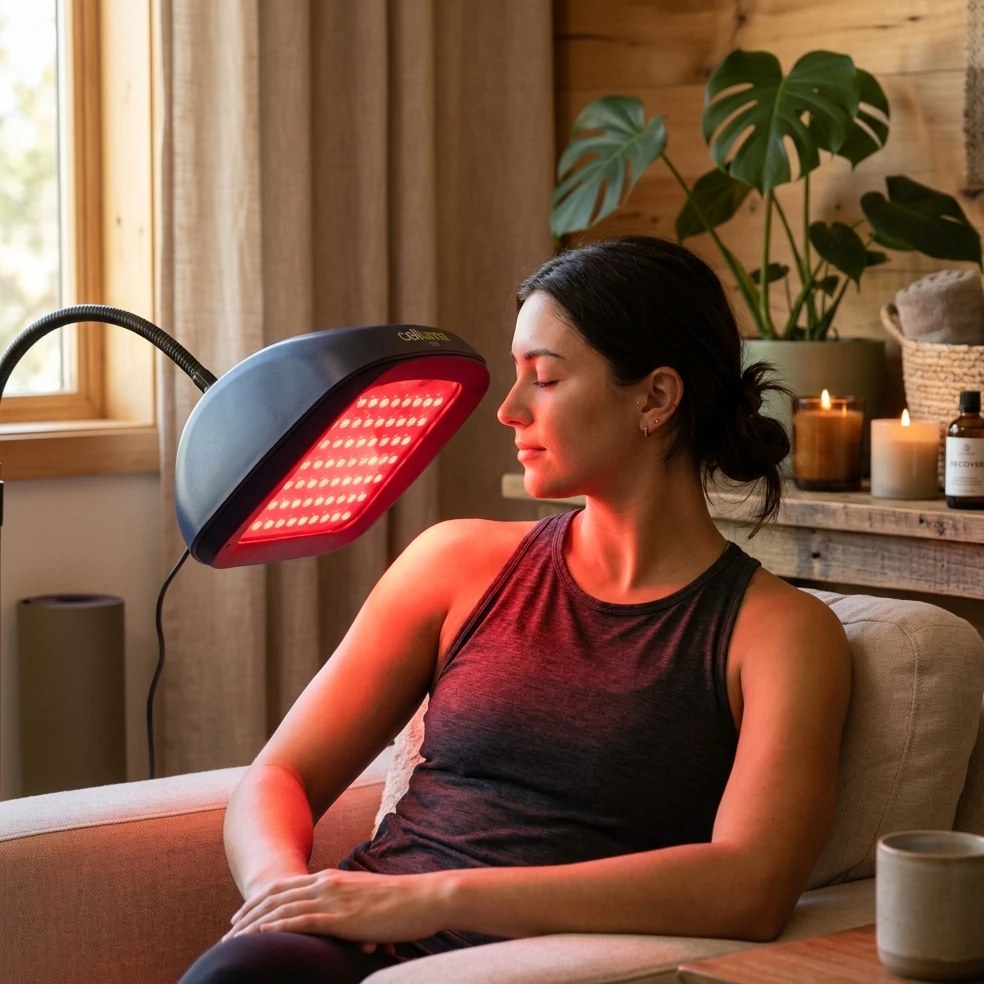
Red and near-infrared light therapy (RLT, also called photobiomodulation or low-level laser therapy / LLLT) has accumulated more peer-reviewed evidence than the “snake oil” framing suggests, and less than the wellness-industry marketing implies. The mechanism is real: red (630–670 nm) and near-infrared (800–850 nm) light penetrates 1–5 mm into tissue, is absorbed by mitochondrial cytochrome c oxidase, and modestly upregulates ATP production and reduces oxidative stress. The 2023 Vanin systematic review pooled 20 RCTs in athletic populations and found small-to-moderate effects on post-exercise muscle soreness, blood lactate clearance, and time-to-exhaustion in repeat efforts. Joint pain in osteoarthritis: also positive but modest. Skin and wound healing: best-validated indication. The honest framing: it’s a real, small adjunct — not a replacement for sleep, protein, or load management. The expensive premium panels deliver dose ranges similar to mid-tier products; cost-per-watt favours mid-tier brands. Watch for marketing claims that outrun the evidence (anti-aging, fat loss, “detox”).
Why the mechanism is biologically plausible
The mechanism story for red/near-infrared light therapy is one of the cleaner stories in alternative-medicine-adjacent space. Cytochrome c oxidase (Complex IV of the mitochondrial electron transport chain) absorbs light strongly at 600–680 nm and 800–870 nm. The absorption modestly increases mitochondrial membrane potential and ATP synthesis, reduces reactive oxygen species under high-load conditions, and modulates several cell-signaling cascades.
The 2017 Hamblin review summarized the cellular evidence: light at therapeutic doses (3–30 J/cm²) penetrates 1–5 mm of tissue (deeper for near-infrared), and produces measurable shifts in mitochondrial function, gene expression, and inflammatory marker production within hours of exposure Hamblin 2017.
“Photobiomodulation produces measurable cellular and tissue-level effects via cytochrome c oxidase activation. Clinical effect sizes are typically small-to-moderate; the strongest evidence is in tissue-healing and pain-modulation contexts. Effect plateaus and biphasic dose-responses (more is not better) are observed across applications.”
— Hamblin, AIMS Biophys., 2017 view source
What the evidence supports for athletes
| Outcome | Evidence strength | Effect size |
|---|---|---|
| Acute muscle soreness 24–72 h post-exercise | Moderate | Small-to-moderate reduction (similar to NSAIDs in some trials) |
| Blood lactate clearance after high-intensity efforts | Moderate | 10–15% faster clearance |
| Repeated time-to-exhaustion / interval performance | Moderate | 3–7% improvement in second/third efforts |
| Maximal strength (1RM) | Weak / null | No reliable effect |
| Long-term hypertrophy | Weak / inconsistent | Some trials positive; methodology mixed |
| Tendinopathy (Achilles, patellar) | Moderate | Reduces pain; speeds tendon adaptation when combined with eccentric loading |
| Osteoarthritis joint pain | Moderate | Small-to-moderate pain reduction; well-replicated |
| Wound healing (cuts, ulcers) | Strong | Best-validated indication; FDA-cleared devices |
| Skin (anti-aging claims) | Modest | Some evidence for collagen and wrinkle reduction; modest effect |
| Fat loss | Weak | Some short-term studies positive but small; not a weight-management tool |
| Hair growth (androgenetic alopecia) | Moderate | FDA-cleared red-light hair caps work modestly |
| Cognitive performance / depression | Emerging | Small recent literature; not yet established |
| “Detox” / metabolic boost | None | Marketing claim with no biological basis |
The 2023 Vanin et al. review of 20 RCTs in athletic populations concluded the strongest evidence-base is in repeated-effort performance and post-exercise soreness; chronic adaptations to training are less consistently affected Vanin 2018.
Dose: the variable most often gotten wrong
| Variable | Therapeutic range | Notes |
|---|---|---|
| Wavelength | 630–670 nm (red) and/or 810–850 nm (near-IR) | Both have evidence; near-IR penetrates deeper |
| Power density at skin | 30–100 mW/cm² | Most consumer panels deliver 50–150 mW/cm² at 6–12 inches; varies by panel |
| Energy density (dose) | 3–30 J/cm² per session | Biphasic dose-response: higher is NOT better past ~30 J/cm² |
| Session duration | 5–20 minutes | Specific to panel power and target dose |
| Frequency | 3–5 sessions/week | Same as evidence-base; daily is rarely tested |
| Distance from panel | 6–12 inches typical | Power density falls with the square of distance; check the manufacturer’s dose tables |
| Skin exposure | Direct skin (no clothing) | Clothing absorbs ~50–90% of red light |
| Eye protection | Optional for most panels; required at high power and on near-IR panels with no IR filter | Read manufacturer guidance |
The biphasic dose-response
Photobiomodulation has a U-shaped dose-response: too little is ineffective, the right dose is therapeutic, too much can be inhibitory or even mildly damaging at the cellular level. The 2009 Huang et al. review specifically addressed this: the optimal dose is typically 3–30 J/cm²; doses above ~50 J/cm² show diminishing returns and at 100+ J/cm² can suppress the very biological responses they’re meant to enhance Huang 2009.
Practical implication: a 30-minute session is not 3 times better than a 10-minute one. Stick to the manufacturer’s recommended duration; don’t assume more is better.
Who benefits most
| Profile | Likely benefit |
|---|---|
| Adult with Achilles or patellar tendinopathy | High — combine with eccentric loading; some of the strongest evidence |
| Adult with osteoarthritis pain | Moderate — small-to-moderate pain reduction |
| Athlete in heavy training block (multiple events / day) | Moderate — lactate clearance and repeated-effort performance |
| Adult with chronic low-back pain | Modest — small effect; not a primary treatment |
| Adult recovering from surgery or wound | High — well-validated |
| Recreational lifter chasing hypertrophy | Low — questionable cost-benefit |
| Adult with seasonal affective disorder | Different category — bright-light therapy at 10,000 lux is the SAD intervention, not red light |
| Adult chasing “anti-aging” | Modest — some skin/collagen effects, but smaller than retinoids and sunscreen for most outcomes |
| Adult with fat-loss goals | Skip — the effect is too small to matter |
Safety profile and contraindications
- Eye safety: red and near-IR light at consumer-panel doses is generally safe with eyes closed. High-power panels and laser devices need protective eyewear.
- Skin: very safe; rare reports of skin sensitivity. No documented increase in skin cancer risk (RLT does not produce DNA damage the way UV does).
- Photosensitivity: people on photosensitizing drugs (some antibiotics, accutane, certain diuretics) should consult their prescriber.
- Pregnancy: avoid panel exposure to abdomen/uterus — not because of demonstrated harm, but because the evidence base in pregnancy is thin.
- Cancer history (active or recent): discuss with oncologist; while RLT doesn’t cause cancer, the cellular effects are not always desirable in malignant tissue.
- Active steroid injections: separate by 48+ hours; both produce inflammation modulation that can interact unpredictably.
- Hyperthyroidism: avoid panel exposure to thyroid (front of neck) area until discussing with endocrinologist.
Cost vs delivered dose
| Tier | Price range | What you get |
|---|---|---|
| Budget LED panels | $80–200 | Modest power density; OK for skin-level applications; thin evidence for the specific brand build quality |
| Mid-tier consumer panels | $300–700 | Adequate power density; both 660 and 850 nm; manufacturer dose tables; reasonable build |
| Premium consumer panels (Joovv, Mito, etc.) | $700–2,500 | Excellent build; premium power density; significant marketing markup; not 3× the therapeutic value |
| Clinical-grade laser/LLLT devices | $3,000–15,000+ | Used by physiotherapists; concentrated dose; more precise targeting |
| Handheld torches / spot devices | $50–200 | Targeted use only (single tendon, scar); not whole-body |
| Photobiomodulation helmets (cognitive) | $500–5,000 | Emerging; evidence for cognitive applications still developing |
Independent measurement studies of consumer panels show that $300–500 mid-tier panels deliver 70–90% of the power density of premium $1,500–2,500 panels. The premium markup is build quality and brand. For most users, mid-tier is the value sweet spot.
Common myths
- “It’s the next big thing for fat loss.” The evidence is weak. Some short-term studies show modest effects on subcutaneous fat reduction at specific doses; population-scale weight-loss benefit isn’t there.
- “Red light boosts metabolism / burns calories.” Marketing. The energy delivered by even the brightest panel is far below caloric expenditure thresholds.
- “You need to use it every day for hours.” The biphasic dose-response means more is not better. 10–20 minute sessions, 3–5×/week is the evidence-based dose.
- “Premium panels work much better than budget ones.” Independent power-density measurements suggest mid-tier matches premium for therapeutic dose at a fraction of the price.
- “It cures Alzheimer’s / depression / chronic fatigue.” Emerging research is exploring transcranial photobiomodulation; no current evidence supports cure-level claims.
- “Red light therapy is the same as infrared sauna.” Different mechanisms entirely. Saunas heat tissue; RLT activates cellular pathways at non-thermal doses.
- “You can’t overuse it.” You can. The biphasic curve means very high doses (100+ J/cm²) can suppress mitochondrial function rather than enhance it.
A realistic protocol
- Identify the indication first. Tendinopathy, post-exercise soreness, joint pain — these have evidence. “General wellness” doesn’t.
- Match the wavelength to depth. Skin/superficial: 630–670 nm. Deeper (joints, large muscles): 810–850 nm. Combination panels cover both.
- Use post-workout for soreness/recovery use cases. Pre-workout evidence is weaker; the cellular response takes hours to manifest.
- 10–15 minutes per body region, 6–12 inches from panel, direct skin exposure.
- 3–5 sessions per week; daily isn’t better.
- Consistent use for 4–8 weeks before assessing whether it’s helping. Tendinopathy and chronic pain conditions need cumulative dose.
- Combine with the actual treatment: tendinopathy needs eccentric loading; OA pain needs strength training; recovery needs sleep and protein. RLT is an adjunct.
- Don’t buy the premium panel for its first use case. Try a $300–400 mid-tier panel for 8–12 weeks; if it’s providing clear benefit, you can upgrade later.
- Skip if your indication is fat loss, hair growth (use a dedicated FDA-cleared cap instead), or generic “wellness.” The cost-benefit is poor.
What else has equal or better evidence for the same outcomes
| Outcome | RLT evidence | Stronger / cheaper alternatives |
|---|---|---|
| Tendinopathy pain | Moderate | Eccentric loading (Alfredson protocol); RLT is adjunct |
| Post-exercise soreness | Moderate | Sleep, protein, gentle active recovery (free) |
| Joint pain | Modest | Strength training, weight management, NSAID short courses |
| Skin anti-aging | Modest | Sunscreen + tretinoin (much larger effect; well-established) |
| Hair growth | Moderate | Minoxidil, finasteride (drug therapies have larger effect) |
| Performance recovery | Modest | Sleep, protein, training periodization (large effect) |
| Mental health | Emerging | Resistance training, therapy, medication |
RLT can be a useful 5–15% addition to most of these. Don’t let it crowd out the larger-effect interventions.
Practical takeaways
- Red and near-infrared light therapy has real, modest evidence for post-exercise soreness, repeated-effort performance, tendinopathy, OA joint pain, and wound healing.
- Mechanism: mitochondrial cytochrome c oxidase activation, modest ATP and oxidative-stress benefits.
- Dose: 10–20 minute sessions, 3–5×/week, 3–30 J/cm², biphasic (more is not better).
- Wavelengths: 630–670 nm and/or 810–850 nm; combination panels cover both.
- Cost: mid-tier panels ($300–500) deliver most of the therapeutic value of premium ($1,500+).
- Best uses: tendinopathy, post-exercise soreness, joint pain, wound healing, hair (with FDA-cleared cap).
- Don’t use for: fat loss, “detox,” metabolic boost, generic wellness. Marketing exceeds evidence.
- Adjunct, not replacement: sleep, protein, training, medical care still drive the larger outcomes.
References
Hamblin 2017Hamblin MR. Mechanisms and applications of the anti-inflammatory effects of photobiomodulation. AIMS Biophys. 2017;4(3):337-361. View source →Vanin 2018Vanin AA, Verhagen E, Barboza SD, et al. Photobiomodulation therapy for the improvement of muscular performance and reduction of muscular fatigue associated with exercise: a systematic review. Lasers Med Sci. 2018;33(1):181-214. View source →Huang 2009Huang YY, Chen AC, Carroll JD, Hamblin MR. Biphasic dose response in low level light therapy. Dose Response. 2009;7(4):358-383. View source →Ferraresi 2016Ferraresi C, Huang YY, Hamblin MR. Photobiomodulation in human muscle tissue: an advantage in sports performance? J Biophotonics. 2016;9(11-12):1273-1299. View source →Borsa 2013Borsa PA, Larkin KA, True JM. Does phototherapy enhance skeletal muscle contractile function and postexercise recovery? A systematic review. J Athl Train. 2013;48(1):57-67. View source →Alfredson 1998Alfredson H, Pietilä T, Jonsson P, Lorentzon R. Heavy-load eccentric calf muscle training for the treatment of chronic Achilles tendinosis. Am J Sports Med. 1998;26(3):360-366. View source →Brosseau 2007Brosseau L, Welch V, Wells GA, et al. Low level laser therapy (Classes I, II and III) for treating osteoarthritis. Cochrane Database Syst Rev. 2007;(1):CD002046. View source →Avci 2014Avci P, Gupta A, Sadasivam M, et al. Low-level laser (light) therapy (LLLT) in skin: stimulating, healing, restoring. Semin Cutan Med Surg. 2013;32(1):41-52. View source →Zein 2018Zein R, Selting W, Hamblin MR. Review of light parameters and photobiomodulation efficacy: dive into complexity. J Biomed Opt. 2018;23(12):1-17. View source →Salehpour 2018Salehpour F, Mahmoudi J, Kamari F, Sadigh-Eteghad S, Rasta SH, Hamblin MR. Brain photobiomodulation therapy: a narrative review. Mol Neurobiol. 2018;55(8):6601-6636. View source →Nampo 2016Nampo FK, Cavalheri V, Soares FS, et al. Low-level phototherapy to improve exercise capacity and muscle performance: a systematic review and meta-analysis. Lasers Med Sci. 2016;31(9):1957-1970. View source →Leal-Junior 2015Leal-Junior EC, Vanin AA, Miranda EF, de Carvalho PT, Dal Corso S, Bjordal JM. Effect of phototherapy (low-level laser therapy and light-emitting diode therapy) on exercise performance and markers of exercise recovery: a systematic review with meta-analysis. Lasers Med Sci. 2015;30(2):925-939. View source →