The 60-second version
Blue-light blocking glasses are a real intervention with a small, narrow evidence base — not the comprehensive panacea the marketing suggests. The peer-reviewed sleep literature is consistent: evening exposure to blue-spectrum light suppresses melatonin secretion by 30–90% within 30 minutes, depending on intensity and duration. Blue-light filtering glasses (orange, amber, or rose-tinted lenses that block ~400–500 nm wavelengths) partially restore melatonin onset and improve subsequent sleep onset by ~10–20 minutes in the better-controlled trials. They’re most useful in two specific situations: (1) evening training under bright gym fluorescents within 2–3 hours of bedtime, and (2) late-evening screen exposure when sleep is the priority. They are not supported for daytime computer use as “eye strain” protection (the evidence there is null), and they’re no substitute for actually dimming evening light, getting morning sunlight, or maintaining a consistent sleep schedule. The cleanest framing: useful tool for a specific timing problem, not a wellness purchase.
Why this question matters for late-evening trainees
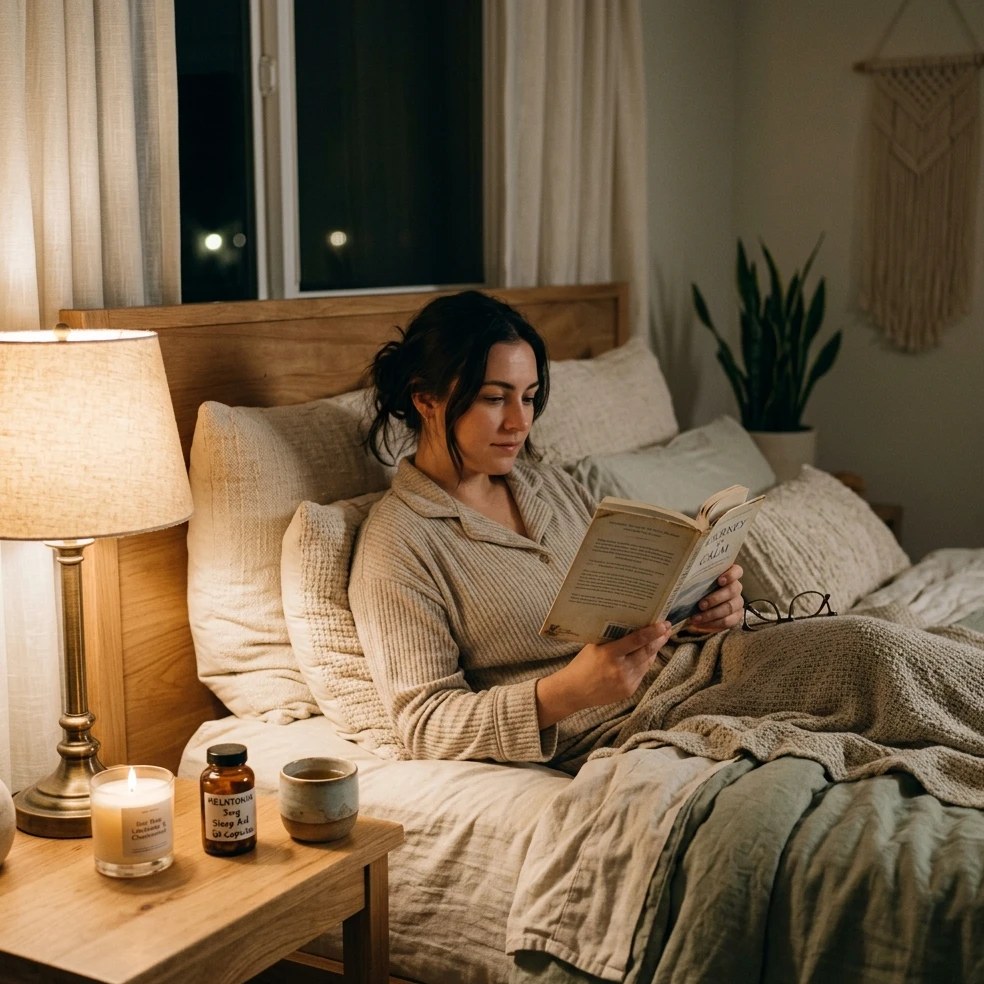
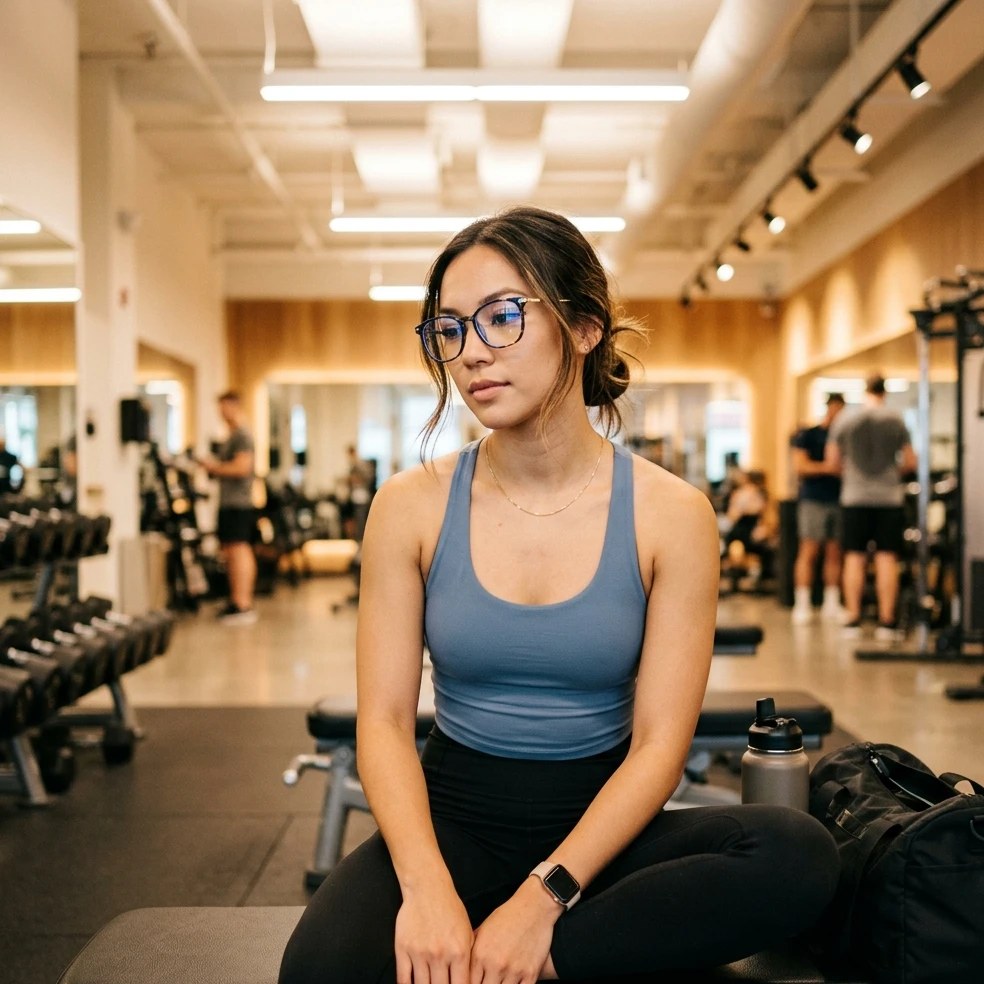
Modern gyms run bright. The typical commercial gym is lit to 300–500 lux at face level — equivalent to bright office lighting and well above the 50-lux threshold at which evening melatonin suppression begins. For someone training at 8–9 PM with a 10:30 PM bedtime, 40–90 minutes of exposure to gym lighting is enough to delay melatonin onset by 60–90 minutes, pushing actual sleep onset later than intended Gooley 2011, Chang 2015.
The downstream cost: shorter total sleep, lower deep-sleep proportion, and worse next-morning recovery markers. The 2015 Chang study showed that 5 nights of evening light exposure equivalent to a typical lit-gym environment reduced REM sleep by ~14% and slightly delayed circadian phase compared to dim-light evenings Chang 2015.
“Exposure to room light before bedtime suppresses melatonin onset and shortens melatonin duration. The magnitude is dose-dependent on light intensity, exposure duration, and spectral composition, with short-wavelength (blue) light producing the strongest suppression per unit of intensity.”
— Gooley et al., J Clin Endocrinol Metab., 2011 view source
How blue-light filtering actually works
Melatonin suppression by light is mediated by intrinsically photosensitive retinal ganglion cells (ipRGCs), a non-image-forming photoreceptor class with peak sensitivity at ~480 nm (blue-cyan range). These cells project to the suprachiasmatic nucleus (the body’s master circadian clock) and signal “daylight is present, suppress melatonin.”
Blue-light blocking lenses filter wavelengths in the 400–500 nm range, with darker amber/orange tints blocking more aggressively. The amount of blocking varies dramatically by product:
| Lens type | Blue-spectrum blocking | Best use |
|---|---|---|
| “Computer” / clear blue-light lenses | 10–30% of blue-spectrum | Marketing-driven; minimal melatonin protection; useful tinted screen glare reduction |
| Light yellow / amber lenses | 40–60% | Evening computer / phone use; mild melatonin protection |
| Strong amber / orange lenses | 70–90% | Evening melatonin protection; the trial-grade lenses |
| Red lenses | 95–99% | Maximum protection; uncomfortable for vision; specialty / sleep-clinic use |
The 30%-blocking “computer” lenses sold at most retail optical stores have minimal evidence for sleep benefit; the deeper amber/orange lenses (often $40–120) are what the research literature has tested.
What the evidence actually shows
| Outcome | Evidence strength | Notes |
|---|---|---|
| Reduced evening melatonin suppression | Strong | ~50–80% restoration of melatonin onset with strong amber lenses (Sasseville 2006; Esaki 2017) |
| Improved sleep onset latency | Moderate | ~10–20 minutes faster sleep onset in better trials |
| Improved subjective sleep quality | Moderate | Self-reported sleep quality improves; magnitude small |
| Improved next-day mood / alertness | Weak-to-moderate | Some trials positive; smaller effect than direct sleep extension |
| Reduced “digital eye strain” / asthenopia | Null | 2017 Cochrane review of daytime use found no benefit (Singh 2017) |
| Improved daytime alertness when worn during day | Negative | Wearing all-day blue-blocking can suppress useful alertness signal |
| Improvement in delayed sleep-phase syndrome | Moderate | Used in clinical chronotherapy alongside morning bright light |
| Improvement in shift-work sleep disorder | Moderate | Useful for night-shift workers needing to sleep during the day |
The 2018 Shechter et al. RCT randomized 30 adults with insomnia symptoms to amber-tinted glasses or clear placebo glasses for 2 hours before bed for 7 nights. The amber group showed ~30 minutes more sleep, faster onset, and better subjective sleep quality — modest but reliable effects in the population most likely to benefit Shechter 2018.
Specific use cases for trainees
| Situation | Likely benefit |
|---|---|
| Training under bright gym lights at 8–9 PM with 10:30–11 PM bedtime | Real; the most-justified use case |
| Late-evening screen time after training | Real; complements the gym-light filtering |
| Returning home from a 9 PM session and trying to wind down | Real for the wind-down portion; less useful during training itself |
| Daytime gym training (morning, lunch) | None; daytime blue exposure is desirable for circadian alignment |
| “Computer eye strain” | None; the 2017 Cochrane review is unambiguous |
| Travel jet-lag protocols | Real if used at appropriate destination evening hours; combine with destination-time melatonin (see melatonin article) |
| Shift workers needing daytime sleep | Real; widely used in shift-work medicine |
A practical evening protocol for late trainees
- From session-start to ~30 min after: amber-tinted glasses, especially under bright gym fluorescents. The cumulative dose matters more than instantaneous intensity.
- Walk home / commute: keep glasses on if late-evening; remove if outdoors with low ambient light.
- 30–90 min before bed: glasses on if any screens, bright kitchen lights, or evening reading lamps are in use.
- Final 30 min before bed: ideally lights down, screens off; glasses become unnecessary.
- Morning: get bright outdoor (or bright artificial) light within 30–60 min of waking. Don’t wear blue-blockers during the day.
The combination of evening blue-blocking + morning bright light is the validated protocol; either intervention alone is weaker than the pair.
What works at least as well
- Dim the actual lights. A dimmer switch + warm-spectrum bulbs (<3000K) at home from 8 PM onward is the lowest-tech, most-effective intervention.
- Phone “Night Shift” / “Night Mode”. Built into iOS and Android; shifts screen colour temperature toward warm/red after sunset. Free; effective.
- Computer software (f.lux, Windows Night Light). Equivalent to phone night mode for desktops.
- Don’t train at 9 PM if you can train at 6 PM or 7 AM. The schedule is the upstream variable; glasses are a workaround.
- Get earlier outdoor light in the morning. The most powerful entrainment cue.
- Pre-set bedroom for darkness: blackout curtains, sleep mask. Removes the “morning street-light wakes me at 5 AM” problem.
Honest comparison: a dimmer switch + warm bulbs + phone night mode addresses 80% of the evening light problem at a fraction of the cost of premium blue-blocking glasses. The glasses earn their place when you can’t control the environment (gym, restaurant, friend’s house).
Blue-light contact lenses and intraocular implants
A small market for “blue-light filtering” contact lenses and post-cataract intraocular lens implants exists. The ophthalmology evidence for these is mixed; mild filtering may help post-cataract patients with photophobia, but as a general consumer product the case is weak. Stick to glasses if you want filtering; don’t modify your eyes for it.
Common myths
- “Blue light from screens damages your eyes.” Not at typical exposure levels. The 2017 American Academy of Ophthalmology position statement is clear: blue-light from screens is far below damage thresholds.
- “Blue-light glasses prevent macular degeneration.” No evidence. AMD is multifactorial and not driven by typical screen exposure.
- “Cheap blue-light glasses work as well as premium.” Often not. The 30%-blocking lenses have minimal evidence; you need the deeper amber/orange tints.
- “Wear them all day for protection.” Counterproductive. Daytime blue light reinforces alert-day circadian signaling. Wearing all-day filtering can flatten the circadian amplitude.
- “Children should wear them while gaming.” If gaming is late evening, sure. Daytime gaming with blue-blocking lacks evidence.
Cost guidance
| Price | What you typically get |
|---|---|
| $10–20 | 10–30% blocking; clear lenses; minimal evidence-based effect |
| $25–60 | 40–70% blocking; light amber; modest evidence-based effect |
| $60–120 | 70–95% blocking; strong amber/orange; the trial-grade range |
| $120+ (premium / clinical) | Same effective filtering as $60–120 range; brand and frame quality drive price |
Buy in the $40–90 range for evening use. Don’t pay $200 for a frame; the lens chemistry is the variable that matters and a $50 lens with strong amber tint outperforms a $200 designer frame with weak tint.
Practical takeaways
- Blue-light blocking glasses have real but narrow evidence — useful for evening melatonin protection, not for “eye strain.”
- Best use case: late-evening training under bright gym lights, plus the wind-down hours after.
- Strong amber/orange lenses (70–95% blocking) are what the research has tested; clear “computer” lenses do little.
- Effects: ~50–80% restoration of melatonin onset, ~10–30 min better sleep onset.
- Don’t wear during the day — flattens circadian amplitude and reduces useful alert signal.
- Pair with morning bright light; evening filtering alone is weaker than the combination.
- Lower-cost alternatives that work: dim warm bulbs + phone night mode + earlier training time.
- If you do buy: $40–90 amber-tinted lenses; don’t pay premium for designer frames.
- The intervention doesn’t fix poor sleep hygiene; it complements it.
References
Gooley 2011Gooley JJ, Chamberlain K, Smith KA, et al. Exposure to room light before bedtime suppresses melatonin onset and shortens melatonin duration in humans. J Clin Endocrinol Metab. 2011;96(3):E463-E472. View source →Chang 2015Chang AM, Aeschbach D, Duffy JF, Czeisler CA. Evening use of light-emitting eReaders negatively affects sleep, circadian timing, and next-morning alertness. Proc Natl Acad Sci U S A. 2015;112(4):1232-1237. View source →Sasseville 2006Sasseville A, Paquet N, Sevigny J, Hebert M. Blue blocker glasses impede the capacity of bright light to suppress melatonin production. J Pineal Res. 2006;41(1):73-78. View source →Esaki 2017Esaki Y, Kitajima T, Ito Y, et al. Wearing blue light-blocking glasses in the evening advances circadian rhythms in the patients with delayed sleep phase disorder: an open-label trial. Chronobiol Int. 2016;33(8):1037-1044. View source →Shechter 2018Shechter A, Kim EW, St-Onge MP, Westwood AJ. Blocking nocturnal blue light for insomnia: a randomized controlled trial. J Psychiatr Res. 2018;96:196-202. View source →Singh 2017Singh S, Anderson AJ, Downie LE. Blue-light filtering spectacle lenses: optical and clinical performances. PLoS One. 2019;14(2):e0212521. View source →Burkhart 2009Burkhart K, Phelps JR. Amber lenses to block blue light and improve sleep: a randomized trial. Chronobiol Int. 2009;26(8):1602-1612. View source →Vandewalle 2007Vandewalle G, Schmidt C, Albouy G, et al. Brain responses to violet, blue, and green monochromatic light exposures in humans: prominent role of blue light and the brainstem. PLoS One. 2007;2(11):e1247. View source →Brainard 2001Brainard GC, Hanifin JP, Greeson JM, et al. Action spectrum for melatonin regulation in humans: evidence for a novel circadian photoreceptor. J Neurosci. 2001;21(16):6405-6412. View source →Hatori 2017Hatori M, Gronfier C, Van Gelder RN, et al. Global rise of potential health hazards caused by blue light-induced circadian disruption in modern aging societies. NPJ Aging Mech Dis. 2017;3:9. View source →Vagge 2021Vagge A, Ferro Desideri L, Del Noce C, Di Mola I, Sindaco D, Traverso CE. Blue light filtering ophthalmic lenses: a systematic review. Semin Ophthalmol. 2021;36(7):541-548. View source →Rosenfield 2016Rosenfield M. Computer vision syndrome (a.k.a. digital eye strain). Optom Pract. 2016;17:1-10. View source →