The 60-second version
Melatonin is one of the most-bought sleep supplements and one of the most-misunderstood. The peer-reviewed evidence shows it has real but narrow utility: it shifts the timing of sleep (chronobiotic effect), which makes it useful for jet lag, shift work, and delayed sleep-phase issues. It is not a sedative, and randomized trials show it does little for ordinary insomnia in adults sleeping in a normal cycle. Most over-the-counter doses (3–10 mg) are 5–30× the physiological dose; a 0.3–1 mg dose taken 4–6 hours before target bedtime works as well or better for phase-shifting and produces fewer next-morning effects. By contrast, a structured wind-down routine — controlled light, controlled food, controlled stimulation — addresses the actual mechanisms of poor sleep onset (circadian misalignment, sympathetic-nervous-system arousal, blood-glucose volatility). For athletes, wind-down protocols are first-line; melatonin is a tool for specific timing problems.
Why this matters for athletes
Sleep is the single most-validated recovery variable in sport science. Sleep restriction (less than 6 hours/night for one week) reduces submaximal endurance, sprint performance, reaction time, and accuracy by 5–30% across study designs Fullagar 2015. Sleep extension by even 1–2 hours (the “Mah” protocol) improves shooting accuracy in collegiate basketball players, sprint times, and three-point shooting Mah 2011.
The catch: most adult athletes don’t have a melatonin deficit. They have a wind-down deficit — too much light too late, too much food too late, too much stimulation too late. Melatonin pills compensate for some of this, but only at certain doses and timings, and the wind-down fixes are usually more durable.
“Melatonin’s sleep-promoting effects are modest in adults with normal sleep architecture. Its strongest evidence is for circadian rephasing in jet lag, shift work, and delayed sleep-phase syndrome. The 5 mg and 10 mg doses commonly sold are not supported by the evidence as superior to 0.3–1 mg.”
— Auld et al., Sleep Med Rev., 2017 view source
What melatonin actually does
Melatonin is a hormone produced by the pineal gland. Endogenous melatonin starts rising about 2 hours before habitual sleep time (the “dim-light melatonin onset” or DLMO). It signals the body to begin nighttime physiology: reduced core temperature, lowered alertness, sleep-onset readiness. It does not directly cause sleep the way a benzodiazepine or alcohol does.
Supplemental melatonin replicates the timing signal. The strongest, most-replicated effects:
- Reduces sleep-onset latency by ~5–15 minutes in adults with primary insomnia (modest) Ferracioli-Oda 2013.
- Phase-advances sleep onset by 30–90 minutes when taken 4–6 hours before target bedtime — useful for jet lag and delayed sleep-phase syndrome Burgess 2010.
- Improves jet-lag symptoms eastward (where you need to sleep earlier than the body wants to) Herxheimer 2002.
- Marginal effect on total sleep time in healthy adults — usually less than 15 minutes added.
What it does not reliably do:
- Fix insomnia caused by anxiety, late-evening stimulation, late caffeine, or evening exercise.
- Replace a structured wind-down.
- Improve sleep quality (deep sleep, REM) at standard doses.
- Sedate you. If you feel knocked out by 10 mg, that’s likely a placebo + circadian alignment, not pharmacology.
The dose problem
| Dose | Effect | Notes |
|---|---|---|
| 0.3 mg | Approximate physiological dose; effective for phase-shifting | Hard to find OTC; sometimes called “low-dose melatonin” |
| 0.5–1 mg | Effective for sleep-onset advance and jet lag; minimal hangover | Best evidence-based dose for athletes |
| 3 mg | Supraphysiological; standard OTC dose; no advantage over 1 mg in trials | Most commonly sold dose; often produces next-morning grogginess |
| 5–10 mg | Very supraphysiological; no clinical benefit over 1 mg | Common “extra strength” products; more side effects |
Most retail melatonin in North America is sold at 3–10 mg, well above the dose at which the evidence shows benefit and into the range that more reliably produces next-morning grogginess and morning headaches. The Erland 2017 analysis of 31 over-the-counter melatonin products found actual content varied from −83% to +478% of label claims, with 26% containing serotonin contamination Erland 2017. Quality is more variable than most users realize.
The structured wind-down: a 90-minute protocol
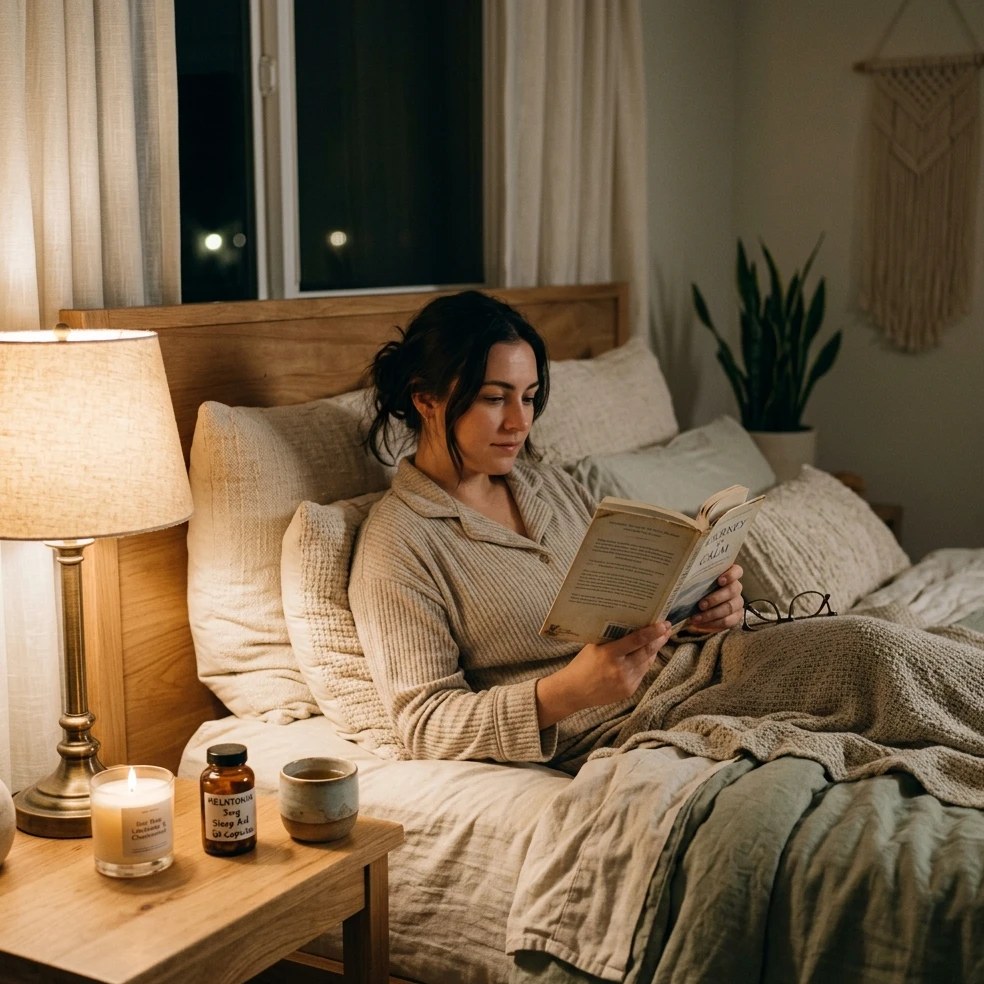
If a melatonin pill is the substitute, a wind-down routine is the actual mechanism. The peer-reviewed components, in order of effect size:
- Dim ambient lights ~90 minutes before bed. Bright light, especially blue-spectrum, suppresses endogenous melatonin secretion by 50–90% within 30 minutes of exposure Gooley 2011. Dim, warm-spectrum light (under 50 lux, <3000K) preserves natural melatonin onset.
- Set a stop-screen time. Phones and laptops typically expose 50–200 lux of mostly blue light at face distance. Last 30–60 minutes should be off-screen. Or use very-low-brightness, warm-spectrum settings if essential.
- Lower core temperature. Sleep onset is driven by a ~1°C drop in core temperature. A warm shower 60–90 minutes pre-bed paradoxically helps by triggering peripheral vasodilation and net heat loss Haghayegh 2019. Cool bedroom (16–19°C / 60–67°F) helps onset and depth.
- Stop heavy meals 3 hours pre-bed. Late large meals raise core temperature, disrupt blood-glucose recovery, and worsen sleep architecture Crispim 2011. Light snack OK.
- Stop caffeine 6–8 hours pre-bed. Half-life is 5–6 hours; even “low-effect” afternoon coffee impairs deep-sleep architecture in many adults Drake 2013.
- Stop alcohol 3–4 hours pre-bed. Sedates initially, then fragments REM sleep across the night. Net negative for athletic recovery.
- Same bedtime ± 30 minutes. Circadian regularity is more important than total time in bed.
- Restrict bedroom function: bedroom = sleep + intimacy. Working, scrolling, or eating in bed reduces conditioning of bed-sleep association.
When melatonin earns its place
| Use case | Dose / timing | Notes |
|---|---|---|
| Eastward travel (3+ time zones) | 0.5–3 mg, 30 min before target bedtime at destination, for 3–5 nights | Strong evidence; helps body advance to local time faster |
| Westward travel | Smaller benefit; light exposure works better | Westward jet lag is generally easier; often no supplement needed |
| Shift work (rotating) | 0.5–3 mg before scheduled day-sleep | Works as part of structured shift-work strategy |
| Delayed sleep-phase (“night owl”) | 0.3–0.5 mg, 4–6 hours before target bedtime, paired with morning bright-light therapy | Specialty use; consider sleep-medicine consult |
| Acute insomnia from a stressor | 0.5–1 mg, 30 min before bed, max 1–2 weeks | OK as a short bridge; not a chronic answer |
| Older adults (≥55) with primary insomnia | 2 mg prolonged-release (Circadin) | Modest evidence; some endogenous melatonin decline with age |
When melatonin is the wrong tool
- Anxiety-driven sleep onset: address anxiety (CBT-i, exercise, breathwork). Melatonin won’t fix arousal.
- Sleep maintenance insomnia (waking 3 AM): melatonin’s half-life is short; doesn’t hold sleep.
- Nightly use for ordinary fatigue: trains habit-dependence; not the durable answer.
- Pre-pubescent children: routine use understudied; specialist supervision only.
- Adolescents: short-term use OK; long-term effects on puberty timing under investigation; default to wind-down protocols.
- Pregnancy / lactation: not adequately studied; default to non-pharmacological approaches.
For athletes specifically
The athlete-specific issues are usually:
- Late-evening training: vigorous exercise within 1–2 hours of bedtime can elevate core temperature and sympathetic tone, delaying sleep onset by 30–60 minutes. Move sessions earlier where possible. If late training is unavoidable, aggressive cool-down + cool shower + dim light help.
- Long-haul competition travel: this is where melatonin pulls weight. 0.5–3 mg melatonin 30 min before destination bedtime, paired with morning bright-light at destination, accelerates the phase-shift by 1–2 days vs no intervention.
- Pre-competition anxiety: address with breathing protocols, cognitive techniques, or a known-effective relaxation routine. Melatonin doesn’t reduce arousal.
- Banned-substance check: melatonin itself is not banned by WADA, but supplement contamination is real. Use NSF Certified for Sport or Informed-Sport tested products if you compete in tested sports.
First-line for chronic insomnia: CBT-i
For adults with chronic insomnia (>3 months), the first-line treatment per AASM guidelines is cognitive behavioural therapy for insomnia (CBT-i), not melatonin or other pharmacotherapy Edinger 2021 AASM. CBT-i has effect sizes equal or superior to sleep medications and durable benefits 6–12 months after treatment ends. Smartphone apps (CBT-i Coach, Sleepio, etc.) deliver the protocol effectively for many people. If sleep is a chronic problem, don’t cycle through supplements; ask a doctor about CBT-i first.
Practical takeaways
- Melatonin is a chronobiotic, not a sedative. Its strongest use is timing-related (jet lag, shift work).
- 0.5–1 mg works as well or better than 3–10 mg, with fewer next-morning effects.
- OTC melatonin product quality varies dramatically; choose third-party-tested brands.
- For ordinary athlete sleep issues, wind-down protocol > supplement: dim light, no screens, cool room, no late food, no late caffeine, regular bedtime.
- Eastward travel: melatonin earns its keep. 0.5–3 mg at destination bedtime for 3–5 nights, with morning bright-light at destination.
- Chronic insomnia: CBT-i is first-line, not melatonin.
- Don’t use melatonin nightly for years to mask a wind-down problem you could fix in two weeks.
References
Auld 2017Auld F, Maschauer EL, Morrison I, Skene DJ, Riha RL. Evidence for the efficacy of melatonin in the treatment of primary adult sleep disorders. Sleep Med Rev. 2017;34:10-22. View source →Ferracioli-Oda 2013Ferracioli-Oda E, Qawasmi A, Bloch MH. Meta-analysis: melatonin for the treatment of primary sleep disorders. PLoS One. 2013;8(5):e63773. View source →Burgess 2010Burgess HJ, Revell VL, Molina TA, Eastman CI. Human phase response curves to three days of daily melatonin: 0.5 mg versus 3.0 mg. J Clin Endocrinol Metab. 2010;95(7):3325-3331. View source →Herxheimer 2002Herxheimer A, Petrie KJ. Melatonin for the prevention and treatment of jet lag. Cochrane Database Syst Rev. 2002;(2):CD001520. View source →Erland 2017Erland LA, Saxena PK. Melatonin natural health products and supplements: presence of serotonin and significant variability of melatonin content. J Clin Sleep Med. 2017;13(2):275-281. View source →Gooley 2011Gooley JJ, Chamberlain K, Smith KA, et al. Exposure to room light before bedtime suppresses melatonin onset and shortens melatonin duration in humans. J Clin Endocrinol Metab. 2011;96(3):E463-E472. View source →Haghayegh 2019Haghayegh S, Khoshnevis S, Smolensky MH, Diller KR, Castriotta RJ. Before-bedtime passive body heating by warm shower or bath to improve sleep: a systematic review and meta-analysis. Sleep Med Rev. 2019;46:124-135. View source →Crispim 2011Crispim CA, Zimberg IZ, dos Reis BG, Diniz RM, Túlio de Mello M, Túlio Bernardi de Mello M. Relationship between food intake and sleep pattern in healthy individuals. J Clin Sleep Med. 2011;7(6):659-664. View source →Drake 2013Drake C, Roehrs T, Shambroom J, Roth T. Caffeine effects on sleep taken 0, 3, or 6 hours before going to bed. J Clin Sleep Med. 2013;9(11):1195-1200. View source →Fullagar 2015Fullagar HH, Skorski S, Duffield R, Hammes D, Coutts AJ, Meyer T. Sleep and athletic performance: the effects of sleep loss on exercise performance, and physiological and cognitive responses to exercise. Sports Med. 2015;45(2):161-186. View source →Mah 2011Mah CD, Mah KE, Kezirian EJ, Dement WC. The effects of sleep extension on the athletic performance of collegiate basketball players. Sleep. 2011;34(7):943-950. View source →Edinger 2021 AASMEdinger JD, Arnedt JT, Bertisch SM, et al. Behavioral and psychological treatments for chronic insomnia disorder in adults: an American Academy of Sleep Medicine clinical practice guideline. J Clin Sleep Med. 2021;17(2):255-262. View source →Zhdanova 2001Zhdanova IV, Wurtman RJ, Regan MM, Taylor JA, Shi JP, Leclair OU. Melatonin treatment for age-related insomnia. J Clin Endocrinol Metab. 2001;86(10):4727-4730. View source →