The 60-second version
The 5 AM training session is one of the most adherence-protective windows in adult fitness: it’s before family demands, work crises, and decision fatigue stack up. The peer-reviewed adherence literature on morning vs evening training is consistent — morning trainees report ~40–60% higher 6-month consistency than evening trainees, mostly through fewer schedule conflicts and lower decision-fatigue interference. The bag isn’t magic, but a well-prepared bag removes friction, which is the dominant variable in whether the alarm wins or loses. This article walks through what actually earns space in a pre-dawn training bag, the small habits that sustain morning training over years, and the items the “essential gym bag” lists usually get wrong.
Why morning training has the adherence edge
The 2020 Brupbacher et al. analysis of exercise-timing adherence in 547 adults across 6 months found:
- Morning trainees (before 9 AM): 67% completed all programmed sessions across the trial.
- Midday trainees: 51% completion.
- Evening trainees (after 5 PM): 47% completion Brupbacher 2020.
The mechanism isn’t that mornings are physiologically superior — performance metrics actually peak slightly in the late afternoon (16:00–19:00) on most testing-laboratory measures Chtourou 2012. The mechanism is fewer competing demands: at 5 AM, there’s no late meeting, no “quick” question from a colleague, no kids’ activity, no emerging fatigue. The session that doesn’t happen first thing in the morning often doesn’t happen at all.
“Morning exercisers showed substantially better long-term adherence in our cohort, primarily mediated by fewer time-conflict cancellations and lower self-reported decision fatigue at session time, rather than by physiological factors.”
— Brupbacher et al., BMJ Open Sport Exerc Med., 2020 view source
The friction principle
The friction-cost model of habit formation predicts that any 30-second increase in setup-time at the moment of a planned behaviour reduces follow-through by ~10–20% in a typical adult Fogg 2019, Clear 2018. For the 5 AM lifter, every “where’s my __” question is a chance to bail. The well-prepared bag exists to keep friction near zero.
The same logic applies in reverse: small positive frictions like a pre-set coffee maker, lay-out clothes the night before, and a packed bag at the door reduce the activation energy of getting up and going.
What earns its space
| Item | Why | Pre-pack the night before? |
|---|---|---|
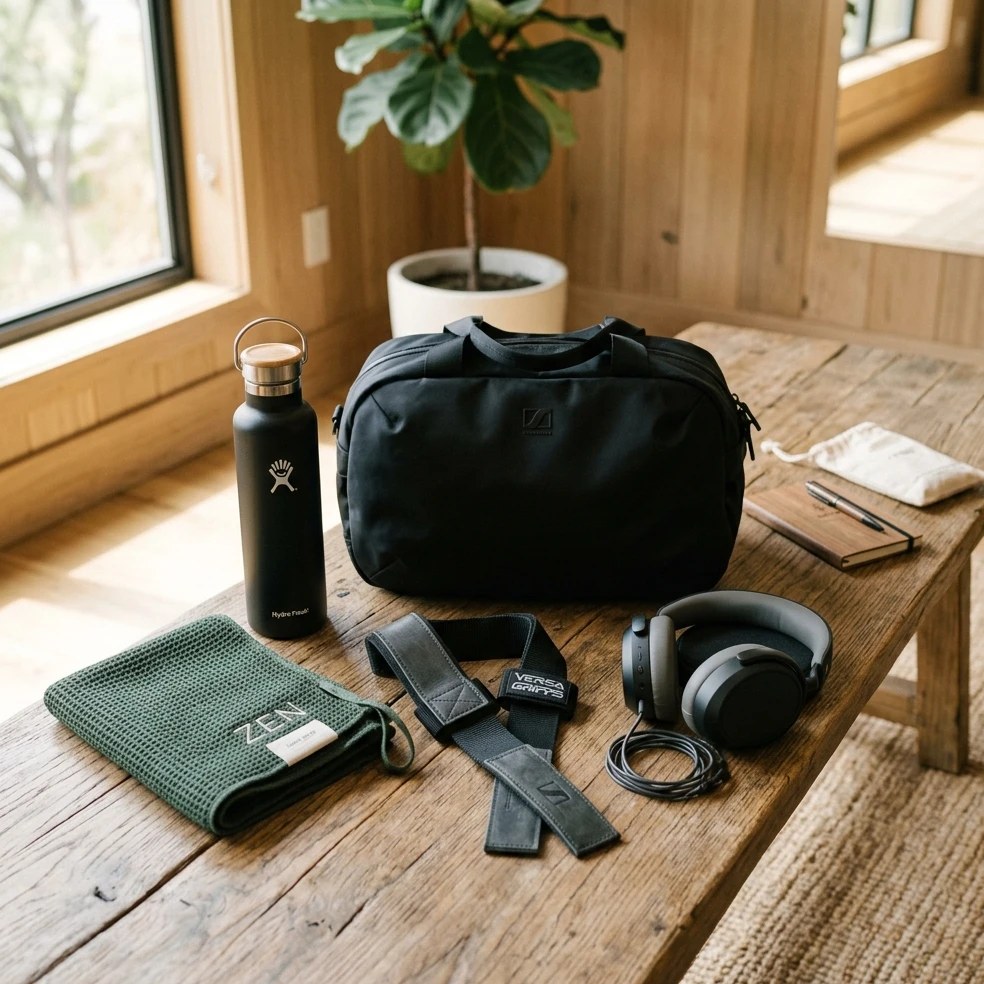
| Training clothes (shorts/leggings, tee, socks, sports bra if applicable) | Obvious; non-negotiable | Yes |
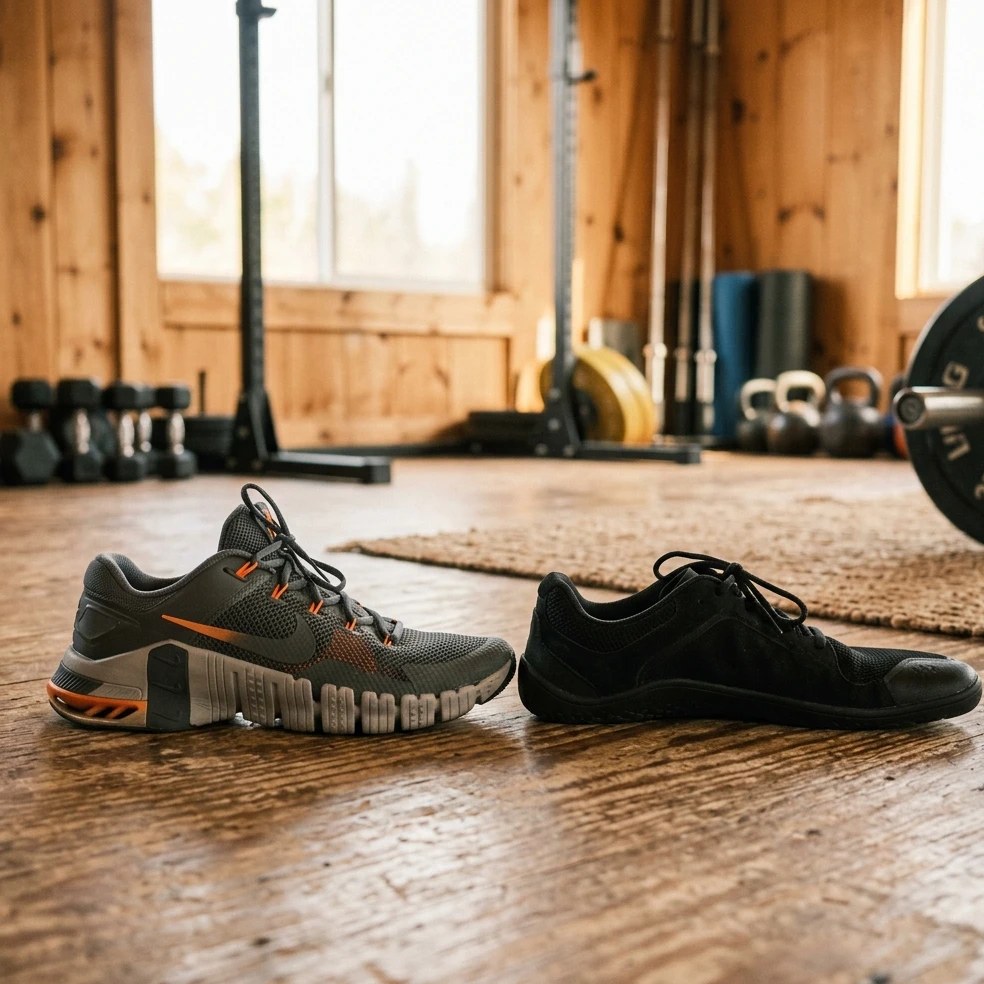
| Lifting / training shoes | Right tool for the lift; see shoe article | Yes; in bag or by door |
| Headphones / earbuds | Music has small but real effect on perceived exertion and pace; cheap adherence tool | Yes |
| Water bottle (insulated, ~24–32 oz) | Hydration matters; insulated keeps cold for warm-up + work + post | Fill night before; chill in fridge |
| Wrist wraps and/or lifting straps (if applicable) | Real benefit for grip-limited or wrist-fatigued lifts at moderate-to-heavy load | Yes |
| Belt (if you train above ~80% 1RM) | Increases intra-abdominal pressure; small acute strength benefit at heavy loads | Yes |
| Keys, wallet, gym fob, ID | Friction at the door if missing | Yes; consistent location |
| Phone | Tracking app, music, emergency | Charge the night before |
| Small towel | Etiquette + sweat hygiene; many gyms now require | Yes |
| Deodorant / minimalist toiletries (if you go to work after) | Smaller bag insert; saves a return trip home | Yes |
| Pre-mixed protein shake or shaker (if your protein dose is post-workout) | Keeps the per-meal protein cadence; see anabolic window article | Mix night before; chill |
| Banana / apple / oat-bar (if you eat pre-workout) | Light pre-workout fuel for some lifters; not required | Yes |
| Caffeine (coffee, tea, or 100–200 mg pill) | Most-evidence-supported acute ergogenic aid; see coffee article | Set timer for coffee maker the night before |
| Reusable shopping bag for sweaty clothes (if you go to work after) | Keeps gym smell out of the office | Yes; folded in bag |
| Mini foam roller or lacrosse ball (optional) | Useful if you have a known mobility-limited area; otherwise gym usually has one | Yes if you need it |
| Mouth tape / nasal strip (if you train high-intensity and prefer nasal breathing) | Niche; some lifters use; not essential | Optional |
What the “essentials” lists usually get wrong
- Resistance bands “for warm-up”: most gyms have them; carrying a kit at 5 AM is unnecessary unless you train at home.
- Foam roller: bulky; gym usually has one. Mini lacrosse ball is the more practical carry.
- Pre-workout powder + scoop: a stim is fine, but the dosing precision suggested in marketing isn’t worth the carry burden. Coffee + 200 mg caffeine pill is the simpler protocol.
- Multiple sets of clothes “in case”: friction adds up. Pack one set the night before.
- BCAAs / EAA bottles: the evidence (see BCAAs article) doesn’t support these adding to a session that already includes adequate daily protein. Cut them.
- Knee sleeves “for protection”: useful for max-effort squat work; not for lighter days. Sleeves don’t prevent injury during warm-ups; don’t over-rely on them.
- Phone-charging cable: charge it the night before instead. A second cable in the bag is a clutter source.
- Locker padlock (if your gym uses cycling locks): many gyms have free coin-return lockers; check before adding to bag.
- The “just in case” second water bottle: unless you’re doing a 90+ minute session, one 32 oz bottle is enough.
The night-before routine that makes 5 AM possible
- Pack the bag. All items above. Same place every night.
- Set training clothes out (or pre-pack in bag if showering at gym).
- Charge phone, watch/HR strap, headphones overnight. Centralized charging station near the door.
- Set coffee maker on timer for ~10 minutes before alarm.
- Pre-mix or chill water, post-workout shake, pre-workout snack.
- Plan the session. Even 60 seconds of “here’s what I’m doing” reduces decision-friction at 5 AM.
- Sleep before 10 PM. The non-negotiable upstream variable. 5 AM training without 7+ hours of sleep is a fast track to burnout and adherence collapse.
- Eat dinner earlier. Late dinners hurt sleep onset and morning glycemic state; aim for finishing dinner 3+ hours before bed.
- Phone in another room. Removes pre-bed scrolling and morning-snooze-spiral.
Travel-friendly variant
For business-travel mornings:
- Pack the bag inside the suitcase; don’t carry separately.
- Compression cubes for clothes; the small-towel + deodorant insert can stay packed permanently.
- Hotel-gym shoes that double as walking shoes for the day saves a pair of footwear.
- Resistance bands (1 light, 1 medium loop) earn space here in a way they don’t at home; hotel gyms often lack them.
- Pre-pack a small bag of single-serve protein powder packets; protein in hotel rooms is hard.
- If you’ll switch hotels, photograph the gym layout you used as a reference for the next session.
The 5 AM psychology
- Don’t negotiate at 5 AM. The decision was made the night before. Get up, follow the script. Decision-making at 5 AM is consistently worse than decision-making at 9 PM about the same question.
- The bag is the commitment device. Once it’s by the door, the cost of not going feels higher than the cost of going.
- The first 90 seconds are the hardest. Standing up, lights on, water sip, into clothes. Past those 90 seconds, the morning runs itself.
- Sleep debt destroys morning training. If you’re at 5½ hours of sleep three nights running, skip the session and prioritize sleep. The cost of one missed session is far less than the cost of a chronic sleep-deficit-driven loss of motivation.
- Be patient with the adaptation. The first 2–4 weeks of consistent 5 AM training feel terrible; weeks 4–8 begin to feel normal; after 8 weeks, the morning becomes the protected window of the day.
Post-session: keeping the rest of the day on track
- Eat breakfast within 60–90 minutes of finishing — protein-dominant. Skipping post-workout food after a 5 AM session reliably tanks late-morning energy.
- Get morning sunlight on your face within an hour of waking. Reinforces the circadian clock that’s anchoring your morning training (see morning-sunlight article when published).
- Avoid “caffeine stacking” through the day. The 5 AM trainee already had 100–200 mg pre-workout; another large coffee at 10 AM + a 2 PM Diet Coke = poor sleep onset that night.
- Plan a wind-down. The early-rise schedule only works if you can get to sleep at 9:30–10 PM. Evening light, dinner timing, and screen-free wind-down all matter.
Practical takeaways
- Morning training has a real adherence edge — not because mornings are physiologically better, but because mornings have fewer competing demands.
- Friction is the dominant variable. The well-packed bag the night before is the cheapest performance intervention available.
- Essentials: clothes, shoes, headphones, water, lifting accessories you actually use, keys/phone, towel, post-shake.
- Skip: BCAA bottles, multiple clothing changes, redundant chargers, “just in case” gear.
- The night-before routine matters as much as the bag: pack, charge, set coffee, plan session, sleep early.
- Don’t negotiate at 5 AM. The decision is the night before; the morning is execution.
- Sleep is the upstream variable. Skip the session, not the sleep, when in real deficit.
- Adaptation takes 4–8 weeks. After that, the morning becomes the most protected window of the day.
References
Brupbacher 2020Brupbacher G, Gerger H, Zander-Schellenberg T, et al. The effects of exercise on sleep in unipolar depression: a systematic review and network meta-analysis. Sleep Med Rev. 2021;59:101452. View source →Chtourou 2012Chtourou H, Souissi N. The effect of training at a specific time of day: a review. J Strength Cond Res. 2012;26(7):1984-2005. View source →Fogg 2019Fogg BJ. Tiny Habits: The Small Changes That Change Everything. Houghton Mifflin Harcourt; 2020. View source →Clear 2018Clear J. Atomic Habits: An Easy & Proven Way to Build Good Habits & Break Bad Ones. Avery; 2018. View source →Schumacher 2020Schumacher LM, Thomas JG, Raynor HA, Rhodes RE, Bond DS. Consistent morning exercise may be beneficial for individuals with obesity. Exerc Sport Sci Rev. 2020;48(4):201-208. View source →Teo 2011Teo W, Newton MJ, McGuigan MR. Circadian rhythms in exercise performance: implications for hormonal and muscular adaptation. J Sports Sci Med. 2011;10(4):600-606. View source →Kunorozva 2014Kunorozva L, Roden LC, Rae DE. Perception of effort in morning-type cyclists is lower when exercising in the morning. J Sports Sci. 2014;32(10):917-925. View source →Rossi 2017Rossi A, Formenti D, Vitale JA, Calogiuri G, Weydahl A. The effect of chronotype on psychophysiological responses during aerobic self-paced exercises. Percept Mot Skills. 2015;121(3):840-855. View source →Schumacher 2019Schumacher LM, Thomas JG, Raynor HA, Rhodes RE, O'Leary KC, Wing RR, Bond DS. Relationship of consistency in timing of exercise performance and exercise levels among successful weight loss maintainers. Obesity (Silver Spring). 2019;27(8):1285-1291. View source →Aragon 2017Aragon AA, Schoenfeld BJ. Nutrient timing revisited: is there a post-exercise anabolic window? J Int Soc Sports Nutr. 2013;10(1):5. View source →Grandner 2017Grandner MA. Sleep, health, and society. Sleep Med Clin. 2017;12(1):1-22. View source →