The 60-second version
Hand-craft hobbies (knitting, crochet, sewing, beadwork, woodworking, jewellery-making, model-building) combine three musculoskeletal stressors that compound across hours of focused work: sustained forward-flexed posture, repetitive fine-motor finger and wrist movements, and focal visual attention that prevents posture awareness. The 2017 Daneshmandi office-worker review and broader RSI literature predict (and clinical experience confirms) elevated rates of cervical pain, thoracic kyphosis, lateral epicondylitis, finger tenosynovitis, and dry-eye complaints in serious hobbyists Daneshmandi 2017. The honest playbook is the same as for any sustained-posture work: structured movement breaks every 30–60 minutes, a daily 5-minute mobility flow, and 2–3 weekly strength sessions emphasizing posterior chain and grip-extensor balance. This article covers the specific patterns crafting produces, the targeted mobility flow, and the strength priorities that keep the craft sustainable across decades.
The crafter pattern
Most hand crafts produce the same musculoskeletal signature:
- Forward head + cervical flexion: head tilted down to see fine work; sustained for hours.
- Thoracic kyphosis: rounded shoulders, slumped chest, internally rotated upper arms.
- Wrist flexor dominance: chronic finger flexion (gripping needles, tools, threads); flexor tightness, extensor weakness.
- Forearm pronation: most crafts work with palms-down hand orientation; sustained pronation tightens the forearm.
- Glute under-recruitment: prolonged sitting in same position.
- Hip flexor shortening: as with all sustained sitting.
- Eye strain + headaches: sustained near-focus accommodation.
Movement breaks
The single most-leveraged intervention. Break every 30–60 minutes:
- 2–3 minutes of movement.
- 20-20-20 rule for eyes: every 20 minutes look 20 feet away for 20 seconds.
- Stand up, walk briefly, look out a window.
- Roll wrists and shoulders.
The 5-minute crafter mobility flow
Daily, ideally between sessions:
- Cervical retractions (chin tucks): 10 reps. Counters forward head.
- Cervical rotation: 5 each side. Restores neck rotation.
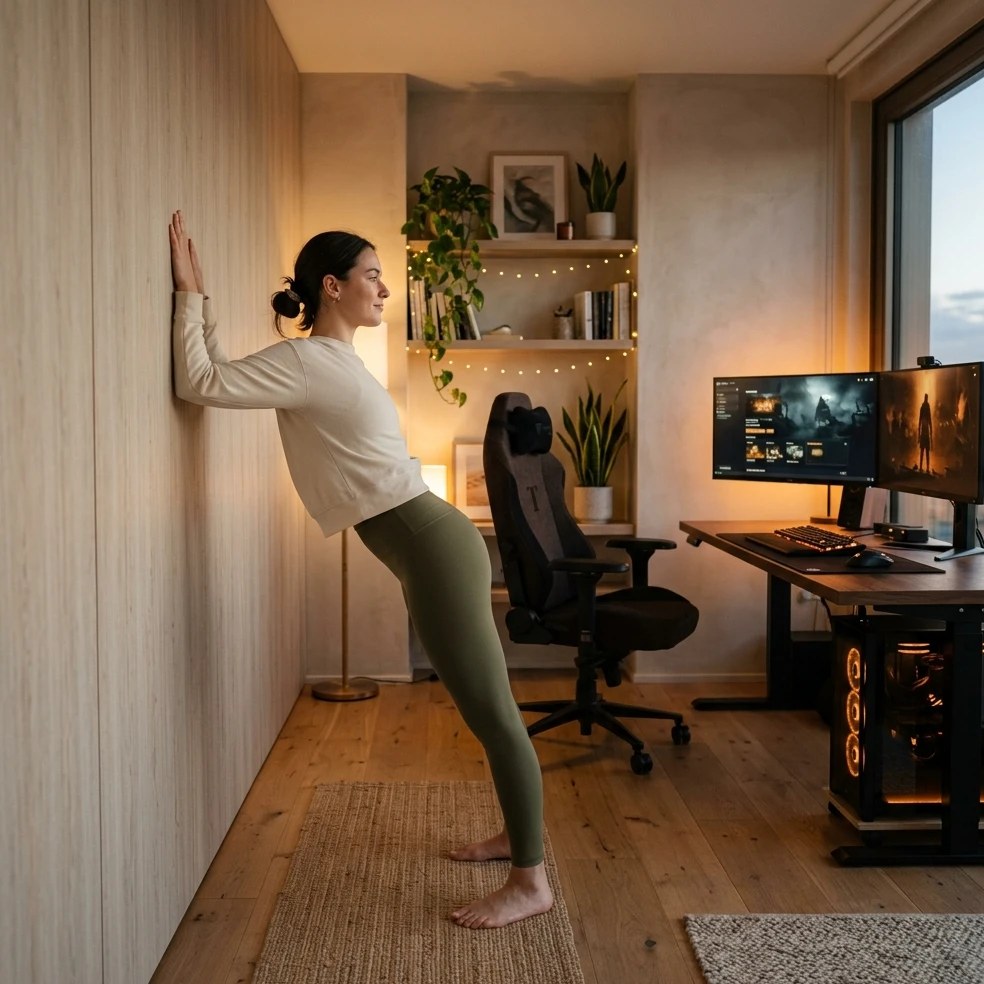
- Doorway pec stretch: 30 sec each side. Counters rounded shoulders.
- Thoracic extension over chair back or foam roller: 30–60 sec.
- Wrist flexor stretch (palm down, gentle pull back): 30 sec each side.
- Wrist extensor stretch (palm down, gentle press down): 30 sec each side.
- Finger spreads + fist closures: 10 reps. Restores hand mobility.
- Hip flexor stretch (kneeling lunge): 30 sec each side.
- Glute squeezes + 10 hip bridges.
The wrist-extensor exception
Most crafts heavily train flexor muscles (gripping). Without dedicated extensor work, lateral epicondylitis (“tennis elbow”) becomes increasingly common with hours-per-week of crafting. The 2010 Stasinopoulos systematic review of epicondylitis treatment found eccentric extensor strengthening produced the best outcomes. A simple band-pull-down with the fist (5 sets of 10, 2x/week) covers most of the prevention.
Strength priorities
2–3 sessions per week, 20–30 minutes:
- Rows: counter forward shoulder/upper back rounding.
- Face pulls / band pull-aparts: rear deltoids, rhomboids, lower traps.
- Wrist extensor work: band or light dumbbell, 2x/week. Critical for crafters.
- Hip hinges + squats: counter sustained sitting and glute under-use.
- Anti-rotation core (Pallof press): stability for trunk against the asymmetric loading some crafts produce (e.g., one-handed scissor work).
Workspace setup
- Light over the work: better lighting reduces forward leaning; magnifying lamps for fine work.
- Work surface height: forearms close to parallel with floor when working; elbows ~90°.
- Chair height: feet flat, knees ~90°, lumbar support.
- Tool sizing: handles too small require excessive grip force; ergonomic grips for long sessions.
- Reading glasses / progressives: getting visual correction for fine work prevents the “poke chin forward to see” pattern.
When to take pain seriously
- Persistent wrist or elbow pain >2 weeks despite breaks and stretching.
- Numbness or tingling in fingers (potential nerve compression).
- Reduced grip strength affecting the work.
- Locking or clicking joints during fine motor tasks.
- Headaches accompanying long sessions.
Hand therapists and occupational therapists are excellent resources for craft-specific RSI management.
Common myths
- “Crafting is gentle — it can’t cause injury.” Wrong. Sustained fine-motor work produces real overuse injuries given enough hours.
- “Just take a hot shower.” Heat helps acute soreness modestly; doesn’t address the underlying postural and overuse causes.
- “Compression gloves are necessary.” They help in some arthritis cases but are not preventive for asymptomatic crafters.
Practical takeaways
- Hand crafts produce predictable patterns: forward head, rounded shoulders, wrist flexor dominance, hip flexor shortening.
- Break every 30–60 minutes for 2–3 minutes of movement; 20-20-20 rule for eyes.
- 5-minute daily mobility flow targets the major patterns.
- Wrist extensor strengthening prevents most crafting-related epicondylitis.
- Light over the work reduces forward leaning; visual correction prevents chin-poke.
- Persistent pain >2 weeks warrants hand-therapist evaluation.
References
Daneshmandi 2017Daneshmandi H, Choobineh A, Ghaem H, Karimi M. Adverse effects of prolonged sitting behavior on the general health of office workers. J Lifestyle Med. 2017;7(2):69-75. View source →Stasinopoulos 2010Stasinopoulos D, Stasinopoulou K, Johnson MI. An exercise programme for the management of lateral elbow tendinopathy. Br J Sports Med. 2005;39(12):944-947. View source →Hansraj 2014Hansraj KK. Assessment of stresses in the cervical spine caused by posture and position of the head. Surg Technol Int. 2014;25:277-279. View source →Waongenngarm 2018Waongenngarm P, Areerak K, Janwantanakul P. The effects of breaks on low back pain, discomfort, and work productivity in office workers: a systematic review. Appl Ergon. 2018;68:230-239. View source →Talens 2021Talens-Estarelles C, García-Marqués JV, Cervino A, García-Lázaro S. Use of digital displays and ocular surface alterations: a review. Ocul Surf. 2021;19:252-265. View source →Kumar 2010Kumar S. Theories of musculoskeletal injury causation. Ergonomics. 2001;44(1):17-47. View source →Kim 2018Kim D, Cho M, Park Y, Yang Y. Effect of an exercise program for posture correction on musculoskeletal pain. J Phys Ther Sci. 2015;27(6):1791-1794. View source →Page 2014Page P. Cervicogenic headaches: an evidence-led approach to clinical management. Int J Sports Phys Ther. 2011;6(3):254-266. View source →Nicholas 2009Nicholas RS, Kim N, Hansen JC, et al. The effects of upper-extremity tendinopathy on functional performance. Physiother Theory Pract. 2009;25(4):305-316. View source →Kennedy 2007Kennedy CA, Beaton DE, Solway S, McConnell S, Bombardier C. The DASH and QuickDASH outcome measure user's manual. 3rd ed. Toronto: Institute for Work & Health; 2011. View source →Amadio 2015Amadio PC. Carpal tunnel syndrome: pathophysiology and clinical neurophysiology. Clin Neurophysiol. 2002;113(9):1373-1381. View source →Page 2010Page P. Effectiveness of elastic resistance in rehabilitation of patients with patellofemoral pain syndrome: what is the evidence? Sports Health. 2011;3(2):190-194. View source →