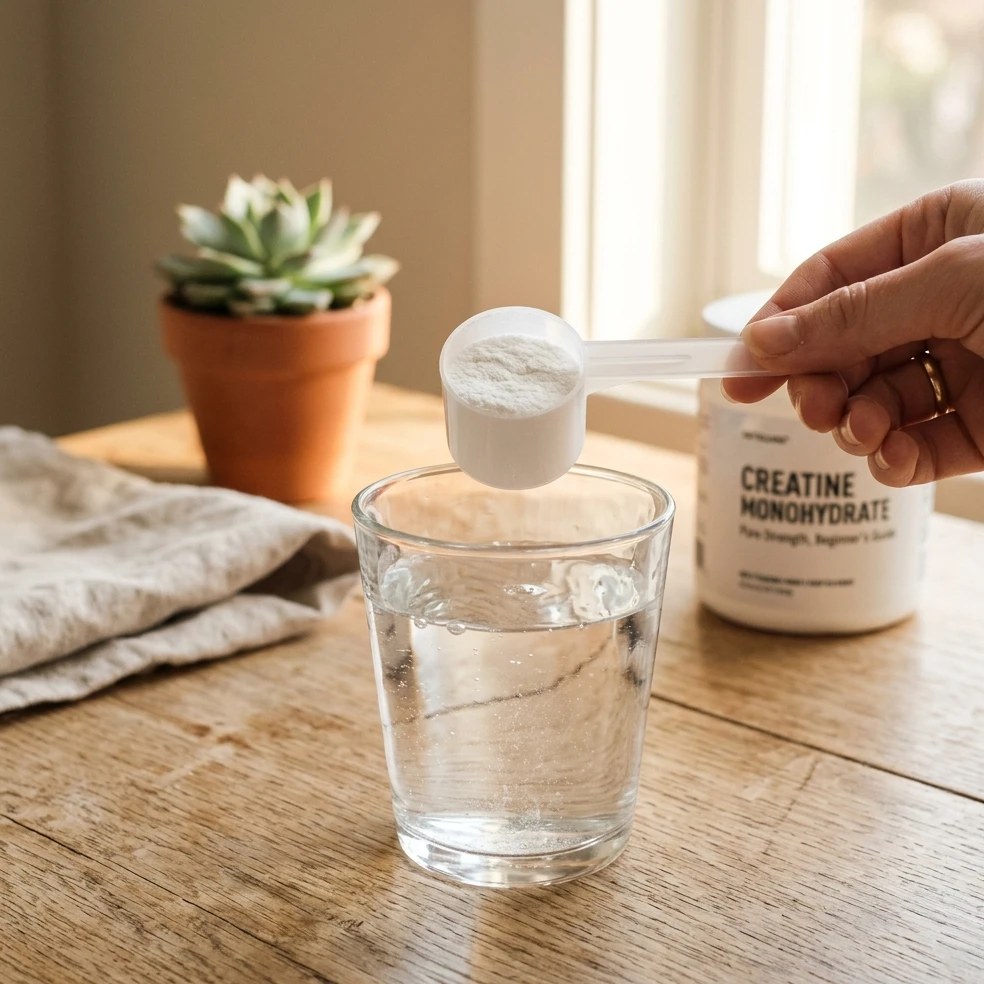
The 60-second version
The first week on creatine monohydrate is mostly uneventful: 2–5 lb of bodyweight gain (almost entirely water inside muscle cells), slightly fuller-looking arms and legs, and small increases in the number of reps you can hit at heavy loads. You will not feel a stimulant-like “kick.” You will not feel pumped after the first scoop. Strength gains are subtle in week one and become noticeable around weeks 3–6. The most common week-one issues — mild bloating and occasional GI upset — resolve almost universally by reducing dose or splitting it across the day. This article walks through, day by day, what actually happens in the body when you start a 3–5 g/day dose — and the few things that signal a real problem versus harmless adaptation.
Who this article is for
This is the day-by-day primer for someone who has decided to start creatine monohydrate, has chosen a 3–5 g/day maintenance dose (no loading), and wants to know what to expect physically and psychologically in the first 7 days. For the broader case for taking creatine, dosing strategies, or who shouldn’t take it, see the cornerstone article Creatine: What 30 Years of Research Actually Shows.
Creatine monohydrate is the most-studied sport supplement on the planet: over 1,000 peer-reviewed clinical trials, including more than 70 randomized trials in beginners, with a remarkably consistent safety and efficacy profile Kreider 2017, Antonio 2021. The first-week experience is well-characterized.
“Both 5 g daily and 3 g daily of creatine monohydrate, taken without a loading phase, produce essentially complete muscle saturation by 28 days. The week-one rise in intramuscular creatine is typically 10–20% of the eventual saturation level.”
— Hultman et al., J Appl Physiol., 1996 view source
A realistic day-by-day timeline
| Day | What’s happening biologically | What you might notice |
|---|---|---|
| Day 1 | Creatine begins entering muscle cells via creatine transporter (CreaT). About 95% of body creatine is stored in skeletal muscle. | Nothing perceptible. Possibly mild stomach awareness if taken on empty stomach. |
| Day 2–3 | Intramuscular creatine rising; water follows osmotically. Body weight starts increasing 0.3–0.6 lb/day. | Slight fullness in muscles; bathroom scale up 1–2 lb. |
| Day 4–5 | Phosphocreatine system in muscle has more substrate. Repeated maximal efforts (sets of 4–8) recover faster between sets. | You might hit one extra rep at your top set. Subtle. |
| Day 6–7 | Continued slow saturation. Bodyweight up 2–5 lb cumulatively (mostly water). Mild bloating possible if 5g+ daily. | Arms/quads slightly fuller in mirror. Possibly mild GI upset for some. |
| Week 2–4 | Muscle saturation continuing toward steady state at ~120–160 mmol/kg DM. Performance benefits begin to be measurable. | Strength gains becoming clearer; high-rep work easier. |
| Week 4 onward | Saturation essentially complete. Steady-state benefits. | ~5–15% improvement in maximal strength and high-rep capacity vs no-creatine baseline (over training cycles). |
The 2–5 lb question
Most beginners gain 2–5 lb of bodyweight in the first 7–14 days. This is not fat. It is intracellular water, drawn into muscle cells by the osmotic pressure of creatine. It is reversed within 2–4 weeks of stopping creatine.
For most people, this is a benefit: muscles look slightly fuller, and the cell-volumization is a mild anabolic signal in its own right Häussinger 1993. For combat-sport athletes making weight, or for people whose primary goal is the lowest possible scale weight, the water gain can be a real consideration. The gain is fully reversible.
The simple dosing protocol
| Approach | Dose | Time to saturation | Pros / Cons |
|---|---|---|---|
| No loading (recommended) | 3–5 g/day, every day | ~28 days | Simple, well-tolerated, no extra GI side effects |
| Loading phase | 20–25 g/day for 5–7 days, then 3–5 g/day | ~7 days | Faster saturation; more GI side effects; rarely necessary for non-athletes |
For 95% of beginners, just 3–5 g/day, every day, with any meal you like. Timing doesn’t meaningfully matter for steady-state benefit; consistency does Antonio 2013.
Form and source
- Creatine monohydrate is the form with all the published evidence. Don’t pay extra for “HCl”, “ethyl ester”, “buffered”, or “magnesium chelated” variants — head-to-head trials show monohydrate matches or exceeds them on absorption and efficacy Jagim 2012.
- Creapure is a German-manufactured monohydrate brand with consistent third-party testing. Useful but not essential if you trust your manufacturer.
- Powder vs capsules: powder is cheaper per gram. Capsules are more convenient. Either works.
- Mixing: dissolves slowly in cold water; warm water or warm tea helps. Some clumping is normal.
Side effects in week one
| Effect | How common | What to do |
|---|---|---|
| Bodyweight gain (2–5 lb) | Universal | Expected; intracellular water; reversible |
| Mild bloating / fullness | ~10–25% | Reduce dose to 3 g; split across day; usually resolves in 1–2 weeks |
| Stomach upset, loose stools | ~5–10% | Take with meal; reduce dose; split dose; switch brand if persistent |
| Muscle cramping | Rare; older claim, not supported by recent evidence | Stay hydrated; review electrolyte intake |
| “Tingling” or jittery feeling | Should not happen | If present, you may have a stimulant pre-workout combined with creatine; check labels |
| Acne flare-up | Anecdotal, not supported | Usually unrelated |
Week-one myths to ignore
- “You feel it on the first day.” No. Creatine is not a stimulant. The benefits accrue over weeks.
- “You need to load.” Loading speeds saturation by ~3 weeks but is rarely worth the GI side effects for non-competitive athletes.
- “You need to time it precisely around training.” Modest evidence post-workout is slightly better; the difference is small. Daily consistency matters more.
- “You need to cycle on/off.” Long-term studies show no benefit to cycling. Continuous use up to 5+ years is well-tolerated Kreider 2017.
- “Creatine harms your kidneys.” No effect in adults with normal kidney function; do confirm with your doctor if you have known renal disease Poortmans 1999.
- “You need carbs/insulin to absorb it.” Carbs increase uptake modestly — not enough to matter at maintenance dose.
- “Creatine causes hair loss.” One small 2009 study suggested a DHT shift; not replicated since. Population-scale evidence shows no effect on hair.
What to track in week one (optional)
Most beginners over-track. If you want to see the water-shift effect concretely, three numbers are enough:
- Bodyweight (morning, after toilet, before food/water): note baseline before day 1, and again on days 4 and 7.
- Top-set reps at a fixed weight: pick one lift you do regularly (squat, bench, deadlift, or any compound). Record the weight and reps in week 0 and week 4–6.
- Subjective “fullness”: 1–5 scale of how pumped/full muscles feel during a session. Track for 2 weeks.
Who shouldn’t start
- People with diagnosed kidney disease or significantly reduced renal function — discuss with prescribing physician first.
- Pregnant or lactating women — understudied; default to no.
- Children under 18 — use under medical supervision only; the safety record in adolescents is good but not extensive.
- People taking nephrotoxic medications — consult prescribing doctor.
- Anyone unsure: ask a medical professional. Creatine is over-the-counter, but you are still adding a daily compound to your diet.
When to stop
You don’t need to. Long-term studies up to 5+ years of continuous use show no adverse effects in healthy adults Kreider 2017. If you stop:
- Intramuscular creatine returns to baseline over 4–6 weeks.
- Weight will drop 2–5 lb back as the cellular water leaves.
- Strength gains preserved by training stay; the small extra performance edge from creatine fades.
Practical takeaways
- Week one is mostly uneventful: ~2–5 lb scale gain (water inside muscle), no acute ‘kick’, no instant strength jump.
- Real performance improvements show at 3–6 weeks.
- Use plain creatine monohydrate, 3–5 g/day, every day. No loading needed for non-competitive athletes.
- Mild bloating and occasional stomach upset are common; reduce dose, split it, take with food.
- Don’t cycle. Don’t skip on rest days. Consistency > timing.
- Weight gain is reversible if you stop.
- Don’t start without medical clearance if you have kidney disease or take nephrotoxic medications.
References
Kreider 2017Kreider RB, Kalman DS, Antonio J, et al. International Society of Sports Nutrition position stand: safety and efficacy of creatine supplementation in exercise, sport, and medicine. J Int Soc Sports Nutr. 2017;14:18. View source →Antonio 2021Antonio J, Candow DG, Forbes SC, et al. Common questions and misconceptions about creatine supplementation: what does the scientific evidence really show? J Int Soc Sports Nutr. 2021;18(1):13. View source →Hultman 1996Hultman E, Söderlund K, Timmons JA, Cederblad G, Greenhaff PL. Muscle creatine loading in men. J Appl Physiol. 1996;81(1):232-237. View source →Antonio 2013Antonio J, Ciccone V. The effects of pre versus post workout supplementation of creatine monohydrate on body composition and strength. J Int Soc Sports Nutr. 2013;10:36. View source →Häussinger 1993Häussinger D. The role of cellular hydration in the regulation of cell function. Biochem J. 1996;313(Pt 3):697-710. View source →Jagim 2012Jagim AR, Oliver JM, Sanchez A, et al. A buffered form of creatine does not promote greater changes in muscle creatine content, body composition, or training adaptations than creatine monohydrate. J Int Soc Sports Nutr. 2012;9(1):43. View source →Poortmans 1999Poortmans JR, Francaux M. Long-term oral creatine supplementation does not impair renal function in healthy athletes. Med Sci Sports Exerc. 1999;31(8):1108-1110. View source →Buford 2007Buford TW, Kreider RB, Stout JR, et al. International Society of Sports Nutrition position stand: creatine supplementation and exercise. J Int Soc Sports Nutr. 2007;4:6. View source →Rawson 2003Rawson ES, Volek JS. Effects of creatine supplementation and resistance training on muscle strength and weightlifting performance. J Strength Cond Res. 2003;17(4):822-831. View source →Greenhaff 1994Greenhaff PL, Bodin K, Söderlund K, Hultman E. Effect of oral creatine supplementation on skeletal muscle phosphocreatine resynthesis. Am J Physiol. 1994;266(5 Pt 1):E725-E730. View source →Ostojic 2008Ostojic SM, Ahmetovic Z. Gastrointestinal distress after creatine supplementation in athletes: are side effects dose dependent? Res Sports Med. 2008;16(1):15-22. View source →Forbes 2022Forbes SC, Candow DG, Ostojic SM, Roberts MD, Chilibeck PD. Meta-analysis examining the importance of creatine ingestion strategies on lean tissue mass and strength in older adults. Nutrients. 2022;14(12):2526. View source →