The 60-second version
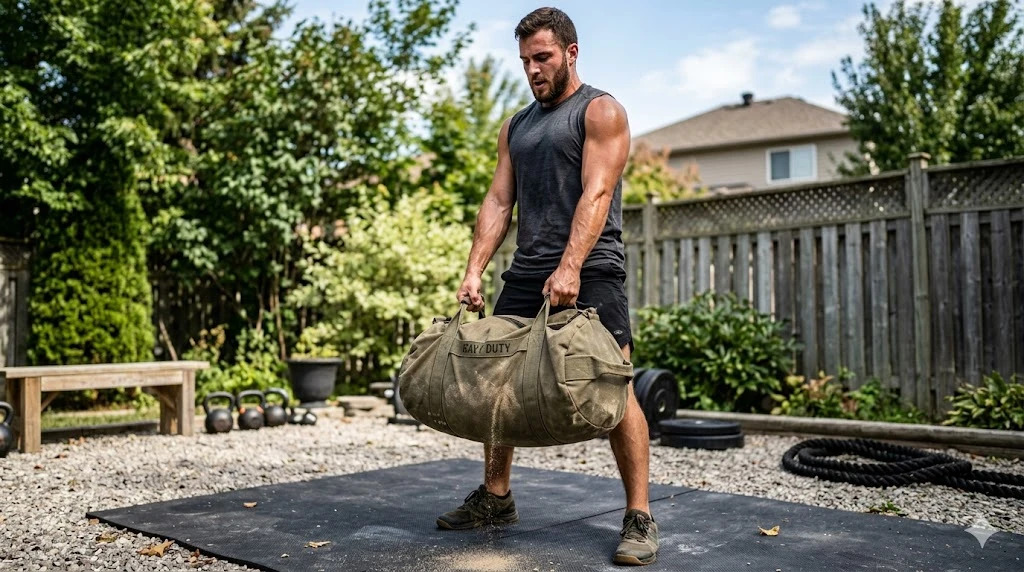
A homemade sandbag — canvas duck-cloth shell, triple-bagged sand fill, $30–50 in materials — delivers a hypertrophy stimulus that most $300+ commercial implements don’t replicate. The shifting load adds the unstable-implement demand Behm 2010 Behm 2010 framed as a real but secondary training stimulus, while still loading the mechanical-tension and metabolic-stress pathways Schoenfeld 2010 Schoenfeld 2010 identified as dominant for hypertrophy. Lake 2012’s ballistic-loading research on kettlebells Lake 2012 supports the broader case for non-rigid loaded implements as effective training tools. Anderson 2005 Anderson 2005 added the proprioceptive-balance benefit. A 4-week sandbag-led mass-gain protocol — clean and press, bear hug squats, shoulder carries, deadlifts — produces measurable strength and hypertrophy gains for adults at every level.
Why the sandbag works for hypertrophy
The hypertrophy stimulus, per Schoenfeld 2010’s well-cited synthesis Schoenfeld 2010, has three primary drivers: mechanical tension (the muscle generates force against load), metabolic stress (the muscle accumulates metabolites during repeated submaximal work), and muscle damage (the muscle experiences microtrauma that triggers repair and growth). All three are loaded by sandbag work, with the additional layer of unstable-load stabiliser recruitment that rigid implements don’t produce.
The mechanical-tension load on a sandbag is comparable to a barbell at matched gross weight, with one important caveat: the shifting fill makes the load feel heavier than the equivalent rigid weight by about 15–25% in subjective perception. This is the “dead weight feels different than swinging weight” phenomenon that strongman competitors have discussed for decades. Lake 2012’s biomechanics work Lake 2012 on the kettlebell swing documented this kind of moment-arm-and-momentum interaction for ballistic implements; the sandbag adds it to the slower carry-and-lift movements as well.
The metabolic-stress load is also higher than equivalent rigid-load work because the stabiliser recruitment elevates total muscle activation per rep. A bear-hug front squat with a 75-lb sandbag produces approximately the metabolic demand of a 95–105-lb barbell front squat for most trainees — a useful efficiency for home-gym athletes whose total available load is constrained.
The construction details that make it last
A sandbag built well lasts 5–10 years of regular use; a sandbag built poorly fails within weeks. The construction details matter. The outer shell is canvas duck cloth (12–15 oz weight) or military-grade nylon; both materials handle the abrasion of repeated loading and dropping. Stitching should be double-rowed reinforced seam at minimum; quad-stitched if you can get it. Handles should be sewn into the shell with bartack reinforcement at the attachment points.
The inner fill bag system is the failure-most-likely component. The recommended construction: 3-mil contractor garbage bag inside a feed bag (or empty 50-lb dog-food bag) inside the canvas shell. The contractor bag handles the moisture barrier; the feed bag handles the tear resistance; the canvas shell handles the abrasion and provides the handles. Duct-tape the inner contractor-bag opening; the feed bag should be sewn closed or zip-tied; the outer shell uses a velcro-and-strap closure for easy fill adjustment.
The fill itself should be clean play-sand or all-purpose sand, dried thoroughly before bagging. Wet sand will mold within weeks even inside the moisture barrier. Estimate 1.5 lb of sand per fluid-cup volume; a 50-lb sandbag needs roughly 6–7 gallons of dry sand. Anderson 2005’s broader instability-training framework Anderson 2005 doesn’t care about your fill specifically; what matters is the unstable-implement nature, which any clean dry granular fill produces.
The 4-week mass-gain protocol
The protocol that produces measurable strength and hypertrophy gains for most adults is 4 days per week, alternating two upper-body-focused and two lower-body-focused sessions. Each session is 35–45 minutes including warmup. The exercise selection is the canonical sandbag movement library: clean and press, bear-hug front squat, shoulder carry, sandbag deadlift, sandbag row, Turkish get-up.
Week 1 baseline: 3 sets of 8 reps at moderate effort (RPE 6–7 of 10). Week 2: 3 sets of 10 reps at moderate-hard effort (RPE 7–8). Week 3: 4 sets of 8 reps at hard effort (RPE 8). Week 4 deload: 2 sets of 8 reps at moderate effort (RPE 6). The volume progression follows the established hypertrophy-block patterns the Schoenfeld 2010 framework Schoenfeld 2010 supports; the deload week prevents overreaching and consolidates the previous three weeks’ adaptations.
The exercise pairing within each session: a primary heavy compound (clean and press or bear-hug squat), an accessory secondary (shoulder carry or sandbag row), and a third accessory (Turkish get-up or sandbag get-up). The total session volume is 9–12 working sets across the three exercises — a modest enough load that the 4-day weekly frequency is recoverable for most adults.
The core sandbag movement library
The clean-and-press is the foundational sandbag movement. Bend at the hips, grip the bag at the top handles, drive through the legs to bring the bag to chest height, then press overhead. The shifting load makes the press portion feel meaningfully different from a barbell or dumbbell press — the stabiliser demand at the top of the movement is substantial. Lake 2012’s broader ballistic-loading framework Lake 2012 supports this kind of moving-load training as a meaningful addition to traditional barbell work.
The bear-hug front squat is the second foundational movement. Hold the sandbag against the chest with arms wrapped underneath, perform a controlled squat through full range. The chest-loaded position elevates upper-back and core demand substantially; trainees who’ve done barbell front squats will recognise the position but feel the additional core and shoulder demand of the unstable load. Sets of 8–12 reps are the productive range.
The shoulder carry is the third foundational movement. Lift the sandbag to one shoulder, walk a measured distance (typically 30–50 metres), then switch shoulders for the return. This is a loaded carry with the additional unilateral-load demand the shoulder position creates. Behm 2010 Behm 2010 framed the unilateral-instability work as a high-yield stabiliser stimulus; the shoulder carry is the canonical implementation.
Loading progression and the size question
The starting weight question depends on training history. For untrained or beginner adults: 25–40 lb (11–18 kg). For an intermediate trainee: 50–75 lb. For an advanced trainee: 100–150 lb. The shifting load makes a 50-lb sandbag feel more like a 60–65-lb barbell at matched movement; size down from your usual external-load assumptions for the first 2–3 weeks while you adapt to the unstable demand.
The progression-by-load question is harder for sandbags than for barbells because the load increment is typically 10–25 lb rather than the 2.5–5 lb of barbell training. The practical solution is volume-based progression: rather than adding load each week, add a set or 2 reps per set. Across an 8-week block, you might progress from 3 sets of 8 reps with a 50-lb sandbag to 4 sets of 12 reps with the same sandbag — a 50%-volume increase that produces meaningful hypertrophy without requiring weight changes.
For trainees who do want to progress load, the practical solution is to build two sandbags at different weights or to refill a single sandbag periodically with additional sand. The latter is messy and most home trainees prefer the two-bag approach: a 35-lb starter and a 75-lb intermediate covers most progression for most adults without a third bag becoming necessary.
Programming the sandbag into a broader training context
The sandbag is most productively used as a primary or secondary training implement, not as the sole training tool. For trainees who own a barbell and weight set, the sandbag is the unstable-load complement to the stable-load barbell work — loading the proprioceptive and stabiliser demand the rigid implement doesn’t reach. Anderson 2005 Anderson 2005 framed the unstable-implement work as “5–10% additional adaptation on top of stable-load training” — not transformational, but real and sustainable.
For trainees without a barbell setup — the home-gym athlete on a budget, the apartment dweller without floor space for a rack — the sandbag can serve as the primary loaded implement. Combined with a kettlebell or two and bodyweight work for accessory volume, the sandbag covers most of the compound-movement load that a barbell otherwise would. The hypertrophy and strength outcomes are roughly 80–90% of what a comparable barbell program produces, at roughly 5–10% of the equipment cost.
The most-common programming error is treating the sandbag as a barbell substitute for maximal-effort 1–3 rep work. The unstable load is not optimised for that loading pattern; the technique consistency at maximal effort is harder to maintain and the injury risk is elevated. Sandbag training lives in the 6–15 rep hypertrophy zone; below 6 reps the rigid-implement alternatives are typically a better choice.
Recovery and the elevated stabiliser demand
Sandbag training’s elevated stabiliser recruitment produces a different recovery profile than rigid-load equivalents. The next-day soreness pattern is typically more diffuse (more muscles involved at lower intensity) and tends to persist 24–36 hours rather than the 12–24 hours typical of barbell-only sessions. This is a real consideration for the 4-day weekly frequency: trainees with poor sleep, inadequate nutrition, or high non-training stress should consider 3-day weekly frequency until the recovery margin is established.
The hydration and protein-intake demands are not different from any other resistance-training program of comparable volume: 0.7–1.0 g of protein per pound body weight daily, 3–4 L water daily, 7–9 hours sleep nightly. The sandbag-specific recovery consideration is grip and forearm fatigue, which builds across a 4-week block faster than the systemic fatigue does. Brief (5–10 minute) forearm and grip mobility work most days helps the cumulative pattern.
The 4-week deload pattern Schoenfeld 2010 Schoenfeld 2010 and the broader hypertrophy literature support is non-negotiable for sustainable progress. Skipping the week-4 deload in favor of continuing the volume increases is the most-common “why am I plateauing” pattern in self-programmed training. The deload preserves the previous three weeks’ adaptations and prepares the system for the next progression block.
Bottom line: a high-value home-gym implement
The most defensible bottom line for adult readers is that a well-built homemade sandbag is one of the highest-value home-gym implements available. The cost is $30–50 in materials, the construction time is 1–2 hours, the lifespan is 5–10 years of regular use. The hypertrophy and strength outcomes are comparable to barbell training at matched volume, with the additional benefit of the unstable-load stabiliser recruitment Behm 2010 Behm 2010 and Anderson 2005 Anderson 2005 document.
For Wasaga and Georgian Bay readers specifically, the practical lever is the sandbag’s portability. The same implement that loads home-gym sessions also travels to the beach for outdoor sessions, to the cottage for vacation training, to the backyard for family-watching sessions. Few other training implements offer the same dollar-per-utility ratio across as many training contexts. The 4-week mass-gain protocol is the on-ramp; the longer-term programming integrates the sandbag as a regular feature of the training week.
Practical takeaways
- A homemade sandbag costs $30–50 and lasts 5–10 years of regular use. Construction is canvas duck-cloth shell, triple-bagged sand fill, sewn-in handles.
- The unstable load adds stabiliser-recruitment demand beyond what rigid implements (barbell, dumbbell, kettlebell) produce.
- The 4-week protocol is 4 sessions weekly with progressive volume, followed by a deload week. Skipping the deload is the most-common plateau cause.
- Starting weight is 25–40 lb for beginners, 50–75 lb for intermediates, 100–150 lb for advanced. The shifting load makes the bag feel heavier than the equivalent rigid load.
- Programming the sandbag at 6–15 reps in hypertrophy ranges matches its loading characteristics; maximal-effort 1–3 rep work is better suited to rigid implements.
- Recovery demand is slightly elevated vs barbell training due to stabiliser recruitment; consider 3-day weekly frequency if recovery margin is thin.
References
Schoenfeld 2010Schoenfeld BJ. The mechanisms of muscle hypertrophy and their application to resistance training. J Strength Cond Res. 2010;24(10):2857-2872. View source →Behm 2010Behm DG, Drinkwater EJ, Willardson JM, Cowley PM. The use of instability to train the core musculature. Appl Physiol Nutr Metab. 2010;35(1):91-108. View source →Lake 2012Lake JP, Lauder MA. Mechanical demands of kettlebell swing exercise. J Strength Cond Res. 2012;26(12):3209-3216. View source →Anderson 2005Anderson K, Behm DG. The impact of instability resistance training on balance and stability. Sports Med. 2005;35(1):43-53. View source →