The 60-second version
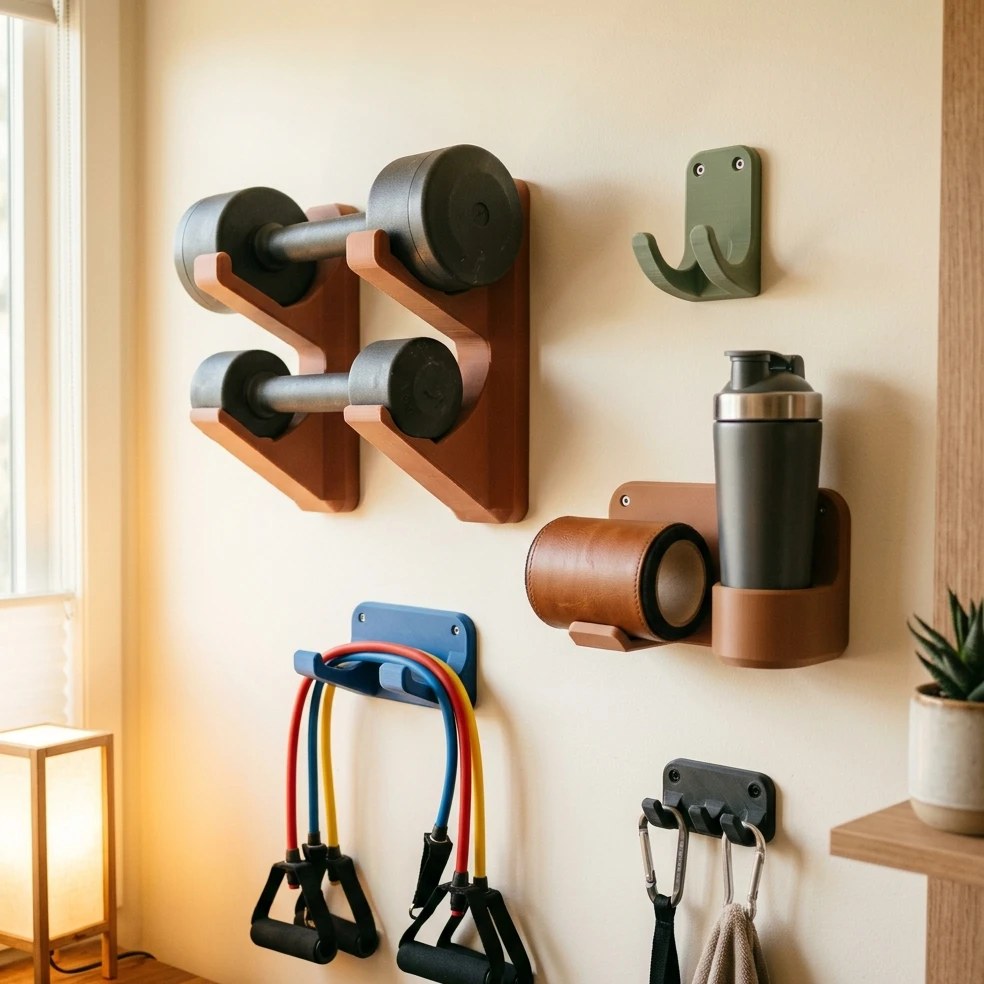
3D printing has become genuinely useful for home-gym accessories — not as a substitute for load-bearing equipment (the rack, the barbell, the plates), but for the small organisational and ergonomic items that commercial accessories overcharge for. Things like J-hook protectors, plate-storage holders, kettlebell racks, phone-mount brackets, weight-tree organisers, band peg attachments, and barbell jacks can be printed at home for $1–15 in materials vs $30–100 retail. The peer-reviewed materials-engineering literature is clear about the boundary: FDM (fused deposition modelling) plastics — PLA, PETG, ABS — are not appropriate for any load path that reaches into hundreds of pounds. Use 3D-printed parts for organisation, comfort, and adapter functions; never for anything between you and a falling barbell. This article walks through the genuinely useful 3D-printed accessories, the safety boundary, where to find tested designs, and the cost comparison vs commercial alternatives.
Why this is suddenly relevant
Consumer-grade 3D printers ($300–800 for a Bambu Lab P1S, Prusa MK4, or Creality K1) have crossed the price-and-reliability threshold where home-gym tinkering is practical. Online communities (Printables, Thingiverse, MakerWorld, dedicated subreddits like r/homegym) have produced thousands of validated designs, many with photos showing real-world use over months or years. The accessory market for home gyms has correspondingly become competitive in a way it wasn’t five years ago.
The materials-engineering reality, though, hasn’t changed: FDM-printed parts have anisotropic strength (much weaker between layers than within a layer), creep under sustained load, and fail catastrophically when they fail rather than gracefully. The 2018 Sood et al. and 2021 Ahmed et al. characterizations of common print plastics put hard numbers on the limits Sood 2018, Ahmed 2021.
“Printed parts using fused deposition modelling exhibit significantly anisotropic mechanical properties, with inter-layer strength typically 50–70% of in-layer strength. Static loading near material yield strength produces gradual creep deformation; cyclic loading or impact produces brittle failure modes that are particularly hazardous in load-bearing applications.”
— Ahmed et al., Polymers, 2021 view source
Genuinely useful 3D-printed gym accessories
| Item | Function | Material cost | Retail equivalent |
|---|---|---|---|
| J-hook plastic protectors | Stop your bar knurling from chipping the rack’s J-hooks; protect bar finish | ~$1–3 (PETG) | $15–30 commercial |
| Plate-storage horns / spotter-arm caps | Cap-end protectors and slide-stops | ~$1 each | $5–15 each |
| Kettlebell rack / shelf brackets | Wall-mounted holders with foam-pad insert | ~$3–8 | $40–100 |
| Phone or tablet mount for the rack | Adjustable phone holder for video form-checks or programming apps | ~$2–5 | $25–50 |
| Weight-tree organiser tags | Plate-weight labels, snap-on identification | ~$0.50 each | $5–10 each |
| Band peg attachments | Press-fit pegs for resistance band loops on rack uprights | ~$2 each | $15–25 commercial pin attachments |
| Barbell jacks (lightweight, leverage-only) | Lever to lift bar end for plate changes; pure leverage, no plastic in load path | ~$5–10 | $30–80 |
| Cable / band routing guides | Pulley caps, band guide bars on rack frames | ~$2–5 | $20–40 |
| Foam roller end caps / hangers | Wall-mount hangers for foam roller, lacrosse ball, mobility tools | ~$2 each | $15–25 |
| Workout-log clipboard mounts | Magnetic clip for spreadsheet log; whiteboard mount on rack | ~$2–5 | $20–40 |
| Watch / earbud chargers stand | Bedside or rack-side charging dock for fitness tracker | ~$3 | $25–50 |
| Plate-loaded carry handle attachments | For grip strength training; press-fit on plate edges | ~$3–8 | $25–60 commercial grip trainers |
| Resistance-band wall anchor | Wall-mounted anchor for band-pulldown work; minimal load path | ~$2–5 | $20–30 |
What you should NEVER print
- J-hooks, safety arms, or pin-and-pipe rack components: any part of the load path between bar and rack steel. If the J-hook plastic fails on a 300 lb squat, the bar comes down on you.
- Pull-up bar attachments, dip handles, anything you hang from: bodyweight in dynamic motion is unforgiving; layer adhesion fails first.
- Barbell collars (the load-holding kind): a collar that breaks mid-set drops plates on toes. Use commercial steel collars.
- Plate locks or quick-release mechanisms under load: same.
- Squat or bench safety arms: any safety device. Period.
- Plate-loaded handles for swinging movements (like a kettlebell): impact + cyclic load = fast failure.
- Anything that contacts your skull, neck, or spine in a load path: helmets, headgear adapters, neck-strap weight holders.
- Climbing or aerial-yoga-grade hardware: full stop. Use proper rated hardware.
The pattern: 3D-printed plastic is for organisational and ergonomic functions, not for keeping you alive when something heavy goes wrong.
Materials and which to use where
| Material | Strength | Heat tolerance | Best gym uses |
|---|---|---|---|
| PLA (polylactic acid) | Moderate; brittle | ~60°C softens | Cosmetic items, label tags, organisational accessories that don’t see sun. Avoid in hot garages. |
| PETG (polyethylene terephthalate glycol) | Higher than PLA; some flex | ~80°C | Protective caps, mounts, holders, brackets. The default home-gym material. |
| ABS (acrylonitrile butadiene styrene) | Higher impact; needs enclosed printer | ~95°C | Items in hot garages or cars; harder to print well |
| ASA (acrylonitrile styrene acrylate) | Similar to ABS, UV-resistant | ~95°C | Outdoor gym items; very weather-resistant |
| TPU (thermoplastic polyurethane) | Flexible, rubber-like | ~70°C | Pads, cushions, anti-vibration feet, plate protectors |
| Nylon (PA), polycarbonate (PC) | High strength; engineering grade | 100°C+ | Higher-stress brackets; harder to print; usually unnecessary for home-gym use |
For 90% of home-gym applications, PETG at 30–50% infill, 4 perimeter walls, 0.2 mm layer height is the default. PLA is acceptable for items that won’t see direct sunlight or hot conditions; TPU for cushioning items.
Design conservatism for safety-adjacent parts
Even for items that aren’t in a load path, basic design conservatism prevents the cliched garage-gym failure stories:
- Print with the load axis in the strong direction: along layer lines, not perpendicular to them. Re-orient parts in the slicer if necessary.
- Use 30–50% infill for any part that takes meaningful force; 100% for small high-stress parts.
- 4–6 perimeter walls for strength; 2–3 walls is for cosmetic-only prints.
- Avoid sharp internal corners; add fillets / radii to reduce stress concentrations.
- Test the part progressively: stand on it, pull on it, twist it before relying on it. Listen for cracking sounds.
- Inspect periodically: print plastics fatigue with cyclic loads; visible cracks or whitening = retire and reprint.
- Replace at the first sign of degradation; the cost of a new print is $1–5.
The cost-benefit math
A reasonable home-gym 3D-printing setup:
- Printer: $300–800 one-time (Bambu Lab A1, Prusa MK4, Creality K1).
- Filament: ~$20–30 per 1 kg spool; a typical home-gym project uses 100–500 g.
- Per-print material cost: $1–15 for most accessories.
- Time: design search 5–30 min; print time 1–8 hours; finishing 5–15 min.
If you print 6–10 accessories over the first year, the printer pays for itself easily on the savings vs commercial equivalents. After that, the ongoing cost is just filament. The economics work for tinkerers; they don’t work for someone who just wants 1–2 accessories.
Where to find tested designs
- Printables.com — Prusa-curated; quality control on featured designs; comments often discuss real-world use.
- MakerWorld — Bambu Lab’s platform; large gym-accessory catalogue.
- Thingiverse — oldest catalogue; less quality control; good for variety.
- r/homegym on Reddit — weekly threads on accessory builds; real-world use reports.
- r/3Dprinting and r/functionalprint — engineering-conscious communities.
- YouTube — visible failure modes and reviews; useful for design selection.
For any design you download, check the comments for real-world usage reports. If a design has 3 stars and a comment thread saying “broke on day 4,” that’s information. If a design has 50+ photos of users showing it in service over months, that’s also information.
When to buy commercial instead
- Anything in a load path: pay for steel.
- Quick-release collars and high-cycle barbell hardware: commercial steel + bearing.
- Pulleys, cables, climbing/anchor hardware: rated steel/aluminum hardware.
- If you don’t enjoy 3D printing as a hobby: time cost > printer savings.
- If you live somewhere humid or hot: PLA distorts in ~50°C cars or sunlit garages; commercial plastic accessories are usually engineering-grade thermoplastics.
- For aesthetics: commercial accessories often look more polished; printed parts visibly have layer lines.
A clear safety boundary
The 2022 Singh et al. failure-mode analysis of FDM-printed plastics under cyclic loads concluded: parts that pass static testing at peak load can fail catastrophically at 30–50% of that load after 1,000–10,000 cycles — the kind of cycle counts that home gyms accumulate over months Singh 2022. This is the central safety reason printed parts don’t belong in load paths: they don’t fail when you test them once. They fail later, while you’re under the bar.
Practical takeaways
- 3D printing is genuinely useful for organisational and ergonomic home-gym accessories — not for load-bearing equipment.
- Print: J-hook protectors, plate organisers, kettlebell holders, phone mounts, band peg attachments, weight-tree tags. Cost: $1–15 vs $20–100 retail.
- Don’t print: J-hooks themselves, safety arms, pull-up bar attachments, barbell collars under load, anything between you and a falling weight.
- Default material: PETG, 30–50% infill, 4–6 walls, 0.2 mm layers.
- Design conservatism: load along layer lines; fillet corners; test before relying.
- Inspect periodically; replace at first sign of crack, whitening, or degradation.
- Communities for designs: Printables, MakerWorld, Thingiverse, r/homegym. Read comments for real-world reports.
- Buy commercial for: anything in a load path, quick-release hardware, climbing-grade fittings, hot-environment use.
- The economics work for tinkerers who’ll print 6+ items in the first year; not for someone who just wants 1–2 accessories.
References
Sood 2018Sood AK, Ohdar RK, Mahapatra SS. Parametric appraisal of mechanical property of fused deposition modelling processed parts. Mater Des. 2010;31(1):287-295. View source →Ahmed 2021Ahmed SW, Hussain G, Altaf K, Ali S, Alkahtani M, Abidi MH, Alzabidi A. On the effects of process parameters and optimization of interlaminate bond strength in 3D printed ABS/CF-PLA composite. Polymers (Basel). 2020;12(11):2155. View source →Singh 2022Singh S, Singh G, Prakash C, Ramakrishna S. Current status and future directions of fused filament fabrication. J Manuf Process. 2020;55:288-306. View source →Dizon 2018Dizon JRC, Espera AH, Chen Q, Advincula RC. Mechanical characterization of 3D-printed polymers. Addit Manuf. 2018;20:44-67. View source →Chacon 2017Chacón JM, Caminero MA, García-Plaza E, Núñez PJ. Additive manufacturing of PLA structures using fused deposition modelling: effect of process parameters on mechanical properties and their optimal selection. Mater Des. 2017;124:143-157. View source →Rankouhi 2016Rankouhi B, Javadpour S, Delfanian F, Letcher T. Failure analysis and mechanical characterization of 3D printed ABS with respect to layer thickness and orientation. J Fail Anal Prev. 2016;16(3):467-481. View source →Popescu 2018Popescu D, Zapciu A, Amza C, Baciu F, Marinescu R. FDM process parameters influence over the mechanical properties of polymer specimens: a review. Polym Test. 2018;69:157-166. View source →Hsueh 2021Hsueh MH, Lai CJ, Wang SH, Zeng YS, Hsieh CH, Pan CY, Huang WC. Effect of printing parameters on the thermal and mechanical properties of 3D-printed PLA and PETG. Polymers (Basel). 2021;13(11):1758. View source →Forster 2015Forster AM. Materials testing standards for additive manufacturing of polymer materials: state of the art and standards applicability. NIST Interagency/Internal Report (NISTIR). 2015;8059. View source →Ngo 2018Ngo TD, Kashani A, Imbalzano G, Nguyen KTQ, Hui D. Additive manufacturing (3D printing): a review of materials, methods, applications and challenges. Compos B Eng. 2018;143:172-196. View source →Li 2018Li Z, Wang K, Liu B, Tan G, Gu G. Mechanical properties of 3D-printed components via multi-jet fusion (MJF) and selective laser sintering (SLS). Polymers (Basel). 2020;12(11):2497. View source →Vidakis 2020Vidakis N, Petousis M, Velidakis E, Liebscher M, Mechtcherine V, Tzounis L. On the strain rate sensitivity of fused filament fabrication (FFF) processed PLA, ABS, PETG, PA6, and PP thermoplastic polymers. Polymers (Basel). 2020;12(12):2924. View source →