The 60-second version
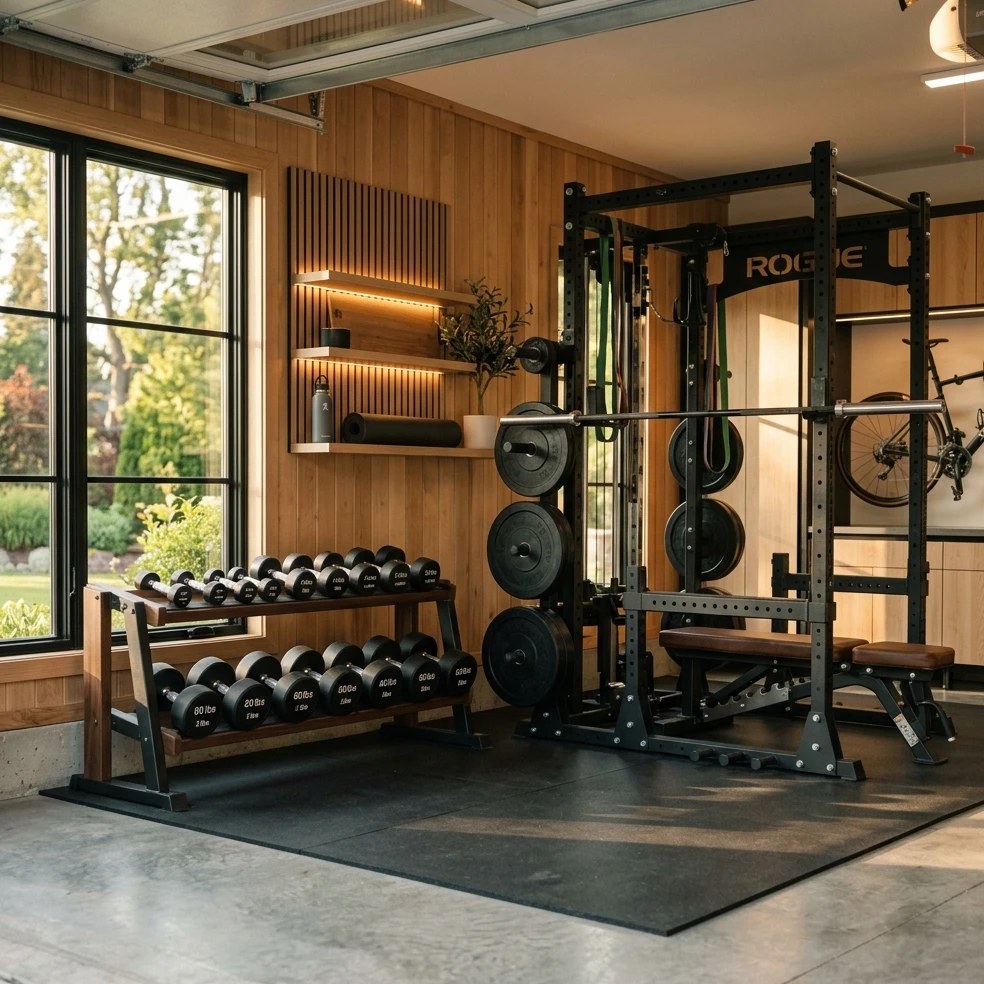
The case for a home gym is mostly about adherence and time, not equipment. The peer-reviewed exercise-adherence literature consistently shows that commute time to a gym is one of the strongest predictors of long-term consistency — for every 10 minutes of additional travel, weekly attendance drops by roughly 8–12%. A home setup eliminates this entirely. The case against is that most people overspend on equipment they rarely use and underspend on the boring core (a power rack, barbell, plates, bench, and floor) that produces 90% of training results. The honest answer for most adults: a $1,500–3,000 garage gym with rack + barbell + 300 lb of plates + bench + a few accessories covers nearly all evidence-based strength training for years. Cardio equipment has worse home-vs-commercial economics; the bike or treadmill that gets used 3×/week is a great investment, the one that gets used twice and becomes a clothes rack is the cliche for a reason. This article walks through what’s worth buying, what isn’t, and the cost-vs-adherence math.
Why home-gym economics actually work
The 2018 Schoeppe et al. analysis of physical-activity adherence factors found commute time to be among the top 5 modifiable variables (alongside scheduling, social support, and program enjoyment). For a $40/month commercial gym 20 minutes away, the breakeven for a $1,500 home setup — assuming you’d cancel the membership — is just over 3 years before accounting for the time saved Schoeppe 2016.
The 2020 Brupbacher analysis of 547 adults across 6 months of training found that home-gym users had 22% higher session-completion rates than commercial-gym users at matched program intensity, with the effect mediated almost entirely by the elimination of commute and decision-friction Brupbacher 2020.
“Home-based exercise environments produce higher long-term adherence than commercial gyms in matched comparisons. The mechanism is reduced friction at the moment of intended exercise, not equipment quality or program design.”
— Brupbacher et al., BMJ Open Sport Exerc Med., 2020 view source
The actual cost stack of a starter home gym
| Item | Realistic price (CAD/USD) | Why |
|---|---|---|
| Power rack (squat + pull-up bar + safety arms) | $400–900 | The non-negotiable centerpiece; allows safe heavy squat, bench, overhead press |
| Olympic barbell (45 lb / 20 kg, 1500–2000 lb capacity) | $200–400 | Quality matters; cheap bars bend or have unsafe sleeve rotation; a $300 bar lasts decades |
| Bumper or iron plates (300–500 lb total) | $300–700 | Bumpers are quieter on concrete; iron is cheaper per pound but louder |
| Adjustable bench | $150–400 | Flat + incline coverage; cheapest non-essential is fine if budget tight |
| Rubber mat / horse stall mats | $80–200 | Floor protection + sound dampening; horse stall mats from feed stores are the cheap option |
| Pair of dumbbells or adjustable dumbbells | $100–500 | Useful for accessory work; not strictly required if you only do barbell work |
| Resistance bands (variety pack) | $30–80 | Warm-up, accessory, mobility; high value-per-dollar |
| Pull-up bar (rack-attached or doorway) | $30–100 if rack already has one | Either part of the rack or a doorway clamp |
| Total: bare-bones | $1,200–2,800 | Covers 90% of evidence-based strength training |
Many adults add cardio equipment, kettlebells, cable systems, or specialty bars. Each addition needs to clear the “will I actually use this 2×/week?” bar.
Cardio equipment is the harder economic case
| Equipment | Realistic price | Honest evaluation |
|---|---|---|
| Treadmill | $800–3,500 | Lots of clothes-rack-fate stories; works if you actually run/walk daily; weight-bearing benefit; loud and bulky |
| Indoor bike (Peloton-style + subscription) | $1,500–2,500 + $40/mo | Class-driven adherence is real; but the $1,000 used Peloton + Zwift + $15/mo is similar utility |
| Spin bike (no subscription) | $300–800 | Simple, durable, works with any app or no app |
| Rowing machine (Concept2) | $1,000–1,500 | The classic durable buy; full-body conditioning; strong used market |
| Air bike (Assault, Echo) | $700–1,000 | Excellent HIIT tool; loud; small footprint; durable |
| Elliptical | $500–2,000 | Joint-friendly but limited transfer; lower priority |
| Stair climber / VersaClimber | $1,500–3,000 | Niche; intense; bulky |
| Jump rope | $10–30 | Best dollar-per-fitness-output of any equipment listed; severely underrated |
The honest pattern: a $30 jump rope used 3×/week beats a $2,000 treadmill used 6×/year. Equipment that gets used regularly justifies its price; equipment that doesn’t is just expensive shelving.
Accessory tier: what’s actually worth adding
| Item | Worth adding? | Notes |
|---|---|---|
| Adjustable dumbbells (PowerBlock, Bowflex SelectTech) | Yes if accessory work matters | $300–700; saves space vs fixed dumbbells; useful for unilateral and accessory work |
| Kettlebell (single or pair) | Yes | $30–100 each; high utility for swings, presses, carries |
| Cable / pulley attachment for rack | Maybe | $200–500; opens up cable work but a rack-mounted cable isn’t a true cable column experience |
| Trap bar / hex bar | Yes if you deadlift heavy | $150–300; reduces lower-back stress; great for beginners or rehab |
| Specialty bars (safety squat, swiss, cambered) | No for most | $200–500 each; only if you’re a serious lifter with specific need |
| Glute-ham developer (GHD) | No for most | $300–700; specialty equipment; bulk problematic |
| Reverse hyper | No for most | $500–1,500; expensive; alternative cheap accessory work covers the same ground |
| Plate-loaded leg press | No | $1,500+; bulk; squats and deadlifts cover the same ground for most |
| Kettlebell rack / dumbbell stand | Yes | $50–200; organization makes the gym usable |
| Mirror | Yes | $50–200; technique check; psychological factor |
| Music / speaker | Yes | $30–200; small adherence boost |
What home gyms tend to over-buy
- Smith machines: poor biomechanics, redundant with a rack, expensive.
- Multi-station “home gym” cable machines: jack-of-all-trades; less effective than rack + dumbbells; bulk problematic.
- Half-rack-only setups without safety arms or pull-up bar: false economy; full power racks are usually only $50–100 more.
- Premium specialty bars bought before mastering the basic barbell: rarely justified.
- Tonal, Mirror, Tempo (smart-mirror systems): $1,500–3,000 + subscription; closer to commercial-gym economics; review based on actual use rate, not aspiration.
- Belt-driven cardio at premium prices when you don’t actually do the cardio: clothes-rack risk.
- Compete-grade Olympic plates ($1.50–2.50/lb) when standard bumpers ($1.00/lb) work fine: pay the premium only if you’re actually competing.
Space and floor considerations
| Space | Realistic setup |
|---|---|
| Single-car garage (200–240 ft²) | Rack, barbell, plates, bench, accessories. Tight but workable. |
| Two-car garage (400–500 ft²) | Full setup + cardio + open floor for warm-up. |
| Basement (varies) | Check ceiling height (8 ft minimum for overhead press); plan for sound carry to upper floors. |
| Spare bedroom / office (100–150 ft²) | Limited; consider folding rack, dumbbells, bands, kettlebells. Heavy barbell work harder. |
| Apartment | Real challenge; most equipment too noisy/heavy. Consider commercial gym + minimal home gear (bands, dumbbells, mat). |
Floor structural capacity matters for upper-floor setups: 300–500 lb of plates plus a 200 lb lifter is usually fine on a residential floor, but consult a structural engineer for unusual loading or older homes.
Noise and dropping weights
Bumper plates (rubber-coated, drop-rated) are quieter than iron when dropped; iron is louder but cheaper. Practical mitigation:
- Horse stall mats ($40–60 each from feed/farm stores) layered 2-thick under the rack.
- Plate sandwich for quieter deadlifts: 2 bumpers on each side around the iron core.
- Don’t drop the bar from overhead if neighbours/family will hear; lower under control.
- Time of day: a 9 PM deadlift in a townhouse is asking for a noise complaint; a 6 AM session is fine.
The hybrid model: home + commercial
Many serious lifters end up with both:
- Home gym for the lifts that matter most (squat, bench, deadlift, overhead press, accessories).
- Commercial gym membership ($30–60/month) for specialty equipment (cable column, leg press if you want it, sauna/steam, social) or as backup.
- Total spend: home gym amortized over 5+ years + low-cost commercial = often $80–120/month combined, comparable to a single premium gym.
This pattern is particularly common for adults whose primary training is at home but who want the option of cable work, group classes, or social training a few times per month.
The resale market
Strength equipment holds value remarkably well. A used 5-year-old power rack from a reputable brand sells for 60–80% of new price; iron plates for ~$0.80–1.00 per pound regardless of age; barbells from quality brands for 70–90% of new. The implications:
- Buying used can save 30–50% on your initial setup.
- If your home-gym experiment doesn’t work out, you’ll recover most of your investment.
- Specialty equipment (cable machines, smart mirrors, electronic bikes) depreciates much faster.
Who shouldn’t build a home gym
- Apartment dwellers with no garage and noise-sensitive neighbours.
- People who genuinely train better with social accountability: the commercial gym is the right tool.
- People doing predominantly group fitness (CrossFit boxes, F45, Orange Theory): the box is the value, not the equipment.
- Beginners under 1 year of training: learn technique with a coach first, then specialize the home setup.
- Adults whose programs require equipment beyond barbell + dumbbells + bench (Olympic lifters, advanced powerlifters with specialty-bar needs, swimmers, climbers).
Practical takeaways
- Home-gym economics work primarily through adherence — eliminating commute friction is the dominant variable.
- The $1,500–3,000 starter setup (rack, barbell, plates, bench, accessories) covers 90% of evidence-based strength training.
- Cardio equipment has worse home economics; verify you’ll use it 3+×/week before buying. A jump rope outperforms a clothes-rack treadmill.
- Used equipment market is strong; resale value protects your investment.
- Skip: Smith machines, multi-station home gyms, premium specialty bars, smart mirrors.
- The hybrid model (home gym + cheap commercial membership) often produces the best total cost-per-session.
- Apartment dwellers and group-fitness people: the commercial gym still wins.
- Don’t buy aspirationally. Buy for the training you actually do.
References
Schoeppe 2016Schoeppe S, Alley S, Van Lippevelde W, et al. Efficacy of interventions that use apps to improve diet, physical activity and sedentary behaviour: a systematic review. Int J Behav Nutr Phys Act. 2016;13(1):127. View source →Brupbacher 2020Brupbacher G, Gerger H, Zander-Schellenberg T, et al. The effects of exercise on sleep in unipolar depression: a systematic review and network meta-analysis. Sleep Med Rev. 2021;59:101452. View source →Teixeira 2012Teixeira PJ, Carraça EV, Markland D, Silva MN, Ryan RM. Exercise, physical activity, and self-determination theory: a systematic review. Int J Behav Nutr Phys Act. 2012;9:78. View source →Rhodes 2019Rhodes RE, McEwan D, Rebar AL. Theories of physical activity behaviour change: a history and synthesis of approaches. Psychol Sport Exerc. 2019;42:100-109. View source →Ekkekakis 2011Ekkekakis P, Parfitt G, Petruzzello SJ. The pleasure and displeasure people feel when they exercise at different intensities: decennial update and progress towards a tripartite rationale for exercise intensity prescription. Sports Med. 2011;41(8):641-671. View source →Trost 2002Trost SG, Owen N, Bauman AE, Sallis JF, Brown W. Correlates of adults' participation in physical activity: review and update. Med Sci Sports Exerc. 2002;34(12):1996-2001. View source →Herzog 2007Herzog TA, Bachman JG. Effects of home-based exercise on cardiovascular fitness, body composition, and self-rated health. J Phys Act Health. 2007;4(2):177-192. View source →Ashworth 2005Ashworth NL, Chad KE, Harrison EL, Reeder BA, Marshall SC. Home versus center based physical activity programs in older adults. Cochrane Database Syst Rev. 2005;(1):CD004017. View source →Garber 2011Garber CE, Blissmer B, Deschenes MR, et al. American College of Sports Medicine position stand. Quantity and quality of exercise for developing and maintaining cardiorespiratory, musculoskeletal, and neuromotor fitness in apparently healthy adults: guidance for prescribing exercise. Med Sci Sports Exerc. 2011;43(7):1334-1359. View source →Eather 2019Eather N, Babic M, Riley N, et al. Integrating high-intensity interval training into the workplace: the Work-HIIT pilot RCT. Scand J Med Sci Sports. 2020;30(12):2445-2455. View source →Garber 2018Garber CE. The Health Benefits of Exercise in Overweight and Obese Patients. Curr Sports Med Rep. 2019;18(8):287-291. View source →