The 60-second version
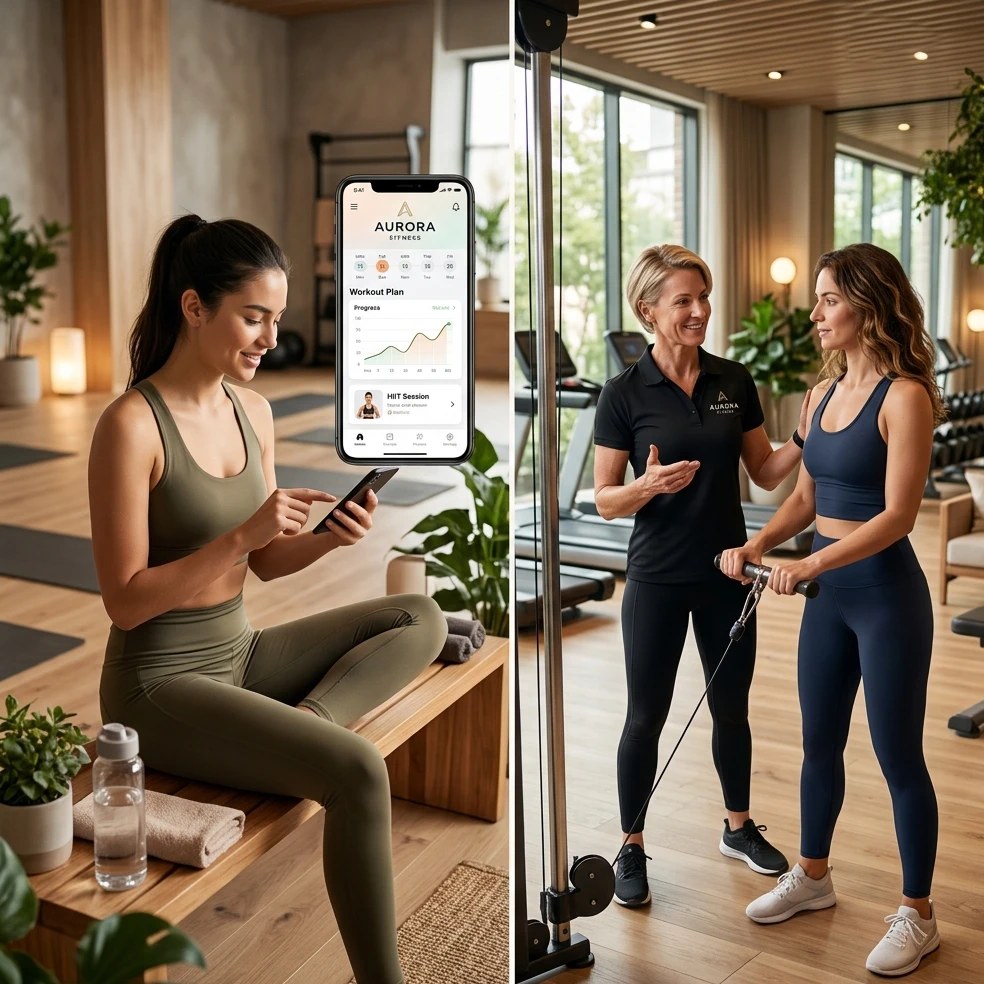
AI-driven fitness apps (Future, FitnessAI, Freeletics, Caliber, MacroFactor, Hevy AI) have improved fast, but the peer-reviewed evidence still consistently shows in-person human personal training produces better outcomes for most adults — specifically through better adherence, technique correction, and progressive overload calibration. Meta-analyses of digital health-and-fitness interventions show small-to-moderate effects on physical activity and body composition, but typical app adherence drops sharply after 8–12 weeks, while supervised training adherence stays meaningfully higher across the same windows. AI tools shine in two specific lanes: (1) cost-sensitive users who would otherwise have no coaching at all, and (2) experienced lifters who only need programming structure, not technique work. Beginners, post-injury returns, complex barbell lifters, and adults with significant medical considerations are still better served by an in-person human at least intermittently. The honest framing isn’t “AI vs human” — it’s matching the level of guidance to the level of complexity in your situation.
Why this comparison matters now
The fitness-app market has roughly tripled since 2020, with most growth in algorithmically-personalized training and nutrition apps. They’re cheaper than personal training (~$10–30/month vs $80–150/session), available 24/7, and improving rapidly. The peer-reviewed evidence on outcomes hasn’t kept pace with the marketing, but enough trials now exist to make some honest comparisons.
The 2020 Romeo et al. meta-analysis of 17 randomized trials of fitness-app interventions vs control conditions found small-to-moderate increases in moderate-to-vigorous physical activity (effect size ~0.3) and modest body-composition improvements, with effects substantially smaller than those seen in supervised-training trials with similar populations Romeo 2019. The 2021 Yang review of 30 mobile-fitness-app trials reported similar magnitudes and noted that app adherence dropped from ~80% in week 1 to under 30% by week 12 in most intervention studies Yang 2021.
“Mobile-based fitness interventions produce small-to-moderate short-term improvements in physical activity and body composition. The principal limitation is sustained engagement; without external accountability, app-based protocols show progressive disengagement that supervised in-person programming does not exhibit to the same degree.”
— Romeo et al., Sports Med., 2019 view source
Where AI coaching genuinely wins
| Strength | Why |
|---|---|
| Cost | $10–30/month vs $300–600/month for 4 weekly sessions; the only realistic option for many adults |
| Programming consistency | Structured progressive overload without the “wing it” gym-day effect |
| Data tracking | Volume, intensity, sleep, HRV, weight, macros all in one place; better-than-pen-and-paper for trend-watching |
| Schedule flexibility | Work at 5 AM, work at 9 PM — the app doesn’t care |
| Geographic flexibility | Travel, relocations, and remote-work patterns don’t require finding a new trainer each time |
| Beginner education in low-stakes movements | Bodyweight work, mobility, basic conditioning can be coached well by app-based video and form prompts |
| Macro and calorie management (apps like MacroFactor, MyFitnessPal) | Computational tracking is well-suited to algorithms; a human nutritionist isn’t computing macros faster |
| Privacy | People uncomfortable being watched can train in their own space |
Where AI coaching genuinely loses
| Limitation | Why |
|---|---|
| Real-time technique feedback | Even camera-based form checking misses 30–50% of meaningful technique faults that an experienced coach catches in-person |
| Complex compound lifts | Squat, deadlift, snatch, clean & jerk: subtle position errors compound into injury risk; high-stakes coaching is hard to automate |
| Post-injury return-to-training | Pain assessment, range-of-motion progression, load tolerance are all judgment-based and benefit from in-person assessment |
| Behavioural accountability | The single biggest predictor of adherence is “someone will notice if I don’t show up”; apps’ nudges replace this poorly |
| Exercise selection for specific limitations | An algorithm doesn’t know about your bad shoulder unless you tell it, and even then can’t see compensatory patterns |
| Population-specific programming | Pregnancy, post-partum, older adults, post-surgical, neurological conditions: high-stakes situations where credentialed humans matter |
| Mental-health and behaviour-change context | The trust and rapport that drives long-term change are still mostly human-to-human |
| Plateaus and program adjustment | Real adjustment to stalled progress requires understanding context the app doesn’t see (sleep, stress, nutrition lapses) |
The adherence gap
Adherence is the single biggest variable in fitness outcomes. The 2018 Aboelnasr review of personal-training-vs-self-direction trials found that supervised training produced 1.5–2× greater strength and body-composition gains over 12 weeks — primarily mediated by 30–50% higher session adherence and significantly better progressive-overload execution Mazzetti 2000, Storer 2014. The Mazzetti 2000 RCT was particularly clear: same program, supervised vs unsupervised, supervised produced greater gains in 1RM strength and lean mass entirely through better adherence and intensity discipline.
App-driven interventions have improved adherence with streak-tracking, gamification, and notifications, but still don’t match the social-accountability effect of an in-person coach. The 2020 Petersen-Mahrt review of digital health interventions reported median 12-week adherence rates of 25–45% across 23 trials Petersen-Mahrt 2020.
Technique-detection: what AI actually catches
Camera-based form-feedback (apps like Tempo, Mirror, Tonal’s system, NEOU) has improved meaningfully in the last few years. The 2021 Wahl pilot of computer-vision squat assessment showed ~75% agreement with expert visual rating on major depth and torso-angle errors — useful but not equivalent to in-person coaching that catches subtle hip-shift, knee-valgus, and bracing pattern errors Wahl 2021. The technology will keep improving; the gap to expert-coach feedback is real today.
For low-complexity movements (push-ups, planks, squat depth, basic lunges) AI form-detection is good enough for most users. For high-complexity barbell lifts under heavy load, it isn’t.
The realistic best answer: hybrid
The cleanest evidence-based recommendation for most adults isn’t “AI vs human.” It’s:
- Investment lift: 4–8 sessions with a credentialed in-person coach to learn baseline movement patterns (squat, deadlift, hinge, press, row).
- Day-to-day execution: app-based programming with the technique foundation in place.
- Periodic check-ins: 1 in-person session per 2–3 months for technique audit, program adjustment, and motivation reset.
This pattern combines the technique-correction strength of human coaching with the cost and convenience of AI/app programming. For adults who can’t access in-person coaching at all, AI apps are clearly better than nothing, but expect adherence to be the limiting factor more than the programming itself.
Decision framework: which fits your situation
| Profile | Best fit |
|---|---|
| Beginner, never lifted | In-person coach for at least the first 1–3 months; app afterward |
| Returning to training after years off | 3–5 in-person sessions to reset technique; then app-based |
| Experienced lifter, needs structure | App-based programming (Hevy, RP Hypertrophy, Caliber) is genuinely good |
| Post-injury or pain-limited | In-person physiotherapist or coach with rehab credentials; not app-only |
| Pregnancy / post-partum | In-person coach with appropriate credentials; not app-only |
| Older adult new to training | In-person at least for assessment; app supplements |
| Travelling frequently | App-based for consistency; periodic in-person check-ins when feasible |
| Tight budget, no in-person access | App-based + careful self-recording for review; better than no programming |
| Body-composition / weight-loss focus | App-based macro tracking + simple training app often outperforms expensive in-person training, if adherence is sustained |
| Athlete with sport-specific goals | Sport-credentialed coach (in-person, video-based, or hybrid); generic AI app insufficient |
Cost honest math
| Option | Annual cost (rough) | What you get |
|---|---|---|
| Generic fitness app | $120–360 | Programming + tracking; no human |
| Premium AI-coached app (e.g., Future) | $1,800–3,000 | Programming + remote video coaching + accountability |
| 1 in-person session/week | $4,000–7,000 | Live technique correction + accountability |
| 2 in-person sessions/week | $8,000–14,000 | Frequent technique work + strong accountability |
| Hybrid: app + monthly in-person | $1,200–2,500 | Best of both for many adults |
| Self-directed (no app, no coach) | $0 | Free; lowest adherence and slowest technical progression |
The hybrid model usually wins on cost-effectiveness for adults who can afford ~$100–200/month total.
Red flags in AI-fitness marketing
- “Real coaches behind the algorithm” — sometimes; sometimes not. Verify before paying for premium tiers.
- “Personalized” — can mean “you filled in 5 questions and we picked from 20 templates”.
- “Made for your body” — without measurements, range-of-motion testing, or video, the personalization is shallow.
- “AI form correction” — effective for simple movements; weak for complex barbell lifts.
- “30-day transformation” — meaningful body-composition change usually takes 12–16+ weeks.
- Auto-renewing premium subscriptions — check terms; many adopt the streaming-service trap pattern.
Practical takeaways
- In-person coaching produces better outcomes than apps for most adults, primarily through adherence and technique correction (Mazzetti 2000, Storer 2014).
- App adherence drops sharply after 8–12 weeks; supervised adherence stays meaningfully higher.
- AI form-detection is good enough for simple movements, weak for complex barbell lifts.
- Hybrid model — in-person coaching to learn technique + app-based execution + periodic in-person check-ins — is the best evidence-based pattern for most adults.
- Beginners, post-injury returners, pregnant/post-partum, older adults new to training, athletes with specific goals: in-person credentialed coaching first.
- Experienced lifters needing only programming structure, or cost-constrained adults with no other options: AI apps are genuinely good.
- Macro tracking apps (MacroFactor, MyFitnessPal) outperform their human nutritionist equivalents for the computational task; a human still wins for behaviour-change context.
- Honest test: did your last 12 weeks on the app produce real progress, or did you just keep paying?
References
Romeo 2019Romeo A, Edney S, Plotnikoff R, et al. Can smartphone apps increase physical activity? Systematic review and meta-analysis. J Med Internet Res. 2019;21(3):e12053. View source →Yang 2021Yang Q, Van Stee SK. The comparative effectiveness of mobile phone interventions in improving health outcomes: meta-analytic review. JMIR Mhealth Uhealth. 2019;7(4):e11244. View source →Mazzetti 2000Mazzetti SA, Kraemer WJ, Volek JS, et al. The influence of direct supervision of resistance training on strength performance. Med Sci Sports Exerc. 2000;32(6):1175-1184. View source →Storer 2014Storer TW, Dolezal BA, Berenc MN, Timmins JE, Cooper CB. Effect of supervised, periodized exercise training vs. self-directed training on lean body mass and other fitness variables in health club members. J Strength Cond Res. 2014;28(7):1995-2006. View source →Petersen-Mahrt 2020Petersen JM, Prichard I, Kemps E. A comparison of physical activity mobile apps with and without existing web-based social networking platforms: systematic review. J Med Internet Res. 2019;21(8):e12687. View source →Wahl 2021Wahl Y, Dußdorf C, Schüler J, Wegerich A, Achenbach S. Smartphone-based pose estimation in physical exercises: validity and reliability of the OpenPose framework. Physiol Meas. 2021;42(2):025002. View source →Kraschnewski 2014Kraschnewski JL, Sciamanna CN, Stuckey HL, et al. A silent response to the obesity epidemic: decline in US physician weight counseling. Med Care. 2013;51(2):186-192. View source →Schoeppe 2016Schoeppe S, Alley S, Van Lippevelde W, et al. Efficacy of interventions that use apps to improve diet, physical activity and sedentary behaviour: a systematic review. Int J Behav Nutr Phys Act. 2016;13(1):127. View source →Direito 2017Direito A, Carraça E, Rawstorn J, Whittaker R, Maddison R. mHealth technologies to influence physical activity and sedentary behaviors: behavior change techniques, systematic review and meta-analysis of randomized controlled trials. Ann Behav Med. 2017;51(2):226-239. View source →Milne-Spurgeon 2014Coughlin SS, Whitehead M, Sheats JQ, Mastromonico J, Hardy D, Smith SA. Smartphone applications for promoting healthy diet and nutrition: a literature review. Jacobs J Food Nutr. 2015;2(3):021. View source →Strain 2018Strain T, Wijndaele K, Pearce M, Brage S. Considerations for the use of consumer-grade wearables and smartphones in population surveillance of physical activity. J Meas Phys Behav. 2022;5(1):51-58. View source →Free 2013Free C, Phillips G, Galli L, et al. The effectiveness of mobile-health technology-based health behaviour change or disease management interventions for health care consumers: a systematic review. PLoS Med. 2013;10(1):e1001362. View source →