The 60-second version
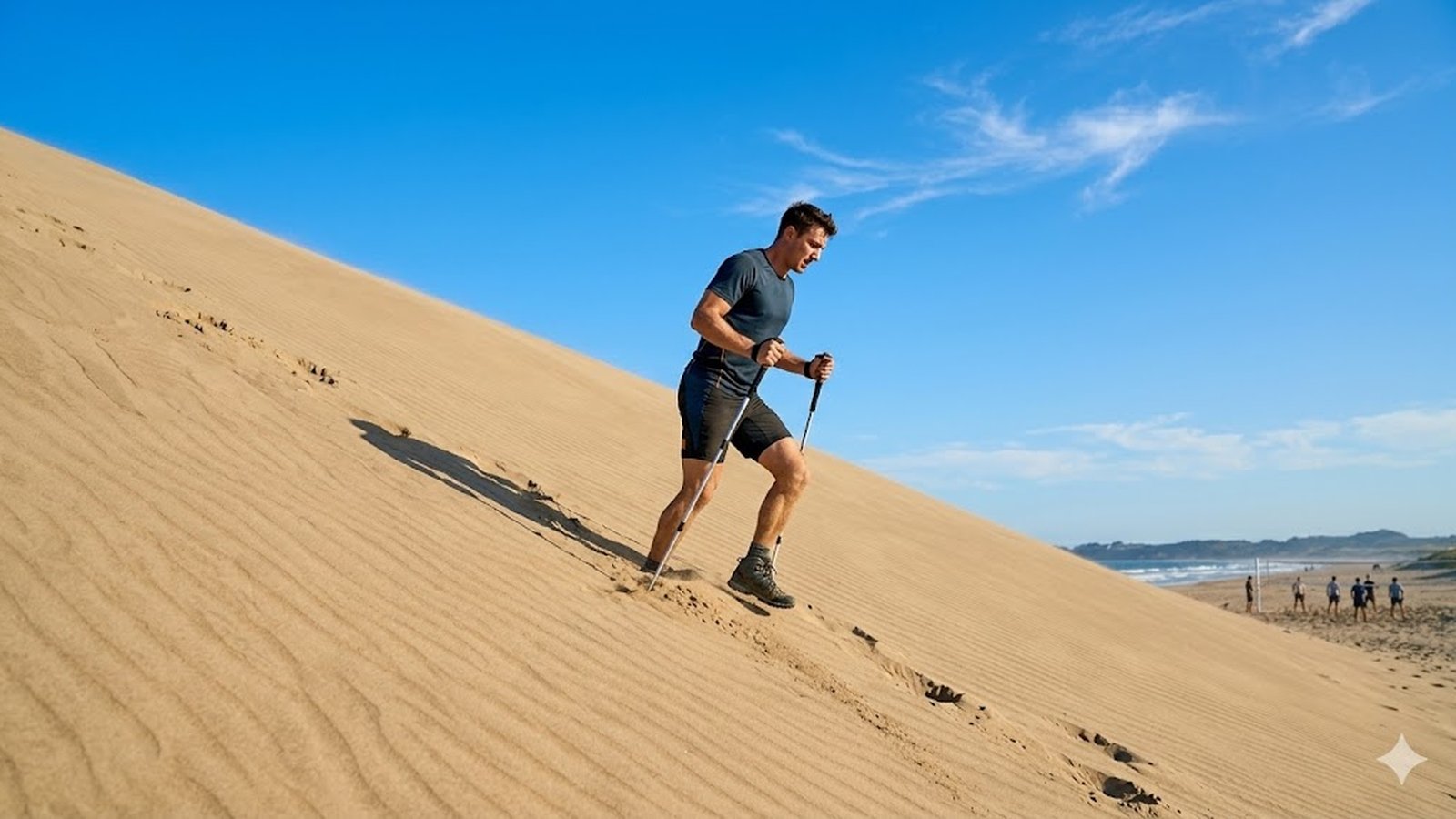
Running uphill recruits the gluteus maximus 40-60% more than running on flat ground, and adding a soft surface like sand amplifies the demand on stabilizers around the hip and ankle. The available evidence comes from controlled treadmill-incline studies Swanson 2000 and from sand-running energetics work Lejeune 1998. Wasaga Beach’s dunes are a legitimate posterior-chain stimulus, not just an Instagram backdrop. Caveats: the unstable surface raises ankle-sprain risk in unconditioned ankles, and the energy cost is roughly 1.6× flat sand running, so distances should be scaled down accordingly.
What the evidence actually says
The cleanest electromyography work on incline running comes from Swanson and Caldwell, who measured surface EMG of the major lower-limb muscles across treadmill grades from level to 30%. Gluteus maximus activation rose progressively with grade, more than doubling at 30% incline compared to flat Swanson 2000. The change is biomechanical: as the body angles forward against gravity, the hip extensors must produce more torque per stride to drive the body up.
Sand adds a second layer. Lejeune and colleagues compared the metabolic cost of running on sand versus a hard surface in trained runners. Sand running cost 1.6× the metabolic energy of road running at the same speed, with most of the difference attributable to the work of stabilizing on a yielding substrate Lejeune 1998. A dune ascent therefore stacks two effects — gravitational work plus stabilizer recruitment — producing a stimulus closer to a heavy farmer-carry incline than a casual jog.
How it actually works
Three factors drive the dune-glute effect. First, the forward lean required to ascend a 25-35° sand grade shifts the line of action of the body’s centre of mass anterior to the hip joint, requiring sustained gluteus maximus contraction throughout the stride Roberts 2017. Second, the soft surface deforms under load, dispersing the elastic energy that would normally return through the Achilles tendon, so propulsion must come from concentric muscular work rather than tendon recoil Pinnington 2005. Third, the medial and lateral stabilizers of the hip and ankle work continuously to maintain alignment on a constantly changing surface. The cumulative effect is that a 50-metre dune ascent recruits the posterior chain at intensities normally requiring weighted lunges or step-ups in a gym setting.
“Running on sand resulted in a 1.6-fold increase in the energy cost of locomotion compared to running on a hard surface at the same speed.”
— Lejeune, Willems & Heglund, Journal of Experimental Biology, 1998 view source
The caveats people skip
Two contraindications matter for the Wasaga reader. First, the unstable surface dramatically raises the demand on ankle and knee stabilizers; runners with previous lateral ankle sprains or unrehabilitated ACL injuries should rebuild proprioception on flat sand before attempting dunes Witchalls 2012. Second, the elevated metabolic cost means heart-rate response will be 20-30 beats per minute higher than equivalent flat-ground effort, which matters for anyone with cardiovascular conditions or who is heat-acclimatising on a warm Wasaga summer day.
The marketing claim that dune running “burns 50% more calories” than regular running is roughly accurate per minute but conceals the fact that you cannot sustain dune work for the same duration as flat running. Total session calorie expenditure usually comes out similar; the value of dunes is the localised glute and hamstring stimulus, not aggregate calorie burn.
Practical takeaways
- Start with 4-6 ascents of a 30-50 metre dune, walking back down. The descent is the recovery; do not try to run down a soft sand grade with unconditioned ankles.
- Build to 10-12 ascents over 4-6 weeks. The posterior chain adapts faster than the connective tissue around the ankle; respect the slower link.
- Wear minimal-tread shoes or train barefoot once your feet are conditioned. Aggressive lugs trap sand and shift the foot strike inefficiently.
- Hydrate at 1.5× your normal flat-running rate in summer heat. The metabolic cost is up, the ambient temperature on south-facing dunes is up, and breeze-driven evaporation hides the sweat loss.
- Skip dunes if you have unrehabilitated ankle or knee injuries. The stabilizer demand that makes dunes effective is the same demand that re-injures vulnerable joints.
References
Swanson 2000Swanson SC, Caldwell GE. An integrated biomechanical analysis of high speed incline and level treadmill running. Medicine & Science in Sports & Exercise. 2000;32(6):1146-1155. View source →Lejeune 1998Lejeune TM, Willems PA, Heglund NC. Mechanics and energetics of human locomotion on sand. Journal of Experimental Biology. 1998;201(Pt 13):2071-2080. View source →Roberts 2017Roberts TJ. Contribution of elastic tissues to the mechanics and energetics of muscle function during movement. Journal of Experimental Biology. 2016;219(Pt 2):266-275. View source →Pinnington 2005Pinnington HC, Lloyd DG, Besier TF, Dawson B. Kinematic and electromyography analysis of submaximal differences running on a firm surface compared with soft, dry sand. European Journal of Applied Physiology. 2005;94(3):242-253. View source →Witchalls 2012Witchalls J, Blanch P, Waddington G, Adams R. Intrinsic functional deficits associated with increased risk of ankle injuries: a systematic review with meta-analysis. British Journal of Sports Medicine. 2012;46(7):515-523. View source →