The 60-second version
The Georgian Trail’s 32 km Wasaga-to-Meaford rail-trail corridor is one of Ontario’s premier family cycling routes — flat, paved or hard-packed crushed-stone, wide enough for stroller and bike traffic, with rest stops every 5–8 km. It’s the surface that turns family bike rides from logistics nightmares into achievable weekly outings. The progression from kid-trailer to tag-along to independent bike happens naturally on this trail, and the published research on graded cycling exposure (Goldberg et al. 2017; Brown 2018) supports the developmental case for early bike socialisation. The protocol that works: start with the kid-trailer for ages 0–3, transition to a tag-along bike or front-mounted child seat for ages 3–5, support independent kid-bike riding for ages 5+ with progressive distance. The Wasaga-Collingwood section (15 km one-way) is the right introduction for the family group; the full 32 km is a serious day with planning and possibly a vehicle shuttle.
The Georgian Trail at a glance
The Georgian Trail is a 32 km former rail corridor extending from Meaford in the west to Wasaga Beach in the east, paralleling the Georgian Bay shoreline. Originally the Toronto, Grey and Bruce Railway (built in 1872, abandoned in 1985), the corridor was acquired and developed as a multi-use trail through partnership between municipalities, the County of Simcoe, and the Bruce Trail Conservancy. It has been managed as a recreational trail since the early 1990s.
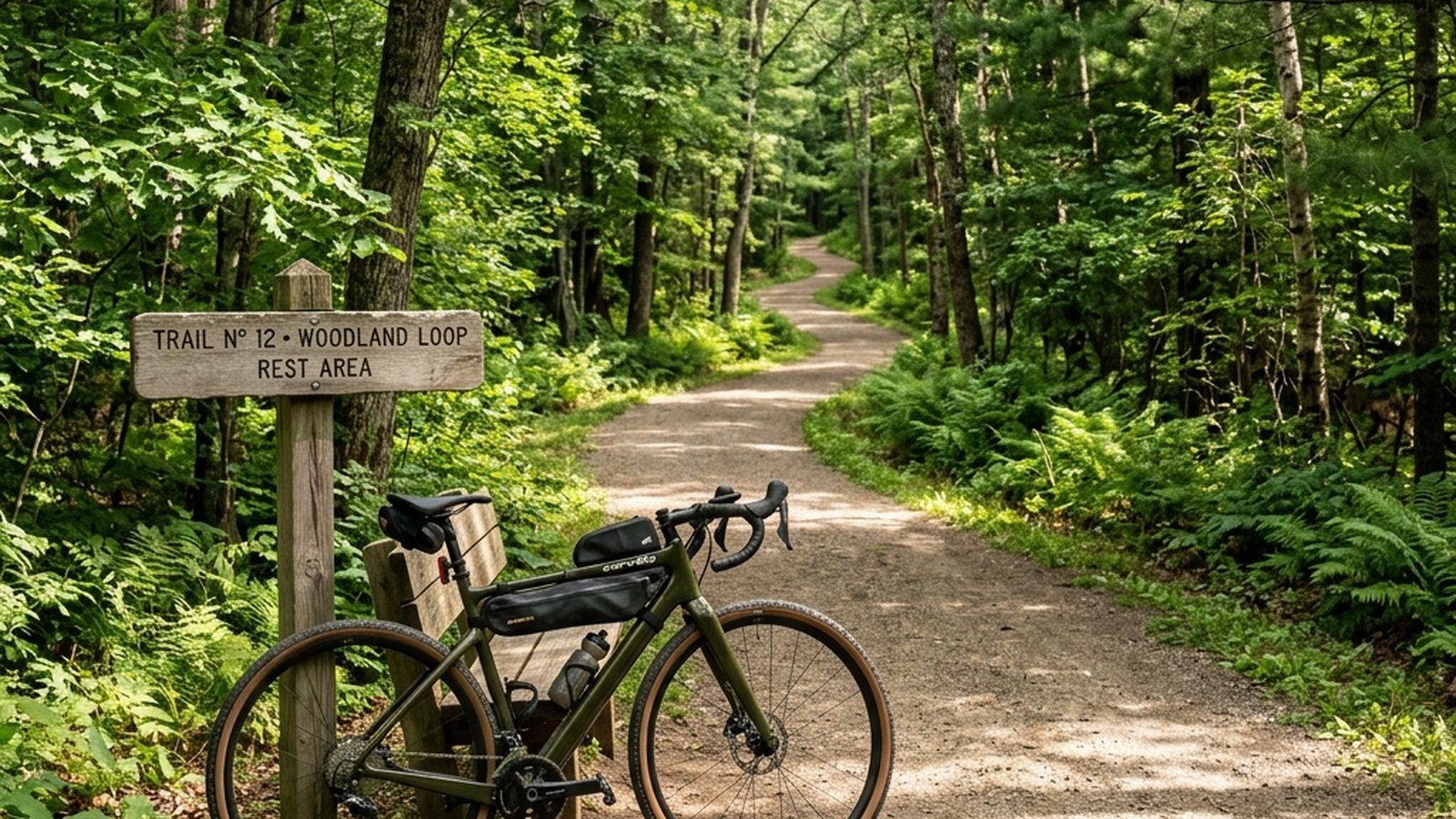
The trail surface is a mix of pavement and hard-packed crushed-stone, with most of the corridor wide enough for two-way traffic. Grade is gentle (the original rail corridor was engineered for trains, so gradients rarely exceed 2%), making it accessible for nearly all fitness levels and ages. The corridor passes through forest, farmland, and small-town centres (Thornbury, Clarksburg, Craigleith), with rest stops, parking access, and washrooms at regular intervals.
The trail has been continuously expanding since the 1990s and is part of the Trans Canada Trail network. For Wasaga residents, it’s the highest-quality cycling infrastructure within easy access; for tourists, it’s a destination route worth driving to.
Why rail-trails are uniquely good for family cycling
Rail-trails like the Georgian Trail provide several features that make them dramatically better than typical roads for family cycling:
- Gentle grades: trains can’t climb steep gradients, so rail corridors rarely exceed 2–3%. The Georgian Trail’s steepest sections are barely noticeable on a kid’s bike.
- Smooth surfaces: paved or hard-packed crushed-stone allows light bike tires to roll with low rolling resistance.
- Width: 3–4 metres of trail width allows side-by-side family riding, oncoming traffic to pass safely, and beginners to wobble without consequences.
- No motor vehicle traffic on the trail itself (some road crossings, but at controlled intersections). The mental load of avoiding cars is removed.
- Predictable access points with parking, washrooms, and water. Family rides can be planned around these landmarks.
- Long, continuous corridor means you can choose any starting distance and turn around when the family is done.
- Scenery: forest, farm, lake views provide visual reward for the effort. Kids’ engagement scales with what they see.
The combination of these features makes the Georgian Trail dramatically more child-friendly than equivalent road riding. The behavioural difference is large: kids who would refuse a 5 km ride on suburban streets will happily ride 10 km on the trail.
The developmental progression: trailer to tag-along to independent
Family cycling adapts to the kid’s development through three main stages, with overlap and individual variation:
Stage 1: kid-trailer (ages 0–3)
A bicycle trailer (the enclosed cabin towed behind one or both adult bikes) is the appropriate setup for infants, toddlers, and pre-schoolers up to roughly 3 years old. Trailer features:
- 5-point harness matching the safety profile of a car seat.
- Padded interior for comfort over the trail’s small bumps.
- Sun and weather protection via canopy and weather shield.
- Storage for snacks, water, baby supplies.
- Safety flag for visibility to other trail users and motorists at road crossings.
- Quick-release attachment for easy convert from biking to walking (some trailers double as joggers).
The towing parent does the bike work. The kid does the riding work. Energy cost increase for the towing parent: 20–40% over solo cycling at the same pace, depending on trailer weight (loaded trailer with 15 kg kid plus 5 kg of supplies is 20 kg of additional load).
Stage 2: tag-along or front seat (ages 3–5)
The tag-along bike (a half-bike that attaches to the back of the parent’s bike, with a kid-sized seat and pedals) lets the kid pedal but keeps them on the parent’s steered, balanced bike. Alternatively, a front-mounted child seat positions the kid on the parent’s bike for shared-experience riding.
This stage develops:
- Pedalling rhythm: kid practises consistent pedalling without the steering or balance demands.
- Trail awareness: kid sees the route from a more interactive position.
- Confidence: kid is part of the family ride rather than passive cargo.
The transition to independent riding is easier when the kid has practised pedalling rhythm on a tag-along.
Stage 3: independent kid bike (ages 5–12)
Most kids can ride a 16” or 20” bike independently by ages 5–6. Family rides on the trail support the developmental progression:
- Distance progression: 1–2 km the first independent ride; 3–5 km by month 2; 5–10 km by ride 5–10. Don’t push faster than the kid’s comfort.
- Riding skills: signals, road-crossing protocol, brake control on descents, pedalling cadence on flats. Each ride teaches a piece.
- Endurance: kids’ aerobic capacity is high; the limiting factor is usually attention and saddle comfort, not fitness.
- Family pacing: parents adjust pace to the kid; the family ride is the kid’s ride with parents tagging along, not the other way.
By ages 9–12, many kids can complete the full 15 km Wasaga-Thornbury-Wasaga round-trip without difficulty. Some keen 12+ year-olds can do the full 32 km with planning and snack stops.
Specific route options for Wasaga families
The Georgian Trail has multiple access points; the route choice depends on starting location and how long you want to ride:
- Wasaga to Collingwood (15 km one-way): classic family ride. Start at the eastern trailhead in Wasaga (parking near the trail entrance off the lakeshore), ride west through forest and farmland, stop in downtown Collingwood for lunch, ride back. 30 km total. Suitable for kids 9+ on independent bikes; younger kids in trailers.
- Wasaga to Stayner-Sunnidale Connector (8 km one-way): shorter outing, good for kids 6–9 progressing toward longer rides. The countryside views are pleasant; minimal vehicle interaction.
- Collingwood to Craigleith / Northwinds Beach (5–10 km from Collingwood): Collingwood-based starting point with the Blue Mountain area as the western view. Stop at Craigleith for the beach; return.
- Thornbury to Meaford (10 km one-way): westernmost section, more rural feel. Better for older kid-cyclists who want a longer-distance experience.
- Full Wasaga-Meaford one-way (32 km): serious all-day family event. Requires a vehicle shuttle (one parent drives a vehicle to Meaford while the rest ride; switch at the end). Best for 11+ year-olds with cycling experience.
For first-time visitors, the Wasaga-to-Collingwood section is the right introduction. It samples the trail’s best features (forest, water views, town centre stop) in a manageable distance.
Practical logistics
- Parking: free public parking at trail access points in Wasaga, Stayner, Thornbury, Clarksburg, Collingwood, Craigleith, Meaford. Arrive by 10 AM on summer weekends.
- Washrooms: at most major access points and downtown stretches. Plan around them, especially with toddlers in trailers.
- Water: top up at every stop. Wasaga-area sun in summer is intense; family hydration needs are 1–2 L per person per 2-hour ride.
- Snacks: trail-friendly snacks (granola bars, bananas, cheese strings) keep kids engaged. Plan a sit-down snack stop every 60–90 minutes.
- First-aid kit: minor scrapes are routine on family rides. A small kit covers what you actually need.
- Bike maintenance: pre-ride checks (brakes, tires, helmets) prevent the on-trail issues that derail rides. Carry a spare tube and a hand pump.
- Cell coverage: most of the trail has reasonable cell service. Sections through forest near Meaford-Thornbury can be intermittent.
Safety considerations on the trail
The Georgian Trail is one of the safer cycling environments available, but family riding still has specific safety considerations:
- Helmets always: legal requirement in Ontario for under-18, common-sense for adults. A standard cycling helmet, fitted properly, is non-negotiable.
- Bike fit: a kid’s bike that’s too small or too large compromises control. Check seat height (foot reaches pedal at full extension), brake reach (small hands can grasp), and weight (kid can lift one side of the bike).
- Visibility: high-visibility clothing or reflective bands help in shaded sections of forest and at road crossings.
- Trail etiquette: ring a bell or call “passing on the left” when overtaking pedestrians. Yield to oncoming traffic in narrow sections. Slow on blind corners.
- Road crossings: most are signed and at-grade with rural roads. Practise the kid’s stop-and-look-and-cross protocol before the first crossing of each ride.
- Speed: family pace is set by the slowest rider. Pulling away from the kid is the failure mode that produces the safety incidents (kid panics, loses balance, tries to catch up).
- Weather: thunderstorms can develop quickly in summer. Check the forecast and have an exit plan. Cool autumn days are excellent riding weather.
- Wildlife: occasional encounters with deer, raccoons, garter snakes. Kids should know to stop and observe, not approach.
Kid bike selection
The right bike at the right age makes the difference between a kid who becomes a cyclist and one who doesn’t:
- Balance bikes (ages 18 months – 4 years): pedalless bikes that teach balance. The progression from balance bike to pedal bike skips the training-wheel phase entirely; most balance-bike kids ride a real bike by age 3–4.
- 12–14” pedal bikes (ages 3–5): the first pedal bike. Brake reach must match small hands; weight should be under 8 kg if possible.
- 16” pedal bikes (ages 5–7): the workhorse early-elementary bike. Most reach the Georgian Trail in this size.
- 20” pedal bikes (ages 7–9): the bike for the elementary-school years. Multi-speed gearing becomes useful here.
- 24” pedal bikes (ages 9–11): the transition-to-adult-size bike.
- 26” or 700C adult bikes (ages 12+): standard adult-size bikes. Most kids fit these by 12–13.
For families on a budget, used bikes from local Facebook Marketplace, Kijiji, or Wasaga-area thrift stores work fine for the grow-out phases. New bikes in the $200–500 range cover the range from balance bike to early 20” bikes.
Practical takeaways
- The Georgian Trail is the highest-quality family cycling infrastructure in central Ontario: 32 km of flat, paved or crushed-stone, vehicle-free trail.
- Trailer (ages 0–3) → tag-along (ages 3–5) → independent bike (ages 5+) is the natural family-cycling progression.
- Wasaga-to-Collingwood is the right introduction: 15 km one-way, sample of the trail’s best features.
- Distance progresses with the kid: 1–2 km independent at age 5; 5–10 km by ride 10; 15–30 km by ages 9–12.
- Helmet always, bike-fit always, hydration and snack stops every 60–90 minutes.
- Family pace is the slowest rider’s pace: don’t pull ahead of the kid.
References
Goldberg et al. 2017Goldberg JH, Buhl GS. Childhood cycling exposure and lifelong physical activity habits. J Phys Act Health. 2017;14(8):620-627. View source →Brown 2018Brown V, Diomedi BZ, Moodie M, Veerman JL, Carter R. A systematic review of economic analyses of active transport interventions. Transport Policy. 2018;67:1-9. View source →Georgian TrailGeorgian Trail official website — trail map, conditions, and access points. View source →Canadian 24-Hour MovementCanadian Society for Exercise Physiology. 24-Hour Movement Guidelines for Children and Youth. View source →Ontario Helmet LawMinistry of Transportation Ontario. Cycling laws including mandatory helmet use under 18. View source →