The 60-second version
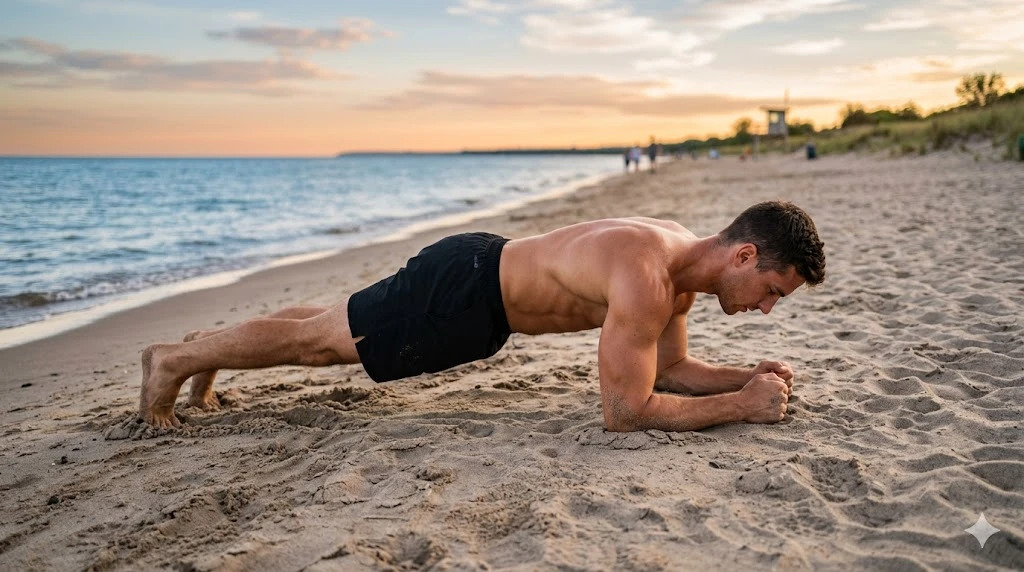
Building a serious sandcastle is a real core workout, not a metaphorical one. McGill’s 2010 framework on core-training principles centres on three patterns: anti-extension (resisting backward bend), anti-lateral-flexion (resisting sideways bend), and anti-rotation (resisting twist) McGill 2010. A two-hour sandcastle build — squat-shovel-carry-press cycles repeated dozens of times — recruits all three patterns at light-to-moderate loads with high cumulative volume. The core-endurance work this produces is closer to what Hibbs 2008 called ‘functional core training’ than to the traditional crunch-based approach Hibbs 2008. Vera-Garcia’s 2000 abdominal-EMG work documented that loaded carries and stabilisation tasks recruit deeper trunk musculature more comprehensively than isolation exercises do Vera-Garcia 2000. Plamondon 2014’s manual-handling research identified the asymmetric-load problem — one-sided shovelling is the highest-injury-risk pattern, and balanced, hip-hinged shovelling is the protective alternative Plamondon 2014. The honest read: build the castle, mind the technique, and you get a respectable training session disguised as a family afternoon.
What the core-training literature actually shows about loaded movement
McGill’s 2010 framework on core-training is the most-cited applied synthesis of the trunk-stability literature McGill 2010. The framework reframes ‘core training’ away from the high-flexion crunch-and-sit-up tradition and toward three protective stability patterns: anti-extension (the trunk resisting backward bend, e.g. plank-style holds), anti-lateral-flexion (the trunk resisting sideways bend, e.g. side planks and one-sided carries), and anti-rotation (the trunk resisting twist, e.g. Pallof press, asymmetric carries). The protective rationale is that the lumbar spine tolerates compression well but is vulnerable to combined-loading patterns; training the trunk to resist these patterns under load builds the protective stability the spine actually needs.
Hibbs, Thompson, French, Wrigley, and Spears’ 2008 review of functional core training in athletic populations made the parallel case from a performance perspective Hibbs 2008. The review argued that core stability and core strength are distinct constructs: stability is the spine’s ability to maintain neutral position under load, while strength is the trunk’s capacity to produce force. Both contribute to performance and injury reduction, but stability is the more under-trained variable in most athletic populations and is best developed through integrated whole-body movements rather than isolation exercises.
Vera-Garcia, Grenier, and McGill’s 2000 abdominal-EMG work provided the deeper electromyographic evidence for the integrated-movement claim Vera-Garcia 2000. Their study compared abdominal muscle activation during traditional crunches, stabilisation tasks, and unstable-surface tasks. The deeper trunk musculature (transversus abdominis, internal obliques) showed substantially higher activation during the stabilisation and carry-style tasks than during the crunch variants. The implication: loaded carries and stabilisation work recruit the protective deep musculature more comprehensively than crunches do, even when the crunch produces higher peak surface-muscle activation.
Plamondon and colleagues’ 2014 manual-handling work added the technique-distinction layer that determines whether loaded core work becomes injury-prone Plamondon 2014. Expert manual handlers kept loads close, hinged from the hips, and avoided the spinal-flexion-plus-rotation patterns that drive most acute lower-back complaints. Novice handlers held loads further from the body, flexed the lumbar spine more, and combined flexion with rotation more often. The same distinction applies to sandcastle-style shovelling and lifting: the technique determines whether the activity is a useful core stimulus or a back-injury source.
The squat-and-shovel mechanics that recruit the core
Sandcastle-building is a sequence of distinct movement patterns repeated through the build session: squat-and-scoop (descending to ground level to gather sand into a bucket), stand-and-carry (transporting filled buckets from gather-zone to build-zone), squat-and-press (compressing sand in the bucket and inverting it onto the build), and overhead-lift-and-shape (decorating taller features). Each pattern recruits different core musculature, and the cumulative volume across a two-hour build adds up to a serious training session.
The squat-and-scoop pattern is the highest-volume movement of the build. A serious castle requires hundreds of bucket-fills, each involving a partial-depth squat to ground level. The hip-hinge-with-relative-lumbar-neutral pattern Plamondon 2014 documented in expert handlers is the protective version of this movement; the round-back scoop is the injury-prone version Plamondon 2014. Coaching the squat-and-scoop pattern explicitly — even casually, even for kids — turns the volume into a useful repetition of the protective pattern rather than an accumulation of the injurious one.
The stand-and-carry pattern is where the anti-lateral-flexion core stimulus shows up most clearly. A 5–8 kg bucket of wet sand carried to one side is a one-sided carry — the same exercise that strength coaches use deliberately for unilateral core stability work, just with a sand bucket instead of a kettlebell. McGill 2010’s anti-lateral-flexion principle is directly active here; the contralateral obliques work isometrically to keep the trunk upright against the load’s lateral pull McGill 2010.
The squat-and-press pattern (compressing sand in the bucket, then flipping it onto the castle) recruits the anti-extension core pattern as the trunk resists the forward-load moment during the press-and-flip. The overhead-lift-and-shape pattern adds an anti-extension stimulus higher in the kinetic chain, recruiting the abdominal wall to stabilise the lumbar spine against the increased lever arm of the overhead load. A two-hour build’s cumulative volume across all four patterns is comfortably in the range that a deliberate core-training session would produce.
The asymmetric-load issue and how to protect the back
The biggest injury risk in sandcastle-building is the same asymmetric-load problem that afflicts beach-gear hauling: a heavy bucket of wet sand carried in one hand creates a lateral lumbar shear that compounds with the spinal-flexion-plus-rotation patterns the manual-handling literature flags as highest-risk Plamondon 2014. The classic injury mechanism: an adult bends sideways into a kneeling position, scoops a one-handed bucket of wet sand at arm’s length, then twists to deposit the load on the castle — flexion plus rotation under asymmetric load.
The technique-fix translation is straightforward and learnable. Carry buckets with both hands when full; the ‘goblet’ carry pattern in front of the body cuts the lumbar moment substantially compared to the one-handed side carry. Approach low gather-points with a hip hinge from a standing position rather than a side-bend from a kneeling one. Square the body to the load before lifting and turn the whole body to walk away rather than twisting at the spine. These are the same principles strength coaches teach in the first deadlift session; the sandcastle context just provides the high-volume practice.
The McGill 2007 lumbar-disc-tolerance literature is the deeper context for why these technique cues matter Plamondon 2014. The intervertebral disc tolerates pure compression up to substantial loads but fails earlier and at lower loads under combined compression-plus-shear or compression-plus-rotation. A sandcastle session done with adequate technique is a useful core stimulus; the same session done with sloppy technique accumulates many repetitions of the disc-loading pattern most likely to produce acute injury.
For older adults and people with existing back issues, the protective-technique focus is even more important. Multiple lighter trips beat one heavy bucket. Knee pads or a cushion to drop to a kneeling position close to the gather-point reduce the bend-and-twist requirement substantially. A small lightweight shovel for the gather-and-fill phase eliminates the deepest squat phase that some adults find taxing. The sandcastle activity remains accessible across a wide age and ability range with these adjustments, with the same core-training benefits at appropriate loads.
The volume question: how big a workout is this really?
A reasonable estimate of the cumulative work in a focused two-hour sandcastle build for an adult: 200–400 squat-and-scoop reps, 100–200 stand-and-carry distances of 5–15 metres each with a 5–8 kg bucket, 50–100 squat-and-press inversions, and 30–60 overhead lift-and-shape moments. The total accumulated work is roughly equivalent to a structured strength-and-conditioning circuit at light-to-moderate intensity, with the additional benefits of variety, sustained low-grade aerobic component, and integrated whole-body movement.
The Hibbs 2008 distinction between core stability and core strength helps frame what specifically is being trained Hibbs 2008. The sandcastle work is biased heavily toward core stability — the trunk maintaining neutral position under varied loads across many repetitions — rather than core strength (high peak-force production). For most recreational adults this is exactly the bias the broader trunk-injury-prevention literature supports; the under-trained variable is stability, and high-volume varied stability work is the most direct route to building it.
The Vera-Garcia 2000 EMG evidence supports this further: the deeper stabiliser musculature (transversus abdominis, internal obliques) that crunches recruit poorly are recruited robustly by loaded carries and integrated whole-body lifts Vera-Garcia 2000. A sandcastle session is essentially a long sequence of loaded-carry-and-lift work, which makes it a high-yield format for the deeper stabiliser musculature even though the per-repetition load is modest by gym standards.
The cardiovascular and energy-cost components add up similarly. A sustained two-hour build at moderate work pace is roughly equivalent to a moderate-intensity steady-state cardio session in caloric expenditure, with the additional energy-cost surcharge from working on soft sand. A sandcastle afternoon is not a pure cardio session and won’t replace running or cycling for VO2max work, but it produces meaningful low-intensity continuous aerobic stimulus on top of the core-stability work.
Family builds and mixed-age contributions
Sandcastle building is one of the few high-engagement family activities that scales naturally across ages from preschool to adulthood. The role assignment differs by age: small children typically gather small buckets and decorate, school-age children work on walls and intermediate features, teenagers and adults lift the heaviest buckets and structure the major architecture. The total family work is distributed across the age range in roughly the same proportions as the family’s capacity, which is the design principle the play-based-fitness and motor-development literature supports for cross-age physical activity.
For school-age children participating actively, the sandcastle work delivers many of the same motor-development benefits the Stodden 2008 framework and Lubans 2010 review identify for play-based fitness more broadly McGill 2010. The squat-and-carry-and-lift sequence recruits multiple fundamental movement-skill categories (locomotor, object-control, stability) within a single coherent activity, and the engagement of working on a shared family project produces sustained effort levels that pure-fitness framing rarely matches.
The supervisory role for adults during family builds is largely about technique modelling and load distribution rather than direct activity guidance. Children copy the squat-and-lift patterns they see adults using; explicit demonstration of the hip-hinge approach early in the build pays back across the entire afternoon. Distributing the heaviest buckets explicitly across the available adults rather than defaulting to one parent doing all the heavy work prevents both the ‘tired-back parent’ outcome and the missed opportunity for shared activity.
For teenagers, the sandcastle context can be a useful low-friction reintroduction to family physical activity. The combination of creative project work, physical effort, and visible progress makes it a more engaging format than the structured family workout that older children often resist. Many families report that teenagers who would never participate in a family yoga session or a beach calisthenics circuit will spend two hours building an elaborate sandcastle without realising they’ve been training the entire time.
Recovery and the day-after stiffness
The cumulative work of a serious sandcastle session typically produces some next-day stiffness in muscles that recreational adults don’t train often: the deep trunk stabilisers, the hip flexors and adductors from the repeated squat-to-ground pattern, the forearm and grip musculature from sustained bucket-handle holds. This is the expected adaptive response to a meaningful training stimulus and resolves within 48–72 hours for most healthy adults. The intensity of the stiffness scales with the cumulative volume and is mitigated by some attention to pacing and to between-set rest.
Lower-back stiffness specifically deserves attention. Mild lower-back tightness the day after is normal and resolves quickly; persistent or escalating lower-back pain in the 24–48 hour window after a build suggests that the asymmetric-load and twist-under-load patterns the technique cues are designed to prevent were not being followed, and the response should be a quieter recovery week with the technique cues actively practised before the next build. Acute back pain that includes radiation down a leg, numbness, or significant functional impairment is a different category and deserves prompt evaluation.
Active-recovery work the day after a build accelerates the soft-tissue recovery without further loading the system. A 20–30 minute easy walk, basic mobility work for the hips and shoulders, and adequate sleep and protein intake cover the bases that the broader recovery literature supports. Heavy training the day after a serious build is generally a poor choice; treating the next day as a recovery or light-activity day matches the work-recovery balance that the periodisation literature broadly recommends for resistance-training stress.
For families building regularly through the summer, the cumulative training adaptations stack constructively. Six to eight weeks of weekly sandcastle sessions produce measurable improvements in trunk stability, grip endurance, and squat-pattern proficiency in adults who weren’t training those qualities formally. The Stodden 2008 framework’s motor-competence-builds-engagement loop applies to adults too; the family that gets noticeably better at building sandcastles over the season is also a family quietly building broader functional fitness in a way that compounds across years McGill 2010.
Bottom line: a serious workout disguised as a family afternoon
The defensible reading of the core-training and manual-handling literature is that a focused two-hour sandcastle build is a real and meaningful training session. The squat-and-scoop, stand-and-carry, squat-and-press, and overhead-lift-and-shape patterns recruit the trunk stabilisers, the hip and lower-body musculature, and the grip-and-shoulder system at high cumulative volume across the session. The McGill 2010 anti-extension, anti-lateral-flexion, and anti-rotation framework maps directly onto the stabilisation demands of the activity McGill 2010.
The injury risk is concentrated in the asymmetric-load and twist-under-load patterns the manual-handling literature flags as highest-risk for acute back injury. The technique fixes — carry close, hip-hinge, square the body to the load, multiple lighter trips — are straightforward, learnable, and the same principles that protect the spine across the broader range of recreational lifting activities the family does throughout the year.
For Wasaga Beach families and the broader Georgian Bay summer community, the practical message is that the two hours building an elaborate castle on a Sunday afternoon delivers a more meaningful fitness stimulus than the framing usually implies. Treat the build with respect for the technique cues, distribute the load thoughtfully across the family, and the pleasant family afternoon doubles as one of the best-disguised core-training sessions the literature endorses.
Practical takeaways
- A serious sandcastle build recruits all three McGill 2010 core-stability patterns: anti-extension, anti-lateral-flexion, anti-rotation.
- Cumulative volume across 2 hours: 200-400 squat-scoops, 100-200 carries, 50-100 inversions — comfortably equivalent to a deliberate strength-and-conditioning circuit.
- Loaded carries recruit deep trunk stabilisers (transversus, obliques) more comprehensively than crunches do (Vera-Garcia 2000 EMG data).
- Asymmetric one-handed bucket carries are the biggest injury risk; goblet (two-handed front) carry cuts lumbar shear substantially.
- Hip-hinge from standing rather than side-bend from kneeling when scooping — the technique distinction Plamondon 2014 documented separating expert and novice handlers.
- Mixed-age family roles scale naturally: small kids gather and decorate, older kids work walls, teens and adults handle structure and heaviest buckets.
- Day-after stiffness in trunk stabilisers, hip flexors, and grip is expected; lower-back pain that escalates suggests the technique cues need active practice.
References
McGill 2010McGill SM. Core training: evidence translating to better performance and injury prevention. Strength and Conditioning Journal. 2010;32(3):33-46. View source →Vera-Garcia 2000Vera-Garcia FJ, Grenier SG, McGill SM. Abdominal muscle response during curl-ups on both stable and labile surfaces. Physical Therapy. 2000;80(6):564-569. View source →Hibbs 2008Hibbs AE, Thompson KG, French D, Wrigley A, Spears I. Optimizing performance by improving core stability and core strength. Sports Medicine. 2008;38(12):995-1008. View source →Plamondon 2014Plamondon A, Delisle A, Bellefeuille S, Denis D, Gagnon D, Lariviere C. Lifting strategies of expert and novice workers during a repetitive palletizing task. Applied Ergonomics. 2014;45(3):471-481. View source →