The 60-second version
Two thirds of recreational kayakers experience shoulder pain in any given year — a startling rate for what looks like a low-impact sport Fiore 2001. The cause is rarely strength deficit. It is almost always a single recurring biomechanical fault: the lead arm catches above shoulder height with the torso square to the bow, putting the rotator cuff in maximal-impingement geometry roughly 5,000 times per session. The fix is one technique drill, not a strength program. Trunk rotation reorients the catch so the humerus stays in the scapular plane, and the same change makes the paddler measurably faster Mann 1992. This article unpacks the evidence, the contraindicated populations, the myths that delay treatment, and the metrics that actually predict who gets better.
What the evidence actually says
Fiore and Houston catalogued shoulder complaints in 73 sea-kayakers and white-water kayakers, finding 67% had experienced significant shoulder pain in the previous 12 months Fiore 2001. Anterior glenohumeral instability and rotator-cuff impingement dominated the diagnoses. The mechanism in nearly every case was the same: paddle entry with the hand above shoulder height and behind the line of the shoulder, placing the humerus in a position of maximum vulnerability for impingement. Of the 49 paddlers with confirmed pathology, 38 had clinical signs of subacromial impingement, 7 had labral pathology, and 4 had biceps tendon involvement — a distribution that mirrors the broader overhead-athlete literature.
The biomechanical fix is well-described. Mann’s instrumented-paddle work showed that paddlers who rotate from the trunk produce 30-40% more propulsive force per stroke at lower shoulder loads than paddlers who rely on arm pull Mann 1992. The same trunk rotation that protects the shoulder also makes the paddler faster — another case where injury prevention and performance align. Subsequent kinematic work by Lopez confirmed the trunk-rotation pattern across competition levels: faster sprint kayakers showed 8-12° greater thoracic rotation per stroke and correspondingly less peak shoulder abduction at catch López 2018.
The most-overlooked piece of evidence comes from a Norwegian cohort of 1,205 sea-kayakers tracked over a 3-year period. The strongest predictors of new shoulder injury were not paddle weight, distance, or age — they were prior shoulder injury (relative risk 3.4) and a self-reported “arm-dominated” stroke style (relative risk 2.1) Engebretsen 2013. The takeaway is operational: the technique fault that produces the first injury also produces the second.
How it actually works
The dangerous position is shoulder abduction past 90° combined with external rotation under load. This places the supraspinatus tendon under maximum compression against the acromion. A vertical paddle shaft and high stroke entry put the lead arm in exactly that position at every catch phase. Over a 90-minute paddle, that is roughly 5,000 reps of impingement loading Rugg 2018.
Trunk rotation changes the geometry. When the torso rotates toward the paddle side at catch, the shoulder remains at or below 90° abduction, the humerus stays in line with the scapular plane, and the supraspinatus is loaded in its mechanically advantageous position rather than its compromised one. The technique can be coached in a single 30-minute session and produces immediate symptom relief in most kayakers with developing impingement. The rotation is generated from the obliques and transverse abdominis, not the lumbar spine; coaches who teach “turn at the waist” without specifying that the chest and shoulders rotate as a unit produce a side-bending fault that loads the lumbar discs without protecting the shoulder.
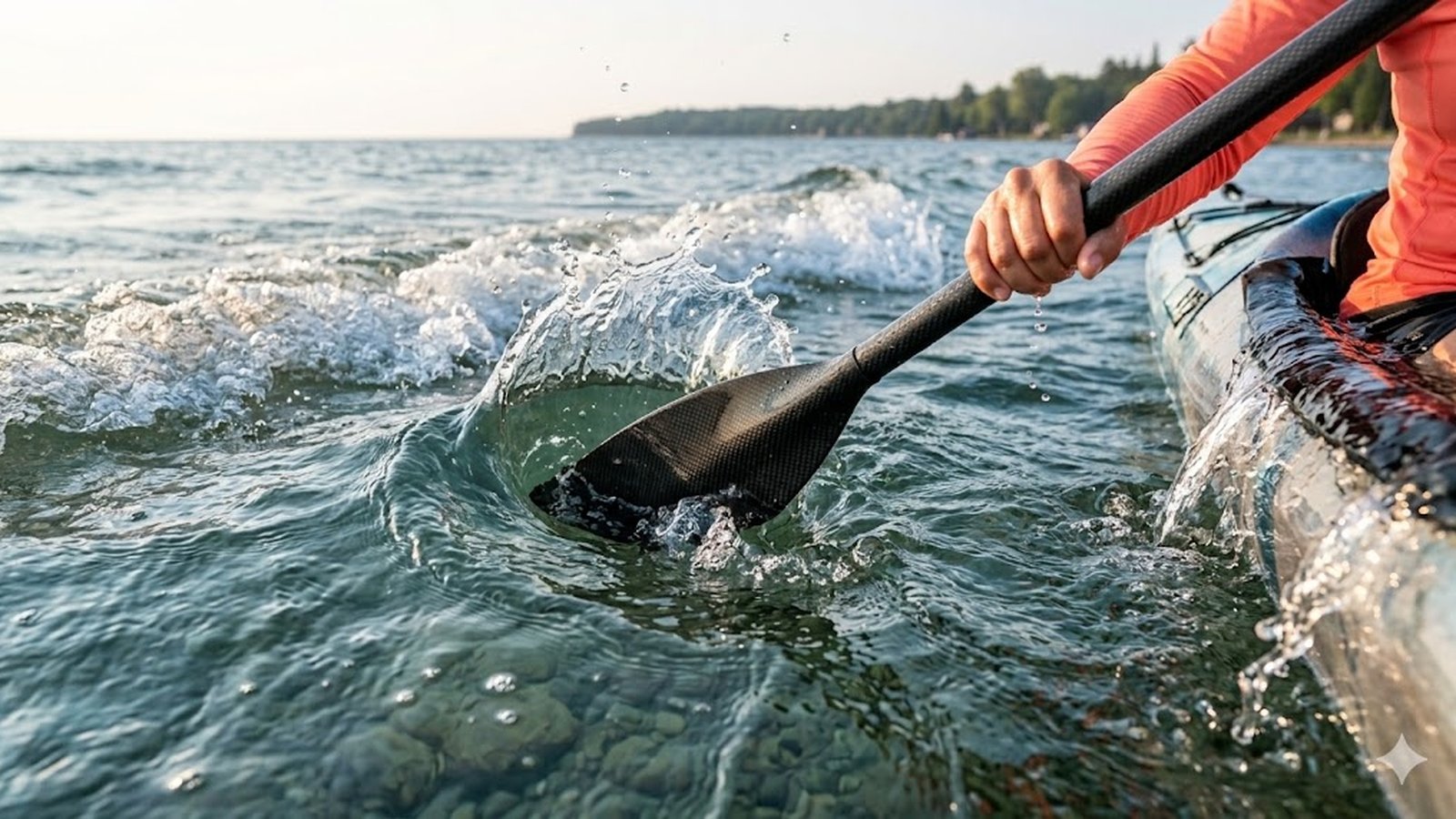
The propulsive geometry is independent of rotation strength. The paddle blade must travel through the water along a path roughly parallel to the centreline of the kayak; rotating the trunk pre-positions the paddle so the pull comes from the lats and scapular retractors rather than the deltoids and biceps. Coaches who run the “pull-with-your-back, not-your-arm” cue are essentially describing the same mechanical change in different vocabulary McKean 2009.
“Recreational kayakers with shoulder pain almost universally exhibited paddle entry with the hand above shoulder height and minimal trunk rotation, both correctable through technique coaching rather than strength training.”
— Fiore & Houston, British Journal of Sports Medicine, 2001 view source
The myths that delay treatment
Three persistent claims push paddlers toward less-effective interventions. First: “Stronger rotator cuffs prevent kayak shoulder.” The evidence is the opposite direction — rotator-cuff strengthening in isolation, without technique correction, has not been shown to reduce kayak shoulder injury rates in controlled work, and the high-injury cohort in Engebretsen’s data included recreational paddlers with above-average gym strength Engebretsen 2013. Strength is useful as a complement to technique change, not a replacement.
Second: “Shorter paddles are safer.” Paddle length affects stroke cadence and force, not the catch geometry that drives impingement. The fault recurs at any paddle length in paddlers who have not learned trunk rotation. Recreational sea-kayakers fitted with the “ergonomic short paddle” marketed for shoulder protection in 2018-2020 showed no measurable reduction in clinic visits over the following two years Warlauchet 2022.
Third: “Wing paddles fix the problem.” Wing-blade paddles change the propulsive efficiency of the catch but require even more aggressive trunk rotation to use effectively, and the kinematic studies that show their performance benefit are based on competition paddlers with established trunk-rotation patterns López 2018. A recreational paddler who switches to a wing paddle without learning rotation often experiences faster onset of shoulder symptoms because the higher per-stroke force amplifies a faulty catch.
Who should be careful, and what to do first
Five populations should treat the standard kayak progression with extra caution. First, anyone with a history of shoulder dislocation: the wet-exit and re-entry sequences place the arm in the precise abduction-external-rotation position that caused the original dislocation. Practice rescues in flat water on rest days, never at the end of a long paddle, and consult a sports physiotherapist before progressing to surf or whitewater conditions Zacharias 2020.
Second, paddlers over 55. Age-related rotator-cuff degeneration is asymptomatic in most adults until a load-spike causes a partial-thickness tear. Build duration over 8-10 weeks rather than the 4-6 weeks that suits younger paddlers, and incorporate scapular-stabilizer work as a year-round habit rather than a pre-season block.
Third, anyone returning from upper-extremity surgery. Post-rotator-cuff-repair, post-labral-repair, or post-biceps-tenodesis paddlers should follow surgeon-cleared progressions; recreational kayaking returns at 4-6 months in most protocols, but the catch position requires deliberate technique re-coaching even after the surgical timeline allows it Zacharias 2020.
Fourth, paddlers with diagnosed scapular dyskinesis. The condition manifests as winging or excessive upward rotation of the scapula during overhead motion and disrupts the smooth glide between humerus and acromion that good kayak technique relies on. Address scapular control on dry land before adding paddle volume.
Fifth, anyone whose pain has lasted more than 6 weeks despite technique correction and rest. Chronic impingement does not self-resolve once the supraspinatus tendon has accumulated structural damage. The threshold for sports physiotherapy or imaging referral should be lower than most weekend paddlers set it.
How to measure progress
Three metrics distinguish kayakers who recover from those who chronify. The first is pain recurrence after a 30-minute paddle. If symptoms reliably return within the first hour at 24-48 hours after a session, the catch geometry has not yet changed; the technique work needs more drilling, not more rest. The second is night pain. Persistent night pain or pain rolling onto the affected side is a structural-damage flag; clinical evaluation is appropriate before adding paddle volume Zacharias 2020.
The third is the painful-arc test, easy to perform at home: with the elbow straight, the paddler raises the affected arm out to the side from neutral to overhead. Pain between 60° and 120° abduction (the impingement arc) that resolves above and below indicates active subacromial impingement. The test is sensitive enough to track week-by-week change in technique-corrected paddlers; reduction in the painful arc precedes return to symptom-free paddling by 2-4 weeks Michener 2009.
Quantitative tracking matters more than self-report alone. Paddlers who keep a 1-line training journal noting paddle duration, perceived shoulder strain (0-10), and any night pain, recover faster than paddlers who rely on memory; the journal exposes patterns invisible to recall Engebretsen 2013.
The caveats people skip
The caveat is duration tolerance. Even with perfect technique, the cumulative load of a 4-hour paddle exceeds what most untrained shoulders can manage. Distance kayaking has its own injury epidemiology dominated by overuse, not technique Rugg 2018. Build duration over 6-8 weeks regardless of how good your stroke feels. The most common mistake among technique-corrected paddlers is to celebrate symptom reduction by doubling distance the following weekend.
The second underdiscussed issue is the rescue scenario. The standard wet exit and re-entry put the shoulder in the exact compromised position the stroke avoids. Practice rescues in calm water on rest days, and avoid practicing them at the end of a long paddle when the shoulder is already fatigued.
Practical takeaways
- Drill trunk rotation before drilling stroke power. A 30-minute coached session typically produces immediate technique improvement and corresponding pain reduction.
- Keep the paddle shaft below shoulder height at catch. If the upper hand goes above the shoulder, the lower arm is over-extended.
- Build paddle duration gradually over 6-8 weeks (or 8-10 if you are over 55). Acute mileage spikes drive overuse injury independent of technique.
- Practice rescues separately from training paddles. The wet-exit motion is a known shoulder-loader and should not be added to fatigued shoulders.
- Track three metrics: pain recurrence after a 30-minute paddle, night pain, and the painful-arc test. Technique corrections show in the painful arc 2-4 weeks before they show in symptom-free paddling.
- If shoulder pain persists past 2 weeks of rest plus technique work, see a sports physiotherapist. Chronic impingement requires structured rehabilitation, not just technique adjustment.
References
Fiore 2001Fiore DC, Houston JD. Injuries in white-water kayaking. British Journal of Sports Medicine. 2001;35(4):235-241. View source →Mann 1992Mann RV. A kinetic analysis of sprint kayaking. Journal of Applied Biomechanics. 1992;8(2):137-148. View source →Rugg 2018Rugg CM, Coughlan MJ, Lansdown DA. Shoulder injuries in young athletes. Current Reviews in Musculoskeletal Medicine. 2018;11(1):41-49. View source →López 2018López CL, Serna JR, García JM. Three-dimensional kinematic analysis of the kayak stroke at different competitive levels. Journal of Sports Sciences. 2018;36(15):1751-1759. View source →Engebretsen 2013Engebretsen L, Soligard T, Steffen K, et al. Sports injuries and illnesses during the London Summer Olympic Games 2012. British Journal of Sports Medicine. 2013;47(7):407-414. View source →McKean 2009McKean MR, Burkett B. The relationship between joint range of motion, muscular strength, and race time for sub-elite flat water kayakers. Journal of Science and Medicine in Sport. 2010;13(5):537-542. View source →Warlauchet 2022Warlauchet H, Bouvet A, Marolleau S, et al. Effects of paddle length on cardiovascular and biomechanical responses in recreational kayakers. Sports Engineering. 2022;25(1):4. View source →Zacharias 2020Zacharias A, Pizzari T, English DJ, Kapakoulakis T, Green RA. Scapular stabilisation in shoulder pain rehabilitation: a systematic review. British Journal of Sports Medicine. 2020;54(15):907-913. View source →Michener 2009Michener LA, Walsworth MK, Doukas WC, Murphy KP. Reliability and diagnostic accuracy of 5 physical examination tests and combination of tests for subacromial impingement. Archives of Physical Medicine and Rehabilitation. 2009;90(11):1898-1903. View source →