The 60-second version
The kettlebell swing is not a squat with extra steps and not a deadlift in disguise. It is a hip-hinge ballistic movement in which the bell’s momentum is generated by an explosive hip extension and arrested at chest height by the lat-and-core stiffening reflexively. Done well, the published EMG and biomechanics data show it produces peak hip and glute power outputs comparable to elite vertical jumps, with metabolic and cardiovascular load that rivals running at 6:30/km pace. Done poorly — usually as a "front-raise with hips" — it loads the lumbar spine, strains the lower back, and produces none of the conditioning effect. Stuart McGill’s biomechanics lab quantified the difference: a properly hinged swing produces high glute activation with manageable spine compression; a quad-dominant or arm-driven swing produces dramatic spine shear forces. The difference between these two patterns is the difference between a tool that is one of the most efficient cardio-strength hybrids ever invented and a tool that hurts you.
The movement, broken down
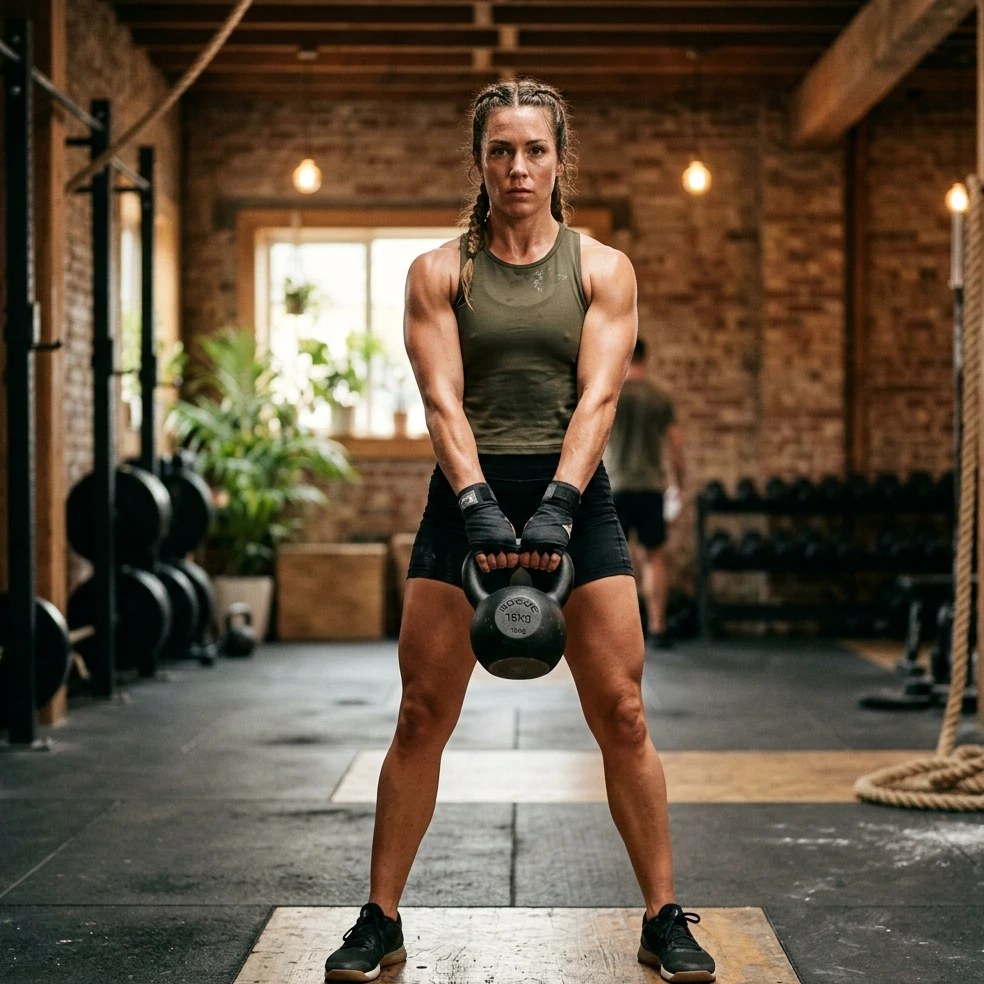
The kettlebell swing is a hip hinge, not a squat. The defining mechanic is that hip flexion (the hinge backward) and hip extension (the snap forward) drive the bell’s motion through their full range, while the knees track the same minimal movement throughout — perhaps 30 degrees of knee bend at the bottom, no more. The arms are essentially passive levers; the bell rises because the hips snapped, not because the shoulders pulled McGill 2012.
The swing has two named variants. The Russian swing rises to about chest height (eye level at maximum). The American swing rises overhead. The published research overwhelmingly studies the Russian style: it produces less spine and shoulder stress while preserving the biomechanical advantages of the movement. McGill’s lab showed the American overhead variant produces 2-3× the lumbar shear forces of the Russian version with no measurable conditioning advantage McGill 2012. For most adults, the Russian swing is the only variant the evidence supports.
What the EMG data show
McGill and Marshall’s 2012 Journal of Strength and Conditioning Research paper put 7 trained men through full kettlebell swing sets while recording high-frequency EMG, motion capture, and lumbar load modeling. Key findings:
- Gluteus maximus activation peaked at 80-100% of maximum voluntary contraction during the hip-snap phase — comparable to or higher than the activation seen in maximal-effort hip thrusts McGill 2012.
- Erector spinae activation peaked at 60-80% MVC, primarily during the bottom hinge and snap-up phases.
- Anterior core (rectus abdominis, obliques) activation peaked above 70% MVC at the top of the swing — the moment the bell’s momentum arrests and the body must stiffen to absorb it.
- Lumbar compression averaged about 3,200 N during heavy swings — meaningful but well within the limits adapted spines tolerate.
- Lumbar shear forces stayed manageable for proper-form swings but rose sharply if the swinger lost neutral spine or initiated with the lower back instead of the hips.
“Properly executed, the kettlebell swing produces peak glute activation comparable to maximal hip thrusts, with concomitant whole-body cardiovascular stress. The shear-and-compression profile is favorable to spinal health when form is preserved.”
— McGill & Marshall, J Strength Cond Res, 2012 view source
The cardiovascular case
The swing’s cardio claim isn’t marketing — it’s replicated in calibrated lab studies. Falatic and colleagues’ 2015 study had female volunteers complete a 12-week kettlebell HIIT protocol with predominantly swings. The intervention produced a 13% improvement in VO2max — effect sizes comparable to dedicated treadmill HIIT in matched populations Falatic 2015. Heart rates during interval-style swing sets routinely run 160-180 bpm in trained subjects.
The reason swings produce such high cardiovascular cost despite being a "lifting" exercise is the metabolic recruitment pattern. Swings ballistically move large muscle masses (hips, glutes, quads, posterior chain) at high velocity, with brief peak output and elevated metabolic clearance demand. The format that came out of the Russian-military training literature — "snatch test" sets of 100 swings in 5-minute blocks — is essentially HIIT with a load Otto 2012.
Weight selection
The kettlebell weight matters more than people expect. Too light, and the bell doesn’t fall fast enough through the bottom of the swing to elastically load the hip extensors — the swing becomes an active arm-and-shoulder exercise. Too heavy, and form breaks down: the hinge becomes a squat, the lumbar spine takes load it shouldn’t, the shoulders compensate with anterior pull. The published guidelines converge on weight ranges by experience and goal:
| Profile | Suggested weight | Notes |
|---|---|---|
| Beginner woman, technical sets | 8-12 kg | Build hinge pattern first |
| Beginner man, technical sets | 16-20 kg | Same pattern emphasis |
| Intermediate woman, conditioning | 16-24 kg | The Russian-standard "GS" (girya sport) is 16 or 24 kg |
| Intermediate man, conditioning | 24-32 kg | The classic "Pood" weight is 32 kg |
| Advanced power work | 32-48 kg | Single-handed pivots, complex flows |
The widespread "32 kg / 1 pood" beginner kettlebell recommendation that circulates in the strength-training community is sharply at odds with the published-injury data: novice swingers using overly heavy bells produce the lumbar-load spikes McGill warned about McGill 2012. Start lighter than feels macho.
Safety and contraindications
Three patterns reliably distinguish safe from unsafe kettlebell swings:
- Hinge first, then snap. The bell is sent backward through the legs by hip flexion, then accelerated forward by hip extension. The arm motion is reactive, not initiated.
- Neutral spine throughout. Look at the floor 2-3 meters in front of you, not at your feet (which forces flexion) or at the wall (which forces extension). The lumbar spine must stay in its normal arch — flat-back hinging or rounded-back hinging both produce lumbar shear.
- Lats and core engaged at the top. The bell stops at chest height because the lats stiffen the shoulder and the core arrests the spine. If you "throw" the bell upward, you’ve lost both connections and the next rep will feel different than the last.
Adults with active or recent lumbar disc herniation, spondylolisthesis, or radicular pain should not perform swings without explicit physiotherapist clearance. The same applies to acute shoulder labral or rotator cuff issues. The swing produces excellent loading patterns when the underlying tissue is healthy and excellent aggravating patterns when it is not Jay 2011.
Protocols the trials actually use
| Protocol | Application | Sets / reps |
|---|---|---|
| Strength + power emphasis | Hip explosiveness | 6-10 sets × 5-8 reps, 90-120s rest |
| HIIT-style conditioning | Cardiovascular fitness | 10 sets × 30s work / 30s rest |
| Manocchia transfer protocol | General strength carryover | 10 weeks × 2 sessions/week, 1-arm + 2-arm swings |
| Beginner technical work | Form development | 5 sets × 10 reps, deliberate tempo, 60s rest |
Manocchia’s 2013 study had subjects perform 2 weekly kettlebell sessions for 10 weeks — primarily swings — and measured strength carryover to the conventional barbell back-squat and clean-and-jerk. The kettlebell group improved their squat by 10% and their clean by 9% without ever lifting a barbell Manocchia 2013. The strength transfer is real because the hip extension pattern is the central driver of nearly all power-based movements.
Who the swing actually suits
| Profile | Swing fit | Why |
|---|---|---|
| Time-pressed adult wanting cardio + posterior chain | Excellent | 15-20 min sessions; both stimuli simultaneously |
| Lifter wanting hip power transfer | Excellent | Manocchia 2013 documented direct squat/clean carryover |
| Adult with weak glutes / sedentary lifestyle | Excellent (after technique) | Highest-MVC glute activation of any non-loaded movement |
| Older adult with healthy spine | Good (modified weight) | Excellent for hip power retention; start light |
| Adult with active lumbar pathology | Avoid | The hinge load is exactly the wrong pattern |
| Beginner with no hip-hinge experience | Build pattern first | Spend 4-6 weeks on bodyweight hip-hinge, RDL, deadlift |
| Adult with shoulder labrum issues | Modify or avoid | Top-of-swing shoulder load is significant |
How to actually start
- Learn the hinge before the swing. Spend 2-3 sessions on broomstick hinges, Romanian deadlifts, and bodyweight hip hinges with a focus on neutral spine. The pattern is the prerequisite, not part of the program.
- Start with the deadlift-stop swing. Pick the bell up like a deadlift, perform 1 swing to chest height, and put it back down. Reset between every rep. This isolates the hinge mechanic from the back-and-forth rhythm that often masks bad form.
- Buy one bell, sized correctly. 16 kg for women new to the movement; 20-24 kg for men. A second heavier bell can be added after 6-8 weeks. Cheap bells with rough handles tear up the hands; spend the extra CAD$30 on a competition or cast bell.
- Use video. Film your swings from the side, every session, for the first 4 weeks. The single most common error — squatting instead of hinging — is impossible to feel from the inside but immediately obvious on tape.
- 2 sessions per week is plenty for most adults. The swing’s posterior-chain load is significant; daily swing volume produces overuse injuries reliably.
- Pair with vertical pulling and pressing patterns. The swing dominates the hip-extension axis; balanced general fitness still requires complementary upper-body work.
Practical takeaways
- The kettlebell swing is a hip hinge, not a squat. Confusing the two is the single most common — and most injurious — novice mistake.
- Properly executed, swings produce 80-100% MVC glute activation with whole-body cardiovascular stress that rivals running at 6:30/km pace.
- Russian swing (chest height) only. The American overhead variant produces 2-3× the lumbar shear with no measurable conditioning advantage.
- Manocchia 2013: 10 weeks of kettlebell-only training improved barbell squat by 10% and clean by 9%. The strength transfer is real.
- Falatic 2015: 13% VO2max improvement in 12 weeks from kettlebell HIIT — comparable to dedicated treadmill protocols.
- Avoid swings entirely with active lumbar pathology, recent shoulder labral issues, or acute back pain. Build the hinge pattern first; weight comes later.
References
McGill 2012McGill SM, Marshall LW. Kettlebell swing, snatch, and bottoms-up carry: back and hip muscle activation, motion, and low back loads. J Strength Cond Res. 2012;26(1):16-27. View source →Falatic 2015Falatic JA, Plato PA, Holder C, Finch D, Han K, Cisar CJ. Effects of kettlebell training on aerobic capacity. J Strength Cond Res. 2015;29(7):1943-1947. View source →Otto 2012Otto WH 3rd, Coburn JW, Brown LE, Spiering BA. Effects of weightlifting vs. kettlebell training on vertical jump, strength, and body composition. J Strength Cond Res. 2012;26(5):1199-1202. View source →Manocchia 2013Manocchia P, Spierer DK, Lufkin AK, Minichiello J, Castro J. Transference of kettlebell training to strength, power, and endurance. J Strength Cond Res. 2013;27(2):477-484. View source →Lake 2012Lake JP, Lauder MA. Kettlebell swing training improves maximal and explosive strength. J Strength Cond Res. 2012;26(8):2228-2233. View source →Jay 2011Jay K, Frisch D, Hansen K, et al. Kettlebell training for musculoskeletal and cardiovascular health: a randomized controlled trial. Scand J Work Environ Health. 2011;37(3):196-203. View source →Beardsley 2014Beardsley C, Contreras B. The functional movement screen: a review. Strength Cond J. 2014;36(5):72-80. View source →Vancini 2019Vancini RL, Andrade MS, Rufo-Tavares W, Zimerer C, Nikolaidis PT, de Lira CAB. Kettlebell exercise as an adjunct training program for runners: review and physiologic considerations. Sports Med Open. 2019;5(1):27. View source →Maulit 2017Maulit MR, Archer DC, Leyva WD, et al. Effects of kettlebell swing vs. explosive deadlift training on strength and power. Int J Kinesiol Sports Sci. 2017;5(1):1-7. View source →Schoenfeld 2017Schoenfeld BJ, Ogborn D, Krieger JW. Dose-response relationship between weekly resistance training volume and increases in muscle mass: a systematic review and meta-analysis. J Sports Sci. 2017;35(11):1073-1082. View source →Warburton 2017Warburton DER, Bredin SSD. Health benefits of physical activity: a systematic review of current systematic reviews. Curr Opin Cardiol. 2017;32(5):541-556. View source →Hreljac 2004Hreljac A. Impact and overuse injuries in runners. Med Sci Sports Exerc. 2004;36(5):845-849. View source →Frost 2003Frost HM. Bone’s mechanostat: a 2003 update. Anat Rec A Discov Mol Cell Evol Biol. 2003;275(2):1081-1101. View source →