The 60-second version
The Nottawasaga River winds 6 km from the Highway 26 bridge to where it empties into Georgian Bay at the Wasaga Beach river mouth, and it is the most under-used stand-up paddleboarding (SUP) and kayak training surface in the area. The river is moving water but at gentle flow rates (typically 0.3–0.7 m/s in summer), wide enough for safe upstream-and-back training, and meaningfully calmer than open Georgian Bay on windy days. For Wasaga residents who want to train SUP technique and balance without the wind chop and surf of the open lake, the river is the better option about 60% of summer days. The published research on SUP physiology (Schram et al. 2019; Bray-Miners 2014) finds it produces moderate cardiovascular load (heart rate around 130–160 bpm at recreational pace) with continuous core engagement; the paddleboard is recruited for trunk stability throughout the session, which is the “active core” benefit the activity is known for. The launch points along the river give 3–6 km of feasible round-trip paddling depending on the access point chosen, with downstream-and-back symmetry that builds skill in both directions.
Why the river is a better SUP training surface than the bay
Wasaga Beach’s waterfront on Georgian Bay produces excellent SUP conditions on calm days — flat, clear, warm shallow water in summer. But Georgian Bay is also exposed to the wind patterns that create unpredictable conditions: an onshore breeze produces 30–60 cm wind chop within 30 minutes, and an offshore breeze blows novice paddlers seaward (which is a real safety risk for inexperienced SUP users).
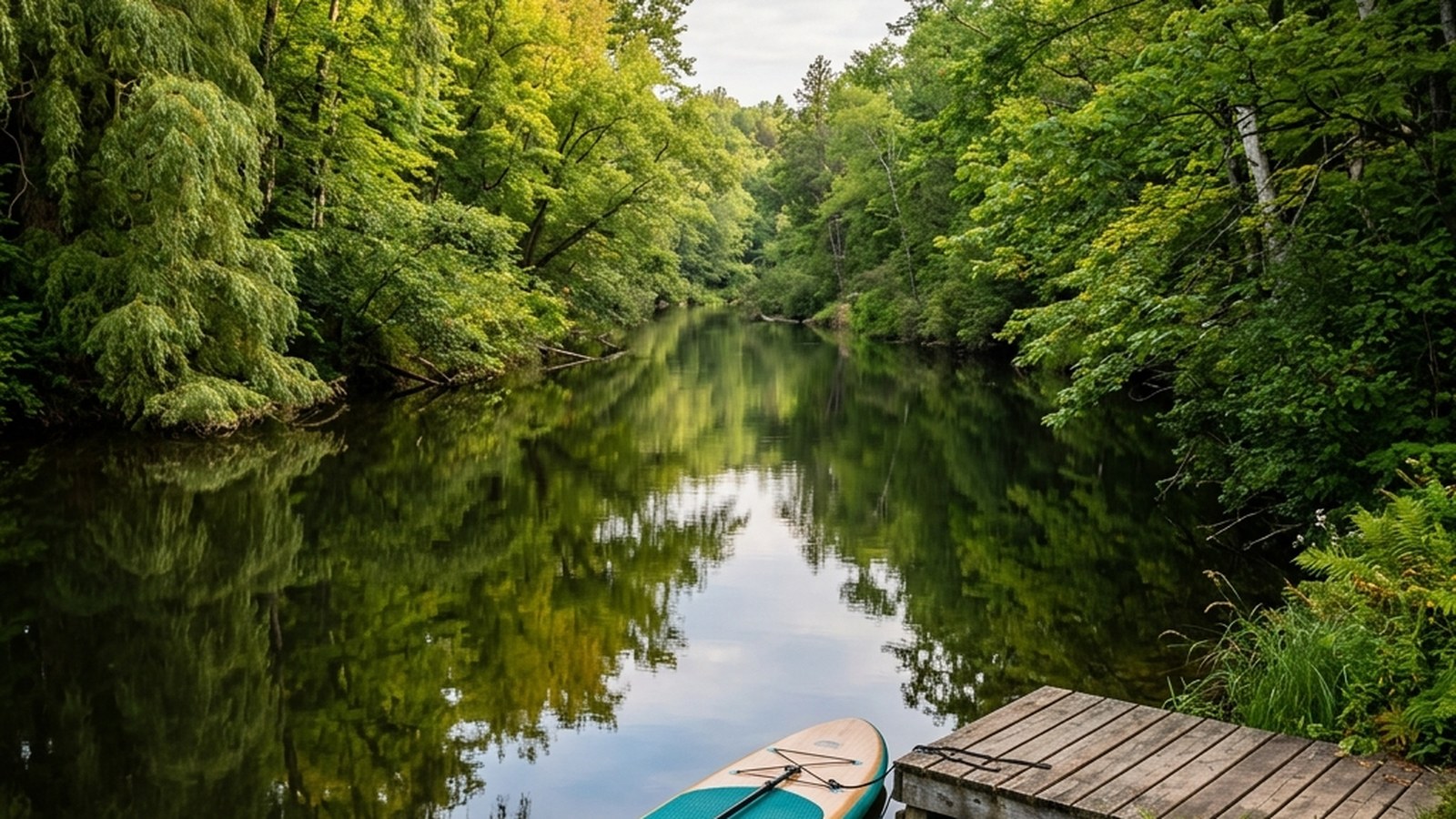
The Nottawasaga River, by contrast, is sheltered from the wind by its riparian forest corridor and by the riverbank topography. Most river sections are 30–50 metres wide with treed banks; even on a 25 km/h wind day the surface stays largely flat. The flow rate matters but is gentle: typical summer flows produce a current speed of 0.3–0.7 m/s, which a recreational paddler can paddle against without difficulty. The river is also markedly warmer than the bay in shoulder seasons (May, September) because it’s shallow and well-mixed.
The complementary point: the river is not a perfect substitute for bay paddling. The bay is where you train sea-state confidence and cover real distance; the river is where you train technique, balance, and cardiovascular fitness without the wind variable. A paddler doing both gets the full skill development.
SUP physiology: what the literature shows
The published research on SUP energetics is small but consistent. The main findings:
- Recreational SUP at moderate pace produces heart rates of 130–160 bpm in healthy adults — comparable to a moderate jog. Schram et al. 2019 measured this directly with portable HR monitoring during 60-minute open-water sessions.
- Continuous core engagement: the paddler maintains balance through micro-corrections of the deep trunk muscles (transversus abdominis, multifidus, internal obliques) for the full duration. Bray-Miners 2014 confirmed via EMG that paddleboard riding maintains higher trunk-muscle activation than seated kayaking or seated rowing.
- Energy cost: roughly 350–500 kcal per hour at recreational pace for a 70 kg adult, with substantial variance based on water conditions and paddle technique. Choppy water and headwinds dramatically increase the cost.
- Low joint impact: SUP is a low-impact activity (no ground reaction forces during the stroke), making it suitable for people with knee, hip, or lower-back sensitivity who can’t tolerate running or high-impact training.
- Balance and proprioception adaptations: regular paddleboarders show measurable improvements in single-leg balance and ankle stability over 8–12 weeks of consistent practice.
Specific launch points along the Nottawasaga River
The river is accessible at multiple points within the Wasaga Beach municipal boundary. The launch points listed below cover the practical options for a Wasaga-based paddler:
- Wasaga Beach river mouth (Beach Area 1, public boat launch): the most accessible and most-used launch point. Concrete ramp, public parking, restrooms within walking distance. From this launch, you can paddle upstream against gentle current for about 1–2 km before fatigue sets in for most recreational paddlers, then float back. Best for first-time river SUP users. Be alert for boat traffic at the river mouth.
- Marl Lake / Schoonertown access: a quieter launch point about 2 km upstream from the river mouth, accessed via the Schoonertown park entrance on the south side of the river. Less boat traffic, more wildlife, more sheltered from any wind. Parking is at the park lot; carry the board about 100 metres to the water.
- River Road East access points: two unofficial launch points along River Road East, about 4–5 km upstream from the mouth. These are local-knowledge locations — small clearings on the riverbank with rough beach access. The water is calm and the riverbanks have notably mature forest cover. Park considerately on the road shoulder; do not block driveways.
- Highway 26 bridge access: the most upstream practical launch, about 6 km from the river mouth via the river path (longer by road). Provides 4–6 km of downstream paddling with full-current assistance, but requires a vehicle shuttle to recover at the river mouth. Best for paddlers with a partner who can drive the vehicle shuttle.
For a first-time visitor, the Beach Area 1 boat launch is the right starting point. It’s public, well-marked, has facilities, and provides the easiest egress if the session goes long.
A specific session protocol for first-time river SUP
For a healthy adult new to paddleboarding (or returning after a season off), the following progression works:
- Session 1 (45 minutes total): launch from Beach Area 1, paddle upstream 500–800 metres at very easy pace, allowing time for balance to settle. Practice forward stroke on each side for at least 5 minutes per side. Float back downstream. Total distance: 1–1.5 km.
- Session 2 (60 minutes): same launch, paddle 1–1.5 km upstream, practice paddling against current. Practice the “step-back” turn (moving feet toward the tail to allow the board to pivot). Float back.
- Session 3 (75–90 minutes): same launch, paddle 2–2.5 km upstream. Practice maintaining a straight-line track without zigzagging (this is the technical skill that separates competent recreational paddlers from beginners).
- Session 4+: alternate between the river and the bay. River sessions for technique work; bay sessions for distance and confidence in surface chop.
Beyond session 4, the paddler can comfortably handle 60–90 minutes of mixed pace covering 5–8 km depending on session goals.
Technique fundamentals for the river setting
The Nottawasaga River is forgiving for technique work but rewards correct fundamentals:
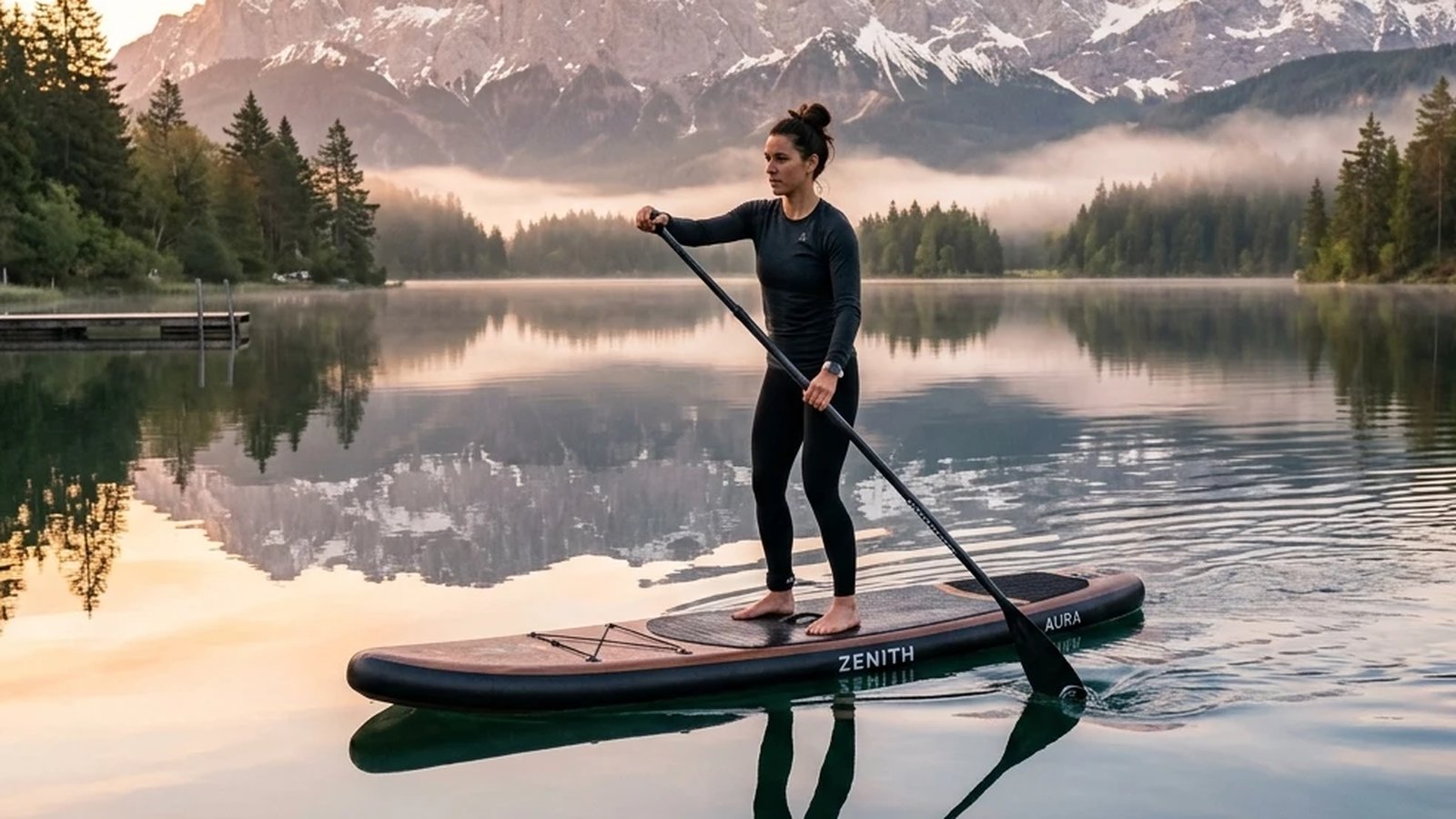
- Stand with feet shoulder-width apart, parallel. Soft knees. Eyes forward toward the horizon, not down at your feet (looking down destabilises balance).
- Paddle with both hands. Top hand on the T-grip, bottom hand on the shaft. The lower hand should be roughly at the height of your hip when the blade is fully submerged.
- Engage the core. The stroke is driven by trunk rotation, not arm pulling. Beginners over-rely on arm strength; this both fatigues the arms and reduces stroke efficiency.
- Stroke length: blade enters the water at the foot, pulls back to roughly the hip, exits cleanly. Pulling past the hip is wasted effort.
- Paddle on alternate sides every 4–6 strokes to track straight. The river current naturally drifts you downstream, so a slight upstream lean compensates.
The river is calm enough that a beginner can spend 30 minutes practising fundamentals without exhaustion or balance failure. This is the value of the river setting over the bay.
Safety considerations on the Nottawasaga
The river is generally calm but has features the paddler should know:
- Boat traffic at the river mouth: small motorboats, fishing boats, and the occasional jet-ski transit the lower 500 metres of river. Stay close to the riverbank and be visible (bright board colour, bright clothing).
- Submerged hazards: the river has occasional submerged logs, especially in spring after high-water events. Slow your pace if visibility is poor (cloudy water).
- Cold-water risk: even in summer, falling in produces an immediate shock if water is below 20°C. Wear a personal flotation device (PFD) at all times — this is required by law in Ontario, not optional.
- Wind change downstream paddle: a calm-water session that turns into a 25 km/h wind can produce significant chop on the wider river sections. Watch the upstream-paddle effort: if you’re struggling against a headwind on the way back, head to the bank and wait for the wind to subside.
- Hypothermia risk for spring/fall sessions: river water in May and October is meaningfully colder than summer (10–15°C). A neoprene top is sensible insurance.
- Wildlife: turtles, herons, and the occasional beaver. Black bears are unlikely on the river but possible on the upstream sections. Be respectful of wildlife — give them distance.
Gear for the river paddler
Recreational SUP needs surprisingly little kit:
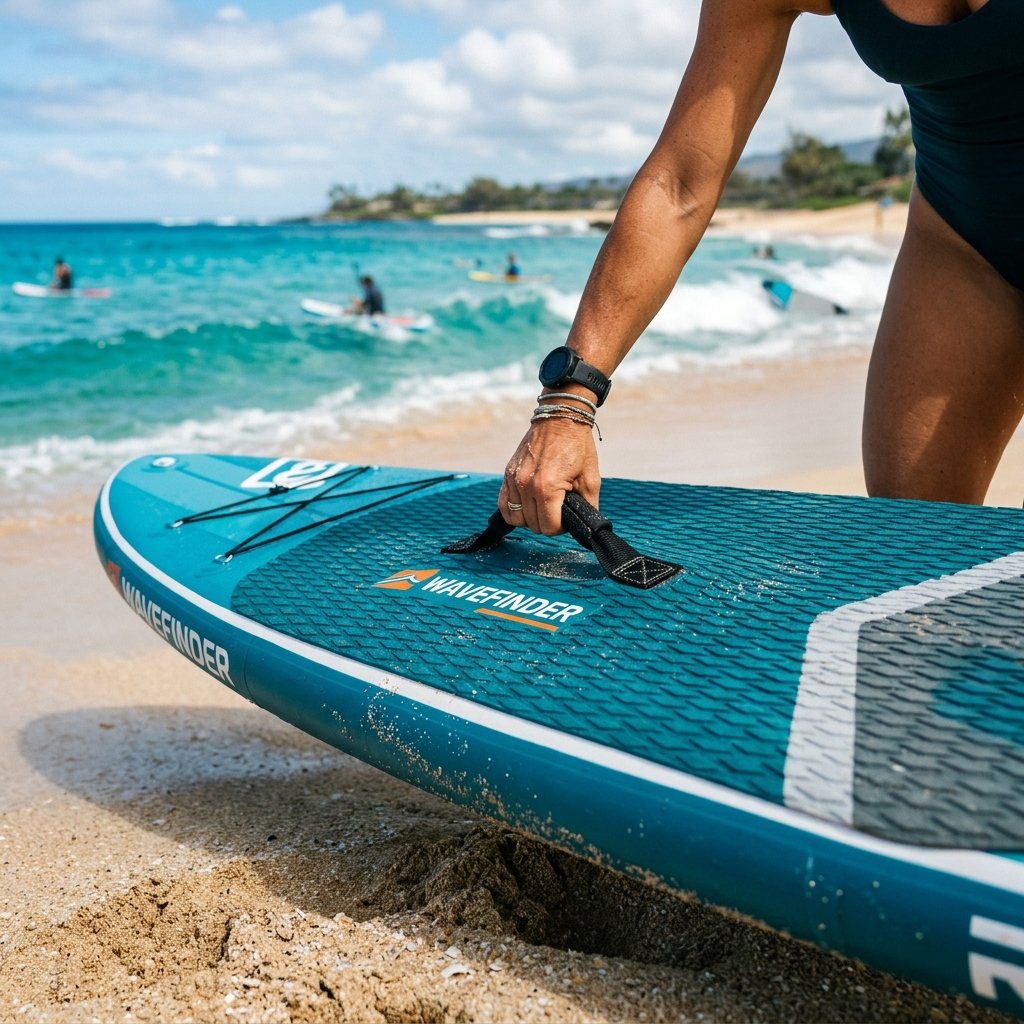
- Paddleboard: an inflatable board (10’6” to 11’6”, 32” wide) is the right starter for most adults. Inflatable boards are durable, easy to transport, and forgiving to learn on. Hard boards are faster but harder to learn on and more transport-intensive.
- Paddle: adjustable aluminum or fibreglass paddle in the right length (typically your height + 8–10 inches for the T-grip extension).
- PFD: legally required. A type III PFD designed for paddling is the most comfortable; the “belt-pack” manual-inflate PFDs are also legal in Ontario as long as you’re wearing them.
- Leash: a coiled ankle leash. If you fall, the board can drift downstream faster than you can swim to recover it. The leash keeps it in arm’s reach.
- Bright-coloured clothing or rashguard: visibility to other watercraft.
- Water bottle in a deck bungee: SUP feels easier than it is, and dehydration sneaks up. A 32 oz insulated bottle covers a 90-minute session.
- Sun protection: water reflection multiplies UV exposure. Long-sleeve UPF rashguard plus reef-safe sunscreen.
Year-round considerations
Spring (April-May): river is high and fast from snowmelt. Wait until late May for safe recreational paddling; cold-water risk is real. Weather is unpredictable.
Summer (June-August): peak season. River is warm, slow, and forgiving. Beach Area 1 boat launch can be busy on weekends; launching by 10 AM provides easier access.
Autumn (September-October): excellent paddling season. Cooler air, water still warm into early October, foliage colour is dramatic. Cell coverage improves as deciduous trees lose leaves — useful for safety check-ins.
Winter (November-March): not feasible. The river freezes in some sections; air temperature makes any cold-water exposure life-threatening. Off-season for SUP entirely.
Combining river SUP with broader fitness goals
SUP integrates well with the broader Wasaga fitness profile. Specific patterns that work:
- SUP + open-water swim: the river is also an excellent open-water swim setting (with appropriate caution and a paddleboard or buoy as flotation). Some local swimmers do a paddleboard-and-swim alternation: paddle 10 minutes, swim 5 minutes, paddle 10 minutes.
- SUP + run: easy SUP recovery the day after a hard run loads the lower body lightly while maintaining cardiovascular volume.
- SUP + strength: the trunk-stability work pairs well with a strength program emphasising ground-based exercises. The micro-correction work the SUP demands is the live counterpart to plank and dead-bug variations.
- Family SUP outings: kids 7+ can solo on a stable board in calm water; younger kids can ride the front deck of a parent’s board. The river is dramatically safer than the bay for family sessions.
Practical takeaways
- The Nottawasaga River is a calmer SUP surface than Georgian Bay on windy days, accessible from multiple launch points within Wasaga.
- SUP at recreational pace produces heart rates of 130–160 bpm with continuous core engagement — moderate cardio with low joint impact.
- Beach Area 1 boat launch is the right first-visit option; River Road East access and the Highway 26 bridge cover the longer-distance and shuttle options.
- PFD always required in Ontario; ankle leash always recommended on flowing water.
- Build the technique on the river, build the distance on the bay for a complete SUP skill development.
- Adaptation timeline: first 4 sessions for fundamentals, then alternating river and bay across a 2–3 month season.
References
Schram et al. 2019Schram B, Hing W, Climstein M. The physiological, musculoskeletal and psychological effects of stand up paddle boarding. BMC Sports Sci Med Rehabil. 2019;11:25. View source →Bray-Miners 2014Bray-Miners J, Runciman RJ, Monteith G. Biomechanics of stand up paddle boarding. Open Sports Sci J. 2014;7:18-23. View source →Transport Canada — Pleasure CraftTransport Canada. Safe Boating Guide and pleasure craft regulations (PFD requirements). View source →Nottawasaga Valley Conservation AuthorityNottawasaga Valley Conservation Authority — flow data and watershed information for the Nottawasaga River. View source →Ontario Parks — WasagaOntario Parks. Wasaga Beach Provincial Park — visitor and waterway access information. View source →