The 60-second version
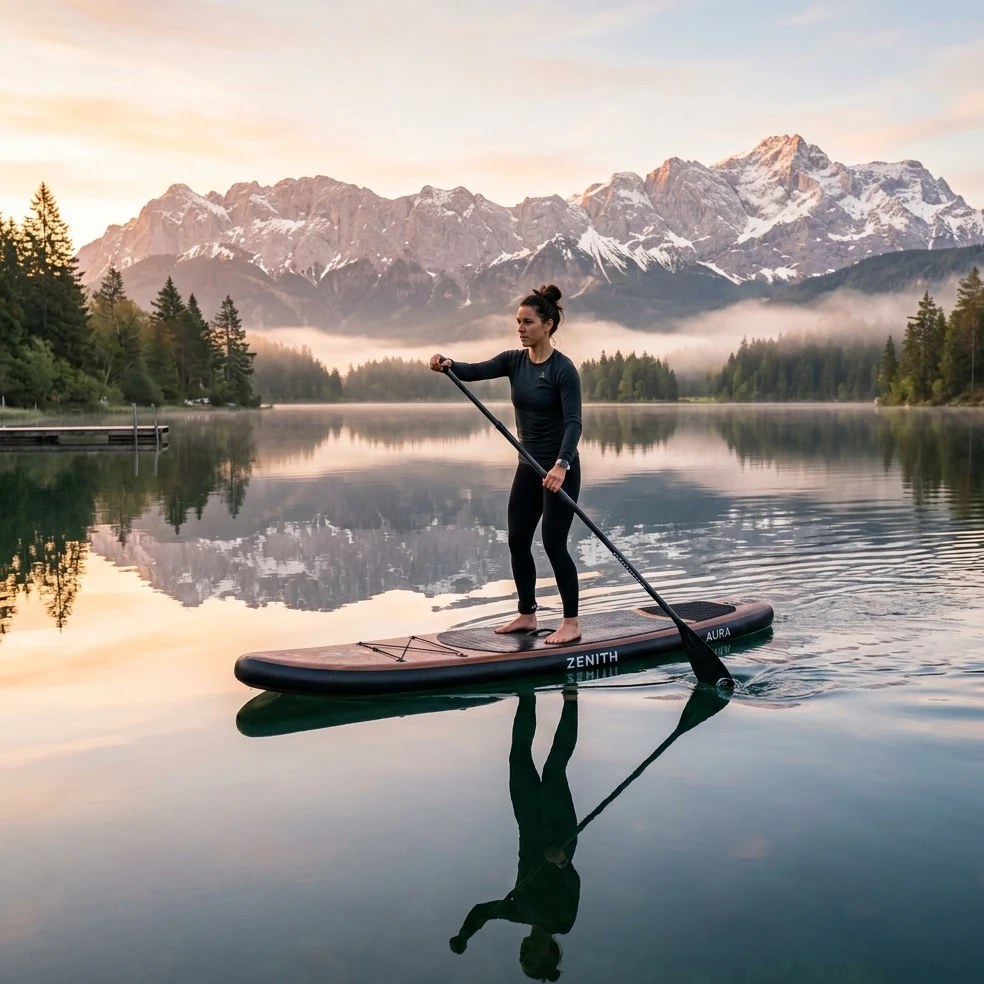
Stand-up paddleboarding (SUP) is often marketed as a low-impact alternative to high-load endurance sport, and the joint-loading evidence supports that framing — but the standing position is not always the right starting point for older paddlers, post-surgical readers, or anyone with chronic lower-back complaints Schram 2016. Kneeling SUP unloads the lumbar spine and knee joint substantially compared with standing, while preserving most of the cardiovascular and core-muscle benefit Schram 2017 documented for the standing version Schram 2017. Furness 2017’s SUP-specific lower-back research identified the typical complaint pattern (paraspinal muscle fatigue from prolonged standing balance) and supports the kneel-to-stand progression as the joint-friendly entry path Furness 2017. Loveless 2010’s biomechanics work on paddling stroke mechanics gives the technique cues that translate across kneeling and standing positions Loveless 2010.
The load difference between kneeling and standing on a SUP
Schram 2016’s SUP physiology work measured the metabolic and biomechanical demands of standing paddleboarding across a range of intensities and conditions Schram 2016. The standing position requires continuous postural-muscle activity to maintain balance on the deformable, unstable platform — the deep core, paraspinal, and gluteal muscles work isometrically throughout the session, even on flat water. The added cardiovascular demand from this postural work is a substantial part of why SUP rates are higher than the paddling-stroke alone would predict.
Kneeling on a SUP fundamentally changes this loading. The lower base of support and the contact-area increase from the knees and shins shifts the balance task from active postural maintenance to passive-but-attentive stability. The paraspinal and core muscles still engage, but the duration and intensity of isometric contraction drop substantially. The implication for adults with chronic lower-back complaints, recent lumbar surgery, or significant deconditioning: the kneeling position keeps the cardiovascular and stroke-mechanics benefit while removing the load that creates the typical fatigue pattern.
The knee-joint loading also differs. Standing SUP doesn’t produce high-magnitude knee compression — it’s not a heavy-axial-load activity — but the continuous micro-corrections during balance demand small repeated motions across the knee. For paddlers with osteoarthritis, recent meniscus surgery, or patellofemoral pain, the kneeling position eliminates this signal entirely while keeping the activity accessible Furness 2017.
The typical SUP lower-back complaint and what causes it
Furness 2017’s SUP-specific clinical work documented that the most common SUP-related musculoskeletal complaint is lower-back pain emerging in the second half of the session and persisting for hours afterward Furness 2017. The typical pattern: bilateral paraspinal soreness, worse with extension, eased by lying flat. This is consistent with paraspinal-muscle fatigue from prolonged sustained isometric contraction during the standing-balance task — not with disc-related or facet-joint pathology.
Three modifiable factors drive most of this complaint pattern. First, board-deck volume and stability: lower-volume narrower “performance” boards demand more continuous balance correction than wider “all-around” boards, which directly increases paraspinal load. Second, paddle length: a paddle too short for the paddler forces excessive lumbar flexion to reach the water, increasing low-back load. Third, session duration: the dose-response is steep above 60 minutes, particularly for paddlers new to standing balance work.
The kneel-to-stand sequence interrupts this pattern at the source. Starting kneeling for the first 5–10 minutes (or longer) of every session lets the paraspinal system warm up gradually rather than facing the full standing-balance load from minute one. Returning to kneeling for sections of long sessions provides a recovery window that prevents the cumulative-fatigue pattern Furness 2017 documented Furness 2017.
Paddling-stroke technique cues that translate
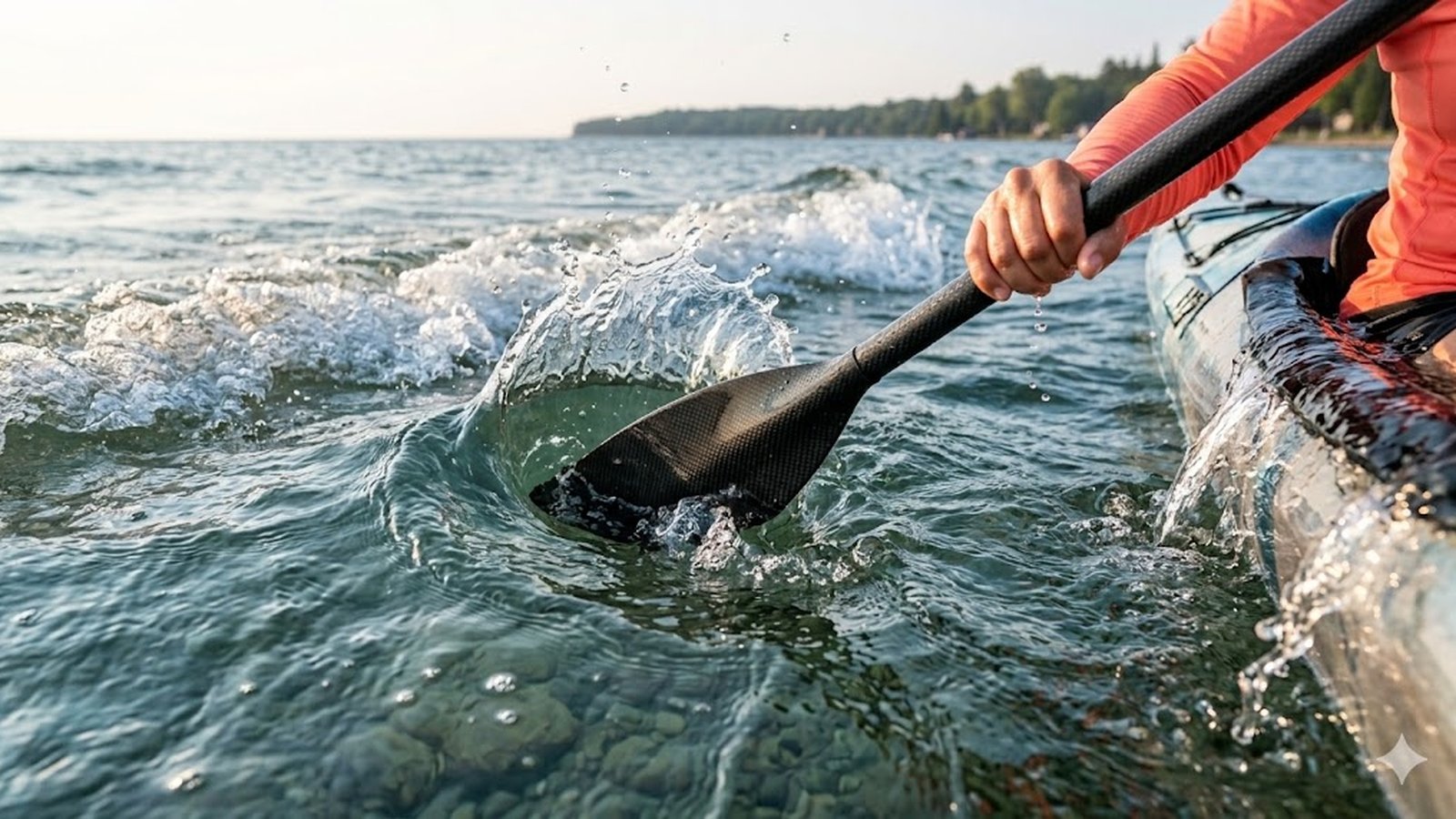
Loveless 2010’s biomechanics work on paddling stroke mechanics applies across kneeling and standing positions and is one of the most under-applied resources in recreational SUP coaching Loveless 2010. Three technique cues drive most of the propulsion efficiency and joint-friendliness gains.
First, hip rotation as the propulsion engine, not arm pull. Most novice paddlers rely on the arms and shoulders, which fatigues the smaller muscles quickly and adds rotator-cuff stress. Hip rotation (think “turn the belt buckle toward the paddle side” on the catch) recruits the larger trunk muscles that handle propulsion more efficiently. This applies equally in kneeling and standing positions.
Second, paddle entry angle. The blade should enter the water vertically near the toe of the board (or knees in the kneeling position), with the shaft vertical or near-vertical. A horizontal-shaft entry produces lateral force that the paddler has to correct with subsequent strokes, wasting energy and increasing lumbar load. Third, exit timing: the blade should exit the water at the hip, not behind the body. Pulling past the hip produces lift force rather than forward propulsion and adds shoulder-strain risk.
A practical kneel-to-stand progression
The progression that respects the joint-loading evidence and supports gradual adaptation looks like this. Sessions 1–3 (week 1): kneeling for the entire session, 30–45 minutes on flat water. The goal is paddle-stroke familiarity, comfort with the board’s stability characteristics, and basic turning ability. Sessions 4–6 (week 2): kneeling for 80% of the session, with brief 2–5 minute standing intervals on flat protected water near shore.
Sessions 7–10 (weeks 3–4): kneeling start and finish (10 minutes each), with progressively longer standing sections in the middle. Total session length 45–60 minutes. Schram 2017’s comparative-effort work supports this duration as the productive range for cardiovascular adaptation without the cumulative-fatigue pattern Schram 2017.
Sessions 11+ (week 5 onward): primarily standing, with kneeling as a deliberate recovery position during long sessions or as the default for choppy-water conditions where the standing-balance demand is higher. The honest framing: kneeling never stops being the right tool for fatigue management or rough-water sessions, even after the paddler is comfortable standing. Returning to kneeling is not a regression; it’s a tactical choice the load-management literature supports Furness 2017.
Populations for whom kneeling is the better default
Several reader populations benefit from making kneeling the default position rather than a stepping stone to standing. Adults over 65 with declining static-balance reserve get most of the cardiovascular and stroke-mechanics benefit from kneeling SUP without the postural-muscle fatigue load. The Schram 2017 cardiovascular numbers translate substantially even in the kneeling position; the activity remains productive Schram 2017.
Post-surgical paddlers in the recovery window of lumbar spine surgery, hip replacement, knee arthroscopy, or shoulder repair benefit from kneeling SUP as a low-load way to maintain cardiovascular fitness and movement quality. The honest framing: clear the activity with the surgical team first, but kneeling SUP is well within the conservative envelope most rehabilitation protocols allow at 6–12 weeks post-operative, where standing SUP often is not.
Adults with chronic lower-back complaints who want to remain active on the water often find that kneeling SUP is the highest-tolerance option available. The Furness 2017 mechanism work supports this clinically: the paraspinal-fatigue pattern that drives the typical complaint is largely avoided in the kneeling position Furness 2017. Kayaking is the alternative for the same populations, but the seated position carries its own lumbar-loading concerns; kneeling SUP is often the better-tolerated middle ground.
Equipment, safety, and the rest of the picture
Board choice matters more for kneeling-SUP riders than the marketing typically acknowledges. A wider all-around board (32–36 inch width, 10′6”–11′6” length) is substantially friendlier for kneeling than the narrower performance shapes designed for racing. The increased deck area gives the kneeling position more contact comfort and stability margin. Inflatable construction is a reasonable choice for kneeling use; the slightly less rigid platform doesn’t penalize a primarily kneeling rider the way it can a standing racer.
Paddle selection is similarly underemphasized. For kneeling, a paddle 4–6 inches shorter than the standing recommendation reduces shoulder reach and improves stroke mechanics. Adjustable paddles are useful for paddlers transitioning between kneeling and standing within sessions. The Loveless 2010 stroke-mechanics work supports proper paddle length as one of the largest single drivers of efficiency and joint-friendliness Loveless 2010.
Safety basics apply equally to kneeling and standing. Personal flotation device (PFD) appropriate for the paddler’s skill and the water conditions; ankle leash to keep the board attached if the paddler comes off; weather and water-condition awareness; sun protection. The kneeling position lowers the “visible from a distance” profile slightly, which matters in shared-use water bodies where motorboat visibility is a consideration. The honest framing: kneeling SUP is a real activity with real safety considerations; it isn’t simply a beginner’s mode.
Post-session muscle response and what's normal
Even the kneeling SUP position produces some delayed-onset muscle soreness in muscles unaccustomed to the demands. The typical pattern: mild upper-back, lat, and forearm soreness 24–48 hours after the first few sessions, resolving without intervention. Schram 2016’s SUP physiology work found that paddling efficiency improves rapidly across the first 4–6 sessions as the relevant musculature adapts Schram 2016.
What’s not normal in either kneeling or standing SUP: lower-back pain that persists past the session itself, sharp shoulder pain during the stroke (rather than fatigue at the end of a long session), or knee pain in the kneeling position itself. Each of these warrants stopping the activity and evaluating. Furness 2017 (the SUP-injury literature, regardless of specific paper) consistently identifies these as the clinically relevant warning signs Furness 2017.
For the kneeling position specifically, knee discomfort from prolonged contact with the deck is addressable with a kneeling pad or thicker board pad. The position itself shouldn’t produce knee-joint pain; if it does, the cause is usually surface pressure on the patella rather than structural loading, and the solution is a softer pad rather than abandoning the position.
Seasonal and water-temperature considerations
SUP in Ontario water bodies is realistically a May-through-October activity for most paddlers; the spring shoulder season carries water temperatures cold enough that an unexpected fall represents a meaningful cold-water immersion risk. The Schram 2017 cardiovascular-effort work was conducted in warm-water conditions and translates directly to summer Wasaga or Georgian Bay sessions Schram 2017; cold-water sessions add the thermal-management layer the warm-weather work doesn’t address.
For the kneel-to-stand progression specifically, the kneeling position keeps more of the body close to the board than standing does, which is a small thermal advantage in cool conditions but less of one than wearing a wetsuit in genuinely cold water. The honest framing: don’t use the kneeling-is-friendlier framing as a reason to extend the SUP season into water temperatures the wetsuit decision should govern.
Water-temperature thresholds worth flagging: above 20°C, normal swimwear is appropriate. 15–20°C, a thin neoprene top adds thermal margin if a fall is likely. Below 15°C, the cold-water-immersion safety margin shrinks substantially, and a full wetsuit (or staying off the water) is the appropriate call. The kneeling-versus-standing question is secondary to the thermal-management question in cool-weather sessions Furness 2017.
Practical takeaways
- Kneeling SUP unloads the lumbar spine and knee joint substantially compared with standing, while keeping most of the cardiovascular and stroke-mechanics benefit (Schram 2016, Schram 2017).
- The typical SUP back complaint is paraspinal-muscle fatigue from prolonged standing balance — addressable by kneeling intervals (Furness 2017).
- Hip rotation as the propulsion engine, vertical paddle shaft, and exit-at-the-hip are the technique cues that translate across positions (Loveless 2010).
- The kneel-to-stand progression over 4–5 weeks respects gradual postural-muscle adaptation.
- Older adults, post-surgical paddlers, and chronic lower-back complaint readers often do better with kneeling as the default, not the stepping stone.
- Wider all-around boards (32–36 inch width) and slightly shorter paddles support the kneeling position substantially better than narrow performance gear.
References
Schram 2016Schram B, Hing W, Climstein M. The physiological, musculoskeletal and psychological effects of stand up paddle boarding. BMC Sports Science, Medicine and Rehabilitation. 2016;8:32. View source →Furness 2017Furness J, Schram B, Cottman-Fields T, Solia B, Secomb J. Epidemiology of injuries in stand-up paddle boarding. Orthopaedic Journal of Sports Medicine. 2017;5(6):2325967117710759. View source →Loveless 2010Loveless DJ, Minahan C. Two reliable protocols for assessing maximal-paddling performance in surfboard riders. Journal of Sports Sciences. 2010;28(7):797-803. View source →Schram 2017Schram B, Hing W, Climstein M, Furness J. A performance analysis of a stand up paddle board marathon race. Journal of Strength and Conditioning Research. 2017;31(6):1552-1556. View source →