The 60-second version
The beach is a useful obstacle-course racing (OCR) training environment for three specific reasons that the peer-reviewed literature supports. First, soft sand running raises energy cost by roughly 1.6× over grass at the same speed (Pinnington 2001 Pinnington 2001), so 30–40 minutes of beach work delivers a cardiovascular stimulus comparable to a longer run on stable ground. Second, the most common OCR injuries are upper-body sprains and abrasions from grip-and-carry obstacles (Rabb 2018 Rabb 2018), and beach carries with cooler-and-bag loads progress those grip-endurance demands without specialized rigs. Third, OCR events run year-round and often in high heat, so beach training in 25–30°C summer conditions doubles as heat acclimation, which the National Athletic Trainers’ Association exertional-heat-illness statement identifies as the single highest-yield protective intervention (Casa 2015 Casa 2015). The honest framing: the beach replaces specific OCR demands, not all of them — you still need rope-climb and monkey-bar access — but it covers more of the race than a typical gym session does.
What the OCR literature actually shows about beach-style training
Obstacle-course racing has grown from a niche event in 2010 to a global participant sport with millions of finishes per year, but the peer-reviewed injury and physiology literature is still small. Rabb 2018, the largest published longitudinal injury analysis (1,782 injuries across 73,366 finishers at 33 Canadian events), found a 2.4% overall injury rate with the highest concentration in upper-body sprains, lacerations, and abrasions tied to grip-and-carry obstacles and to falls on uneven terrain Rabb 2018. Lower-body overuse injuries familiar from road-running were less frequent than expected; the OCR injury profile is closer to climbing or military assault-course injury patterns than to marathon injury patterns.
The physiological demand profile of OCR is unusual. Hoffman 2014, while focused on ultramarathon runners broadly, captured the kind of mixed-modal endurance demand OCR shares: long aerobic base periods broken by short anaerobic spikes, repeated grip-loaded carries, and exposure-related stresses including heat, cold, and dehydration Hoffman 2014. The anaerobic-aerobic alternation is the part that gym-only training underprepares for; an athlete who can run a clean 10K and bench her bodyweight can still gas out on a 50-metre sandbag carry that interrupts a steady-state run.
Pinnington and Dawson’s 2001 sand-running energy-cost paper remains the foundational citation for the ‘why train on sand’ question. Their seven male and five female recreational runners showed that running on soft dry beach sand cost roughly 1.6× the energy of running the same speed on grass — an enormous metabolic surcharge for a surface change Pinnington 2001. The mechanism is twofold: sand absorbs and dissipates the elastic energy that grass and pavement return to the next stride, and it forces additional stabiliser-muscle work as the foot finds and re-finds purchase. Both contribute to a training stimulus that is both cardiovascularly higher and biomechanically more variable than equivalent stable-surface work.
Heat exposure is the third pillar. The National Athletic Trainers’ Association 2015 position statement on exertional heat illnesses identifies progressive heat acclimatisation as the highest-yield single protective intervention against heat stroke during summer endurance events Casa 2015. Most of the protective adaptation occurs in the first 7–14 days of repeated heat exposure during exercise, so a six-week build into a July OCR with three beach sessions per week banks meaningful heat tolerance before race day.
Carry-and-crawl progressions that translate from beach to course
The most race-specific work the beach offers is loaded carries on uneven, energy-absorbing terrain. The carries that map cleanly onto OCR obstacles include: the bucket carry (a 5-gallon water-jug-or-sand bucket held in front, mimicking the OCR bucket-brigade obstacle), the asymmetric suitcase carry (a sandbag or cooler held in one hand, replicating the lop-sided sandbag carries common at OCR events), and the shoulder-yoke carry (a heavy bag balanced across both shoulders, which closely matches sandbag-pancake carries and prepares the upper-trap and rotator-cuff musculature where Rabb 2018’s injury data clusters Rabb 2018).
A reasonable progression for a six-week build: week one, three sessions of 4×50 metres bucket carry at moderate load (15–20 kg) interspersed with 200 metres of easy beach running. Week two, increase carry distance to 75 metres and add asymmetric carries on alternate sets. Weeks three and four, layer in shoulder-yoke carries and reduce rest between sets. Weeks five and six, run the full course-simulation pattern: 400 metres of beach running, 50 metres of carry, 400 metres of running, 50 metres of carry, repeating for 30–45 minutes. The total session work matches the alternation pattern Hoffman 2014 describes for mixed-modal endurance events Hoffman 2014.
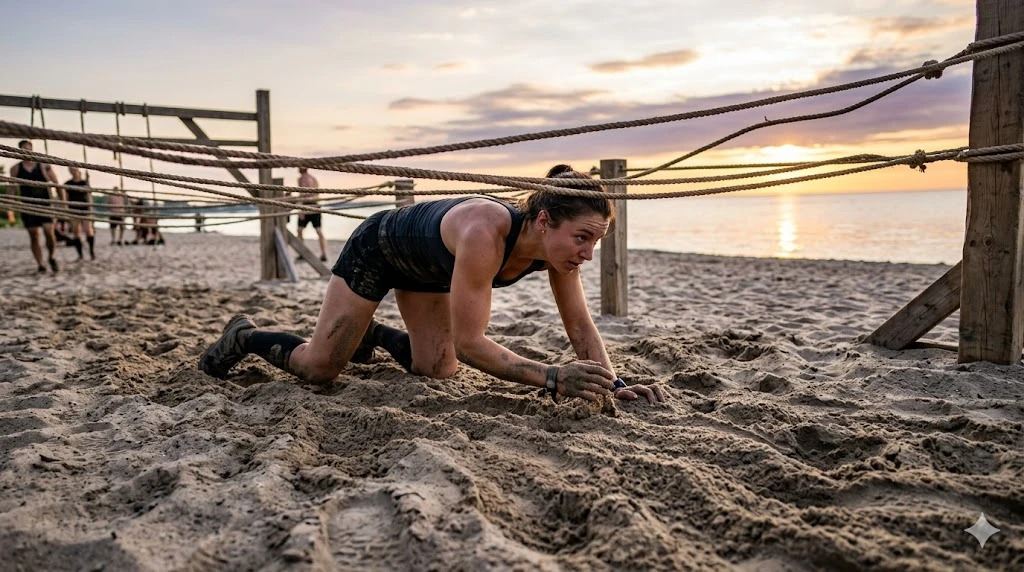
Crawls are the second sand-specific element. Bear crawls and low-army crawls on soft sand combine grip-and-shoulder loading with the unstable-surface stabiliser demand. A useful weekly slot: two 20-metre bear crawls and two 20-metre army crawls within the carry session, either as a recovery exercise between heavier carries or as a finisher. Sand crawl work is conditioning-equivalent to upper-body interval training; the wrists and forearms are the limiting factor for most beginners, which is appropriate because grip-and-carry sprains are the leading OCR injury mechanism.
Beach-specific cautions: crawl on the wet-packed sand band rather than the loose dry sand for skin and soft-tissue protection — loose sand is abrasive and infiltrates wounds. Wear a thin long-sleeve compression shirt during crawl work to reduce the typical post-session forearm and elbow rash. The wet-packed band also offers a more consistent surface for sprint and stride drills, while the loose dry band is reserved for the harder energy-cost-of-transport work where Pinnington 2001’s 1.6× multiplier applies Pinnington 2001.
Grip and shoulder fatigue: the OCR-specific bottleneck
Across the published OCR injury data, the upper-body grip-and-shoulder system is the most-loaded and most-injured. Rabb 2018’s Canadian dataset showed shoulder, wrist, and elbow injuries clustering at the climbing, monkey-bar, spear-throw, and rope-climb obstacles — the points in a course where grip endurance has decayed and a slipped finger or fatigued rotator cuff produces a fall or sprain Rabb 2018. The gym can build absolute grip strength (deadlifts, farmer’s carries, dead-hangs) but rarely builds the specific endurance pattern OCR demands: repeated short-duration maximal grip with limited rest between bouts.
The beach contribution is the loaded-carry volume. A 50-metre asymmetric sandbag carry recruits forearm and finger flexors at near-maximal isometric loads for 25–40 seconds, which is exactly the demand window of monkey bars and spear-rig grips. Three to four such carries per session, twice weekly, builds the kind of grip-endurance the gym’s typical 30-second farmer’s walk doesn’t accumulate. Add weekly dead-hang work (timed hangs from a pull-up bar, accumulating 2–3 minutes total in 20–40 second sets) for a complementary pure-grip stimulus. The two-modality combination — loaded sand carries plus stable dead hangs — covers the grip-endurance window better than either alone.
Shoulder endurance follows a similar logic. The gym’s typical shoulder press and pull-up volume covers strength but underprepares the shoulder for the repeated push-pull-stabilise cycle of monkey bars, traverse walls, and Bucket Brigade carries. Beach crawl work and overhead carries (a sandbag held above the head for short walks) build the integrated shoulder-girdle endurance the race demands. The carry-and-crawl combination biases toward the slow-twitch, postural-control fibres that hold an OCR athlete’s shoulder steady through repeated grip-loaded efforts — the same fibres Rabb 2018’s data suggest are the protective ones for the obstacle clusters that injure athletes most often.
A practical grip-and-shoulder weekly template that pairs gym and beach: one gym session of compound pulls (deadlifts, weighted pull-ups, rows), one beach session of loaded carries and crawls, and one mixed session of dead-hang volume plus moderate-load carry. This pattern over six weeks builds both peak strength and the carry-specific endurance that protects the upper body during the OCR-typical fatigue cascade.
Heat and hydration: the highest-yield OCR-specific adaptation
Casa 2015’s NATA position statement is unequivocal that progressive heat acclimatisation is the most protective intervention for endurance athletes facing summer race conditions Casa 2015. The protective adaptations — increased plasma volume, improved sweat-rate response, lower core-temperature drift, and reduced heart-rate at any given workload — develop over 7–14 days of repeated exercise in heat, with most of the gain captured in the first week of acclimation. For an OCR athlete training for a July or August race, six weeks of regular outdoor beach training during 25–32°C conditions banks substantially more heat tolerance than gym training in air-conditioned environments.
The dose for acclimation is moderate: 60–90 minutes of outdoor exercise in heat, three to five days per week, at the perceived-exertion intensity of a hard race effort. This produces the cardiovascular and thermoregulatory drive that triggers the adaptive response. Beach training fits naturally into this template — the energy cost of sand running plus the carry work pushes core temperature high enough fast enough to drive acclimatisation, even in moderate (rather than extreme) ambient temperatures.
Hydration during heat acclimation training matters more than during cooler-weather training. The NATA position statement recommends matching individual sweat rates with paced fluid intake during exercise — typical sweat rates during summer beach training run 0.8–1.5 litres per hour, with electrolyte losses (especially sodium) significant enough to warrant electrolyte-containing drinks for sessions over 60 minutes Casa 2015. Pre-cooling strategies (a cold drink before the session, a cold towel on the neck) and post-session active cooling (immersion in lake or sea water for 10–15 minutes) accelerate recovery and reduce the cumulative thermal load across a hard training week.
The race-day translation: an athlete who has trained in heat will usually run 5–15 minutes faster across an OCR distance than the same athlete trained in cool conditions, with much lower risk of the kind of late-race exertional-heat-illness collapses that account for a small but serious share of OCR medical encounters. Heat acclimation is one of the few training interventions where the protective and the performance benefits both point in the same direction, and where the beach as a training surface is genuinely better than the gym for the specific event.
What the beach can’t replace
The beach is not a complete OCR training environment. The race-specific obstacles that require apparatus — rope climbs, monkey bars, traverse walls, salmon ladders, spear throws — have to be trained on the actual rigs or close approximations. Most OCR-specific gyms now stock at least the basic rig set; failing that, monthly visits to an OCR-equipped facility plus weekly basement pull-up bar and rope work cover the apparatus side. The beach contributes the cardiovascular, carry, crawl, and heat-acclimation pillars; the apparatus work has to come from somewhere else.
The other gap the beach leaves is cold-weather race preparation. November and December OCR events in Canada and the northern US run in temperatures that demand cold-weather-specific kit and pacing knowledge. A six-week summer beach build serves the July–September race calendar; off-season cold-weather races require their own preparation cycle, with running in cold rain and managing chilled muscle stiffness as the additional skills.
Strength training for the deadlift, squat, and overhead press patterns also has to come from the gym. The carry work the beach offers is endurance-biased; absolute pulling and pushing strength still benefits from periodised barbell work two days per week. The full OCR training week for a serious recreational racer might look like: two gym strength days, two beach carry/run days, one rig-specific session, one long aerobic run, one rest day — with the gym and beach work alternating to manage cumulative fatigue.
Finally, the beach’s biomechanical variability is both its training virtue and its injury risk. Rabb 2018’s data showed lower-extremity sprains and strains as the second-largest injury category at OCR events, with much of that occurring on uneven trail and obstacle approaches Rabb 2018. Sand training prepares ankle and knee for variable terrain, but new sand runners progress conservatively: start with 15–20 minutes of soft-sand running per session and add 5 minutes per week. The same energy-cost surcharge that makes sand effective also accelerates ankle and calf fatigue, which is the most common early-overload pattern when a stable-surface runner transitions onto sand.
A practical six-week beach-OCR template
A pragmatic six-week template for an intermediate runner-and-lifter building toward a summer OCR: weeks one and two focus on sand familiarisation and base carries. Two beach sessions per week, each 45–60 minutes: 20 minutes easy soft-sand running, 4×50 metres bucket carry at 15–20 kg, 2×20 metres bear crawls, 10 minutes of cool-down on wet-packed sand. Heat acclimation begins immediately if training in summer; in cooler weather, layer up to mimic some of the thermal load.
Weeks three and four progress carry distances and crawl volume. Beach sessions extend to 60–75 minutes: 20 minutes mixed-tempo running, 4×75 metres asymmetric sandbag carry, 4×30 metres bear/army crawl mix, 10 minutes shoulder-yoke walks. Add one mixed beach-and-bar session per week: 30 minutes easy beach work plus a separate 20-minute bar block (dead hangs, pull-ups, rope climbs if available) at home or at a gym.
Weeks five and six are course-simulation phase. Beach sessions become continuous race-pace simulations: 30–45 minutes of 400-metres-running-then-50-metres-carry blocks, with the carry implements rotating between bucket, asymmetric sandbag, and shoulder yoke. Full pace, full effort, treating it like the race. One taper-week session in week six reduces volume to 60% with intensity preserved, mimicking the standard endurance taper that the broader endurance literature supports.
Strength work runs in parallel: two gym sessions per week of compound lifts (squat, deadlift, press, weighted pull-up), reduced to one heavier session in the taper week. One easy aerobic run per week (45–60 minutes on stable ground) maintains general aerobic base without adding sand-specific cumulative fatigue. The integrated week delivers the carry, crawl, run, lift, and heat-acclimation stimuli OCR demands without overspecialising on any single one.
Injury prevention and recovery between sessions
The most common early-overload patterns in beach-based OCR training: posterior tibialis and Achilles soreness from soft-sand running, forearm and lateral-elbow soreness from carry volume, and skin abrasions at knees, elbows, and shoulders from crawl work on dry sand. Each has a straightforward management protocol that the broader sports-medicine literature supports.
Posterior tibialis and calf load is best managed by progressive volume tolerance — starting at 15–20 minutes of soft-sand running and progressing 5 minutes per week is the rule that empirically prevents most stress-related calf injuries. Eccentric calf-raise work (3×15 single-leg raises off a step, twice weekly) builds the tendon’s tolerance for the sand-running load. Two days between hard sand sessions is conservative; advanced athletes tolerate three to four sand sessions per week, but only after eight or more weeks of progressive build.
Forearm and elbow load from carry volume responds to the same progression principle and to grip-specific recovery work. Light grip and forearm flexion-extension stretches between sets, and a 5–10 minute easy carry warmup (a half-load 100-metre carry before the working sets) are the simplest preventive measures. Lateral-elbow soreness (medial epicondylitis-pattern) flares when carry volume jumps too quickly; if soreness persists between sessions, reduce carry distance by 25% for one week before progressing again.
Skin and soft-tissue protection during crawl work is mostly a matter of clothing choice: a thin compression long-sleeve shirt and knee-length tights reduce abrasion at the high-contact points, and a small amount of body powder or anti-chafe balm on the knees and elbows reduces friction-burn risk on extended crawl sets. Open wounds — including the small abrasions that accumulate on the hands and forearms during heavy crawl volume — should be cleaned and covered before the next session, as sand-laden cuts are at meaningfully higher infection risk than dry-environment cuts.
Bottom line: the beach is a serious OCR training environment
The honest reading of the OCR-specific evidence is that the beach is a more useful training environment than its ‘summer fitness’ reputation suggests. Sand running adds the energy-cost surcharge Pinnington 2001 documented; loaded carries on uneven surface progress the grip-and-shoulder endurance Rabb 2018’s injury data shows OCR athletes need most; and consistent summer beach work delivers the heat acclimation Casa 2015 identifies as the single highest-yield protective intervention for endurance athletes in summer races.
The practical limit is that the beach replaces about 60–70% of OCR-specific demands — cardiovascular, carry, crawl, heat — while leaving the apparatus-dependent skills (rope, bars, traverse) and the absolute strength piece for the gym and the OCR-equipped facility. A weekly template that pairs two beach sessions with two gym sessions and one rig session covers the full OCR demand profile better than gym-only training does.
For Wasaga Beach readers and athletes across Georgian Bay, the practical implication is that the local landscape is, with no exaggeration, an OCR training facility that happens to also have ice cream stands. The same shoreline that takes families on summer evenings is, six mornings a week, one of the better training environments in the country for the specific event the area’s warm-season runners often target.
Practical takeaways
- Soft-sand running costs ~1.6× the energy of grass running at the same speed (Pinnington 2001) — 30-40 minutes of beach work delivers a strong cardiovascular stimulus.
- OCR injuries cluster at upper-body grip-and-carry obstacles (Rabb 2018), so beach carries and crawls progress the most race-specific endurance demand.
- Heat acclimation is the highest-yield protective intervention (Casa 2015 NATA position) — six weeks of summer beach training banks meaningful heat tolerance.
- Carry types worth rotating: bucket, asymmetric sandbag, shoulder-yoke — each maps onto different OCR-specific obstacles and shoulder demands.
- Crawl on wet-packed sand for skin protection; reserve loose dry sand for the high-energy-cost running where the 1.6× multiplier applies.
- The beach replaces ~60-70% of OCR demands; rope, bars, and traverse-wall apparatus still need rig-specific access at least once a week.
- Progress sand running 5 minutes per week; calf and Achilles overload is the most common early-stage injury pattern.
References
Pinnington 2001Pinnington HC, Dawson B. The energy cost of running on grass compared to soft dry beach sand. Journal of Science and Medicine in Sport. 2001;4(4):416-430. View source →Rabb 2018Rabb H, Coleby J. Hurt on the Hill: A Longitudinal Analysis of Obstacle Course Racing Injuries. Orthopaedic Journal of Sports Medicine. 2018;6(6):2325967118779854. View source →Hoffman 2014Hoffman MD, Krishnan E. Health and exercise-related medical issues among 1,212 ultramarathon runners: baseline findings from the Ultrarunners Longitudinal TRAcking (ULTRA) Study. PLoS One. 2014;9(1):e83867. View source →Casa 2015Casa DJ, DeMartini JK, Bergeron MF, et al. National Athletic Trainers’ Association Position Statement: Exertional Heat Illnesses. Journal of Athletic Training. 2015;50(9):986-1000. View source →