The 60-second version
The first year of parenthood combines four exercise-disrupting variables: severe sleep deprivation, unpredictable schedules, time-constrained windows, and physically demanding child-care tasks (carrying, lifting, awkward bending). The 2018 Saxbe et al. and follow-up parental-fitness research consistently show new parents lose ~15–20% of their pre-pregnancy fitness in the first year regardless of training intent, primarily due to sleep debt and time scarcity. The honest playbook isn’t about doing your old training around the baby; it’s about different training that fits the constraints: 10–20 minute bodyweight sessions, multiple per week, with very low setup time; posterior chain emphasis (parents constantly load the front of their body); core integrity work for postpartum recovery and back protection during baby-handling. This article covers what realistically works in the first 12 months, three short bodyweight routines, and how to use baby-care movements as training rather than fight them.
The actual constraints
- Sleep: typical first-year sleep is fragmented and totals 5–6 hours. Training under chronic sleep restriction recovers slower and produces smaller adaptations.
- Time windows: rarely more than 15–30 minutes uninterrupted. Hour-long gym sessions are usually impossible.
- Physical demands of parenting: carrying 4–15 kg loads many times daily; awkward bending into car seats, cribs, baths.
- Postpartum recovery (for the birthing parent): pelvic floor and abdominal recovery extends 6–12 months.
- Mental load: decision fatigue; no energy for elaborate planning.
What to actually train
- Posterior chain: rows, hip hinges, glute work. Parents constantly load the front (carrying baby on hip, leaning over crib).
- Core integrity: planks, dead bugs, bird dogs. Protects the back during awkward baby-handling.
- Squats and lunges: leg endurance for endless picking up and putting down.
- Light cardio: walking with stroller is real cardio.
- Sleep before optimization: when sleep is severely constrained, training intensity ceiling is lower. Don’t expect PRs.
Three short routines
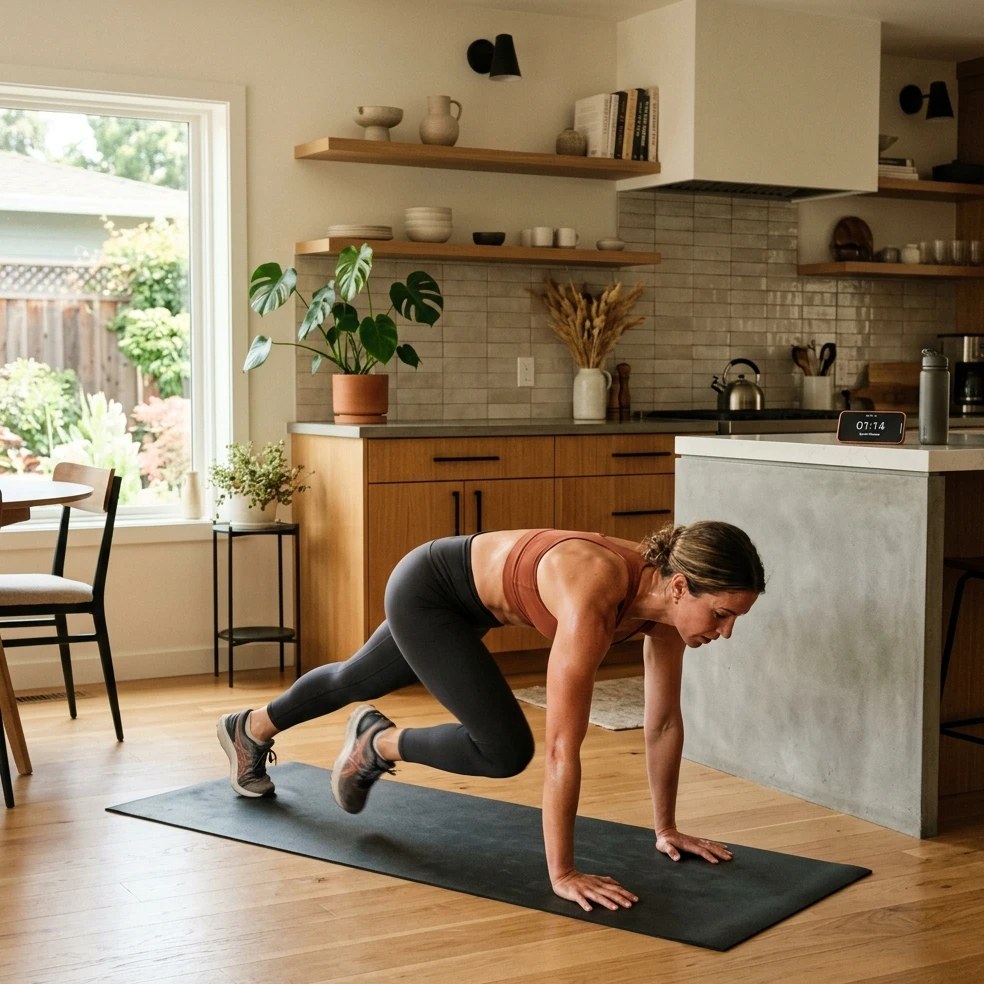
Routine A: 10-minute “baby-naps”
3 rounds, minimal rest:
- 15 bodyweight squats.
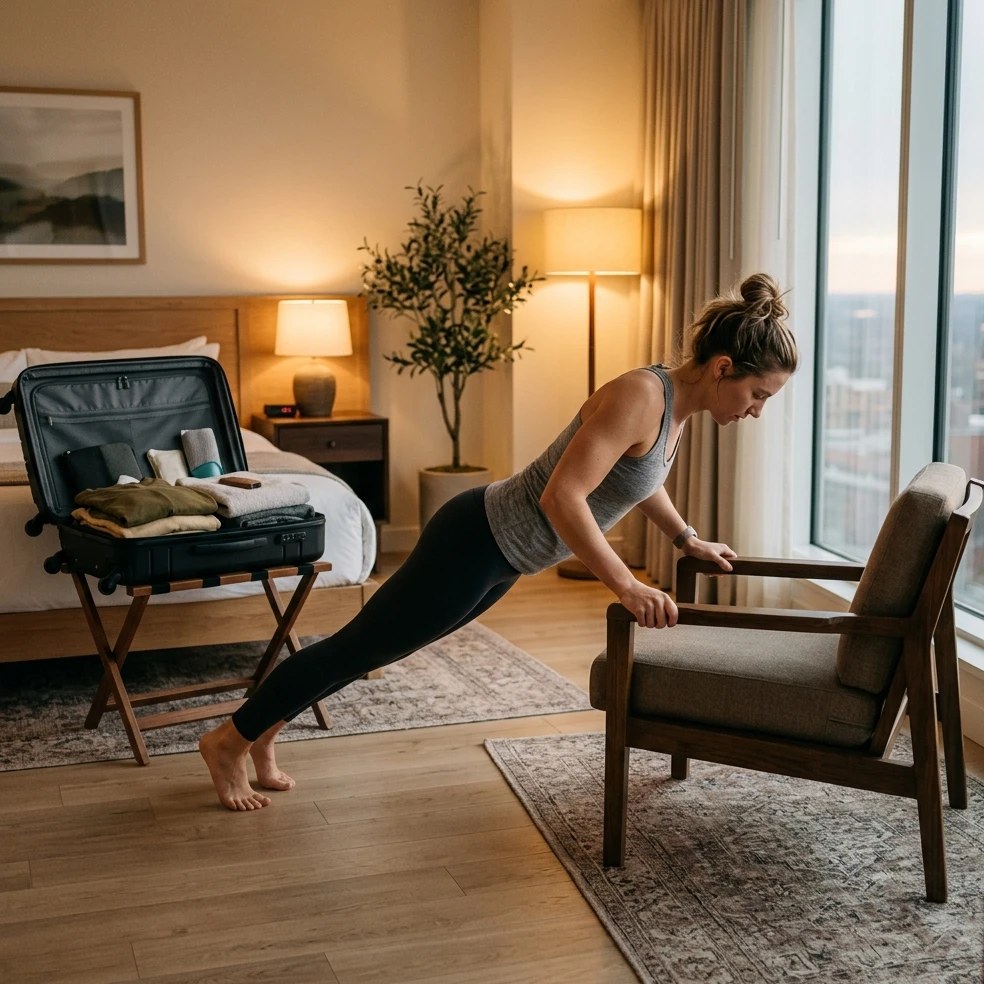
- 10 push-ups.
- 10 reverse lunges per leg.
- 30-second front plank.
- 15 hip bridges.
Routine B: 15-minute strength bias
Pack a backpack with whatever heavy you have (water jugs, books, baby’s diaper bag):
- 5 rounds of (10 backpack squats, 10 backpack rows, 8 push-ups, 12 hip bridges with baby on lap if comfortable, 10 dead bugs).
- 30-60 seconds rest between rounds.
Routine C: 20-minute walk-with-stroller cardio
- 5 minutes brisk walking (warm up).
- 10× 30 seconds at faster pace + 60 seconds at conversational pace.
- 5 minutes brisk walking (cool down).
- Stroller adds variable resistance (hills, terrain).
The carry-as-training reframe
Carrying a 7–10 kg baby for 30+ minutes daily is real loaded carry training. Recognising this changes the framing from “exhausted from carrying” to “getting carry training built into the day.” The training response isn’t to add more loaded carries on top — it’s to support the carrying-already-happening with posterior chain strength and grip work that prevents the cumulative back and shoulder fatigue.
Postpartum-specific
For the birthing parent:
- Wait for clinical clearance before structured training (typically 6 weeks postpartum, longer for c-section).
- Pelvic floor and core recovery (deep core, transverse abdominus work) before return to heavy lifting.
- Diastasis recti screening: visible doming during sit-up attempts warrants pelvic-floor physio referral.
- Don’t rush. The body recovers across 6–12 months; weeks 0–12 are gentle.
Common myths
- “You should bounce back to pre-pregnancy fitness in 6 weeks.” Wrong and harmful. Recovery extends 6–12 months. The pressure to bounce back contributes to postpartum mood and body-image complications.
- “Sleep when the baby sleeps; don’t exercise.” Mixed. Severe sleep debt: yes, sleep over training. Mild sleep debt: brief exercise often improves mood and sleep quality.
- “Stroller running burns the same as regular running.” Slightly more than regular running due to the resistance. Comparable in benefits.
- “You need a full hour or it’s pointless.” Wrong. 10-minute sessions, multiple per week, produce real maintenance and modest gains.
Practical takeaways
- First-year parenthood typically reduces fitness 15–20% regardless of intent — this is normal.
- Train posterior chain and core to counteract the front-loading of baby-care.
- 10–20 minute bodyweight sessions multiple times weekly produces real maintenance.
- Reframe baby-carrying as training rather than fighting it.
- Sleep before optimization. Severe sleep debt > training PRs.
- Postpartum recovery extends 6–12 months; pelvic floor work before heavy lifting return.
References
Saxbe 2018Saxbe DE, Schetter CD, Guardino CM, et al. Sleep quality predicts persistence of parental postpartum depressive symptoms and transmission of depressive symptoms from mothers to fathers. Ann Behav Med. 2016;50(6):862-875. View source →Evenson 2014Evenson KR, Mottola MF, Owe KM, Rousham EK, Brown WJ. Summary of international guidelines for physical activity following pregnancy. Obstet Gynecol Surv. 2014;69(7):407-414. View source →Artal 2003Artal R, O'Toole M. Guidelines of the American College of Obstetricians and Gynecologists for exercise during pregnancy and the postpartum period. Br J Sports Med. 2003;37(1):6-12. View source →Mottola 2018Mottola MF, Davenport MH, Ruchat SM, et al. 2019 Canadian guideline for physical activity throughout pregnancy. Br J Sports Med. 2018;52(21):1339-1346. View source →Herring 2016Herring SJ, Cruice JF, Bennett GG, Davey A, Foster GD. Intervening during and after pregnancy to prevent weight retention among African American women. Prev Med Rep. 2016;4:438-442. View source →Schoenfeld 2017Schoenfeld BJ, Grgic J, Ogborn D, Krieger JW. Strength and hypertrophy adaptations between low- vs. high-load resistance training. J Strength Cond Res. 2017;31(12):3508-3523. View source →Nakamura 2019Nakamura T, Sasaki J, Akashi YJ, et al. Sleep deprivation and exercise responses: a systematic review. Sleep Med Rev. 2019;47:1-10. View source →Dahlgren 2018Dahlgren A, Tucker P, Gustavsson P, Rudman A. Quick returns and night work as predictors of sleep quality, fatigue, work-family balance and satisfaction with work hours. Chronobiol Int. 2016;33(6):759-767. View source →Mota 2015Mota P, Pascoal AG, Carita AI, Bø K. Prevalence and risk factors of diastasis recti abdominis from late pregnancy to 6 months postpartum, and relationship with lumbo-pelvic pain. Man Ther. 2015;20(1):200-205. View source →Saxbe 2017Saxbe D, Rossin-Slater M, Goldenberg D. The transition to parenthood as a critical window for adult health. Am Psychol. 2018;73(9):1190-1200. View source →Kotarsky 2018Kotarsky CJ, Christensen BK, Miller JS, Hackney KJ. Effect of progressive calisthenic push-up training on muscle strength & thickness. J Strength Cond Res. 2018;32(3):651-659. View source →Ratamess 2009Ratamess NA, Alvar BA, Evetoch TK, et al. American College of Sports Medicine position stand. Progression models in resistance training for healthy adults. Med Sci Sports Exerc. 2009;41(3):687-708. View source →