The 60-second version
“Made from recycled ocean plastic” is the most-marketed sustainability claim in athletic wear, and it’s simultaneously genuinely better than virgin polyester for some metrics and meaningfully worse for others. Recycled PET fabric (rPET) reduces virgin-plastic demand and the upstream petroleum footprint, but it doesn’t eliminate the microplastic shedding problem — recycled and virgin polyester both shed ~700,000 microfibres per wash. The peer-reviewed life-cycle assessment literature is clear: rPET cuts production-stage greenhouse gas emissions by ~30–50% vs virgin polyester, but uses similar water and energy in the consumer-use phase, and both end up in the same landfill. The most environmentally-impactful decision an athletic-wear buyer can make isn’t recycled-vs-virgin polyester — it’s buying fewer items, wearing them longer, and washing them less aggressively. This article walks through the actual life-cycle math, what the certifications mean, where rPET earns its premium, and the bigger-impact behaviours the marketing rarely mentions.
Why this question matters
The textile industry produces an estimated 1.2 billion tonnes of CO2-equivalent emissions annually (more than aviation and shipping combined) and accounts for ~9% of microplastic pollution in the world’s oceans. Athletic wear, dominated by polyester and nylon, is a contributor. Brands have responded with recycled-fibre lines (Patagonia, Nike Move to Zero, Adidas Parley, Lululemon, Athleta, prAna), but the marketing claims often outrun the actual environmental delta.
The 2021 Hicks & Theis life-cycle assessment of rPET vs virgin PET in apparel summarized:
- Greenhouse gas emissions: rPET production produces ~30–50% less CO2-equivalent vs virgin PET, depending on the recycling pathway (mechanical vs chemical).
- Energy use: rPET uses ~30–40% less energy at the production stage.
- Water use: ~10–20% reduction; less than the energy/CO2 savings.
- Microplastic shedding (consumer-use phase): essentially identical to virgin PET; rPET fibres shed at the same rate per wash Hicks 2014.
The 2020 Roos et al. analysis of textile circular-economy initiatives concluded that the production-stage benefits of recycled fibre are real but small relative to the dominant impact category, which is the consumer-use phase (washing, drying, transport, eventual disposal) Roos 2020.
“Recycled polyester reduces production-phase impacts by 30–50% versus virgin polyester. However, the dominant impact of an athletic garment over its lifetime is the consumer-use phase — primarily washing, drying, and replacement frequency. Buyers who keep one rPET shirt for five years rather than four virgin-PET shirts over the same period reduce total impact by approximately 70%.”
— Roos et al., J Cleaner Production, 2020 view source
The microplastic shedding problem
This is the issue rPET marketing usually doesn’t address. Both recycled and virgin polyester shed plastic microfibres during washing — the 2016 Napper-Thompson study found ~700,000 microfibres per 6 kg synthetic-fabric wash, with no meaningful difference between rPET and virgin PET Napper 2016. These microfibres pass through wastewater treatment plants, enter the ocean, and accumulate up the food chain.
If reducing microplastic pollution is your concern, the practical answer is not “buy rPET instead of virgin polyester.” It’s:
- Wash less frequently; air out garments between uses.
- Wash full loads on cold; less fabric-fabric friction reduces shedding.
- Use a microfibre-catching laundry bag (Guppyfriend, Cora Ball) which captures 30–80% of shed fibres.
- Switch to natural fibres (Merino wool, cotton, hemp) for the most sweat-heavy garments where you can tolerate the trade-offs.
- Buy fewer, higher-quality items that last longer.
What the certifications actually mean
| Certification | What it certifies | What it doesn’t |
|---|---|---|
| Global Recycled Standard (GRS) | ≥20% recycled content; chain-of-custody verified; restricts certain hazardous chemicals | Doesn’t certify the % is high; doesn’t address microplastic shedding |
| Recycled Claim Standard (RCS) | ≥5% recycled content; chain-of-custody only | Lower bar than GRS; doesn’t restrict chemicals |
| Bluesign | Restricts chemical inputs across textile supply chain; addresses worker safety and environmental impact | Not specifically a recycled-content certification |
| OEKO-TEX Standard 100 | Tested for harmful substances in finished product; no specific recycling claim | Doesn’t certify recycled content or production sustainability |
| Cradle to Cradle Certified | Comprehensive sustainability standard: material health, reuse, renewable energy, water stewardship, social fairness | Smaller market than GRS or Bluesign; harder to find in athletic wear |
| Fair Trade Certified | Worker compensation and safety standards | Doesn’t address materials or environmental impact |
| B Corp | Whole-company sustainability and social-impact standard | Not specific to garments; brand-level not product-level |
For recycled-content claims, look for Global Recycled Standard (GRS) or Recycled Claim Standard (RCS). These have third-party verification of chain-of-custody. Brands that just print “made from recycled bottles” without certification are not lying, but the percentage and verification are unclear.
What major brands actually do
| Brand / line | Recycled-content claim | What’s verifiable |
|---|---|---|
| Patagonia | ~84% of polyester from recycled sources | GRS-certified across most lines; transparent supply-chain reporting |
| Nike Move to Zero | Various lines with recycled polyester | Specific products GRS-certified; not the entire range |
| Adidas Parley (ocean plastic) | Marketed as “made from ocean plastic” | Plastic intercepted from beaches/coasts; some material is post-consumer recycled bottle, partly “ocean-bound” rather than ocean-recovered |
| Lululemon (recycled lines) | Selected products with recycled polyester or nylon | Some products GRS-certified; varies by SKU |
| Athleta | Various recycled-fibre options; B Corp certified company | Whole-company sustainability claims verifiable; product-level varies |
| prAna | Significant focus on recycled, organic, and Fair Trade | Strong overall sustainability profile; B Corp; Fair Trade-certified factories |
| Allbirds (athletic line) | Wool, eucalyptus tree fibre, sugarcane-based foam | Carbon-footprint labelled per product; transparent |
| Tentree | Plants 10 trees per item; uses some recycled materials | Tree-planting verifiable; per-item recycled-content varies |
The trade-offs rarely discussed
- rPET costs ~10–30% more than virgin PET. Some brands pass this to consumers; some absorb it; some (cynically) charge a premium beyond the actual cost difference.
- rPET garments often have slightly different feel — the fibre staple length is shorter from mechanical recycling, sometimes producing a slightly less smooth hand. Modern processing has narrowed this gap.
- Mechanical recycling has a ceiling: PET can be mechanically recycled 5–7 times before degradation; chemical recycling is more durable but uses more energy.
- “Ocean plastic” is often “ocean-bound” plastic: collected from coastlines, beaches, and waterways near oceans, not actually pulled from the open ocean (which is technically harder and rarer).
- Greenwashing risk: a 30% recycled-content shirt is sometimes marketed as “sustainable” with the same enthusiasm as a 100% recycled-content one. Read the actual percentage.
- The most-sustainable garment is usually the one you already own. New rPET production still has a footprint; replacing usable virgin-PET clothing with new rPET often increases total impact.
When natural fibres beat recycled synthetics
For some use cases, natural fibres are a clearer environmental win:
- Merino wool (Patagonia, Smartwool, Icebreaker, Mons Royale): biodegradable, naturally odour-resistant, no microplastic shedding. Trade-off: sheep grazing has its own footprint (methane, land use), and wool requires chemical processing.
- Organic cotton (Patagonia, Pact, prAna): lower-impact than conventional cotton; biodegradable; no microplastic. Trade-off: still water-intensive; not ideal for high-sweat use.
- Hemp / linen: very low water and pesticide footprint; durable; biodegradable. Trade-off: slower drying; less stretch; harder to find in athletic wear.
- TENCEL / Lyocell (wood-pulp-derived): closed-loop solvent process; biodegradable; smooth feel. Trade-off: still requires processing energy.
For athletes specifically, Merino wool is the natural fibre that competes with synthetics on performance metrics (wicking, odour, thermoregulation) without the microplastic issue. The price premium is real but the per-wear cost over a 5+ year garment lifespan is competitive.
A practical purchase framework
- Don’t buy what you don’t need. The biggest single sustainability lever is a smaller wardrobe.
- Wear what you have until it’s worn out. Replacing usable virgin-PET with new rPET is rarely net-positive.
- Prioritize durability over recycled content. A 7-year garment beats two 3-year garments on environmental impact.
- For new purchases, look for GRS or RCS certification on recycled-content claims.
- Use a microfibre-catching laundry bag (Guppyfriend ~$30) for any synthetic athletic wear; meaningfully reduces microplastic shedding.
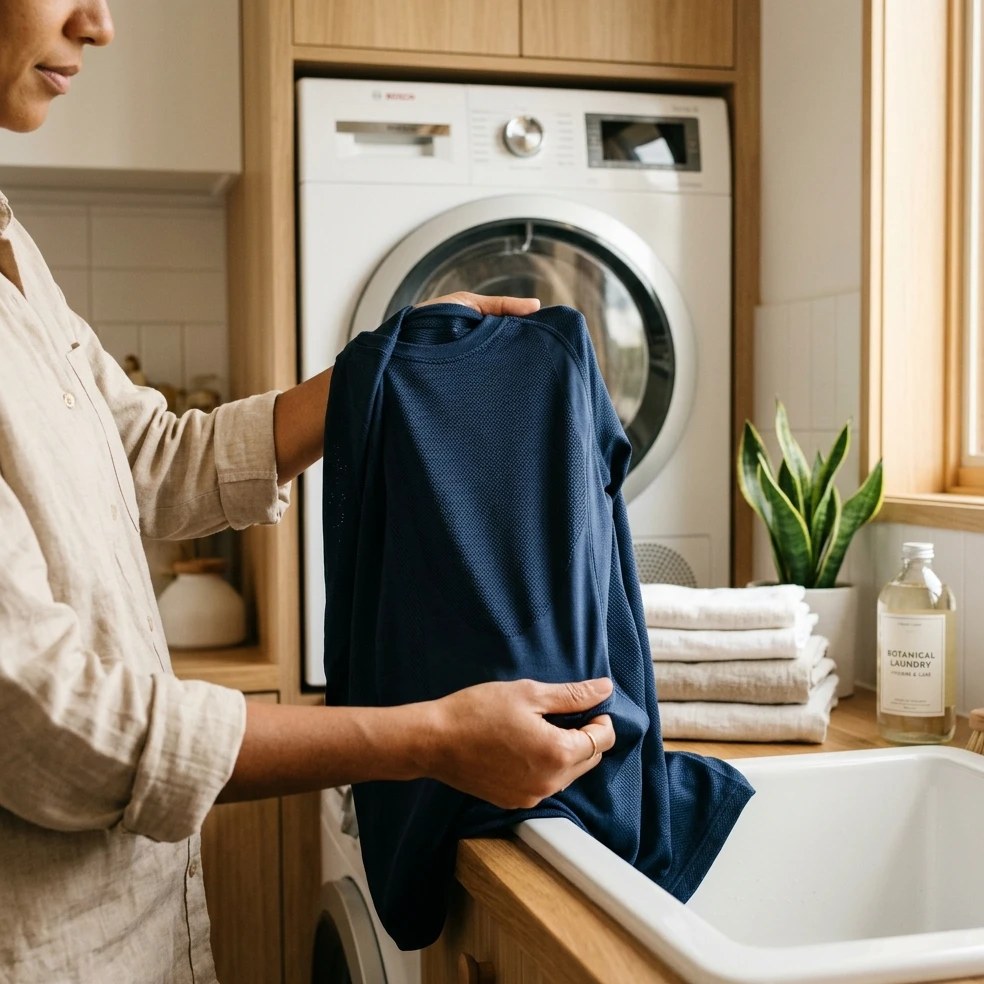
- Wash cold, full loads, less frequently; air out between wears.
- Skip the dryer when possible; air-drying extends fabric life and reduces microfibre breakdown.
- For sweat-heavy use, consider Merino wool; for low-sweat use, organic cotton or TENCEL work well.
- When you do replace, donate or repurpose old gear rather than landfilling.
Common myths
- “Recycled polyester doesn’t shed microplastics.” False. It sheds at the same rate as virgin PET.
- “Ocean plastic clothing solves ocean pollution.” Modest contribution; most “ocean plastic” is intercepted on coastlines, not pulled from open ocean. Useful but not transformative.
- “Buying recycled is always better than virgin.” Often, but only if you actually needed the garment in the first place.
- “Bamboo activewear is sustainable.” Mostly “bamboo viscose,” which is chemically processed wood pulp; the bamboo plant is sustainable but the processing isn’t straightforward.
- “Natural fibres are always better.” Cotton is water-intensive; wool has its own footprint; the answer depends on use case and replacement frequency.
- “If a brand has a sustainability page, it’s sustainable.” Greenwashing exists. Look for third-party certifications (GRS, Bluesign, B Corp) and transparent supply-chain reporting.
Practical takeaways
- Recycled polyester (rPET) reduces production-stage emissions by 30–50% vs virgin PET.
- rPET does not reduce microplastic shedding; both shed ~700,000 fibres per wash.
- The dominant lifetime impact is the consumer-use phase: washing, drying, replacement frequency.
- The most-sustainable garment is the one you already own. Don’t replace usable items just to upgrade to recycled.
- For new purchases: look for GRS or RCS certification on recycled-content claims; verify the actual percentage.
- Microfibre-catching laundry bag ($30) is the highest-impact action a synthetic-wearing athlete can take.
- Merino wool, organic cotton, TENCEL, hemp avoid the microplastic problem entirely; trade-offs vary.
- Watch for greenwashing: “ocean plastic” vs ocean-bound; 30% recycled marketed as full sustainability; brand-level claims that don’t apply to specific products.
- Buy fewer items, wear them longer, wash less aggressively. That’s the real sustainability lever.
References
Hicks 2014Hicks AL, Theis TL. A comparative life cycle assessment of recycled polyethylene terephthalate plastic for use in textile production. J Ind Ecol. 2014;18(5):739-750. View source →Roos 2020Roos S, Sandin G, Zamani B, Peters G, Svanström M. Will clothing be sustainable? Clarifying sustainable fashion. In: Textiles and Clothing Sustainability. Springer; 2017:1-45. View source →Napper 2016Napper IE, Thompson RC. Release of synthetic microplastic plastic fibres from domestic washing machines: effects of fabric type and washing conditions. Mar Pollut Bull. 2016;112(1-2):39-45. View source →De Falco 2019De Falco F, Di Pace E, Cocca M, Avella M. The contribution of washing processes of synthetic clothes to microplastic pollution. Sci Rep. 2019;9(1):6633. View source →Hartline 2016Hartline NL, Bruce NJ, Karba SN, Rué E, Sonar SU, Holden PA. Microfiber masses recovered from conventional machine washing of new or aged garments. Environ Sci Technol. 2016;50(21):11532-11538. View source →Astrup 2015Astrup TF, Tonini D, Turconi R, Boldrin A. Life cycle assessment of thermal Waste-to-Energy technologies: review and recommendations. Waste Manag. 2015;37:104-115. View source →Muthu 2014Muthu SS. Assessing the environmental impact of textiles and the clothing supply chain. Woodhead Publishing; 2014. View source →Ellen MacArthur 2017Ellen MacArthur Foundation. A new textiles economy: Redesigning fashion's future. 2017. View source →Zamani 2017Zamani B, Sandin G, Peters GM. Life cycle assessment of clothing libraries: can collaborative consumption reduce the environmental impact of fast fashion? J Cleaner Prod. 2017;162:1368-1375. View source →Woolridge 2006Woolridge AC, Ward GD, Phillips PS, Collins M, Gandy S. Life cycle assessment for reuse/recycling of donated waste textiles compared to use of virgin material: an UK energy saving perspective. Resour Conserv Recycl. 2006;46(1):94-103. View source →Textile Exchange 2022Textile Exchange. Preferred Fiber and Materials Market Report 2022. Annual industry-wide assessment of fiber sourcing and certification. View source →Mishra 2019Mishra S, Rath C, Das AP. Marine microfiber pollution: a review on present status and future challenges. Mar Pollut Bull. 2019;140:188-197. View source →