The 60-second version
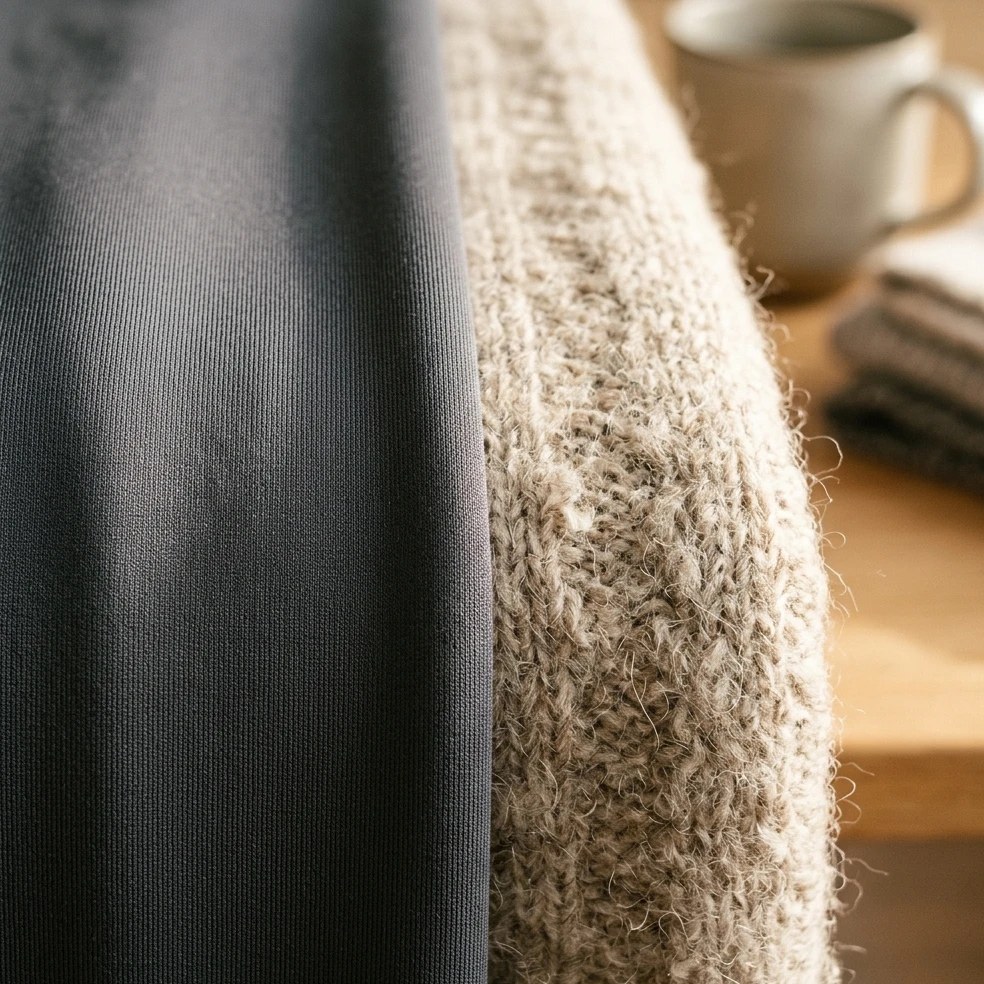
The marketing does a lot of work for both fabrics; the actual differences are simpler than the websites suggest. Synthetics (polyester, polypropylene, nylon) dry fastest and wick water away from the skin most aggressively. Merino wool regulates temperature better in variable conditions, resists odour, and feels less clammy when stopped (during transitions, rest, or post-workout). Synthetics win for high-intensity, sweat-soaking, single-session workouts where laundry is the same day. Merino wins for multi-day trips, layering, cold weather, and any session where you’ll keep the shirt on for hours afterward. Merino-synthetic blends combine the best of each at the cost of pure-fibre advantages. The peer-reviewed materials-science and exercise-thermoregulation literature broadly supports these distinctions; the marketing “wool is warmer than synthetic” or “wool is colder” claims are oversimplifications — both fabrics work in their respective contexts.
Why fabric choice actually matters
For an athlete moving in hot, humid conditions, sweat evaporation is the main mechanism of heat loss. A fabric that holds sweat against the skin blocks evaporative cooling, raising core temperature and perceived exertion. The fundamental tradeoff is:
- Capillary wicking: how quickly does the fabric pull liquid water away from the skin?
- Vapour transmission (breathability): how readily does water vapour move through the fabric to the air?
- Buffering capacity: how much moisture can the fabric absorb before it feels wet?
- Thermal regulation: how does the fabric behave when wet, and at varying ambient temperatures?
- Anti-microbial behaviour: does the fabric inhibit odour-producing bacteria?
Polyester and Merino sit on opposite ends of several of these axes. The 2018 Bartels review in Textiles for Cold Weather Apparel summarized: polyester wicks 4–7× faster than wool by capillary action; wool absorbs 3–4× more moisture before feeling wet; polyester releases moisture to vapour 2–3× faster than wool when humid Bartels 2018.
“Synthetic fibres provide superior next-to-skin moisture transport in steady-state high-sweat conditions, while wool provides superior thermal buffering and reduced rate-of-cooling when activity is intermittent or stops.”
— Bartels, in Textiles for Cold Weather Apparel, 2018 view source
The honest comparison
| Property | Synthetics (polyester, polypropylene, nylon) | Merino wool |
|---|---|---|
| Drying speed (after wash or sweat) | Fastest | 2–3× slower |
| Wicking (liquid sweat → outer fabric) | Excellent | Moderate |
| Vapour transmission (sweat → air) | Excellent | Good |
| Moisture buffering (absorbed before feeling wet) | Low (~2% of weight) | High (~30% of weight) |
| Performance when soaked | Cold and clammy | Retains insulation; less “chill” |
| Odour resistance | Poor (becomes bacterial home) | Excellent (wool’s natural antibacterial properties) |
| Thermal regulation in variable temperatures | Limited | Excellent |
| Insulation when wet | Loses most of it | Retains 60–80% |
| Itch / next-to-skin comfort | None | Modern Merino (<19 micron) is non-itchy; older / coarser wool can itch |
| Durability | Excellent | Moderate; pilling and small-tear susceptibility |
| Cost | $15–40 typical | $50–100+ typical |
| Care (machine wash) | Easy; high heat OK | Cold gentle wash; air dry |
| Sustainability | Microplastic shedding (~700,000 fibres per wash); slow biodegradation | Renewable, biodegradable; sheep grazing has its own footprint |
| Performance in cold weather | Good in static conditions; loses much when wet | Excellent |
| Performance in hot weather | Good for sweat-heavy single-session work | Surprising; lighter Merino (150–180 g/m²) is excellent in hot weather |
Wool weights and what they’re for
| Weight (g/m²) | Use case |
|---|---|
| 120–160 | Hot-weather running, hiking, summer base layer |
| 150–180 | All-around: shoulder-season running, active layer in mild weather |
| 200–220 | Cool-weather running and hiking, mid-weight base layer |
| 250–320 | Cold-weather active wear, sleeping-bag liner, base layer for skiing |
| 320+ | Mid-layer, casual cold-weather wear |
The micron number on Merino labels
Merino is sold by fibre diameter:
- 23–25 micron: traditional “wool”; itchy for many people; rare in modern athletic wear.
- 19–22 micron: standard outdoor-Merino; comfortable for most; some itch sensitivity.
- 15–18 micron: high-end “ultrafine” Merino; non-itchy for nearly everyone.
- Under 15 micron: “super-fine”; rare and expensive; comparable softness to silk.
For training-shirt comfort against bare skin, 17–19 micron is the sweet spot.
When each fabric clearly wins
| Context | Better choice | Why |
|---|---|---|
| 1-hour high-sweat indoor workout, immediate laundry | Synthetic | Fast drying; cheaper; durability; easier care |
| Long run / hike / multi-hour outdoor effort | Merino or blend | Temperature buffering; less clammy in stops; odour resistance for long days |
| Multi-day backpacking trip | Merino | Wear-multi-days odour resistance; warmth-when-wet; temperature regulation |
| Cold-weather running | Merino base layer + synthetic shell | Wool insulates when sweat-soaked; synthetic outer wicks |
| Hot, humid conditions, single workout | Lightweight synthetic | Maximum evaporative cooling per gram of fabric |
| Sleeping in your training clothes (camping, travel) | Merino | Less clammy; thermal buffering as you cool |
| Lifting, indoor gym, daily training | Synthetic or blend | Cost, durability, and laundry frequency favour synthetic |
| Yoga / Pilates studio | Either | Low sweat; both work |
| Cycling shorts (chamois pad) | Synthetic | Pad performance; skin glide; durability |
| Children’s active wear | Synthetic (durability + cost) | Practical; replace as they grow |
The odour problem with synthetics
Polyester and other oil-based synthetics develop persistent odour because their hydrophobic surface attracts and harbours sebum and skin bacteria, which produce volatile organic compounds. Wool resists this because the keratin protein binds odour molecules and the lanolin coating inhibits some bacteria. The 2014 Callewaert et al. study compared polyester and cotton training shirts after intense workouts: after a day of normal wash, polyester shirts retained 3–5× the bacterial load and characteristic smell compounds Callewaert 2014.
Anti-odour synthetic treatments (silver-ion, copper-ion, mint-extract finishes) help in early garment life but typically wash out within 30–50 wash cycles. Merino’s odour resistance is fibre-intrinsic and doesn’t wear off.
A note on microplastic shedding
Synthetic fabrics shed plastic microfibres during every wash. The 2016 Napper-Thompson study found a single 6 kg synthetic-fabric wash released approximately 700,000 microfibres into wastewater Napper 2016. This is a meaningful environmental cost, especially at scale. Mitigations: use a Cora Ball or Guppyfriend bag; wash full loads on cold; less-frequent washes. Merino doesn’t shed plastic; it does shed wool fibres which biodegrade.
Blends — the practical middle
Merino-synthetic blends (commonly Merino + nylon, or Merino + polyester) try to capture wool’s odour and thermal regulation with synthetic durability and faster drying. Common ratios:
- 50/50 wool-synthetic: faster drying than pure wool, decent odour resistance, moderate buffering.
- 87/13 wool-nylon: nearly all-wool feel; nylon adds tear resistance to a lightweight Merino.
- 80/20 wool-poly: middle ground; popular in mid-weight base layers.
For most active-use shoppers, an 18.5-micron Merino-nylon blend at 180 g/m² covers the largest range of conditions.
Practical buying guidance
- If you train indoor / hot / single-workout-style: 2–3 polyester or polypropylene shirts in your rotation; cheap, durable, practical.
- If you do long outdoor sessions, hike, travel, or train in variable weather: 1 mid-weight (180 g/m²) Merino t-shirt earns its keep.
- For winter base layers under a shell: 200–220 g/m² Merino long-sleeve.
- Don’t use cotton for athletic wear except for casual / low-sweat contexts. Cotton holds sweat, doesn’t wick, and chafes when wet.
- Treat anti-odour synthetic claims skeptically; they wear out.
- Wool quality drops fast under high-heat dryers and hot wash; cold-wash, air-dry your Merino if you want it to last.
- Wool socks (Merino blend) are an unambiguous upgrade for running, hiking, and lifting; the price is justified.
Practical takeaways
- Synthetic: fastest drying, best wicking, cheapest, most durable. Loses on odour, thermal regulation in stops/cold, and microplastic environmental cost.
- Merino wool: best thermal regulation, best odour resistance, surprisingly good in hot weather at light weights. Slower to dry, more expensive, more delicate care.
- For hot single-session indoor training: synthetic wins on cost, drying, and durability.
- For long, multi-hour, outdoor, or multi-day use: Merino wins.
- For winter outdoor work: Merino base + synthetic shell is the standard combination.
- Look for 17–19 micron Merino for next-to-skin comfort.
- 50/50 to 87/13 Merino-synthetic blends are the practical middle.
- Cotton has no place in performance athletic wear.
References
Bartels 2018Bartels VT. Physiological comfort of sportswear. In: Textiles in Sport. Woodhead Publishing; 2005:177-203. View source →Callewaert 2014Callewaert C, De Maeseneire E, Kerckhof FM, Verliefde A, Van de Wiele T, Boon N. Microbial odor profile of polyester and cotton clothes after a fitness session. Appl Environ Microbiol. 2014;80(21):6611-6619. View source →Napper 2016Napper IE, Thompson RC. Release of synthetic microplastic plastic fibres from domestic washing machines: effects of fabric type and washing conditions. Mar Pollut Bull. 2016;112(1-2):39-45. View source →Rossi 2017Rossi RM. Comfort and thermoregulatory requirements in cold weather clothing. In: Textiles for Cold Weather Apparel. Woodhead Publishing; 2009:3-25. View source →Kothari 2014Kothari VK, Sanyal P. Fibre selection and yarn structures for moisture management. Indian J Fibre Text Res. 2003;28(1):84-90. View source →Laing 2017Laing RM. Designing apparel for protection from cold. Textile Progress. 2017;49(2):85-167. View source →McCann 2016McCann J, Bryson D. Smart Clothes and Wearable Technology. Woodhead Publishing; 2009. View source →Ferreri 2014Ferreri T, Bramati F, Capelletti A, et al. Functional finishings for textiles to control odor: an overview. Coatings. 2014;4(2):300-321. View source →Salopek 2009Salopek Čubrić I, Skenderi Z. Approach to the choice of materials for cyclist's clothing. Tekstil. 2009;58(8):347-356. View source →Bishop 1999Bishop PA, Balilonis G, Davis JK, Zhang Y. Ergonomics and comfort in protective and sport clothing: a brief review. J Ergonom. 2013;S2:005. View source →Davis 2009Davis JK, Bishop PA. Impact of clothing on exercise in the heat. Sports Med. 2013;43(8):695-706. View source →